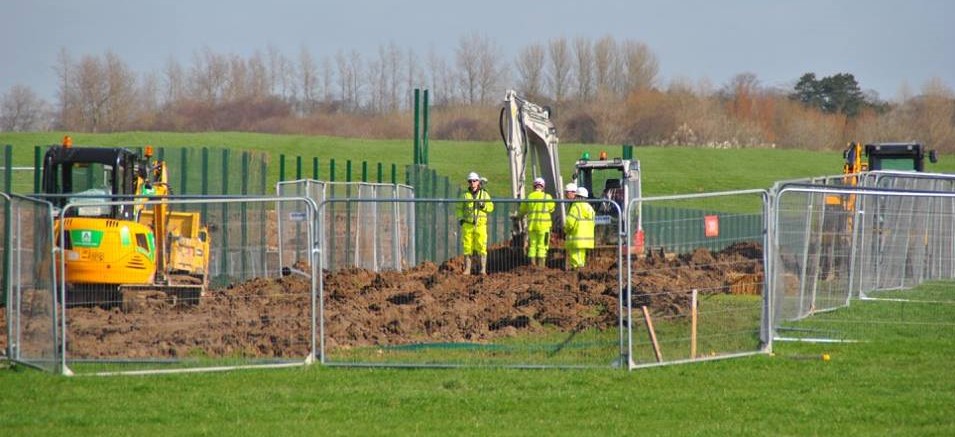
Site work at Preston New Road yesterday. Photo: Ros Wills
Lawyers for the Communities’ Secretary have been defending his decision to grant planning permission for Cuadrilla’s fracking plans near Blackpool.
In October 2016, Sajid Javid approved the company’s scheme to drill, frack and test up to four wells at Preston New Road, Little Plumpton.
A residents group and a local campaigner went to the High Court in Manchester this week to challenge the decision, arguing that was unlawful and should be quashed.
Preston New Road Action Group (PNRAG) said Mr Javid had misunderstood or misapplied local and national planning policy in approving the fracking scheme.
Campaigner, Gayzer Frackman, from Lytham, argued that the minister’s decision failed to consider climate change and gaps in regulations to protect public health.
“Unimpeachable”
PNRAG said Mr Javid had incorrectly concluded that Cuadrilla’s plans complied with a strategic minerals policy in Lancashire called CS5. This is designed to protect and enhance culturally-important landscapes from being harmed by minerals developments.
But this morning Rupert Warren QC, for Mr Javid, said the Secretary of State’s approach had been “unimpeachable”. He said the minister had noted there would be harm to the landscape in two-and-a-half years of the scheme but that the harm would be mitigated and reduced to an acceptable level.
PNRAG had also argued that Mr Javid should have refused permission because he mistakenly found the scheme complied with paragraph 109 in the National Planning Policy Framework. This says the planning system should contribute to and enhance the natural and local environment by protecting and enhancing valued landscapes.
Mr Warren said the Secretary of State had accepted the reasoning of the inspector at the public inquiry who had recommended approval of the project. She had said there would be harm to valued landscapes but it would temporary and the landscape would be restored.
Yesterday, the court heard how PNRAG also challenged the inspector’s view that the fracking site would not breach another Lancashire planning policy, DM2, aimed at protecting local residents.
This says minerals operations would be supported where harm could be eliminated or reduced to acceptable levels or where the operations made a positive contribution to residential amenity.
The inquiry inspector had said the site would not make the outlook for local residents so “unpleasant, overwhelming and oppressive” that it would become an unattractive place to live.
David Wolfe QC, for PNRAG, said this was a very high threshold and the wrong test to apply to the policy.
But Mr Warren responded:
“There is no regulation or legal test which has a threshold on it beyond which the impact on residential amenity is unacceptable.”
PNRAG had also said Mr Javid had treated the group unfairly by not taking into account another local planning policy – EP11. This was used by Lancashire County Council to refuse the planning permission in June 2015 and says developments in the countryside should reflect the local vernacular style.
Nathalie Lieven, QC, for Cuadrilla, said:
“It would be impossible to make a drilling rig meet that policy and it was very plain that this policy was never intended to apply to the development in question.”
Climate change impact and regulatory gaps
The second challenge to the Secretary of State focussed on regulation and climate change impacts.
Mr Frackman, a Lancashire anti-fracking campaigner who changed his name by deed poll, said Mr Javid should have taken account of all the greenhouse gas emissions from the shale gas development at Preston New Road.
The court heard yesterday how Cuadrilla had given estimates of emissions from initial flow tests on the four wells. But it had not calculated the greenhouse gas emissions from the burning of gas produced from extended well tests, which would be piped into the gas main.
Marc Willers QC, for Mr Frackman, had said the exploration scheme was “production in disguise” and the emissions from gas produced in the extended well tests should have been accounted for in the environmental impact assessment.
Without this assessment, he said:
“It would leave the government’s climate change policy, the carbon budget set down in the Climate Change Act, and the Paris Agreement in tatters.
“We would have unassessed, unabated production of shale gas – and even other fossil fuels because you could extend the argument – without any regard to the Environmental Impact Assessment Directive or our climate change obligations.”
But Ms Lieven said this was a “completely flawed” argument. She said:
“The whole assumption is that this is new, additional gas that is being burned.
“There is no evidence on the degree to which Cuadrilla gas going into the network is additional gas being burned, producing additional greenhouse gas emissions. That calculation would be simply impossible to do.”
Whether shale gas should be a substitute for other gas was an issue for national energy policy, she said, not an issue for planning or environmental impact assessments.
Mr Willers had also argued that the Secretary of State should have applied the precautionary principle and refused permission because there were gaps in the regulatory system for shale gas. He said the argument by the inquiry inspector that there were no risks to health from the shale gas scheme was “irrational”.
Mr Warren replied:
“I don’t accept the Secretary of State failed to have regard to the precautionary principle.”
And Ms Lieven said the inquiry inspector, accepted by the Secretary of State, had concluded there would be no unacceptable impacts on human health and that the regulatory system would operate to control them.
What happens next?
The hearing closed at just before 5pm, exactly a year after the final day of the public inquiry into the plans.
The judge, Sir Ian Dove, said he would produce his judgement as soon as possible but was unable to give an estimate of when that would be. He told the legal teams, which comprised eight barristers, as well as solicitors and advisers:
“You have all raised a great deal of interesting food for thought. I need to give my time to do justice to them.”
He said he was pleased the hearing had been held in Manchester, closer to the area of Cuadrilla’s site. He added:
“I will knuckle down now. You can go away having finished your hard work. Mine now starts.”
Report from morning session, Day 1: Cuadrilla’s Lancs shale gas exploration plans were “production in disguise” – High Court told
Report from afternoon session, Day 1: Shale gas regulation is not “up to scratch” and Cuadrilla fracking permission should not have been granted
Categories: Legal

 DRILL OR DROP?
Why do these people hide behind the law on one hand and then break it when it suits them?
Do they no use oil or gas in any form? Where do they expect it to come from?
People generally need to look now to alternative fuels, use less fosil (gas), A petition has recently been submitted in London containing over 600,000 signatures, against government proposals to hype taxes on solar energy, a backward step by the current government.
Reblogged this on keepeastlancashirefrackfreekelff.
Who are “these people” to whom you refer Nibblepibbley? Cuadrilla? The Secretary of State? The Barristers? If you are referring to PNRAG you have absolutely no idea who “these people” are so how dare you level any such accusations at them! How easy it is though to say just what you like when you hide your identity behind “Nibblepibbley”?
Not very clear the defense from the government.
A very confusing, worrying time for us all!
Cuadrilla should not have insulted the Community and the Judicial system by commencing work before the legal challenges had been concluded!
So you expect any vague legal challenge should be able to stop a perfectly legal activity? Anyone who has a beef with any project can delay any activity if they can crowd fund a JR? Lancs CC planning passed the regulatory issues. Then on appeal, so did a very experienced planning officer. Then also the Sec of State. So what is there to complain about? The Climate Change JR appeal failed in Yorkshire so that would again appear to be baseless.
Ken. That’s what I thought. Third Energy win their JR on climate change appeal so this should set a legal precedent case.
It is factually and legally inaccurate to say any JR case that is heard in full in court is baseless: if the case is baseless, it is weeded out before it gets to court. Talk to any lawyer and check your facts Ken – and stop misleading the public.
“……a strategic minerals policy in Lancashire called CS5. This is designed to protect and enhance culturally-important landscapes from being harmed by minerals developments.”
Honestly the challenge team needs to get real and over themselves here. Yes that block of farmland is nice and green BUT it is Not A Culturally Important Landscapes like the Grand Canyon or Stone Hedges or something like that.
Agriculture and farming is not culturally significant to the area? Keep you day jobs. Anthropology is not you forte. Neither is local law. The local people do not want heavy duty Industrial processes to occur in their countryside communities. The will of the people should be respected and not be overridden with legal chicanery and misfeasance to facilitate Cuadrilla. AgriCULTURAL land. Got it?
So how did Cuadrilla get access to the “agricultural” land if farming is so significant and local people don’t want Cuadrilla? Does the land owner not live in the area? And how much farming in the area is economic without CAP payments?
Sorry, Richard, forgot to add “and where are you from?”
The land owner actually lives adjacent to the fracking site, overlooking it in fact and downwind!
I would say he has been sold a pup by Cuadrilla myself!
His family will sure think so when the first earth tremors and flare-offs commence!
If that is the angle you are coming from Richard than you already lost your case. Because the farmland as you claimed lost to the Cuadrilla development site is not a significant loss of productive farmland that would impact on food production. Fortunately for PNRAG team theym didn’t invite you on their team otherwise they would have clearly lost their arguments already. Keep your day jobs too. I will definitely keep mine.
Sorry I was being presumptuous about you Richard. What I should have said was: Keep your day job too if you have one. I will definitely keep mine.
(Btw protesting and camping on the roadside fulltime is not considered and should not be confused as a fulltime job by the norm of our society).
I think he is from Giggle Land, Paul, where they have a laugh via a search engine.
It’s ironic isn’t it. The farmer could have made more money selling his land for a supermarket development, so the local population, who will not pay enough for his agricultural production to keep him and his family financially buoyant, can drive up in their 4X4s to buy French beans, air-freighted from Africa, and moan about courgettes not being available in February!.
Martin, hummm, yes I would have suggested more like Mars via Philadelphia.
Land at Preston New Road despite the efforts of the farmer is clearly marginal, evidenced by low relief seasonal ponding and land drains in the dips, (that’s ice age Fylde clay for you) and hence summer-autumn cattle not grain. However, with large land takes/redevelopment for industrial/commercial units to the west already at Whitehills I think the most likely alternative for the farmer forced to accept 17-20p for a litre of milk from the Aldi’s Lidl’s Morrison’s and Asda’s of this world would have been to construct another of the obscene caravan parks, urbanising the landscape as with those proliferating along the Peel Road area. Fortunately as the 4x4s towing the non statics are run on carrots and elastic bands then our locals would have no issue with any usual choking pollution generated and several of the the oddly accented ferals who have associated themselves with this ’cause’ would be camping in the bushes elsewhere.
I read today that Thames water are expecting their biggest ever fine for a series of massive pollution events, so how about some ‘warrior lock-ons’ at the sewage treatment works belonging to these giant corporate utility poisoners and their legitimate suppliers and contractors? Nah – I didn’t think so, just not sexy enough.
http://www.itv.com/news/meridian/update/2017-03-17/thames-water-faces-massive-fine-over-river-pollution/
The landowner does not or rather did not produce stuff to consume, rather made his money from plant hire.
[Edited by moderator] The farmer is one of the best grassland managers in the county, produces high quality milk and the plant hire business (mini-diggers) is a diversification addition to the primary business of milk production. He probably doesn’t make the net £80 a day rumoured to be collected by the semi-professional “protestors” (although I would normally spell that “protesters”).
Oh dear Peter Roberts…only been there five minutes have you?
Here’s the facts for you. You only need to read them from the sign at the gate.
Mr A Wensley, Farmer
(Another) Mr A Wensley, also a farmer
Mr D Wensley, Plant Hire.
All of whom are thoroughly decent Fylde citizens and pay taxes on the money they make though hard work.
The broader farming community are well aware of the intimidation being subjected on them. How many farms hosting industry and independent monitoring stations have had their water tanks drilled through by protesters…not something the feral ‘Warriors’ from outside our community want to admit to is it [edited by moderator].
There doesn’t seem to be much about the incalculable risk to children’s health posed by the chemicals that cause the earthquakes when mixed with expensive fresh potable water in order to potentially release some gas, or anything about the many concerns of medical experts or the effect on the sales of some thousand new homes which are being built on land that may well have all this dangerous action happening right underneath their foundations or the fact that local residents won’t be able to insure their homes or sell them or gas flares burning 24/7 churning out particulates. Call me stupid but shouldn’t these things be being discussed a bit more or perhaps democracy. I am not an activist but this looks like yet more greed at work to me. With a stuff the consequences attitude. Very foolish for the future of all our children and grandchildren.
Chemical cause earthquakes? That’s a new one. Do you have a gas hob or gas fire or gas boiler at home? Just wondered how you cope with the residues of the gas burning? Masks at home? BA sets? Or perhaps you are not on grid?
Latest reports from the IEA today (see lower down) confirm air pollution heading down due to switching from coal to gas in most major economies. If you are worried about particulates look at diesel cars / trucks; if you are worried about polluted ground water look at agriculture and water companies.
Why would a gas production company want to throw away money by flaring gas 24/7 ?
And I thought that the chemicals were just to keep the sand mobile in the water so that the induced fissures would be kept open by the sand! How could I have got this so wrong?
Correct, viscosifier and friction reducer. See the extract below from correspondance I have had with the Environment Ageny about UK fracking chemicals:
“Which chemicals were used by Cuadrilla in Preese Hall?
Preese Hall site is the only shale gas site to have been hydraulic fractured to date in the UK. Details of the chemicals which we assessed as non hazardous and permitted for use are listed on Cuadrilla’s website. They are:
• 99.75% of the shale gas fracking fluid is made up of water and sand, beyond that a very limited number of chemicals are used:
• Polyacrylamide friction reducers (0.075%), commonly used in cosmetics and facial creams, suspended in a hydrocarbon carrier;
• Hydrochloric acid (0.125%), frequently found in swimming pools and used in developing drinking water wells,
• Biocide (0.005%), used on rare occasions when the water provided from the local supplier needs to be further purified.
Cuadrilla only utilised the polyacrylamide friction reducer in their operations.”
But Enemies of Industry and the antis keep on about “dangerous” chemicals, America is destroyed, everything poisoned…….
https://www.theguardian.com/environment/2017/mar/17/co2-emissions-stay-same-for-third-year-in-row-despite-global-economy-growing
“The biggest drop was seen in the US, where carbon dioxide emissions fell 3%, while the economy grew 1.6%, following a surge in shale gas supplies and more renewable power that displaced coal.”
“They are also a sign that market dynamics and technological improvements matter. This is especially true in the United States, where abundant shale gas supplies have become a cheap power source.”
“In China, coal demand declined as renewables, nuclear and natural gas increased in the power sector.”
“There was also a switch from coal to gas in industry and buildings driven by government policies to tackle air pollution.”
“Emissions in the EU were largely stable as gas demand grew 8% and coal fell by 10%.”
“The UK saw a significant coal-to-gas switch in the power sector in the face of cheaper gas and a carbon price floor which makes polluting coal a more expensive source of energy, the IEA said.”
So if you de-Guardianise the article you are left with “significant increase in use of natural gas to replace coal leads to reduction of emissions in US / UK / China” In the US and China to a lesser extent this gas is shale gas.
IEA:
“In China, as well as in India, the growth in natural gas is significant, reflecting the impact of air-quality measures to fight pollution as well as energy diversification,” said Dr Birol. “The share of gas in the global energy mix is close to a quarter today but in China it is 6% and in India just 5%, which shows they have a large potential to grow.”
In the European Union, emissions were largely stable last year as gas demand rose about 8% and coal demand fell 10%. Renewables also played a significant, but smaller, role. The United Kingdom saw a significant coal-to-gas switching in the power sector, thanks to cheaper gas and a carbon price floor.”
“The biggest drop came from the United States, where carbon dioxide emissions fell 3%, or 160 million tonnes, while the economy grew by 1.6%. The decline was driven by a surge in shale gas supplies and more attractive renewable power that displaced coal. Emissions in the United States last year were at their lowest level since 1992, a period during which the economy grew by 80%.”
“Coal demand fell worldwide but the drop was particularly sharp in the United States, where demand was down 11% in 2016. For the first time, electricity generation from natural gas was higher than from coal last year in the United States.
With the appropriate policies, and large amounts of shale reserves, natural gas production in the United States could keep growing strongly in the years to come. This could have three main consequences: it could boost domestic manufacturing, supply more competitive gas to Asia through to LNG exports, and provide alternative gas supplies to Europe. US and natural gas prospects will be explored in details in the next World Energy Outlook 2017.”
Renewables also increased globally with 50% of the renewables increase being hydro.
This is of course all relevant to the court case.