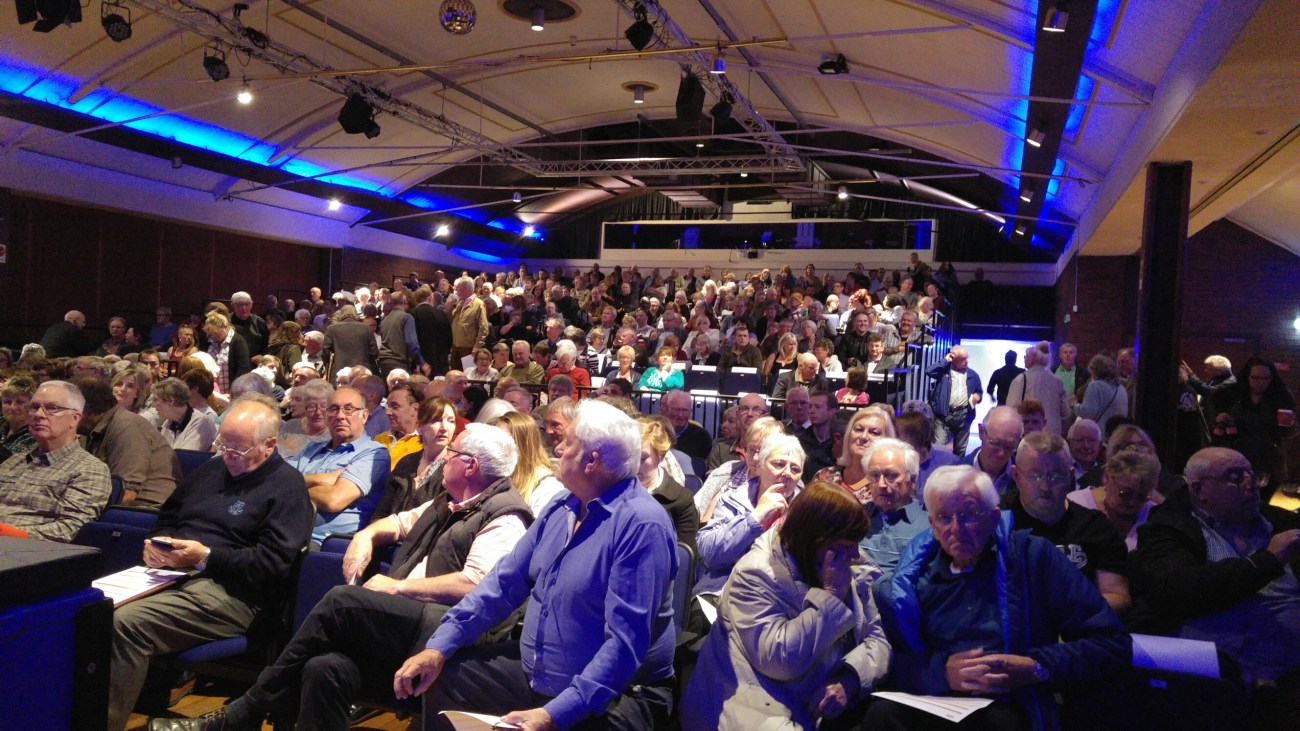
More than 450 people filled Lytham’s Lowther Pavilion Theatre for the first town-hall style meeting on fracking in Fylde for more than two years. Speakers are the event are Fylde resident and engineer, Mike Hill, and retired medical consultant, Dr Frank Rugman. The event is chaired by Charles Metcalfe. DrillOrDrop is reporting live from the meeting. Frank Rugman statement and YouTube video of presentation by Mike Hill
10.18pm: Closing “This is your chance to defend the Fylde”
Meeting chairman Charles Metcalfe says it is now down to local people.
Fracking is expected to start in September and it is likely to run for 24 hours a day, he says. “That will be very hard on local people”, he says.
“People have worked very hard to stop fracking, no one more than Mike Hill”, Mr Metcalfe.
“If ever you have not seen eye to eye with one another this the moment to set those differences aside.
“You have only one enemy and that is the fracking company.
“If fracking goes ahead it will change where you live. It may mean you will not be able to earn a living in the same way.
“It is now over to you. There comes a time in your life when you know that something is wrong. This is that time. It is time to stand up and show your disapproval”
Mr Metcalfe said the first step was to come to the meetings in the coming weeks.
“Please tell people what you have learned tonight.
“This is your only chance to defend the Fylde”
10.13pm: Question about fugitive emissions
A woman from St Annes asks whether Cuadrilla is going to use cold venting. She says flaring will have a visual impact and scare people.
Mike Hill says gases can be cold vented if the flare is not ignited or is burning at too low a temperature. There needs to be proper monitoring of the flare, he says.
There is very little we can do about this, Mr Hill says. Monitoring has to be done by the regulators and should be paid for with a levy on the companies. Government is not in favour of this system, he adds.
10.11pm: Statement about licences across the UK
A woman from East Lancashire says there are nine licences in her area. There are also licences in Yorkshire, she says. Nobody in the UK is going to be safe, she adds.
10.09pm: Question about explosives for perforation guns
Anti-fracking campaigner, Gayzer Frackman, asks whether Cuadrilla had a licence to transport explosives on Lancashire roads to the Preese Hall site for its perforation guns. He asks Supt Richard Robertshaw to try to find out because he’s been unable to.
Supt Robertshaw says he doesn’t have an answer to the question
10.06pm: Question on well pad
A man from Polton-le-Fylde asks how big is the Preston New Road site and how many boreholes there could be on the pad.
Mike Hill says it is approximately four rugby pitches.
“My main concern is what’s underneath the surface, not what’s on the surface
“You could potentially have 60 boreholes. You could have five mile laterals – or 300 miles of boreholes.”
Mr Hill says laddering is going to be tried at Preston New Road for the first time in the UK. There could be 10 boreholes with six lateral boreholes off each one.
“It is totally new. It has not been done before with high volume hydraulic fracturing. It is a risk.”
10pm: Question on regulation
A man who had worked in the industry says there has been scaremongering about fracking.
“We are all concerned but coming from the industry I think we need to look at the other side. I am sorry it is going to happen.”
He asks whether the Oil and Gas Authority (OGA) and the Health and Safety Executive visit the Preston New Road site.
Mr Hill says a well examiner, paid by the operator, produces documents that go to the OGA. The OGA has not inspected the site, he says. They are not taking an over-arching view, separating revenue-raising from safety. They are in charge of licensing and over-seeing the HSE. Mr Hill says:
“It is a serious problem. ‘We are not going to inspect. We are relying on documentation’. \it’s just not good enough.”
9.51pm: Question on policing
To huge applause, a woman asks why are there 150 police on duty at Preston New Road every day to deal with an average of 20 protesters. How are they going to cope if the Roseacre comes on stream, she asks.
Supt Richard Robertshaw, who is in the audience, says there is a large police presence. The total is usually 100. He says:
“It is costing a significant amount of money. We would rather not be doing it. We don’t think it is good value for money. But we have a duty to allow Cuadrilla to go about its lawful business.
“There have been times when it is has been raised that the police operation is too supportive of Cuadrilla.
“The objective of the policing operation is safety first, facilitating the right to peacefully protest, the right of Cuadrilla to go about its lawful business and the right of people not to be disturbed.”
To applause, Supt Robertshaw said yesterday 8 people locked-on and that took considerable resources to deal with.
Charles Metcalfe says he has been told lawful protest has not been part of the equation and that people who protested had felt intimidated by police.
Supt Robertshaw says “We try where we can to facilitate protest.”
He says slow walks would be overly disruptive of the highway.
A woman in the audience says, to applause, that she is prepared to be held up by the protest.
Supt Robertshaw says other people feel equally strongly that they don’t want to be held up.
Mr Hill says police officers are caught in the middle. But policing will become impossible as fracking increases, he says.
“If there are 100 police officers at Preston New Road and then another 100 at Roseacre and 100 at other sites – how are police going to have 500 officers just policing fracking, what is going to happen to crime?”
Supt Robertshaw says
“We don’t have the resources to do this for an extended period of time.
“This isn’t just a Lancashire issue. We’ve had discussions with the Home Office and other forces.
“There is a commitment that if more officers are required, that is what the police service will do. There is always the capacity to deal with it, at a price.”
A woman in the audiences says car drivers are told the road is closed because of protesters, not because police we allowing a lorry out.
9.47pm: Question on flooding
A woman from Scarborough asks about surface water at Preston New Road.
“There is an enormous amount of water on that site.”
Do you know Cuadrilla have been removing the water in tankers?, she asks.
Mr Hill says pads can flood. Flooding in this area is a problem. When you flood the pad, everything washes into the next door field and the impermeable layer is useless. There is not a procedure in place to stop that happening, he says.
9.44pm: Question on impact on farming
A local dairy farmer asks about the impact fracking could have on his cattle.
To applause, Mr Hill says
“We absolutely must protect our farming industry.
“The government is prioritising tax take from gas over farming in the Fylde. I personally think that is appalling.”
Mr Hills says the horizontal wells could go under Lytham, St Annes and over to Roseacre. The operator can drill a lot further than what is planned by the first four horizontal wells.
Many farms could be fracked and their produce could be regarded as fracked food, Mr Hill says
9.40pm: Question on water
A questioner asks whether water for fracking would have priority over local drinking water, particularly in drought.
Mr Hills says the local water company, United Utilities, has the right to extract water from the River Wyre.
“I would be very nervous about the potential for leaks of fracking fluid getting into water courses. Personally, as soon as Cuadrilla start fracking I will go to bottled water. I just can’t take the risk. I know too much about it.”
Mr Hill says UU can drop water pressure to the level that it would take an hour and a half to fill a bath. Both Cuadrilla and UU are both private companies, he says. Cuadrilla is probably paying more for its water than domestic customers.

9.37pm: Question about well failure
A woman asks how long a well lasts, how many wells fail and what happens.
Mr Hill says a certain percentage of wells fail immediately. It is the job of the regulator to spot it and fix it. He says wells should be monitored for at least three decades – a study of wells in the US found 100% of them leaked over time.
“We need a bond for abandonment and the government refused. We have a real problem on our hands.”
9.31pm: Question about fracking and radiation
A local anti-fracking campaigner asks about whether depleted uranium tips could be used on drill bits.
The questioner asks about the disposal of nuclear waste in wells. Mr Hill says the Infrastructure Act allows any substance to be pumped into wells after oil and gas production. Mr Hill says he his concerned about the industry looking at ways to make operations more competitive. He says he thinks it is a real possibility. Research work is underway on putting high-level nuclear waste down boreholes. It would make the industry extremely commercially viable, he adds.
9.29pm: Question on earthquakes
A Fylde resident asks who will pay for training to prevent earthquakes from the fracking process.
Mr Hill says a report on the 2011 earthquake in the Fylde linked it to fracking at the Preese Hall well. He says this was a serious failure at the well. It could have the potential to leak. A larger seismic event would be needed to cause damage on the surface, he says.
9.23pm: Question on conditions
A questioner says: “I was disappointed that Lancashire County Council had not accepted the advice of officers and approved the site with strict conditions.
“I was disappointed it went to government. I think we have ended up with weak conditions
“Is there no chance at this late stage that Cuadrilla would enter into an agreement with you [Mike Hill] to monitor this site at their expense?
Mike Hill says he had been allowed to go on any of Cuadrilla’s site and inspect anything he wanted to, up to the point when Francis Egan became the chief executive. Since then, Mr Hill says, he has been banned from the sites. Cuadrilla is no longer interested in independent monitoring, he says.
Lancashire County Council has no say on the Preston New Road site anymore. It is in the country’s national interest to frack, as far as the government is concerned, he adds..
Proper regulation and monitoring is too expensive and a barrier to the market place, Mr Hill says.
9.20pm: Question on regulation
A local person says this a moment – after the Grenfell Tower tragedy – to promote regulation of fracking. People don’t want to rip up red tape, she says. This is the chance to get fracking regulated.
Mr Hill says he has tried hard to regulate the industry. He stood in the 2015 general election. The winning MP, Mark Menzies, says the people of the Fylde voted for fracking. Politically it is still in the hands of the Conservative Party, which is in favour of fracking, he says.
The government has accepted some ideas on monitoring, Mr Hill says, but it hasn’t accepted that regulation proposed by the Royal Society and Royal Academy of Engineering report should be implemented now.
“We don’t have gold standard regulation.
“Ministers wait for a disaster before doing anything.
“It needs to be more than just me. It needs to be the people of the Fylde”
9.13pm: Question on fracking waste
A local person asks what will happen to the contaminated water from fracking.
Mr Hill says he calls it fracking waste. Since 2012, the Environment Agency has decided there is no Best Available Technique for flowback fracking waste, he says. It has decided doing nothing is the best thing to do with the waste left in the formation.
For flowback that comes back up in the wells, the EA decides it should be recycled, Mr Hill says. He adds that Cuadrilla can bring back up the flowback, process it and use it again for fracking again.
9.10pm: Question on moratorium in New York
A PHD student asks how the public could get involved in working for a moratorium.
Mr Hill says it is through meetings like this. He says he has done more than 70 meetings about fracking. He says he hopes that from this meeting, more and more people will get more and more knowledge, and become more active in protecting their areas.
“We need to work this through together and show the government we are not happy”.
9.05pm: Meeting resumes
Question-time part of the meeting now underway.
Chairman, Charles Metcalfe, says business leaders, school headteachers, councillors, police chiefs and Cuadrilla had been invited to attend the meeting. Superintendent Richard Robertshaw is in the audience.
Mr Metcalfe says accusations had been made that Mike Hill had been guilty of scaremongering. The accusations had been investigated and dismissed. Mr Metcalfe says he will not allow criticisms of Mr Hill’s credentials.
8.40pm: Break for 20 minutes
7.50pm: Mike Hill – speaker
Mike Hill, a Lytham resident, engineer and adviser on shale gas, takes the stage. He tells the meeting he is qualified to talk about fracking but is not a fracker.
He says the mainstream media cannot always be trusted to tell the truth. He advised the audience:
“You must check information for yourself.”
Mr Hill says there will always be risks. The key is to assess them and mitigate them. Fracking carries serious risks, he says, which need mitigating. They are health, economic and lifestyle risks, he says.
Health risks
He says the Preston New Road shale gas site is probably the largest pad in the world. It could eventually have 60 boreholes on it, four times the number on the previously largest pad.
He says risks would arise through emissions to air or groundwater. As an example of emissions to air, he says gases could be emitted through poor burning efficiency from the flare. The risks of these gases increase to people living within a 2km radius.
Fracking fluid comprises mostly water, with some sand, dilute acid and polyacrylamide, a friction reducer,he says. About 50% of fracking fluid returns to the surface. A Cuadrilla executive said he didn’t know where the remaining 50% went.
In the flowback water from Preese Hall, Cuadrilla’s only hydraulically fractured well, there was levels of substances about accepted limits that included cadmium, chromium, and arsenic, Mr Hill says.
“It’s not what you pump in that matters. It’s what comes back. That is pretty toxic and can cause problems to the environment.”
Lancashire would need 6,000 wells across 100 sites, he says. Durham University calculated to get 15% of gas out in Lancashire and Yorkshire would need 33,000 wells, Mr Hill said.
Economic risks
Mr Hill says house prices on the Fylde fell by 9% directly related to fracking of one well at Preese Hall.
He says the main other economic risk is job losses. There has been no formal evaluation done, he says. But he says a commonsense evaluation is that fracking will put people off visiting the Fylde and buying produce from the area. 60,000 people work in those industries and an estimated 25% – or 15,000 people, would lose their jobs, he estimates.
Fracking is usually a net loss to the area, he said.
Life style risks
There will a very significant increase in traffic in the area around Preston New Road, because that’s what fracking needs, Mr Hill said.
In Australia, there has been an increase in road traffic accidents, he said. The response has been the creation of one-way systems. Delays start to build up. But at least you don’t get head-on collisions.
Light and noise at night lead to sleep deprivation, Mr Hill says. It could lead to a down turn in the area.

Control the risks
Mr Hill says the industry checks its own procedures. He asks:
“Should you trust the industry to “mark their own exams”
He criticises Cuadrilla for using maximum limits recorded in a year as a baseline measure for its monitoring data.
He quotes the Environment Agency who said it was monitoring fracking by Cuadrilla at Preese Hall by requiring the company to send a fax on a Friday afternoon.
Is it right that fracking companies mark their own exams?, he asks.
“The industry has been de-regulated”
Mr Hill says the industry has been “significantly de-regulated” in the past decades. He gives as an example the right of UK companies to drill under land without the owners’ permissions.
In contrast, he says, regulation of fracking in the US has significantly increased. He says a ban on flaring in some states of the US has reduced some of the risks to local people.
The UK, he says, nothing of the sort has happened. The government refused to ban flaring on fracking sites. Mr Hill says:
“If you have to have shale gas it is better, morally, to import it from the US because the US is better regulated”.
Cutting red tape
Mr Hill says the MPs, civil servants and ministers he has met regard regulation as red tape that constrains business. But regulations can, he says, prevent deaths.
90% of the recommendations in the Royal Society and Royal Academy of Engineering report on shale gas have not been implemented, he says.
Why is the government taking this risk with the Fylde?
Why is the UK government prepared to take this risk in the Fylde, Mr Hill asks.
” The government balances the tax take from the Fylde against farming and tourism in the area. The national interest outweighs our local interest”
“Protest can only continue”
Mr Hill says democracy has been sidelined with the decision by the Communities’ Secretary, Sajid Javid, to overrule the decision by Lancashire County Council to refuse permission for fracking. There is no local control over risk,he adds.
To applause from the theatre he says:
“There is nothing left but for people to protest, as they are doing at Preston New Road”.
“The protesters are doing it for our families and our area. These protests are only going to expand, particularly when people learn about what the risks are”.
7.30pm: Frank Rugman – speaker
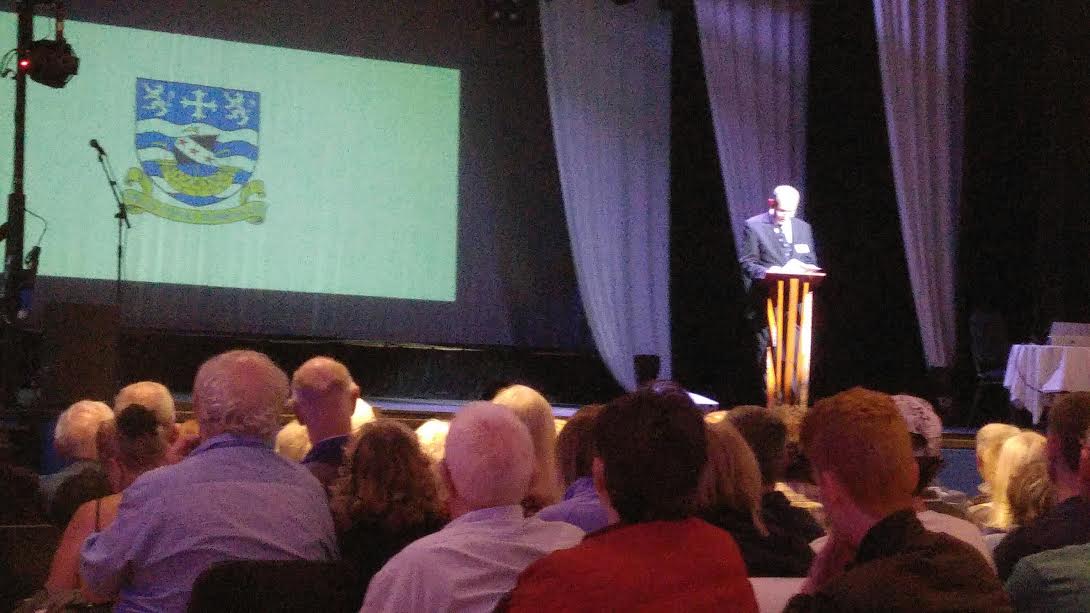
Dr Rugman is one of the authors of the Medact report on Fracking and a retired medical consultant.
Dr Rugman advises people to do their own research on fracking. He is applauded when he says people in Lancashire wonder whether the government would ever impose a so-called sacrifice zone on anywhere in southern England.
Air pollution
He gives details of increased road traffic accidents in fracking areas in the US. He says there is mounting evidence of the increasing impact of invisible air pollution, particularly diesel exhaust. Diesel exhaust causes cancer, he says. Patients with asthma and respiratory disease are particularly vulnerable to diesel emissions. Will fracking increase diesel emissions and will the emissions be monitored?, he asks.
Work by John Hopkins School of Public Health indicates possible associations between:
- Closeness to active fracking and exacerbation of asthma
- Closeness of the mother to active fracking and high-risk pregnancies and premature births
- Closeness to active fracking and migraine headaches, chronic rhino-sinusitis and fatigue
More research is needed to determine whether any associations are causal, Dr Rugman adds.
“Shale gas syndrome”
Dr Rugman refers to what has been called “shale gas syndrome” and says the Pennsylvania Medical Society has called for a moratorium on fracking.
He mentions reports of nosebleeds, dermatological, respiratory, neurological and GI symptoms and increased hospital admissions for heart problems and strokes in fracking areas. There are risks, he says, from radon gas, silica sand and sleep disturbance from noise.
Reports of negative effects on groundwater continue to emerge in the US. A study found toxic groundwater up to 1km from a fracking well.
The US Environmental Protection Agency has finally admitted that there is a connection between the shale gas industry and contaminated groundwater, he says.
But Public Health England report, which concluded that fracking was “low risk”, has been described as “a leap of faith, unsubstantiated by the scientific evidence”, Dr Rugman says. It is, he adds, out of date.
“The assumption that all reported health risks from fracking could simply be overcome by regulation and engineering, has also been widely disbelieved.
“Exposure to harmful volatile organic chemicals from fracking cannot always be eliminated through regulation, as there are technological and economic limitations to the treatment of emissions into the air, into groundwater and from waste.”
“Gold standard regulation”
The audience laughs when he refers to government claims of “gold standard” regulation. In England, he says, there is not even a minimum distance between homes and fracking sites. This ignores evidence that distance is a major factor in determining health of residents, he says.
Dr Rugman says:
“For Fylde residents, the questions are simple: Do you trust this industry with its vested interests, then do you trust the government to regulate this industry?”
He is applauded when he quotes a statement from Cicero on the coat of arms of Lytham St Annes:
“The safety of the people is the highest law”
7.32pm: Meeting underway
Chair of the meeting, Charles Metcalfe, introduces the evening.
7.30pm: People being turned away
Theatre filled to capacity and people being turned away.
7.15pm: Theatre almost full
All but a handful of seats now filled.
6.45pm Crowds gathering
People are already gathering outside the Lowther Pavilion Theatre. A police car and van are parked outside .

Reporting on this meeting was made possible by individual donations from DrillOrDrop readers
Categories: Diary

 DRILL OR DROP?
Thank you the good people of the fylde ,your input to this terrible procedure ,will be seen in the future ,as very inportant ,stance on the halt of a dangerous procedure
[Edited by moderator] Mike Hill is doing a good awareness raising job – a bit too much awareness raising for some it seems. Mustn’t get too close to the truth must we. Reminds me of Max Headroom (the movie).
I see the same pro shale people are here yet again, simply being abusive and attempting to discredit people. I suspect they’re real kick is the reactions they solicit from others. I urge you all to ignore them, and expend your energy on something worthwhile, fighting this industry supported by a government that puts self interest before those of the people, whilst proposing a more enlightened future.
The frackers are having an easy time of it on the Fylde even though it’s taken half a year to do a job that should have taken a few weeks.
I look forward to them trying it on in a Labour voting area. It’ll be like Salford on steroids lol
What a failed ponzi scheme haha
My question went unanswered during the meeting… ‘A woman in the audiences says cars are told the road is closed because of protesters, not because police were allowing lorries in or out’ …. However after the meeting I asked Supt directly for an answer.. he asked what I suggested they should be doing.. my reply was ‘tell the drivers the truth, it is to allow vehicles to enter/leave the site’… he replied ‘he would speak to the officers at pnr about doing this in future’.
Excellent Michelle, thank you.
From Ruth report, Mr Hill seems to be a lot more less alarming about fracking than the usual anti fracking crowd. Maybe his background allows him to see the issue as of risk mitigation and proper regulation rather than fracking is the end of the world. Good to see even the rightfully concerned local admit that the majority of lock on protesters are unlawful and not local.
What is his background? Engineer? In what?
Isn’t he an engineer of some kind?
Thank you Ruth for this detailed report and sorry I could not be there, it was either go to London with friends who know the residents and could help me understand the situation, or a 5.5 hour journey and it looks like I may not even have gotten in?
Another time closer to home maybe?
Interesting information, thanks, 450+ who wanted to know? That is remarkable!
Interesting that the fracking waste, nuclear waste and the water depletion were asked about? Three subjects that the pros dont like to talk about, also road transport, congestion and hold ups blamed on protesters but really because of vehicular entrance/exit TMO contraventions? Were there questions on road condition and capability of withstanding 100 tonne loads with LHV’s? Another elephant on the road so to speak?
Thanks again for your report, very informative.
We could have gone for a beer Phil C as I did not get in either?
Next time maybe?
For the wind turbine diehard fans. Even the industry insiders are doubting if off shore wind energy can survive without government subsidies. So whats the solution the industry came up with? Well, bigger turbine. Bigger is always better. And I thought that was the motto of the mining and o&g industries. Didnt think the renewables would copy it.
http://uk.mobile.reuters.com/article/idUKKBN19I118
Airflow tends to be stronger and more laminar (less turbulent) the higher you go TW, so, taller is better, leading more efficient wind ‘farming’ for turbines. The upside there is that fewer are needed for the same power generation. The slower speed means less noise generated by the tips.
I agree, energy production and distribution should be local and efficient, not centralised and wasteful, there are plenty of links to smaller wind and solar, storage and heat exchangers. Some of the wind turbines are more efficient, quieter, have less down time and can be made quite beautiful. Solar panels can now be made with non rare earth minerals, cheaply and easily, Tesla generators are simple easy to build and non intrusive and non polluting. Single house units from all energy efficient means must surely be the way to go.
Why on earth was Charles Metcalfe from BALCOMBE WEST SUSSEX in the Fylde??? He has not a clue what he talking about! Cuadrilla were not even FRACKING in Balcombe or ever will do ! But Metcalfe and his folloewers it seems do not understand anything! Conoco drilled same site in 1986 for oil and no one protested! [Edited by moderator]
Reblogged this on keepeastlancashirefrackfreekelff and commented:
A very well attended meeting in Lytham with people turned away! Important information about the fracking industry and lack of regulations!