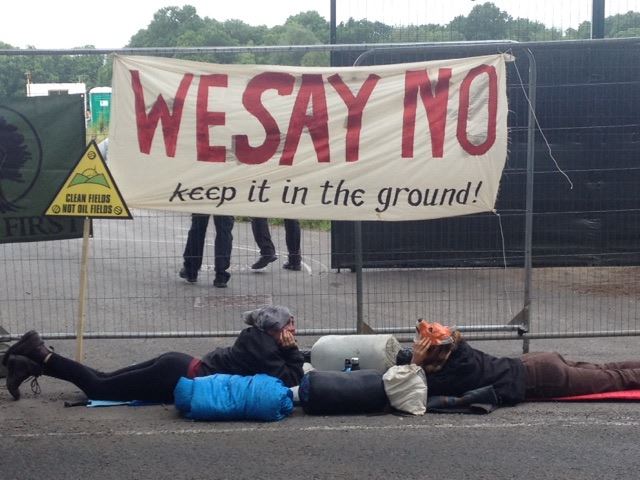
Lock-on protest at Broadford Bridge. Photo: Broadford Bridge Action Group
Two women environmental campaigners who locked themselves together outside the Broadford Bridge oil exploration site in West Sussex have been found guilty under the old law of “besetting”.
Lara Bloch and Sarah McNichol, both 22, said they locked their arms through a concrete-covered tube to raise awareness of drilling at the site near Billingshurst and to attract media attention.
But prosecutors at Brighton Magistrates Court argued this morning that the women intended to cause disruption. Their action delayed operations and cost the site operator, Kimmeridge Oil and Gas Ltd, about £10,000, the court heard.
District Judge Christopher James said the protest, known as a “lock-on”, amounted to besetting, or wrongfully preventing people from carrying out work.
He found the women guilty under section 241 of the Trades Union and Labour Relations Consolidation Act. The women, who had denied the charge, were conditionally-discharged for 12 months and each ordered to pay £500 in compensation, costs and victim’s surcharge.
Announcing his verdict this afternoon, DJ James said:
“You both have deep-seated beliefs but in this case you have strayed over the line into unlawful conduct.”
The case centred on several key issues: whether the women intended to disrupt operations at Broadford Bridge; whether they intended to prevent people entering or leaving the site; and whether there was a loss to the company.
District Judge James said:
“I am sure they did beset the entrance. They did prevent lawful access by others to enter the property and the motive was to protest.
“I am satisfied there are wholly appropriate forms of protest that could be used but this protest aimed to continue disruption for as long as possible.
“It was deliberately designed to obstruct access and interfere with operations of the site.”
The court heard that the women locked-on outside the main gate, off Adversane Lane, at about 6.30am on 12 June 2017. A four-person police protester removal team arrived at about 10am and cut the women free at about 1.30pm.
Kimmeridge Oil and Gas Ltd said in evidence it had expected three deliveries that day. One delivery had to be postponed and the others were delayed. Three vehicles were also due to leave the site. Among them was one of only two specialist trucks of its kind in the UK, the court heard.
Ms Bloch, a student from Oxford, said:
“The main aim was to raise awareness of the drilling taking at the site and to gain media attention.”
She said the BBC and other media outlets had reported the protest:
“We got quite a lot of media coverage. It did raise awareness of what was going on there.”
David Dainty, prosecuting, put it to Ms Bloch:
“The only reason you sat down in the middle of the gate was to stop the trafficking coming in and out.”
“No”, Ms Bloch replied.
District Judge James asked whether she realised that the blockade would stop vehicles at the site. She said there was a second entrance which she thought could be used by deliveries.
The other woman, charity worker Sarah McNichol, from Brighton, said she had found the lock-on device but could not remember where.
She said local protesters, who had been monitoring the use of the alternative access route, had seen vehicles use it to get to the site.
Asked why she continued the lock-on after a police warning that she would be arrested, she said:
“I was not sure that unless we were cut out it would be on the news.”
Mr Dainty put it to her:
“You wanted to get as much disruption as possible. Your purpose was to stop the lorries coming in and out.”
No, Ms McNichol replied.
Stephen Clark, for Ms McNichol, said the Trades Union Act used to prosecute the women had been designed to deal with strikes and picketing.
“If this section of the act is to be used to regulate protests it is for parliament to apply it.”
He dismissed the argument that the women could have used other, less disruptive, forms of protest.
“Otherwise the right to protest would be reduced to the least offensive, which would be the least attractive to media and public attention.”
To be found guilty under the Trades Union Act, prosecutors had to prove repetitious nuisance, not a single occurrence, and an intention to cause a loss, Mr Clark said. The women also needed to have surrounded the site, he said, had hostile intent and induced people to breach a contract.
The women had not surrounded the site, nor had any contact with people inside, Mr Clark said. The intention was to raise awareness, not cause a loss.
Franck Magennis, for Ms Bloch, said:
“There are reasonable doubts that all the elements that the court required have been proved. I invite the court to acquit.”
A spokesperson for Broadford Bridge Action Group said this evening:
“We believe the law has been mis-applied and that the right to protest is diminished by this judgement. These two brave women should be commended for raising awareness about this highly controversial threat to the environment.”
Reporting on this court case was made possible by individual donations from DrillOrDrop readers. You can donate to DrillOrDrop by clicking here or on the donate button in the right-hand panel.
Categories: Legal

 DRILL OR DROP?
So where does law and order come into it. You have rights to peaceful demonstration, you have rights to petition Parliament, and you have rights to bring a prosecution. In this world there are always people for and against any project. I don’t suppose these two women, assuming that they arrived by car, and came back to it to find somebody chained to the wheels claiming that motor cars were polluting the world, would be very pleased. Especially when they had to pay to cut the shackles binding the person to their car. So why is it different and how is their breaking the law acceptable to them, when other’s transgressions which affect them personally, is not. They need to grow up. The law is there for everybody and if you pick and choose which parts of it you will obey, then you can not complain if others pick bits you do agree with and carry out illegal acts against you, because they don’t like it !
“Unlawful conduct”-so, there we are. Clear for all to see. I would suspect further repeats will see the penalties increased.
In other words ‘It is oka to break the law if you have a cause. but not if the cause is not one you support !’
Not aimed at you Martin it is a continuation of my discourse
“Watching and Besetting” a Victorian liberalisation of the Trades Union Law redefined, now found in Section 241 of the Trade Union and Labour Relations (Consolidation) Act 1992 but its origin is in The Conspiracy, and Protection of Property Act 1875, repealed in 1992 .
“So what is “besetting” – or “watching and besetting” as the offence is properly termed? And could it become a significant legal weapon in the armoury against protest? The answer to the second question seems to be yes, since the law has also been used against pensioners and other protesters objecting to the cutting down of trees in Sheffield.
The crucial point about the law is that it involves successfully preventing someone going about their legal work – which, of course, in the anti-fracking context (and tree-felling), is exactly what protesters are attempting to do.
The law is now found in Section 241 of the Trade Union and Labour Relations (Consolidation) Act 1992 but its origin is in the liberalisation of trades union law in the 19thcentury.
The Conspiracy, and Protection of Property Act 1875, repealed in 1992, gave certain immunities to trades unions in trade disputes against conspiracy charges and allowed peaceful picketing. On the other hand “watching and besetting” was to remain illegal. Thus it says at Section 7:
“Every person who, with a view to compel any other person to abstain from doing or to do any act which such other person has a legal right to do or abstain from doing, wrongfully and without legal authority,—
…
(4) Watches or besets the house or other place where such, other person resides, or works, or carries on business, or happens to be, or the approach to such house or place”
is guilty of an offence, adding, however: “Attending at or near the house or place where a person resides, or works, or carries on business, or happens to be, or the approach to such house or place, in order merely to obtain or communicate information, shall not be deemed a watching or besetting within the meaning of this section.”
Section 7 also contains reference to intimidation, persistent following, and hiding the tools or clothing of a worker. So the protection was intended for so-called “scabs” who continued to work through a trade dispute, and the wording remains in Section 241 of the 1992 Act – though not the exemption for “attending at or near the house or place of work … to obtain or communicate information”.
Section 7(4) was little used before the 1983 miners’ strike, during which there were 643 besetting charges, mostly for watching and besetting miners’ homes rather than coal mines.”
Interesting, it seems if you dig deep enough far enough back into history, there is a law somewhere that might be vaguely applicable, though how two women can “surround” a site remains to be established?
There must presumably be a much more recent law to make attempted strangulation illegal too? Or is a lack of Victorian heritage for that therefore necessarily prohibitive?
The Conspiracy, and Protection of Property Act 1875 defining “Besetting” and its use in protesting against fracking.
https://thinkinglegally.wordpress.com/2014/03/07/anti-fracking-and-besetting-a-law-against-peaceful-protest/
No problem Vernon.
I just hope the next case of this type adds some serious hours of community service.
A few questions about “Watching and Besetting”, to which Trades Union is this particularly applicable to? Is there an Oil and Gas Trades Union on site? Are the protesters part of a Trades Union or affiliated to any Trades Union? Are there any Trades Union members, affiliated or otherwise, involved in this protest at all? If so. who?
Can a law which is intended for use in a Trades Union dispute have any relevance whatsoever to a civil protest where no Trades unions are involved, nor are in dispute with any organisation?
Does this Trades union Law, then apply to everyone? Regardless of whether anyone has any connection whatsoever with a Trades Union? including the police and the fracking operators? Can an ohandgee or fracking site be charged with “watching and Besetting” for obstructing a highway in any situation, and operations that cause disturbance and nuisance be culpable under that same law?
Does this law apply to everyone? Or just protesters? Here there be dragons?
Interesting, isn’t it?
The more you look at “watching and besetting”, the more interesting it becomes, because if this law applies, as it seems, to everyone going about their lawful business, then there are all sorts of candidates for this particular accusation, it is a genuine opened and crawling can of worms.
If used by everyone going about their lawful duty and business, even someone stopping you from proceeding in the street or on a highway is a potential candidate for watching and besetting?
What about street surveillance cameras? Carcams? GPS detectors and tracking on phones? Motorway numberplate recorders? Filming of protests by anyone? Preventing peaceful protest?
In its Trades Union dispute intended use, it is a restriction on a Trades Union dispute action, but taken out of its intended context it is a monster of a law if used in any and every situation.
There are countless uses for this in almost any daily civil situation whilst going about your lawful business, or indeed by and for anyone and to anyone?
A lawyers feast perhaps?
Good on the courts. Although I would have made them pay consequential losses too.
Exactly the law is too lenient on protestors who over – step their protest. They cause damage, trespass, and inflict financial loss upon companies . If they prevent a company going about its lawful business then they should have to make good the loss to the company. Afterall, they would soon get a doggy lawyer to sue the company if, in the process of protest that one of their number got accedentally run over by a truck from the company they are demonstrating ! Not nice is it, when you find that the company have legal rights too and two dozen flag waving protestors is not a serious demonstration . There are 65, 000,000 people in the country and most of them are going about their legal business, bringing up kids, going out to work…I wonder if there are proper checks carried out to see if any of the frackers are in receipt of benefits. If so as it is our money, that is, it belongs to the public. Non-peaceful demonstrating costs (the public) more money. And, in my opinion, benefits should be reduced from each individual to help pay the cost