
People voting against fracking at debate at Eckington, 7 December 2017. Photo: Still from video by The People Against Fracking
Fracking was rejected by the vast majority of people at a debate on its role in Britain’s energy mix.
More than 150 people attended the event in a Derbyshire village near the county’s first proposed shale gas site.
Tom Pickering, operations director of INEOS Shale, the company behind the proposal, made the case for fracking. David Kesteven, chair of Eckington Against Fracking put the opposing arguments.
Both made a 10-minute statement (see below) and answered questions submitted in advance and from the audience.
The debate last night at Eckington Civic Centre was chaired by the local Conservative MP, Lee Rowley. He has opposed INEOS’s plans to explore for shale gas at the site at Bramleymoor Lane in the village of Marsh Lane.
At the end of the debate, a large majority of the audience said “no” in a show-of-hands vote on the question Does fracking have a role to play in the British energy mix?
Video of questions section of the debate
Video by The People Against Fracking
- Before the debate, DrillOrDrop invited Mr Pickering and Mr Kesteven to send us a summary of their arguments or a copy of their statement. See below.
The case against fracking, David Kesteven, Chair, Eckington Against Fracking
Why we don’t need shale gas
The Gas Security of Supply strategic assessment, published in October 2017, assumed no shale contributions in the forecast period. It said:
“our security of supply does not depend on new indigenous supplies”
“We are secure now, and the GB gas system is well placed to continue to be secure and robust in a range of supply and demand outcomes over the next two decades.”
The Clean Growth Strategy, published in October 2017 with a forward from the Prime Minister, said the UK needs to “increase the pace of decarbonisation to meet the carbon budgets for the period 2023-2032. It refers to
“decarbonising the gas grid by substituting natural gas with low carbon gases like biogas and hydrogen”.
The National Grid future energy scenarios, published in July 2017, includes shale gas in just two of its four scenarios. In the scenario which assumes emissions reductions need to hold temperature rise to 2 degrees C, there’s a move away from gas as a heating source
The Northern Energy Strategy, published in October 2017, says shale gas “may be too environmentally risky to proceed with”. It says the pursuit of shale gas exploitation “can only happen in conjunction with a major step forward in carbon capture and storage”.
Why we must not have shale gas

Daffodils flowering in December. Photo: David Kesteven
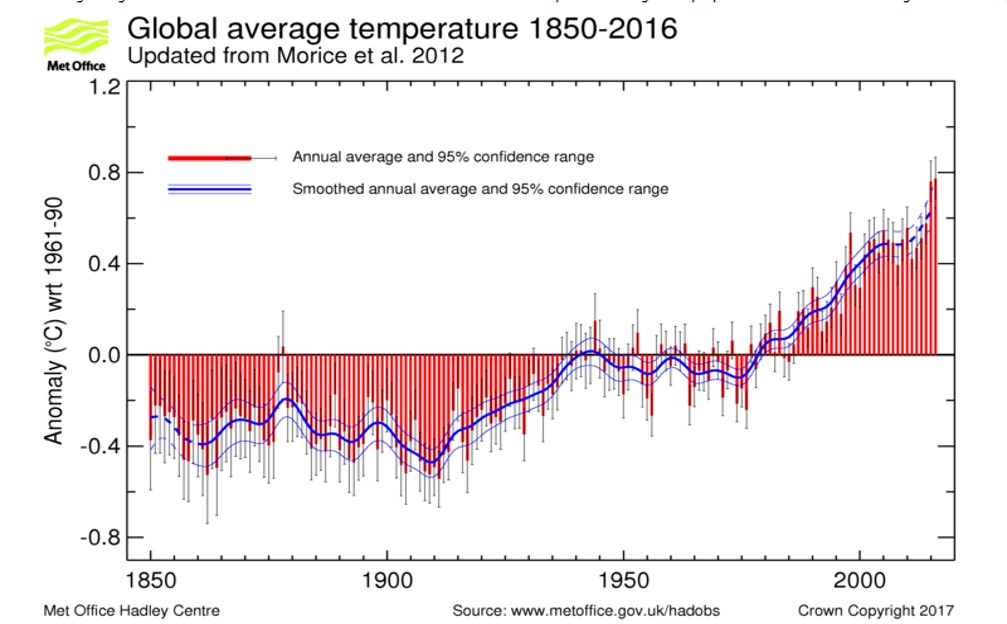
Climate change: Charts of global annual temperature show continuing rises. Daffodils that would be expected to flower in March are now flowering in Derbyshire in December.
Industrialisation and infrastructure: INEOS is proposing 30 well sites in a 10km square. It has said there could be 12-14 wells per site – resulting in up to 360 wells. At Bramleymoor Lane, INEOS is estimating more than 14,000 vehicle movements for its proposed exploration well.
Health: In 2016, members of the Pennsylvania Medical Society voted unanimously for a resolution which called for a moratorium on new shale gas drilling and fracking and a study on its public health impacts. The UK’s Public Health England review on the public health impacts of shale gas extraction looked only at exposures to chemical and radioactive pollutants. It did not review impacts from traffic or noise.
Social licence: A poll of attitudes to INEOS’s Bramleymoor Lane site found that 86% objected, 14% neither supported or objected and 0% supported it.
What we could do instead of shale gas and fracking
Examples of alternatives to shale gas include:
- Blackburn Meadows biomass project
- Solar panels on warehouses, for example in Telford
- Commercial gas generation from waste and grass
Lord Adair Turner said prices for green electricity and batteries have fallen so sharply that even projections for an 85-90% renewables energy system in 2035 now look “ludicrously conservative”.
Conclusion
We should use the decline in North Sea gas as a stimulus to do something better, not an excuse to do something worse. Shale gas does not have a role to play in the British energy mix.
The case for shale gas, Tom Pickering, Operations Director, INEOS Shale
UK gas production is in rapid decline


Total North Sea gas and oil production has been rapidly declining since 2000 while UK reliance on gas imports has grown to over 50% of demand.
We need a mix of energy sources to generate electricity. Coal is being phased out. Wind and solar are intermittent. Gas provides the flexibility to balance the mix. It’s not just about electricity generation.
Why do we need gas?
Heat energy and power generation: 84% of UK homes rely upon gas heating.
Gas is used to produce many items that we use every day: Clothing, packaging, auto, pharmaceuticals, cosmetics, electronics.
To support the switch to renewables: Gas supports intermittent renewables energy production and growth of renewable capacity takes time.
What are the benefits of a local shale gas industry?
Energy Security: We rely upon imports for more than 50% of our gas demand and this is forecast to increase to 80% by 2035.
Climate Change: Local shale gas emits 10% less greenhouse gases than imported gas. For power generation, shale gas has less than half the emissions of coal.
Jobs, Investment and Community Benefits: Potential for £33b investment and 64,000 new jobs. 6% of revenues (£1m per well) to landowners, residents and local communities.
Balance of Payments: Today we send over £7b pa overseas to purchase gas (£20m every day). Why import from countries with questionable regulation and human rights records when we can produce our own gas?
Gas versus renewables
84% of UK homes use gas for heating (61% for cooking). To electrify these for renewable use will cost over £250b and take several decades. To do this by 2050 means converting nearly 2000 homes every single day plus upgrades to the national power infrastructure to supply these homes.
In the future, gas could produce hydrogen by steam reforming, with the CO2 captured and sequestered. The hydrogen would be distributed via the existing gas network.
This is not a gas vs renewables debate – we need both
What is the climate performance of gas?
Locally produced shale gas has over 10% less lifecycle greenhouse gas emissions than imported gas. Locally produced shale gas has less than half the greenhouse gas emissions of coal for power production.
We need gas, today we import >50%, and this is forecast to increase to 80% by 2035. The question is not whether we need gas, but where will it come from?
A steady process of science and consultation

2017/2018
New and existing seismic data acquisition will inform planning applications for wells
Planning applications for vertical coring wells to understand the gas content in the shale rock
2018/2019
Results of core wells will inform planning applications for appraisal wells. Horizontal wells to be hydraulic fractured and flow tested
2019
Results of flow tests will tell us if commercial production is viable
UK shale regime and regulations
Shale gas companies are regulated by the Oil and Gas Authority, the Environment Agency, the Health and Safety Executive, local planning authorities and independent well inspectors.
Summary
- We need gas for several decades, even with aggressive renewables growth and efficiency gains
- Energy Security – our country is importing over 50% of demand today and this import is forecast to increase
- Gas is by far the most climate friendly fuel, and is a key part of the UK’s plans to reach climate targets
- Local shale gas development can bring jobs, investment, community benefits, tax revenues, and improved balance of payments
- Key independent authorities say the safety, health and environmental risks are low given our stringent UK regulatory regime
Categories: Opposition

 DRILL OR DROP?
According to the information supplied by Mr. Kesteven, local support for Ineos fracking was recorded at 0.00% prior to this event. Ruth says in her comments that a “large majority” of people polled at the meeting sided with Kesteven. This would seem to represent an astounding victory for Ineos and Pickering. Pickering entered the room with 0% support and came out with a small minority. You see what happens when people are given facts, and listen to the science? Kudos to Ineos on the victory!
Eatkaletoday
A vote was taken at the end of the session. Excluding the three on the podium whose vote was already known ( 2 no and 1 yes), there was only one vote for yes in the Hall. The rest were either against or did not raise their hand either way.
There were 2 presentations. Tom Pickerings presentation is existing data, so nothing new. David Kesteven spoke more from the heart, with the content as above. His key points were drawn from the docs mentioned above, in that we have sufficient gas from elsewhere, we should keep it in the ground and that we should concentrate on renewables.
There then followed a question session. All questions were directed at at Tom Pickering. None directly addressed the material in either presentation as far as I could see. The questions covered ( as I remember ) such subjects as the amount of traffic generated, how many jobs were local ( of the Seismic Surveying Team ), and would be local, what controls were in place to prevent failure of the well, how the toxic materials from the site would be dealt with, why INEOS had ‘gone upstairs’ with the planning application, how roads would be maintained, how sites were monitored, why a trip to the States had been tightly managed, why a Seismic vehicle had vibrated at the end of a chaps garden, and so on.
So, it was not really a debate, more like a question session to INEOS. No one asked the MP why his party supported fracking, for example, but then there were a lot more people who wanted to ask questions than got to ask them. Reply time was short, so to describe well control architecture ( one question ) would have been difficult at that meeting, but easy at an INEOS open day.
So, Hewes, more of a nimby discussion than anything else. “We like having energy, but would prefer that it be gathered from a far, far away land. We think there’s a lot of it and are willing to take the risk that something disrupts that supply chain and leaves us cold and at the mercy of some dictator in a far off place. A government bureaucrat told us everything would be fine. We don’t mind spewing methane into the atmosphere unnecessarily via the long supply chain and additional carbon footprint from transporting that imported gas, but we still call ourselves “Green” because it is so fashionable to do so and to oppose fracking. We appreciate when our advocates speak from the heart, because science and facts are overrated. Long term energy policy decisions should be made based on emotional arguments.”
Par for the course then.
Eatkaletoday
Yes, more of a meeting to show opposition to fracking than ask about it I guess.
Frick and Frack the comedy duo
The first of many, many, many, many more, it was always going to start, and end this way.
All they have left now is their filthy secret In Junk Shams.
And the hydrogen, in this decarbonised gas grid, will come from where?? According to both Oxford and Cambridge Universities-from gas!
Strange that gem was not supplied to the audience? Not really.
My local biogas scheme is now in administration, and there is a fight to see who will pay the bill for the site to be re-instated.
Wind turbines are to be dismantled in Cumbria, as they are a blot on the landscape.
Vivergo have stopped production of bioethanol from wheat, to add to diesel, in Yorkshire as it is no longer economic.
Wind turbines off Scotland are being blocked by RSPCA to protect the gannet populations.
Wood pellets schemes have resulted in political chaos in N.ireland.
Yes, very alternative.
DYOR.
We don’t want this poisonous industry, we wont have it, what good is more carbon fossil fuels if the process to extract it poisons and destroys the very people it is supposedly benefitting.
Institute all the supressed renewable alternatives now, then we can in junk this filthy poisonous industry sham before it gets a death grip on our beautiful country where we live.
We better do that now before we become just one more carbonised fossil on a dead burned out shell of a planet.
I am quite shocked when air quality is literally killing UK citizens and the impacts of catastrophic climate change is already being felt, with worse to come, that you continue criticising renewables at every opportunity. Are you a climate change denier?
There are many renewable successes, such as offshore wind. May I also point out that hydrogen gas does not have to be produced using methane, there are other ways, including the use of renewables/electrolysis. The cost of renewables is tumbling and the technology is advancing.
And as for fracking, it is not even profitable in the US and CCS is uneconomic, so the writing is well and truly on the wall.
Martin, it seems the RSPB are in favour of wind farms.
https://www.rspb.org.uk/our-work/our-positions-and-casework/our-positions/climate-change/action-to-tackle-climate-change/uk-energy-policy/wind-farms
There seems to be some consistency here. The Harrogate debate ended up with a large majority 85% for the motion “This House Calls for an Immediate End to Fracking in the UK”, and that was after the omniscient Ken Wilkinson had the opportunity to put his case that the science has all been done and there is absolutely nothing to worry about.
Do you think the message might be hitting home yet? Or is it just that Ineos and their friends don’t care over-much?
I suspect the latter, sadly.
It’s a shame Martin cannot seem to grasp the obvious, the people do not want Fracking.
I suggest the objective is to simply annoy people with clearly obvious attempts at putting a positive spin on every negative aspect of this dirty, nasty industry.
People don’t want fracking. They certainly don’t want wind farms. They don’t want solar panels. They don’t want nuclear. They don’t want mining. They don’t want new highway or airports. They don’t want sewage treatment facilities. They don’t want train tracks. They don’t want factories. They don’t want electrical transmission lines. We could go on and on. Does this mean we should stop all of this?
In the 2011 census there were 11,855 resident’s in Ecklington.Only 150 bothered to turn up to a Anti Fracking meeting! I reckon that show’s the majority of Eckington could not care less about fracking.let alone register their objection’s to Ineos or fracking !
11,588 can’t fit into a hall that holds150 (simple mathematics)
https://energy.gov/eere/fuelcells/hydrogen-production-electrolysis
http://www.telegraph.co.uk/business/2017/09/11/uk-offshore-wind-success-must-go-global/
https://www.cnbc.com/2017/10/13/a-hydrogen-generation-plant-that-turns-water-into-car-fuel.html
Kat
I enjoy reading the links, but engineers will be well up on such issues.
Indeed, the latest edition of Materials World (the voice of the Materials, minerals and mining communities) covers
1. Moving from lithium ….A look at two developments that have the potential to become alternatives to Lithium as it becomes more expensive. The USA is looking at an ‘air breathing battery’ which could be used to store electricity for a long time, for one fifth of the cost of current technologies, with minimal location restraints and Zero emissions.
2. Blowing in the wind…The electricity market reform is supposed to prepare the UK for future power demand…but how will it be delivered?
3. Clean fusion by lithium loops. More stuff on fusion…but still a way off it seems.
4. Using philosophy for low carbon materials. There are many activities involved in developing low carbon materials, underpinned by an urgency to change human activities to prevent climate change. The article explains why philosophy will be used as part of the discussion!
5. Cleaning up … New ways of treating large quantities of radioactive waste produced by sites, and the possibility of thermal treatment.
6. Market outlook for the Canadian mining industry… they need to import miners it seems.
7. Hydrogen – the Great hope for transport … the current use of hydrogen in the transport sector and its growth potential. It includes a look at solid storage of hydrogen on metal hydrides.
8. From megawatts to megawatts. An architect takes a closer look at the natural approach to carbon capture and storage in the UK. Cutting to the chase, it’s not storage, but more trees and timber houses.
9. Alexander Parkes, The inventor of the first plastic works. In the UK there are 7500 plastic companies ( not just INEOS ), has a turnover of £19 Billion, exports 35% of production ( to the value of £6.5 Billion ) and produces 2.5 million tonnes of plastic. I only mention this as most of it seems to end up on the verge of our roads, see point 4 above.
And to look forwards too .. The materials protecting the environment Semi ar. 21 Feb in the smoke ( London ).
It’s says ….. It is a real challenge for material scientists and engineers to understand how their expertise and professional practices can affect environmental performance etc etc.
So ….. if engineers are for fracking it will not be due to lack of information I suspect
The people in my village do not want new housing, but they will be built. Every local meeting stated, “we do not want them”. But, 300 new houses were passed, and half of them now constructed. NIMBYS alive and well throughout the UK-shock, horror.
Meanwhile, another worker died this week in the North Sea when he fell off a rig. Sometimes, the costs of being a NIMBY are rather excessive. Over the horizon, like consequences of the manufacture of solar panels, so easy to ignore the inconvenient reality.
Sorry KatT. No intention of following your links, even school children are being educated against such these days. Suggest you Giggle Bass Rock/RSPB/Gannets.
My motives Malcolm have been explained several times over. I am simply the counter to those who want to excite the easily excited-the iced water to the fluffers. I recognise that it is easy to claim “the people do not want fracking” on this site, and other such factually incorrect stuff, even when surveys published on this site show that a large section of the population (well, survey audience) do not even consider the subject as important enough to decide.