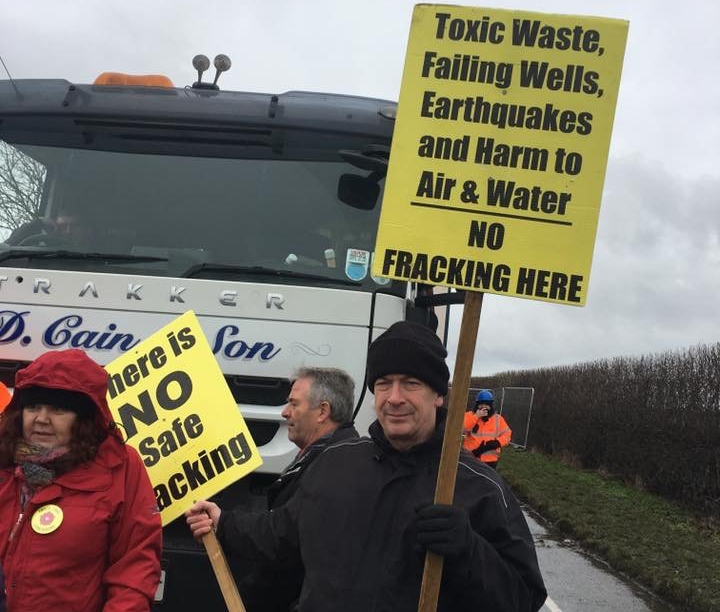
Richard Marshall (right) outside Cuadrilla’s Preston New Road site near Blackpool. Photo: Used with the owner’s consent
Last month, DrillOrDrop reported on proposals by Cuadrilla to vary its environmental permit for the Preston New Road fracking site.
A consultation is now underway, ending on 20 March 2019. In this guest post, anti-fracking campaigner, Richard Marshall, explains why he opposes the changes sought by the company.
I am a resident local to the Preston New Road site and I strongly object to Cuadrilla’s application which seeks to amend their environmental permit to allow for the following:
• Addition of chemicals including Methanol and Glutaraldehyde to the permitted fracturing fluid
• Changing arrangements for the management of waste
• Conducting multiple fracture episodes per lateral well
• Reduce environmental monitoring of surface water and ambient air quality
What is currently being proposed by Cuadrilla is completely different to what was initially presented at Lancashire County Council and during the subsequent Inquiry. Granting this application would essentially enable Cuadrilla to undermine the procedures that are in place to ensure appropriate scrutiny of planning applications, including the consideration of risks to health and safety as well as environmental impact.
During the Inquiry, the Planning Inspector considered Cuadrilla’s Planning Application in detail over a period of six weeks. Local people, local groups, legal teams, environmental groups and stakeholders painstakingly pored over the minutia of Cuadrilla’s proposals including, environmental monitoring, the proposed fracturing process, the chemical components, flow back and the method of storage and disposal. Such deviation from the original plans in terms of process and the chemicals being used, as now being sought in this latest application, necessitates re-examination and becomes a Planning matter.
During the lengthy and intense Inquiry, the Planning Inspector evaluated specialist evidence of risk. It is not acceptable to permit Cuadrilla to subject residents to unevaluated risks to their health and safety as well as to the environment by way of seeking piecemeal amendments to their original EA permit.
It is incomprehensible that Cuadrilla be enabled in this way to introduce new and untested methods at the Preston New Road site without robust and comprehensive consideration of site-specific risks. For example, allowing multi fracks on lateral wells would create significant and unconsidered risks to residents living just 300 metres away from the site.
Cuadrilla state that depending on geological conditions between 10 and 40% of the fracking fluid may return to the surface. This equates to somewhere between 60 and 90% of the chemicals and radioactive frack fluid remaining somewhere in the ground and possibly migrating up to the surface through fissures, transmissible faults or well casing failure which can be caused by the fracking induced seismic events.
The addition of further chemicals to produce a cocktail of substances used in the fracking process combined with radioactive sub surface materials, must surely necessitate an environmental impact assessment. This presents a huge concern and another unevaluated health and safety risk to the thousands of residents living within a two mile radius of the site.
The addition of the toxic chemicals Methanol and Glutaraldehyde (GA) may impact on the health of the most vulnerable residents living close to the site including the young, elderly and those with existing respiratory health conditions. Many adverse health effects on humans have been reported in association with biomedical uses of GA. The prevalence of asthma, chronic bronchitis and nasal symptoms in humans is significantly correlated with peak concentrations of GA exposure. The severity of symptoms is dose-related. Chronic inhalation affects the nose and respiratory tract, and lesions become severe with prolonged duration of exposure.
Polyacrylamide is already being used and during the fracking process it breaks down to Acrylamide which is a highly toxic substance at very low concentrations. Acrylamide is officially classified by the International Agency for Research in Cancer (IARC) as ‘a probable human carcinogen’. Seeking to introduce additional chemicals in this way and at this later stage means that the dangers and risks associated with mixing substances with those already in use has not been assessed.
Without professional scrutiny these risks are unquantified, it is however inevitable that additional pollutants create additional risk. The faulted geology at Preston New Road increases the risk of any pollutants migrating to the surface and contaminating the land and surface water. The land at Preston New Road is still being used for farming. Water on the fields surrounding the site provides drinking water for animals and runs off into the brook which runs through the gardens of residents.
The implications for multiple fracturing of wells have not been given consideration during the previous planning stages and therefor the associated operational risks to health, safety and environment are completely unassessed. The transportation, storage and usage of additional concentrated toxic chemicals must give rise to a comprehensive review of the environmental risk assessment which currently deems the Preston New Road site to be low risk.
The sum of Cuadrilla’s application amounts to substantive changes to the fracking process and deviates considerably from the proposals that were evaluated by the planning Inspector, which ultimately lead to Planning Permission being granted. Cuadrilla’s application to introduce untried, untested, unassessed methods must necessitate further planning consideration. It would be totally unacceptable for the EA to permit these changes without a full and proper assessment of the risk to the environment as well as health and safety and would likely incur legal challenge.
Categories: Regulation

 DRILL OR DROP?
Thank you for your detailed guest post Richard, clearly Cuadrilla are attempting to compromise the present EA regulations and are willing to descend into the USA situation where apparently anything goes regarding what can be injected and re-injected into a fracking well, or any other method of “exploration” and extraction and all the untried and unspecified methods proposed so far Such as the elusive “proppant squeeze” that still evades a published engineering definition.
Of course as you say, all those will be subject to deterioration both from chemical corrosion, acidisation, of the substrata, seismic events and full blown earthquakes.
Many of those chemical agents are protected secret ingredients with proprietary fossil fuel extraction products that are (as yet) banned here.
So it seems the entire issue of the failure of fracking in UK that are unable and unwilling to keep within the regulations and conditions which they themselves agreed to. Has become a sorry backtrack if not backfrack spectacle and a predictable exercise in relocating the all ready wobbly goalposts just to suit the private corporations against the wishes of the local and countrywide residents. The order of the day is now to entirely reframe the entire situation into the usual quagmire of government and corporate unaccountability evasiveness, and de regulated double talk.
Well Good morning ladies and gentlemen, boys and girls, its Sunday again and its the twentieth frack free Sunday since fracking was first allowed in the UK and then failed to produce much more than a propane if not profane gas hiccup and a release of methane whilst there was a simultaneous failure of the monitoring equipment? Purely coincidence of course?…..
In addition to Richard Marshall’s report about the attempts by Cuadrilla to change those wobbly transitory goal posts regarding the chemical constituents that they want to use in their attempts to continue fracking, and the attempts to change the TLS to allow greater than 0.5 on the Richter Scale ans allow more and more earthquakes, there are other moves to not only re-re-re-locate those wobbly goalposts, but to eradicate them entirely.
This is from The Telegraph and reports that “Ministers plot to foil anti-frackers. Sunday 10 March 2019
“Communities could lose the right to block fracking wells as part of a Cabinet plan to create a shale gas industry within a decade, the Telegraph can reveal.”
“The 10-page plan, leaked to anti-fracking campaigners, sets out a timeline for the expansion of the shale gas industry in Britain.
Three Cabinet ministers put their names to the scheme which would see fracking wells classified as ‘nationally significant infrastructure’.
If that was to happen, then councils would be stripped of the ability to block planning applications for fracking wells in local communities.
Instead unelected planning inspectors would be given the power to decide if shale gas drilling sites got the go-ahead, paving the way for a huge uptake in fracking.”
“The move would also speed up the planning process.”
“The change comes as Ineos, one of the big fracking companies headed by billionaire Jim Ratcliffe, disclosed to The Telegraph its own plans to kick-start the UK’s shale gas industry by drilling tens of wells this year. Ineos said it intended to submit a series of planning applications in the spring.
Friends of the Earth, which obtained the leaked letter, branded the proposed changes “an attack on democracy”, while the MPs on the Commons’ Energy and Climate Change committee threatened an investigation.
The letter was sent to George Osborne, the Chancellor, and signed by Amber Rudd, the Energy secretary, Greg Clark, the Local Government secretary and Liz Truss, the Environment secretary.”
https://www.telegraph.co.uk/news/earth/energy/fracking/12130801/Ministers-plot-to-foil-anti-frackers.html
Interesting times ahead indeed folks.
This is David Kesteven of Fracking Farmhouse on the moves to change if not burn down the fossil fuel goal posts and has an interesting letter to David from Natasha Engel when she was Davids MP and was anti fracking at the time…….what does that tell you about Natasha Engel?:
Anyone want to buy several sets of almost unused, but severely battered and bruised tragically unstable goalposts? Going cheap! If you consider that democracy and the planets climate are of no monetary value whatsoever and only money in the offshore tax havens talks of course. (but what is money saying? FUK?)
Have a great Sunday with family and friends and maybe consider the consequences of all these moves to change all the rules and then perhaps consider why such public and environmental and climate change protection regulations were even proposed in the first place if everything is so dismally degradable into a last chance closing down sale?
Might and maybe are not valid reasons for an objection. Cuadrilla are still at the exploratory stage so changes to methods of works are to be expected. The experts will reach a conclusion in relation to chemicals used and any associated impacts. The ability to object is a basic right in our democratic society but objections should be based on facts, not fiction.
Richard’s argument is persuasive. The EA must resist Cuadrilla’s application to vary the terms of its Licence. The recent legal decision empowering local planning authorities to disregard this government’s efforts to prevent the consideration of climate change impacts when assessing fracking applications should provide encouragement for this action by a fearful EA, and our own participation in the Consultation on this issue should provide extra support.
Have I missed publication of and a response to the results of the recent farcical Consultations on Permitted Development and on the inclusion of fracking as a Nationally Significant Infrastructure Project? ‘Farcical’ is perhaps understating the case; perhaps ‘tragic’ might be more appropriate in assessing this government’s response to the climate change implications of the promotion of fossil fuels. Is this shambles what the people settled for after their Brexit decision?
There has been no response yet. Heard a rumour that it will not be until after Brexit.
Iaith2017
Fracking was not part of the Brexit discussion. Is there a link between the two?
Excellent ….well written and excellent information…
May they not be approved.
There is close to zero chance of any chemicals used in fracking affecting people’s health. The article is typical of the fact free nonsense put out by the anti-fracking community to scare people into backing their views
Your response is at least as typical and fact free as we might expect Judith.
PhilpP – I’ve got nothing to prove as it’s not me that’s making up wild theories that aren’t backed up by evidence. Richard has failed to provide any mechanism as to how the chemicals can come into contact with people. Also as mentioned by John Harrison, his chemistry doesn’t stand up to scrutiny.
Judith. By failing to engage with the article, or with the points raised in any meaningful way, the only thing you have proved is that you have no argument. On the other hand, by using the lazy smear of ‘fact free nonsense’, now established as your favorite cliched response, you have suddenly given yourself a lot to prove…. so, please prove for instance that there is nothing factual in Richard’s core statements viz:
“Granting this application would essentially enable Cuadrilla to undermine the procedures that are in place to ensure appropriate scrutiny of planning applications, including the consideration of risks to health and safety as well as environmental impact.
During the Inquiry, the Planning Inspector considered Cuadrilla’s Planning Application in detail over a period of six weeks. Local people, local groups, legal teams, environmental groups and stakeholders painstakingly pored over the minutia of Cuadrilla’s proposals including, environmental monitoring, the proposed fracturing process, the chemical components, flow back and the method of storage and disposal. Such deviation from the original plans in terms of process and the chemicals being used, as now being sought in this latest application, necessitates re-examination and becomes a Planning matter.”
He is clearly talking about amendments being made after the the event of initial permits being granted … post-hoc, or even ad-hoc. Where’s your argument? Do you not even understand why it raises questions?
When I see attack poodles using character and credibility assassination tactics (as their only argument) I reach for my gun.
There is an untold number of complaints, health warnings, anecdotal evidence, medical and scientific studies establishing risk factors in connection with under-regulated fracking developments – about waterborne and airborne contamination etc etc. I’m not proposing we go around that loop again. But there’s still Richard’s main argument about procedure nevertheless.
Perhaps start here, Judith. It’s downloadable….”Compendium of Scientific, Medical, and Media Findings Demonstrating Risks and Harms of Fracking (Unconventional Gas and Oil Extraction)”.
You may of course find it irrelevant, as it’s American.
I quote verbatim from a FB post by a fellow activist and local councillor which neatly explains the EAs own definitions of hazardous substances:
“Remember…. fracking companies like the term “non-hazardous”, they repeat it until you are almost brow beaten into thinking you could happily ingest the stuff they pump into our land….but THIS is what is defined as hazardous and non- hazardous:
A hazardous substance is defined in the Environmental Permitting (England and Wales) Regulations 2016 (EPR 2016) as
“any substance or group of substances that are toxic, persistent and liable to bio-accumulate, or that give rise to an equivalent level of concern”. Such substances must be prevented from entering groundwater.
A non-hazardous pollutant is defined in EPR 2016 as “any pollutant other than a hazardous substance”. Under EPR 2016, the term non-hazardous does not take its common meanings such as harmless, benign or safe. It merely means that “such a pollutant does not meet the criteria laid down in Parts 2 to 5 of Annex I to Regulation (EC) No. 1272/2008 of the European Parliament and of the Council on classification, labelling and packaging of substances and mixtures”.
In short, this means that a non-hazardous pollutant can be extremely harmful to both public health and the environment and the regulator (Environment Agency) must take all necessary measures to limit the input of non-hazardous pollutants to groundwater so as to ensure that such inputs do not cause pollution.”
May be useful to add this finding to our objections. If anyone has any clearer scientific evidence or definitions of the harm these substances cause to human health, wildlife and the environment please quote in your objections and share links here, on Frack Free Lancs etc or on Wake up Blackpool FB pages. Please make your objections count using as much scientific research as you can collate.
Perhaps Richard should practice what he preaches by not publishing an article without subjecting it to professional scrutiny.
Polyacrylamide breaks down to carboxylic acid and ammonia if subjected to high temperature and pH, not to Acrylamide.
Just another example of why the decisions in relation to chemicals used and any associated impacts should be left to the experts.
I am not convinced by the article, although I guess who is or is not convinced will be no surprise to those commenting here.
In particular multiple fractures of the well is part of the existing permit and frack plan. Cuadrilla intend to re enter the well and carry out more fracking as it seems that they only completed 5% of the frack plan.
So I do not see how re entering the well in order to attempt to complete the original frack plan would constitute significant and unconsidered risks to those living as far as 300m of the well site, being risks not considered on the original permit ( which considered multiple cracks ).
More interesting to reproduce the whole story isnt it, not just a selected unattributed reading of part of a report that appears to say what the intended outcome of the extract was supposed to achieve by the extractor:
http://www.njgaokechem.com/FAQ.htm
“Recovery applications, polyacrylamide polymers are susceptible to chemical, thermal, and mechanical degradation. When the labile amine moiety hydrolyzes at elevated temperature or pH, chemical degradation occurs, It will resulting in the evolution of ammonia and a remaining carboxyl group. Thus, the degree of anionicity of the molecule increases. Thermal degradation of the vinyl backbone can occur through several possible radical mechanisms, including the autooxidation of small amounts of iron and reactions between oxygen and residual impurities from polymerization at elevated temperature. Mechanical degradation can also be an issue at the high shear rates experienced in the near-wellbore region. However, cross-linked variants of polyacrylamide have shown greater resistance to all of these methods of degradation, and have proved much more stable.”
there are different types of polymers, which polymerisation process and result is implied?
Evolution, you may note, is an entirely different process to break down, it implies a further chemical reaction: An evolution into various constituents indicates new chemical combinations evolving from a chemical reaction from in this case, polyacrylamide and ??, Not a break down at all. The question then arises, by what methods are the chemical constituents evolved from previous chemical bonds to combine into new chemicals, in particular the de-polymerisation of the polyacrylamide? The implication is in a caustic, heat, pH, or a biological route and hence is not an isolated non biological break down reaction resulting in only one set of chemical constituents at all. it is in fact a process, to get from one set of chemical constituents to evolve into an evolution of of resulting chemicals requires a chemical reaction and from that something is always derived from a host chemical, heat or pH stability to achieve that. So the question is, what is the host catalyst, and what is the effect on that catalyst and how does it re stabilise itself by stealing what it requires to do so from its surroundings or perhaps a biological host.
“What is the environmental effects of polyacrylamide?
It is known that polyacrylamide used in agriculture may contaminate food with the nerve toxin acrylamide. While polyacrylamide itself is relatively non-toxic, it is known that commercially available polyacrylamide contains minute residual amounts of acrylamide remaining from its production, usually less than 0.05% w/w. However, unpolymerized acrylamide, which is a neurotoxin, can be present in very small amounts in the polymerized acrylamide, therefore it is recommended to handle it with caution.
Additionally, there are concerns that polyacrylamide may de-polymerise to form acrylamide. In one (much debated) study conducted in 1997 at Kansas State University, the effect of environmental conditions on polyacrylamide were tested, and it was shown that degradation of polyacrylamide under certain conditions does in fact cause the release of acrylamide.”
Not so cut a dried is it?
I think Richard was simply saying that the multiple or staged fracking of boreholes (I agree, this is now pretty standard practice) was not given due consideration at the time of submissions. Test wells are one thing but clusters of long-lateral wells should have been raised – as the ongoing aim (for full production) – with total disclosure about all the stages and water/chemical volumes that they would involve. The objection seems to be about creeping amendments and lack of full disclosure.
Philip P
I thought that it was clear on the planning stage that these wells,( given their design and the frack plan) would have multiple, or staged fracking, which is what they have had ( ie they have permission to do it ), though not fully. Hence my opinion that it has been given due consideration.
The change seems to be that Cuadrilla have sought clarification that they can re enter these wells to complete their existing frack plan.
As such I do not see this point as a creeping amendment to the existing planning provision, and the risks it considered relating to staged fracking.
The other points ( change to frack fluid constituents, waste disposal, monitoring ) may look more like creeping change, but are separate to this point.
Indeed, should the test wells succeed, then planning permission would need to be obtained for and extra wells and all the associated kit required to get gas into the grid.
Same old story. Just like the traffic light system, they agreed to the regulations and now they want to change them. If they can’t work to the regulations which they have accepted they should admit that they have failed and go away.
Tbh, the changes requested by Cuadrilla are so substantial that they should be required to start the planning application all over again from scratch. This time serious consideration should be given to the matter of Climate Destruction and it shouldn’t be unlawfully swept under the carpet as previously.
Regarding the siesmic activity traffic light system, this has proved effective in closing the site down and preventing too much underground damage or pollution being inflicted. Or has it? Who knows?
Regarding air monitoring, sadly the existing measures used by he Environment Agency have proved woefully inadequate by failing to operate in variable wind conditions therefore failing to detect cold venting on many occasions.
All in all Gold Standard Monitoring has not operated as promised by Cameron and co so the industry nerds to be closed down immediately.
Is HF HydroFlouric acid included in the mix? It eats away the rocks.
thehardbardDavid
No, hydroflouric acid is not included.