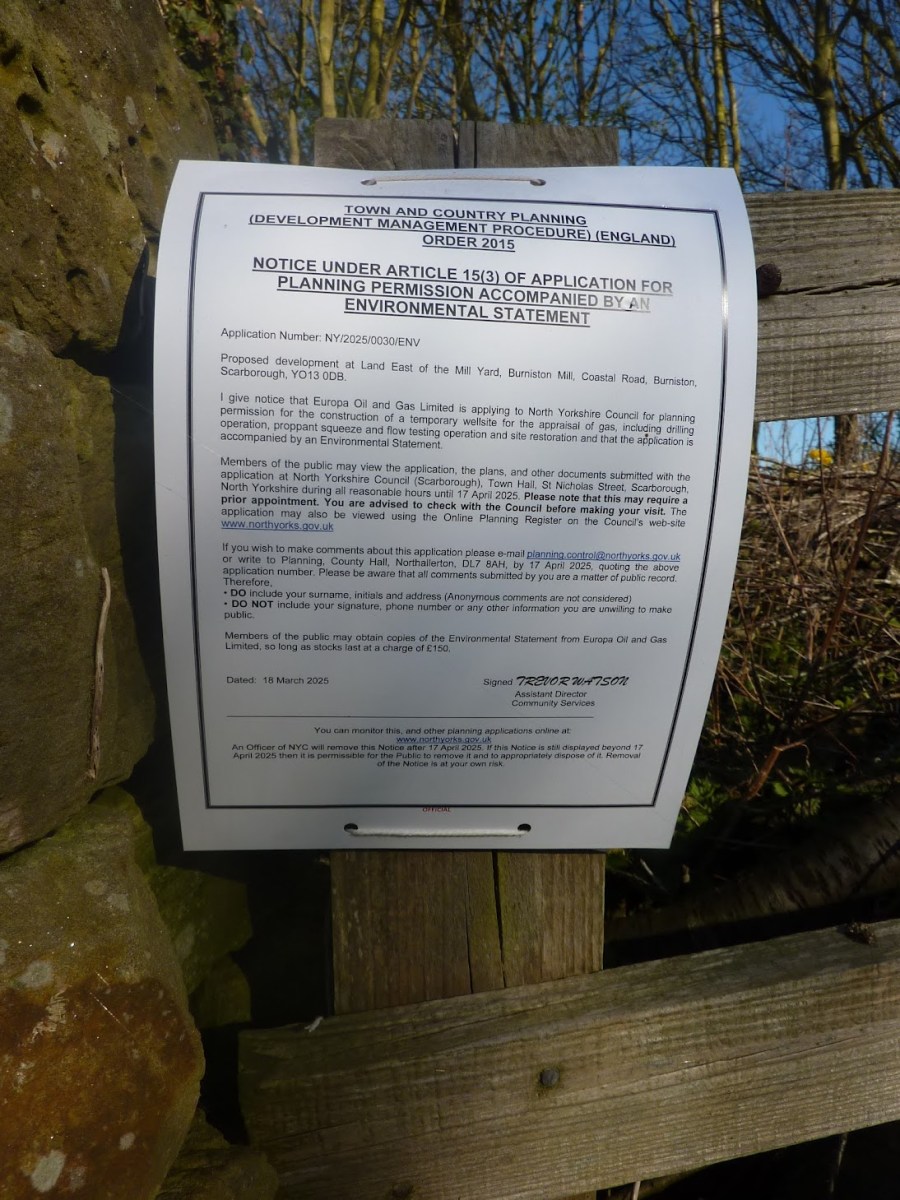
This article reviews more criticisms of Europa’s application not included in our other reports on the public consultation.
Confusion over development phases
Several responses point to confusion over the proposal’s phases of development. They point to some documents that say the site will be restored (phase 4) and others that say equipment will be retained. One response said:
“The implication is clear: Europa’s preferred and expected trajectory is to move from testing/appraisal to production and to retain equipment on site pending further planning applications. In view of the above, the Planning Committee cannot treat this application as a temporary development that would lead to site restoration within a few months of the start of work on site.”
CPRE North and East Yorkshire said:
“Whilst for exploratory activities at this stage, a future proposal for production phases is clearly therefore being considered. … the argument put forward that there are unlikely to be any significant environmental impacts as a result of the temporary nature of the exploratory activities is self-evidently nonsensical.
“As such, the MPA should require the applicant to provide information relating to the construction of a wellsite which has a minimum lifespan of 25years, including exploration, appraisal and production activities and then afterwards requiring decommissioning and site restoration.”
Another response said:
“Europa have contradicted themselves and changed their story many times. Do they want to leave
equipment there after the exploratory phase or leave it as they found it? They have said both. … They seem to take a very gung ho attitude to the whole thing.”
Site restoration
One response criticised the site restoration measures in the application:
“The absence of a structured, legally binding restoration plan raises concerns about the long-term sustainability of the site and its eventual rehabilitation. The proposed site restoration plan lacks sufficient detail regarding restoration timelines, methodologies, and post-extraction monitoring frameworks.”
The National Planning Policy Framework (NPPF) paragraph 224 requires planning authorities to “provide for restoration and aftercare at the earliest opportunity” and be carried out “to high environmental standards”.
NPPF paragraph 228 requires authorities to ensure “appropriate monitoring and site restoration is provided for”.
Cumulative impacts of climate change
North Yorkshire’s mineral plans (policy M17) requires applications to address the cumulative impacts of development on climate change.
Friends of the Earth said Europa’s assessment incorrectly limited its search of not yet implemented projects to a 3km radius. It also said no 3km limit is set out in the policy and so the distance “does not hold”.
It added:
“Well sites beyond this 3km distance, albeit still within North Yorkshire’s boundaries, will still contribute to climate change – so a county-wide search area is surely needed to meet M17’s requirements.”
Friends of the Earth also questioned whether Europa’s environmental statement was compliant with regulations for environmental impact assessments. This states: ‘information reasonably required for reaching a reasoned conclusion on the significant effects of the development on the environment, taking into account current knowledge and methods of assessment’.
Friends of the Earth said:
“The lack of robust consideration of the proposals linked to (cumulative) climate change mitigation (and adaptation) and climate justice more widely, means further information is required before the council can consider fully the application, at a very minimum; or alternatively the application is refused due to lack of such key information.”
Local amenity
The application was also criticised for not adequately addressing cumulative impacts on local amenity.
North Yorkshire Minerals plan policy D02 says minerals proposal would be permitted where ‘it can be demonstrated that there are no unacceptable impacts on the amenity of local communities and residents, local businesses and users of the public rights of way network and public open space’.
One response said:
“The area has narrow rural roads that are unsuitable for heavy goods vehicle traffic associated with hydraulic fracturing. Increased traffic, air and noise pollution, and the risk of spills or accidents present a significant threat to the wellbeing of local residents. …
“[The proposal] threatens local amenity, biodiversity, public health, and national climate commitments.”
Lack of information
One response said:
“A residential application for an extension, for example, would be required to give details of exact sizes and proposed materials. Vagueness in a residential application would not be accepted by planning so it certainly should not be acceptable in a proposal of such scale and potential hazards.”
Public engagement
Some responses criticised the feedback questionnaire used by Europa to assess reaction to its proposal and used in its statement of community involvement.
One response said:
“I object strongly to the biased wording of the three questions asked in the feedback form discussed in the “Statement of Community Involvement”. The deliberate structure of the three questions through over simplification of narrow responses means they are worthless.”
Financial guarantees
National planning policy (NPPF paragraph 205) requires mineral extraction projects to include clear, enforceable restoration plans with financial provisions to ensure compliance.
One response said:
“The application lacks any legally binding financial security, such as an escrow fund or bond, to guarantee full site restoration post-extraction.
“Without financial guarantees, the risk of inadequate remediation increases, potentially leaving local authorities and communities to bear the costs if Europa Gas fails to fulfill its obligations.”

 DRILL OR DROP?