Europa’s plan to use a proppant squeeze – a form of fracking – was in the top 10 reasons to object in the public consultation.
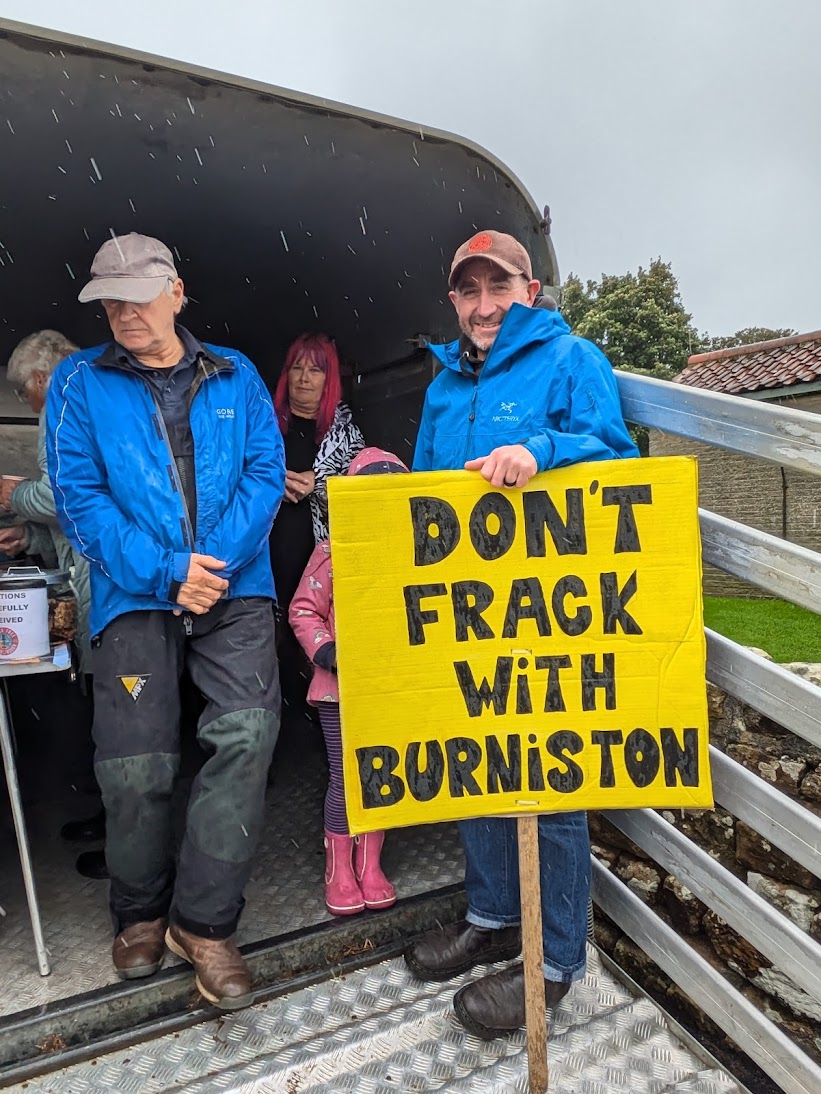
Two-fifths of objections mentioned fracking or proppant squeeze, while more than a third referred to a risk of induced seismicity caused by the operation.
Proppant squeeze injects liquid at pressures high enough to fracture rocks to improve the flow of gas to the surface.
Europa has said its proppant squeeze at Burniston is not fracking because it does not meet the definition of associated hydraulic fracturing in the Petroleum Act 1998.
The company plans to inject up to 500m3 at each fracturing stage. The definition in the act for associated hydraulic fracturing is 1,000m3 per stage or 10,000m3 in total.
This means the proppant squeeze is not prohibited by the moratorium on associated hydraulic fracturing in England.
But many responses to the consultation argued “proppant squeeze is fracking by another name” and the proposal should be refused.
“Fracking by another name”
One response said:
“Attempts [by Europa] to redefine their activities as, ‘not fracking’, when the processes and outcomes are identical, and only differ in scale, is merely disingenuous semantics.”
One said:
“claiming their ‘proppant squeeze’ technique is less dangerous than hydraulic fracking does not negate the fact that this drilling involves fracturing the rock, which may cause earth tremors, subsidence, or damage to the cliffs.”
Another said: “this application is exploiting a loophole” and another described it as “fracking by stealth”.
Another said:
“the company calls their process ‘proppant squeezing’ but that’s just a shabby exploitation of a loophole which goes against everything that made the government stop fracking in the first place.”
Another said:
“Europa can dress it up by insisting it is not fracking but a ‘proppant squeeze’ which, in my opinion, is not much different.”
North Yorkshire definition
Several responses to the consultation pointed out that Europa’s proposed operation would count as fracking under North Yorkshire’s minerals plan. This is the document that shapes decisions on minerals development until 2030.
The plan defines fracking as: “the fracturing of rocks by injecting a pressurized liquid in order to extract oil or gas”
Policy M15 states that, for the purposes of the plan: hydraulic fracturing includes the fracturing of rock under hydraulic pressure regardless of the volume of fracture fluid used.’
If, as appears, the Burniston proppant squeeze meets the North Yorkshire definition of fracking then it could be subject to additional planning restrictions.
Frack Free Ryedale, which campaigned against fracking at Kirby Misperton in North Yorkshire, said:
“the process set out in the application meets the technical criteria for hydraulic fracturing as defined in the Minerals and Waste Joint Plan and compares to previous ‘Fracking’ operations halted under the moratorium, requiring equivalent regulatory scrutiny and planning assessment.”
Yorkshire Landowners, which also campaigned against fracking in the region, said:
“NYC [North Yorkshire Council] should refuse consent on the basis that further extraction of gas from Unconventional strata is not in the interest of the local community or the Country and is contrary to the target of reducing global emissions of Carbon Dioxide.”
North Yorkshire councillor, Steve Mason, founder of Frack Free United, said Europa’s plan “meets the technical criteria for hydraulic fracturing and should be subject to the highest material weight equivalent as fracking developments”.
He compared the volume of liquid that Europa plans to use in the Burniston proppant squeeze to the volume actually used by Cuadrilla at Preston New Road in Lancashire. Europa has said it proposes to use 300m3-500m3 and up to 80 tonnes of proppant for each proppant squeeze stage. At Preston New Road in 2019, Cuadrilla used less than the Burniston proposed volume at all seven stages but still induced seismic events, including a 2.9ML earthquake. This followed the final stage, which used 142m3 of fluid and 3.7 tonnes of proppant.
Cllr Mason said:
“Comparisons with similar operations show that even lower fluid volumes can induce significant seismic events, posing risks to local infrastructure and community safety.”
He also pointed out that Europa used the word ‘fracking’ in correspondence with regulators to refer to the Burniston proppant squeeze.
Keep your distance
Comments to the Burniston consultation also said two other polices in the minerals plan should affect Europa’s proposed site, which is 800m from the North York Moors National Park and less than 500m from homes.
National Park visual separation zone
The North Yorkshire minerals plan established a 3.5km visual separation zone around the edge of the national park. This was designed to prevent industrial development clustering near the park boundary.
Policy M16 of the minerals plan states: “Where proposals for surface hydrocarbon development meet other locational criteria set out in this policy but fall within a National Park or an AONB or the associated 3.5km visual sensitivity zone around these areas … permission will not be granted for such proposals where they would result in unacceptable harm to the special qualities of the designated area/s or are incompatible with their statutory purposes in accordance with Policy D04”.
Buffer zone
The plan also states there should be a buffer zone between homes and hydrocarbon sites to safeguard air quality and mitigate climate change impacts.
Policy M17 said: “Proposals for surface hydrocarbon development, particularly those involving hydraulic fracturing, within 500m of residential buildings and other sensitive receptors, will only be permitted in following the particularly careful scrutiny of supporting information which robustly demonstrates how in site specific circumstances an unacceptable degree of adverse impact can be avoided.”
Comments
One response said there were more than 100 properties within the 500m buffer zone. “This should prevent the development”, the response said.
York Green Party said:
“The proposed site lies just over 1 km outside the North Yorkshire Moors National Park boundary, and certainly less than the 3.5km visual sensitivity zone required by the policy. The nearest buildings are considerably less than the 500m specified in M17. For these reasons the application must be rejected.”
Cllr Mason concluded:
“Although the proposed [proppant squeeze] method attempts to distance itself from standard hydraulic fracturing, it employs similar techniques and therefore should be subject to the same rigorous scrutiny and regulations.
“The use of hydraulic fracturing should automatically trigger the use of local planning policies to address risks related to seismicity and methane emissions.” [see more below]
Risks
Many responses mentioned risks from fracking, including seismicity, air and noise pollution, water contamination, leaking wells and emissions.
Seismicity
The North Yorkshire Minerals Plan requires proposals to be supported by “compelling evidence which demonstrates that induced seismicity can be managed and mitigated to an acceptable level”. This should include information on the known location of any faults and an assessment of the potential for induced seismicity.
The UK Onshore Geophysical Library records no 3D survey of the area around the proposed site or well trajectory. Europa’s planning statement has one reference to ‘seismicity’ in the planning statement and none in the environmental statement.
Europa told investors in 2024 a 3D survey of the Burniston area would cover nearly 24km2. It said it had identified local landowners, the largest of which is the Duchy of Lancaster, the estate held in trust for the Sovereign.
Cloughton Parish Council said:
“the absence of any significant detail about the subsurface geological structure is sufficiently serious to substantiate our objection on its own.
“The Parish Council finds it incredible that Europa has submitted its application without showing this information and inconceivable that this detail is not available to be shared.
Cloughton parish council added:
“the unknown risks of seismic events (earthquakes) on buildings and the local coastline are the single most important omission in this planning application. It is also in contravention of the Mineral & Waste Joint Plan, which requires this information.
“North Yorkshire Planning Authority is urged to make sure that no planning decision is reached without this information being available in advance rather than as part of the licensing process which appears to be the premise on which the company is working.”
Burniston Parish Council said:
“We know that there is a lack of up-to-date data of the ground underneath us, particularly in relation to fault lines.
“It is not understood how any planning decision can be made in this matter which such concerns and lack of data.”
Newby and Scalby Town Council said:
“without a comprehensive 3D seismic survey; without specific confirmation that the proposed development is located in an area of suitable geology; without compelling evidence that demonstrates that any induced seismicity can be managed and mitigated to an acceptable level; without detailed assessments … that specifically confirm the security of the sub-surface structure of the site, the adjacent SSSI and the local aquifer and water boreholes, it is simply too dangerous to approve this planning application.”
A resident living nearest the proposed site said the risk of induced seismicity was “being seriously downplayed”.
“if something does go wrong, the local community will be bearing the consequences for years. The site is very close to weak clifftops, which are already suffering from erosion. No detailed survey has been conducted on the land around or the possible fault lines that will be affected. I think this is totally unacceptable. It’s far too easy for a major corporation to say “sorry” and leave us all with the consequences of something going awry.”
Several responses raised concerns about the impact of hydraulic fracturing on crumbling local cliffs and faults. One said:
“there is a major geological Peak Fault in this area, which may be affected by 24/7 drilling and hydraulic fracturing of the sandstone rock, potentially causing seismic movement or ground subsidence, with even possible damage to nearby houses and buildings.”
Other concerns
Another response argued that potential induced seismicity that could accelerate cliff erosion would contravene the National Planning Policy Framework. Paragraphs 174e and 176 require developments to prevent unacceptable risks from land instability and conserve and enhance landscapes.
CPRE North and East Yorkshire commented on other risks:
“The applicant’s proposed use of proppant squeeze technique for hydrocarbon extraction raises serious environmental and safety concerns. As a method of hydraulic fracturing, it poses significant risks to ground and water sources, and its implementation does not align with the long-term energy security and sustainability goals of the United Kingdom.”
The organisation added:
“One of the gravest concerns is the potential for leakages and contamination. The high-pressure injection process can cause fractures in the surrounding rock, leading to unintended pathways for pollutants to enter groundwater systems.”
National planning guidance says the minerals planning authority (in this case North Yorkshire Council) must be satisfied that issues – such as seismicity, waste, content and disposal of fracturing fluid, well design and integrity and flaring gas – can and would be adequately addressed by taking the advice of the relevant regulatory body.
Friends of the Earth said:
“We don’t see how this is possible in light of the events that happened at Preston New Road, nor the lack of checks such a scheme of this nature would normally have to go through to undertake what is fracking by the back door.”
The organisation urged North Yorkshire Council to consult with the government’s energy security department and the industry regulator, the North Sea Transition Authority, to ensure these issues were adequately addressed.
One response said:
“If people are aware of the fracking that goes on in the area, house prices will plummet, and therefore businesses will most likely do the same.”
Another said:
“Any serious impacts of fracking would have huge implications to local communities and wildlife and be impossible to predict.”
Another said:
“Proppant squeeze shares similar environmental risks with banned fracking practices, including groundwater contamination, induced seismicity, atmospheric pollution, and chemical leakage.”
One response said:
“I was all for fracking at Kirby Misperton a few years ago and very against the anti frackers until it was proven the Preston New Road site caused over 120 tremors.”
Another said:
“This is the same process as Fracking, which has already been deemed harmful. The name of the process does not mitigate the harm”.

 DRILL OR DROP?