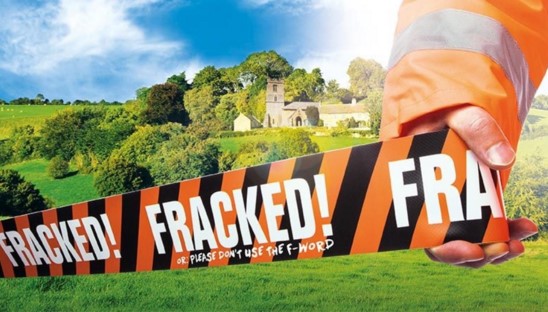
Two sides in the fracking debate went head to head at an event in Chichester to discuss the pros and cons of shale gas.
On the pro side was Professor Ernest Rutter, of Manchester University, and Dr Nick Riley, formerly of the British Geological Survey. Opposing fracking were Emeritus Professor at Glasgow University, David Smythe, and writer and campaigner, Julie Wassmer.
The debate was chaired by Alistair Beaton, the writer of Fracked, a new sell-out play currently running at Chichester Festival Theatre.
About 200 people watched the debate, of whom about 10% were in favour, 50% against and 40% unsure. By the end, six people said they had changed their minds: two from unsure to in favour and four from unsure to against.
DrillOrDrop was in the audience and compiled these extracts of the views of the panellists.
To explore or not explore?

Ernest Rutter
Ernest Rutter (ER): “We don’t know without exploration whether we have an economically-viable resource. We need about 50 wells to find out if there is anything worth proceeding with.”
David Smythe (DS): “Shale gas exploration in Britain should be banned on the precautionary principle. It is no solution to Britain’s own energy needs because if the industry ever got going it would take too long to ramp up to full scale and last, but not least, it is not even economic. It is going to lose the companies and the public large amounts of money.”
Nick Riley (NR): “I think it is unscientific to say there should be a moratorium on exploration because being a scientist I want to know more knowledge. The exploration phase, which is where we’re at – hardly at with shale gas in this country – if we don’t have exploration we won’t be able to address the concerns that the anti –fracking community have: the integrity of the wells, that fluids will move up faults, we won’t be able to do the operations safely.”
Julie Wassmer (JW): “If other countries have the good sense to ban fracking we can do it too and we should.”
Economy benefit or Ponzi scheme?
ER: “I think we should explore the potential of home produced shale gas for business and jobs. As well as the value of the gas produced, thousands of new jobs will be created in the supply chain, many areas of industry will be rejuvenated or made competitive, 6,000 miles of sealed pipes will be needed, tax revenue generated.”
DS: “US shale is not a success. It is a Ponzi scheme. The breakeven point for US shale is $6 per unit. The Henry Hub market value [for gas] is currently $2.30. They are only carrying on because they have to keep drilling to service the debt. The analogue would be: you’re in hock to your credit card, you have to pay the monthly payments, otherwise you get sued by your credit card company so you get another credit card and you borrow money on that to pay the other credit card. The American industry is actually like that but on a huge scale. The American shale gas industry model is unsustainable so why should we be applying this in the UK where the costs will be far higher? They are carrying on because they have to keep drilling to service the debt. The shale bubble, as they call it in the US, is now ready to collapse.
JW: “If the industry came even close to stringent regulation it would be financially unviable. Ironically the industry is already financially unviable due to the low price of oil, for example. The US players are carrying a huge amount of debt. The vast estimates of reserves quoted in press releases here by companies are precisely that. They are estimates for investors. The US has shown that only about 5% of the resource is actually producible. And that percentage is likely to be far lower here due to the geology. Why do they continue? This “frack it and see policy” favouring short-term profit is for the company’s shareholders.”
Can fracking be safe?
EW: “All of this must be done and seen to be done in the framework of best industrial practice.”
NR: “The UK has much better regulation than the US.”

David Smythe
DS: “UK regulation is not the best in the world. It is split between four agencies and a number of things can fall between the cracks between them. Do not be misled by the assertion that the UK regulation is good. It is basically a process of self-regulation and self-reporting.”
JW: “Fracking cannot be regulated safely. Reports come with one important caveat: that fracking can be done safely if there is that robust regulatory regime in place. There isn’t. There’s a set of offshore regulations and what amounts to self-regulation by the companies involved. … [On the Blackpool earthquakes] the company failed even to recognise the significance of that event and those are the energy minister’s words, not mine. So when the government boasts of its gold standard regulation I am minded to ask exactly where were they in 2011 when fracking was still said to be safe. And why on earth should we still trust them now that the Environment Agency and the Health and Safety Executive have suffered so many budget cuts. You cannot make it safe.”
Who gets hurt by fracking?
ER: “Environmental and health impacts, these are the things that concern people most of all, they are local impacts. The big problem is trucking. You cannot get away from that. The main adverse effect is during the construction phase which will last for about one year. People will suffer inconvenience there is no doubt about that. When you have a big construction project someone gets it in the neck.”
NR: “Obviously there will be some places, in residential areas and because of infrastructure where even if the geology is good it is clear that those sites will not be able to be developed.”
JW: “There is a disconnect between what the industry, regulators and government is say and what happens in practice. People on the ground know the threat.”
Is shale compatible with tackling climate change?
ER: “We are committed as a nation to not discharge carbon dioxide into the atmosphere by 2050. That does not mean we have to stop burning fossil fuels. Importing gas doubles greenhouse gas emissions as a nation, compared with home produced gas. Imported gas has to be paid for by the balance of payments. Home produced gas is good, imported gas is bad both for the economy and for greenhouse gas emissions. Home produced gas will replace imported gas not add to it.”

Nick Riley
NR: “I was deeply, deeply, disappointed by Cameron government, without any consultation, scrapping the only, the world’s first, carbon capture and storage demonstration in Scotland on gas fired power generation. … If you use hydrocarbons you should be prepared to produce them domestically if you can. Importing them displaces your issues to another part of the world or the country. We have renewable or nuclear but they are not neutral. They all have an environmental impact.”
JW: As the former climate diplomat John Ashton has said: ‘You can be in favour of fracking or you can be in favour of tackling climate change. But you can’t be in favour of both at the same time’.”
Will shale gas industrialise our countryside?
NR: “If you say that shale gas is going to industrialise our landscape – which I don’t think it will – you should listen to the [Radio 4] farming programme this week. … In the East Midlands, where we have the highest density of oil and gas wells, the EA’s own regional data from 2009 shows that the water companies, the waste disposal firms and farming are the main polluter of groundwater.”

Julie Wassmer
JW: “The truth is out there. It is there in every country where fracking has taken place. In areas, as in Pennsylvania which have been abandoned a sacrificial zones to this industry. So where are the sacrificial zones to be in our densely populated island: in Balcombe, in Blackpool, in the Weald?”
Faults: what’s the risk?
ER: “Most faults will not leak. Most faults seal and that is a fact.”
DS: “We don’t know whether faults are seals or conduits to flow. It is not a closed issue. … What shocked me was that the [Royal Society and Royal Academy of Engineering] report made no mention of the risk of migration of contaminated fluids and the gases themselves up geological faults. And this is partly because they were so hooked up on in their report on discussing the earthquake triggering problem, which in my opinion is not a big issue when you are fracturing. (Disposing of the waste is a different matter). This is not a problem in the USA, which is why there have been relatively few studies of the results of the chances of migration up faults in the US shale basins. This is because they don’t have these kinds of faults.”
NR: “Have you found any leakage coming up faults from carboniferous developments in the North Sea or the Irish Sea? Many of those wells have been fracked. I don’t think faults are a big risk.”
What do we do with the waste?
ER: “We have quite a lot of experience of dealing with water from oil and gas sites. When you do not have an industry you do not have the [waste treatment] infrastructure. You develop the technology when you need it. We don’t know if we are going have the industry so we don’t know whether we need the water treatment infrastructure and technology.”
Who opposes fracking and why?
NR: “Fracking has become a touchstone for a lot of angst in our society for all sorts angst that we have…. I think there is a big fear campaign by anti-frackers. Leaflets were put through letterboxes of farmers in Lancashire with pictures of dead cattle in a field in America. UK regulations over here don’t allow you to have open pools of frack water. Non-governmental organisations: they run businesses and they need the limelight because they need subscriptions. … There is a complete lack of integrity and spin in a lot of things I have seen.”
JW: “It would be wholly wrong to believe that those who oppose fracking are a bunch of irrational eco-freaks. There are nearly 500 residents’ groups [opposing fracking] in this country. Frack Free Sussex alone has over 10,000 followers. Importantly members of these groups include professors, lawyers, doctors, councillors of all parties and engineers who are well versed in this industry and its failings. We fight only with the truth and we don’t need PR companies or to bribe communities with compensation.”
Fracked continues at Chichester Festival Theatre until Saturday 6 August 2016. All performances are currently sold out but returns may be available. Link to tickets
DrillOrDrop always welcomes comments on posts. In order to keep the comments area safe and legal, DrillOrDrop has a new commenting policy which you can read here.
Categories: Uncategorized

 DRILL OR DROP?
Thank you very much for covering this event, Ruth Hayhurst,
I can understand Julie Wassmer propagating false information, after all she is just an activist and has no credentials to give her an ounce of credibility. But this David Smythe fellow is supposed to be a professor of something or other, yet he carries on [edited by moderator] about subjects that he understands not at all.
Smythe says, ““Shale gas exploration in Britain should be banned on the precautionary principle.” First of all, this would be an egregious misapplication of the precautionary principle. As Wikipedia states, the precautionary principle states that “if an action or policy has a suspected risk of causing harm to the public, or to the environment, in the absence of scientific consensus (that the action or policy is not harmful), the burden of proof that it is not harmful falls on those taking an action that may or may not be a risk.” The proof has been provided in study after study after study showing that there is not a systemic risk from fracking. We cannot say that there is no risk from fracking, just as we cannot say there is no risk from driving a car or running an electric generating facility, but the risks are known and are manageable in all of these cases. The burden of proof has been answered in non-biased studies, and in the empirical evidence from the 1mn + wells drilled in the US, in some of the highest density populated places on earth, without the death and mayhem that anti-frack activists claim we should see. On the contrary, shale gas is creating massive public health benefits by cleaning the air. It is also creating jobs, wealth, and energy security. http://www.investors.com/politics/commentary/our-air-is-getting-cleaner-and-natural-gas-deserves-some-fracking-credit/
Smythe seems to advocate a very harsh form of the precautionary principle – a form that has reportedly been the source of millions and millions of deaths around the world. If you’re interested, read more in these stories: https://www.heartland.org/sites/default/files/v25n4-9.pdf https://fee.org/articles/a-deadly-caution-how-fear-is-killing-patients/ http://www.institutmolinari.org/IMG/pdf/note0913_en.pdf
Later, Smythe goes on an unintelligible rant about the Ponzi scheme known as shale gas. I’ve never seen someone look sillier than this man. Every single “Ponzi” argument about the US shale revolution has been completely blown out of the water. People in this country outwardly laugh at old-school proponents of the “Ponzi” thesis, who also tend to have embraced peak energy and have been dead wrong in every respect. Ponzi scheme’s don’t produce cash – they don’t create value. Yet the industry has produced prodigious cash. Ponzi’s constantly need access to fresh capital to continue the scheme. Yet the industry had its capital sources cut off a couple years ago when gas prices crashed and yet the companies survived and then thrived. They lowered their costs and began producing more cash. You can’t drill for gas with costs at $6/mcf and the market near $2 for very long as the company will become a money pit. Yet many of these companies have been drilling for twenty or thirty years and have survived a number of poor cycles. That just doesn’t square with the nut job Ponzi thesis.
http://dailycaller.com/2016/02/11/fracking-keeps-getting-more-and-more-efficient/
There’s more to say, but I’ve run out of time.
You are funny! Did you miss all those reports of US fracking companies going to the wall then?
LOL. Yes, John, whenever a commodity declines precipitously and enterprises that produce that commodity go out of business, that’s definitive proof of Ponzi! That’s not a sensational claim at all, right??
Let’s see, by your definition then every single mining enterprise in the world is part of a giant Ponzi. Farming? Yes, that too is just a massive Ponzi scheme. Fishing? You got it. Now that I think of it, the whole world is a Ponzi scheme, John. Significant amounts of consumer companies go bankrupt in recessions. I just had never thought of this before. The world is on fire with Ponzis, John!!!
In 2009, the natural gas rig count in the US dropped from around 1,600 to just over 600 – a stunning drop of 60%+ in a very short period of time. Now for a Ponzi to work in the gas industry, the Ponzi experts will tell you that you need to keep drilling more wells, John. In fact you need to increase drilling activities at an almost exponential rate because the decline curves are so steep and you need to show growth to continue to attract the capital necessary to fund your business which naturally loses more and more money. So, John, in 2009 drilling almost stopped. Ponzi exposed time, right? If this business was a Ponzi it would have been exposed, by definition, at this point. Growth in drilling goes negative, capital dries up, commodity prices are in the dumpster. The gig is over, every single participant in the industry is hammered by extreme declines in production, cashflow turns massively negative, stock prices plunge, and there are no sources of capital available.
Except this didn’t happen, John. Some companies went bankrupt of course, but the vast majority did not. If the industry were a Ponzi, john, it would not have survived. If decline curves were as steep as Ponzi conspiracy theorists believed, production numbers and revenues would have evaporated across the board. There would be no more shale gas fracking today.
Instead, the industry has thrived. It has thrived even though drilling activity has never returned to 2009 peaks. It has thrived because of lower costs and increased efficiencies. Energy companies have returned hundreds of billions of cash to shareholders in the last seven years, John.
Explain how this has happened vis a vis your Ponzi conspiracy?
Ponzis, like all pyramid type schemes make money in the early stages, but heck – let’s just agree that an industry with extraction costs higher than its income isn’t very attractive to intelligent investors – that may explain the IGas (down 90%+ in about 2 years at 11.5p today) and AJ Lucas (down a similar percentage over 3 years at 21c today) share prices. Who’d in their right mind would buy shale shares?
So, you think that because equity prices in these two companies have fallen that they are clearly poor investments. Suit yourself, but most value investors, including such unintelligent investors as Warren Buffett, seek out companies whose prices have fallen dramatically. Realized sales prices fluctuate with commodity markets, so how can you make a definitive statement that extraction costs are higher than realized prices (you said “income” so I will extend you the courtesy of correcting your mistake)? Why would anyone believe that John Hobson has the ability to accurately forecast commodity prices such that he knows whether firms will be able to produce profits in the future?
John Hobson doesn’t which is why he has to rely on the futures markets
And the UK strip reflects prices that are almost 100% higher than in the US. A level which should provide attractive returns to equity investors.
Mr Sock Puppet – UK prices are about half extraction costs and look set to remain that way. I’d hate to be one of your investors.
Is that right, John? And you know that how? In the US, extraction costs vary from well under $2/mcf to upward of $4, but there’s a single extraction price for all of the UK, and John Hobson knows it? Hmmmmm. Call me cynical, but I just don’t believe you John. My guess is that the engineers, economists, and geologists that work in the oil and gas industry have a better fix on costs than John Hobson (call me crazy!), and they are the ones bidding on licenses. Enough said.
” call me crazy!”
OK you are crazy, but I guess we knew that without your admitting it.
The estimates of extraction costs by The Oxford Institute for Energy Studies, Bloomberg, EY and Centrica provide a range between 47p and 81p a therm.
Gas is currently trading at about 34 p a therm with futures between 35p and 44p for the next 3 years or so
I know maths isn’t your strong suit Mr Sockpuppet, but it’s not hard is it!
Ruth – thank you. It must have been difficult for you as the debate was fast moving and recording was not allowed – so well done at capturing the flavour of the event with your paraphrasing. Regarding CCS, shale gas/conventional gas, economics etc see the recent report by the Committee on Climate Change- https://www.theccc.org.uk/publication/onshore-petroleum-the-compatibility-of-uk-onshore-petroleum-with-meeting-carbon-budgets/ A point I wanted to make is that the recommendations of this commitee is that they state that shale gas development should not be located on deep peats. That should also apply to other energy infrastructure then! Most of the southern North Sea is floored with deep peat as are many of our upland areas – you can work out for yourself where windfarms are located.
Ruth- I was not surprised at the straw pole regarding whether then debate made an impact on shifting the audiences’ postions. When the debate is polarised it is unlikely that positions will change. see http://www.realclimate.org/index.php/archives/2016/06/boomerangs-versus-javelins-the-impact-of-polarization-on-climate-change-communication/
Ask your anti fracking mate Wassmer why she blocked me on Twitter? Could it be that she talk’s SCAREMONGERING BULLSHIT re;Fracking!
It was because your grammar is so poor, Malcolm: there should be no apostrophe between the ‘k’ and the ‘s’ of ‘talk’s’; no semi-colon between ‘re’ and ‘Fracking’ and no capital ‘F’ on ‘Fracking’. I do hope that helps to explain. You see, those who oppose fracking are sticklers for accuracy – unlike those who quote 200 wells having been safely fracked in the UK – without ever explaining that these were non-shale fracs and therefore not at all comparable to HVHF. There has only been one shale fracking instance in the UK, remember? In Lancashire in 2011? Commonly known as Cuadrilla’s “Omnishambles” as the company earned the rebuke of the then energy minister – and I don’t think he was “scaremongering” either. By the way, “scaremongering” looks much better in lower case than the capitals you used. After all, you wouldn’t want people to think you were hysterical, would you? J x
What a silly argument you’ve put forth Julie! “Those who oppose fracking are sticklers for accuracy – unlike those who quote 200 wells having been safely fracked in the UK – without ever explaining that these were non-shale fracs and therefore not at all comparable to HVHF. ” If fracking is as dangerous as you portray it to be, Julie, then why would conducting these operations in alternate rock formations be safe? It’s a distinction without a real difference, my friend. HVHF has been conducted safely for 40 years. You don’t know each of the rock formations where fracking took place in the UK because the companies have never divulged this information. You don’t know how much fluid they used, or how many stages they used. You know that they’ve fracked an estimated 200 wells and no one has died, the landscape was not ruined, earthquakes did not cause mayhem and widespread destruction, parts of the country did not fall off into the sea, and the water table was not contaminated. Yet there was not much, if any, fracking related regulation in place to protect us from the evils of fracking at the time.
So, if you’re a stickler for accuracy, as you claim, then let’s see you revise your statement to be more consistent with the facts, ok?
No – nobody actually “knows” how many wells have been fracked in the UK – if you claim otherwise let’s see your source. If you have one please let the DECC know before they get dismantled. As it happens you are just repeating factoids again.
We do of course know that one non-shale fracked well used just 160 m3 of fluid compared to the GWPFs estimate of 19000 m3 required for a shale HVHF frack. Now I’d call that a “real difference” , wouldn’t you?
Why does the industry keep making this false comparison unless it has something to be worried about?
Being intentionally misleading like this is just one reason why the industry you are pumping can’t get near a social licence to operate here in the UK.
Julie’s point is nonsensical. She doesn’t know the specifics of what was involved in the estimated 200 fracks that have taken place in the UK and neither do you or I. So, to make a claim that those wells are not at all comparable to HVHF is without merit.
Whether the wells used 1/2 million gallons or 5 million gallons, doesn’t make much difference, John. The techniques would have been almost identical to what is being done today, the proppants would be the same or similar, and most important the mechanics of the operation and the mechanisms by which the environment would be put at risk would be identical.
What kind of empirical evidence can you provide that confirms the thesis that smaller frack jobs with more limited laterals requiring less less fluid, are governed by different physical properties than larger lateral frack jobs and thus have different impacts? What empirical evidence can you provide that demonstrates that the 200 fracked wells in the UK used 160 cubic meters of fluid each?
.
I do wish you wouldn’t keep asking the same questions multiple times – it’s very rude. See my previous answer.
“Those who oppose fracking are sticklers for accuracy”, now of all the codswollop that has come from your past posts those few words you write take the cake!
Accuracy, where?
You, and your brigade don’t deal in fact but do deal on pure speculation and scaremongering.
While I find the argument of the frackers has merits their name calling and labeling of the opponent is a bit vulgar and vemous No wonder the public don’t support them.
Speculation? As in those guesstimates of gas in place and recoverability?
Scaremongering? As in ex-vicars writing lurid descriptions of mythical aunties dying of cold (and suggesting that fracking would have given her cheap gas)?
Yes the pro-frackers are rather good at both of those Michael.
In a debate you have the pros and cons , you argue by producing or facts or a vision .I see a lot of negative argumentation based on facts but I still can’t find even one positive assertion that is not prove as a lie or is even a fact . What kind of a debate can we have if the pro fracking side doesn’t want to engage other than saying “we don’t know” or” we can’t know how safe until we try”. Where is science or even common sense gone ?
I think, Mr Riley, you have entirely missed the point regarding entrenched positions. The American article you inexplicably refer to is simply saying deeply-held beliefs are hard to shift. Which is stating the obvious, however dressed up, as is common with social scientists. We don’t need “academics” to tell us that. What is of more interest in the straw “pole” you refer to (some academics it seems would benefit to a return to school and the language roots training as advocated by our Conservative betters, or at least learn to think clearly and realise polarisation has little to do with how opinion is translated into voting) is the shift in the views of the “don’t knows”. DECC (RIP) Wave surveys this year have confirmed that the more people know about fracking the less they like the idea. The Chichester result, whilst not statistically significant, seems either to confirm that or confirm that you did not make a good case for fracking on the night. Which wouldn’t surprise me as fracking is difficult to justify, so don’t feel too bad about your performance.
Hi NickP, I think you meant to say “the more misinformation foisted upon people by anti-frackers, the more people think they know about fracking, and the more they oppose it.” Just a minor correction!
Says the guy who just tried to claim there is no difference between using 160 and 19000 m3 of fluid.
Did I say that, John? Or are you fabricating yet another story to suit your purposes? Hm?
I’ll ask you once more since you haven’t responded to my question yet. What kind of empirical evidence can you provide that confirms the thesis that smaller frack jobs with more limited laterals requiring less less fluid, are governed by different physical properties than larger lateral frack jobs and thus have different impacts? What empirical evidence can you provide that demonstrates that the 200 fracked wells in the UK used 160 cubic meters of fluid each?
Volumes are bigger, rates may be higher, surface pressures are similar with smaller fracks and the the new bigger fracks. Wellhead equipment and casing (surface pressure limiting factors) are the same so maximum surface pressure is the same (10k or 15k depending on equipment being used). Chemicals and sand are the same – except in the UK where only none hazardous chemicals can now be used. Not sure what was used before onshore. Lets not forget that every leak off test conducted when drilling out a new casing shoe is a mini frack,usually in shale, albeit with a much smaller volume. Usually two or three per well unless integrity tests were conducted in place of.
Pure shales will have greater compressive strength to overcome, however Bowland shale for example is quite sandy and will be similar to fracking a tight conventional sandstone reservoir with low permeability.
If any one wants to have a look at or sample the Bowland Shale there is a good outcrop on the Abbeystead to Dunlop Bridge Road on the left up the PROW just before you go down into Sykes Farm.
You can take the sample and get it’s compressive strength tested John – this may help you and Mr. ball resolve your differences.
“Chemicals and sand are the same – except in the UK where only none hazardous chemicals can now be used….”
Chemicals permitted for use at Broadford Bridge:-
•Barium Sulfate
•Calcium Chloride
•Calcium Hydroxide
•Carbohydrate
•Polyanionic Cellulose
•Crystalline Silica Quartz
•Diethylene Glycol Monobutyl Ether
•Ethylene Glycol Monobutyl Ether
•Fatty Acid, Tall-Oil with Diethylenetriamine, maleic, anhydride, tetraethylenepentamine and triethylenetriamine
•Hydrocarbons C11 to C14, N-Alkanes, Isoalkanes, Cyclics
•Hydrotreated Light Petroleum Distilate
•Polymer in an Aqueous Emulsion
•Sodium Carbonate
•Sodium Hydroxide
•Xanthan Gum
•Calcined Petroleum Coke
•Calcium Carbonate
•Crystalline Silica Cristoballite
•Crystalline Silica Tridymite
•Methanol
•Mica
•Morpholine Process Residues
•5-Methyl Oxazolidine
•Nitrilotriacetic Acid, Trisodium Salt Monohydrate
•Silica Gel
•Sodium Bicarbonate
Clearly not “under-the-sink household chemicals”.
The following are either carcinogenic and/or ‘high level’ hazardous (fatal/toxic/harmful):
Crystalline Silica Quartz, Crystalline Silica Tridymite and Crystalline Silica Cristobalite (carcinogenic and high level hazard)
Hydrocarbons C11-C14, N-Alkanes, Isoalkanes, Cyclics, <2% Aromatics (high level hazard)
Methanol (high level hazard)
Nitrilotriacetic Acid, Trisodium Salt Monohydrate (carcinogenic and high level hazard)
Ethylene Glycol Monobutyl Ether (high level hazard)
Hydrotreated Light Petroleum Distilate (high level hazard)
N,N'-Methylene bis (5-Methyl Oxazolidine) (high level hazard)
The total number of health warnings stated in the Material Safety Data Sheets are:
•1 count of “Highly flammable liquid and vapour”
•1 count of “May be corrosive to metals”
•8 counts of “Explosive”
•1 count of “Toxic if swallowed”
•4 counts of “Harmful if swallowed”
•3 counts of “May be fatal if swallowed and enters airways”
•1 count of “Toxic in contact with skin”
•2 counts of “Harmful in contact with skin”
•2 counts of “Causes severe burns and eye damage”
•7 counts of “Causes skin irritation”
•3 counts of “May cause an allergic skin reaction”
•4 counts of “Causes serious eye damage”
•8 counts of “Causes serious eye irritation”
•1 count of “Toxic if inhaled”
•3 counts of “Harmful if inhaled”
•3 counts of “May cause respiratory irritation – single exposure”
•1 count of “Causes damage to organs – single exposure”
•10 counts of “Causes damage to organs through prolonged and repeated exposure”
•1 count of “May damage fertility or the unborn child”
•9 counts of “May cause cancer”
•1 count of “Suspected of causing cancer”
A further 9 products permitted for the site have neither their composition disclosed, nor any safety data – these are the so-called trade secrets. In other words, neither we, the councils nor the EA have any knowledge about these substances that they have permitted for use in fairly close proximity to residential properties, equestrian facilities and that all must be transported within 10 feet of a childrens' nursery.
Freedom of Information requests on Broadford Bridge reveal that:
– There will be NO air monitoring of the site at all by the EA (FOI received January 2015)
– The HSE stated that "Environment Agencies are the main regulator for chemicals used on onshore wells in Great Britain", and that it is not their responsibility to check the MSDSs for the chemicals being approved. However, a follow up FOI to the EA revealed that they DO NOT check the MSDSs either. In other words, the chief regulators for chemicals in the UK do not consult the MSDSs for the chemicals and products that they permit.
– Another FOI to the EA revealed that they were not even aware that several pages from the MSDSs were missing during the public consultation in 2014.
Julie,
I have never heard of Broadford Bridge so looked it up and found this:
“This Broadford Bridge-1 borehole is a conventional exploration well similar to many others already drilled in West Sussex in recent decades and will NOT, at any stage, involve hydraulic fracturing of shales.”
I thought we were discussing shale gas fracturing not drilling fluids.
So please advise which of your long list of chemicals (which includes many natural products and many which are used in many different industries, cars and households) were used in the Frack Fluid at Cuadrilla’s Preese Hall?
Re Broadford Bridge – “gateway drilling” in light of the following:-
Please note: Broadford Bridge is being touted as a conventional exploration well, but in a quarterly return to the Securities and Exchange Commission (a legal requirement for US companies, which are obliged to sign a statement under threat of severe criminal penalties that what is stated within the returns is 100% accurate). In March 2014, the following was stated: “A complete suite of logs and cores is planned to be collected from the Kimmeridge Clay and Liassic formations, which we believe will provide technical data, including thickness, oil maturity, formation pressure, and rock brittlesness, to be able to assess the potential for unconventional development of these formations.” Note – “uncoventional”.
By the govt’s redefinition of fracking (HVHF) in the Infastructure Act, what took place at Preese Hall in 2011 would now no longer be considered to be fracking so isn’t your question re “Frack Fluid” irrrelevant? And re that new definition, using volume, see the following response from Prof Stuart Haszeldine of Edinburgh Univ:-
“I have not discovered any argued definition to explain how or why these numbers were chosen.
Or, indeed, why volumes of fluid are chosen at all – when the geological effects of fracking are really a consequence of strain rate (i.e. “speed” of imposed deformation of the rock).
In all other subsurface activities I known of at present (and maybe somebody will communicate a new activity), then fluid injection is deliberately and closely monitored to control the maximum imposed additional pressure. In most cases that is to avoid fracking the rock. What we learn from that is that maximum pressure is important, nit just fluid volumes.
Looking at it positively, then a lesser volume of injected fluid, compressed to a high pressure, contains less stored energy than a higher volume of injected fluid, compressed to the same pressure. The induced fractures should, usually, extend less far into the rock formation. So you could see an argument of “safer” being used.
However the “safer” argument is only really useful if it can be demonstrated that a statistically lesser hazard is created than with larger fluid volumes. Clearly, if such “low volume” fracking was used at Preese Hall, then that certainly triggered earth tremors which would have happened years, or decades or further, into the future. So in locations of the UK where the rocks are already stressed to breaking point (i.e. most of the UK), then this additional disturbance was clearly enough to induce an earth tremor. Consequently, I’d like to see the technical and supporting argument underlying and justifying this choice.
In operational terms, this is a very “useful” definition, because it means that companies can drill, and undertake low volume fracking, without needing to apply for a fracking licence. There is the potential to gain useful scientific information – for example how great was the pressure needed to induce the small frack, and what was the flow rate of hydrocarbon back into the borehole, from the smaller fracking radius affected around the borehole. This could help build up a database of stress conditions deep below ground, and a database of producing flow rates from the targeted mud rocks or tight reservoirs.
However, given the very clear public concern about fracking of any type in the UK, it seems to me that releasing these new rules and definitions, buried in the text of the Infrastructure Act, without a clear supporting scientific argument, explanation, and justification, is potentially very unhelpful. That risks the perception, of what could be a move to enable scientific data to be gathered, to be perceived as dodgy and conspiratorial manipulation of the rules by Government. Much more debate is needed to understand why this “definition” is needed which ignores fluid pressures, and to explain why this is not simply a cynical swerve around the planning and judicial rules of precedent, to enable drilling and fracking where many members of the public are opposed to that activity.
Sincerely
Stuart Haszeldine” ENDS
I’d say what you do need to be aware of, following all of the above, is that communities will continue to oppose this industry and shale will fail. As Andrew Austin once said (late of IGas) “Anywhere we choose to drill or would look to drill would have to be with the acquiescence of the local community and in working with it. Frankly if you do not have the social licence to operate with the acquiescence of the people you are with, when you are dealing with your neighbours that is going to be a constraint. It goes back to Lord Lawson’s question earlier about what the barriers are right now. They are getting local acceptance where we are trying to drill. We need to work with those communities, and it is the inability to manage that, that would rule out any particular area.” ENDS.
Companies do not have “local acceptance” and – be under no illusions – they won’t get it. Andrew Austin is long gone….
(Off to do some work now…)
Sorry Julie, I thought we were discussing chemicals used in frack fluid? The only shale gas well fracked to date in the UK was Preese Hall. Why would this be irrelevant to the subject?
There will always be a pre frack stage of a smaller volume to obtain the parameters for the main treatment. It may be that the pre frack results indicate that the main treatment will fail and it won’t be pumped.
As for the definition, personally I would call any fracture treatment exactly that, whatever the volume. Just as I would call an acid wash an acid wash, an acid frack an acid frack etc.
As for shale gas failing in the UK, I agree it will probably fail. But on planning issues at specific sites (traffic, noise and or amenity impact) or economics if the forecasters are correct (this I cannot agree with based on the Cuadrilla well results).
But it will not fail due to a few protesters on Facebook and Twitter, objecting to oil and gas drilling processes which few understand or have experience of, and slow walking and cutting air brake lines of trucks. There are planning and regulatory systems in place to consider the subsurface aspects.
Thank you, Paul. The facts are a refreshing change from the hot air expressed elsewhere in this discussion board. The anti’s attempt to portray the 200 previously fracked wells in the UK as if they are completely dissimilar to what is done today is amusing to see. They may have been at smaller scale (we don’t know the facts about each of these operations, so we cannot really say) but I have yet to hear a convincing argument as to why that would substantially change the physical relationships caused by fracking that the anti’s view as being so dangerous. In the absence of such evidence, I must conclude that they are full of it (surprise!) as I cannot fathom why a 1 stage frack should be so different from a 24 stage frack other than the obvious.
That’s because you aren’t interested in the volume related impacts on the communities who will have to host these wells Peeny. If you have a little think about waste fluid disposal that might just set you thinking along the right lines – you might then get on to traffic, noise pollution; atmospheric pollution etc etc etc – the many impacts that have a fairly linear relationship with fluid volumes. It’s not exactly rocket science is it?
Well said NickP i was at the debate and the significant thing about the vote was that it was an overwhelming majority against fracking before the debate and of the few who were undecided swayed toward the antifracking side . If this was a reflection of the general public’s views and im sure that it is, then democratically fracking should not happen. To be honest the debate could have lasted much longer and issues like Climate change could have been discussed in more depth. The pro side still seem to rely on out of date and inaccurate data . I wonder just how long they will be able to do this as more people become aware and take action?
https://www.theguardian.com/environment/planet-oz/2016/jul/12/us-senators-detail-a-climate-science-web-of-denial-but-the-impacts-go-well-beyond-their-borders