Photo: 10 Downing Street
The Prime Minister has intervened in proposals for a shale wealth fund to include an option to make direct payments to people affected by fracking.
According to a statement from Downing Street, quoted widely in this morning’s papers, Theresa May wanted people to “personally benefit from economic decisions”.
Opponents of shale gas developments have described the idea as a bribe that would not work. (See Reaction)
Consultation plans
A consultation on proposals for the shale wealth fund had been expected to propose that proceeds from shale revenues would be shared only with community trusts and local authorities.
But the details, due to be published tomorrow, will now include money being paid directly to local residents in shale areas.
No level of individual payment was included in the Downing Street statement. The Sun reported that people could get £10,000 and MailOnline said the figure could be £13,000. This is not expected to be a lump sum and there is no information about the length of time over which payments would be made, who would receive them or how the recipients would be chosen. DrillOrDrop will report on the consultation when it is published tomorrow.
The shale wealth fund was first proposed in last year’s autumn statement. The government then promised to put up to 10% of shale gas tax revenues into a fund which, it said, could deliver up to £1bn of investment in local communities hosting shale gas developments. There is no suggestion that the proportion of tax revenues has changed.
But today’s statement said the government had “changed the consultation to ensure a greater focus on control for local communities – including insisting on proposals to transfer funds directly to households rather than local authorities”.
The statement said: “The new fund could deliver up to £10m per eligible community”.
 Mrs May is quoted:
“The Government I lead will be always be driven by the interests of the many – ordinary families for whom life is harder than many people in politics realise.
“As I said on my first night as Prime Minister: when we take the big calls, we’ll think not of the powerful but of you.
“This announcement is an example of putting those principles into action. It’s about making sure people personally benefit from economic decisions that are taken – not just councils – and putting them back in control over their lives.
“We’ll be looking at applying this approach to other government programmes in the future too, as we press on with the work of building a country that works for everyone”.
The government’s proposals are for payments from tax revenues and, therefore, rely on shale site operating companies making a profit and paying tax.
There is a separate scheme from the industry group, UK Onshore Oil and Gas, which proposes the operator will pay £100,000 per hydraulically fracked exploration site to the local community, regardless of production, revenue or profit. UKOOG also proposes to pay 1% of production revenues to communities before the operator has accounted for costs.
INEOS has said it will pay 6% of production revenues to local landowners and the community.
Reaction from environmental groups
Tony Bosworth, Energy Campaigner, Friends of the Earth
“Communities across the UK have made it clear that they don’t want fracking.
“A YouGov survey for the Sunday Times last year showed that, even where communities were offered £1 million, they still remained opposed to fracking taking place near them.
“Local people won’t suddenly be bribed into accepting this unpopular practice, which poses risks to people and the environment.”
Dr Doug Parr, UK chief scientist, Greenpeace
“The government has tried to sweeten the fracking pill with cash payments before, and it didn’t work. Over the last two years, public opposition has soared and support for shale has tanked.
“People’s concerns about climate change and their local environment cannot be silenced with a wad of cash. You can’t put a price on the quality of the air you breathe, the water you drink, and the beauty of our countryside.
“If Theresa May wants to show the UK is open for business, she should reverse the policies that have harmed our vibrant clean energy sector and back the technologies that can supply cheap, homegrown energy for decades to come.”
Lancashire reaction
Maureen Mills, Halsall Against Fracking
“We are undergoing a seismic survey in PEDL 164 and already at least one house sale that we know of has fallen through just because it showed up on the search.
“Theresa May says her government will be ‘driven by the interests of the many – ordinary families for whom life is harder than many people in politics realise.’
“Her government will be driven, as always, by ‘the powerful’ who stand to make billions out of inflicting fracking on communities. No amount of bribery, community or individual, will give her social license for fracking and she knows it.”
Pam Foster, Residents Action Against Fracking
“If Theresa May wants to give power back to the people why not uphold the democratic decision of their elected representatives, Lancashire County Council, who said no to fracking? Power is being transferred from the people of Lancashire to central government and the shale gas industry.”
Tina Rothery, anti-fracking campaigner
“The UK government is trying anything it can to enforce fracking on communities across UK – this will not work any better than all of their previous failed PR initiatives. We are not driven by greed – we are driven to defend our young.”
Mike Hill, anti-fracking campaigner, speaking on BBC News
“What Theresa May’s decided to do is preparing to overrule the council decisions [in Lancashire to reject fracking], overrule the local residents and individuals of Lancashire and impose fracking on them by what I can only describe as bribery, there is no other way to put it.
“It will be highly divisive of communities across the UK. It will put neighbour against neighbour and basically it is putting money at the centre of this argument instead of putting health and communities at the centre of this argument.”
Barbara Richardson, Roseacre Awareness Group, which opposes fracking plans by Cuadrilla
“As if ‘up to £10k’ could compensate us for what we would have to endure.
“We moved to the countryside for the peace, quiet and way of life it offers. We worked hard to afford it. Our home is not likely to sell at all with a 24 x 7 fracking site next door to it, so how this could ‘compensate for any disruption and impact on property prices’ is ridiculous.
“This tells me the government is desperate. They know there is huge and growing opposition and rightly so.”
Claire Stephenson, of Preston New Road Action Group, which opposes fracking plans by Cuadrilla
“I think it’s unreservedly outrageous that what is in effect, a bribe, is now due for a government consultation on how to force communities to accept fracking. The headlines are stating cash for ‘communities affected by fracking’. Is this finally an admission that we WILL be affected by fracking?
“The reporting on this release from the mainstream media is flawed and fanciful and contains so many inaccuracies about the fracking process. We will scrutinise this consultation when it is released tomorrow to see how they are imagining they can administrate it in their fairyland of fracking.
“Theresa May stated again yesterday: “As I said on my first night as Prime Minister: when we take the big calls, we’ll think not of the powerful but of you.” I think that basically translates as we’re actually thinking about the ‘big calls’ whilst trying to keep you, the little insignificant people, mollified and controlled.
“Our opposition to fracking isn’t about money – it’s about our health, our children, our safety, the quality of the air that we breathe and the cleanliness of the water that we drink. You can’t buy that and you can’t buy us.
“Communities are furious that this is now turning into a cash bribe and it will only serve to reinforce our opposition and strengthen our resolve. We said no to fracking. No amount of dirty money will change that.”
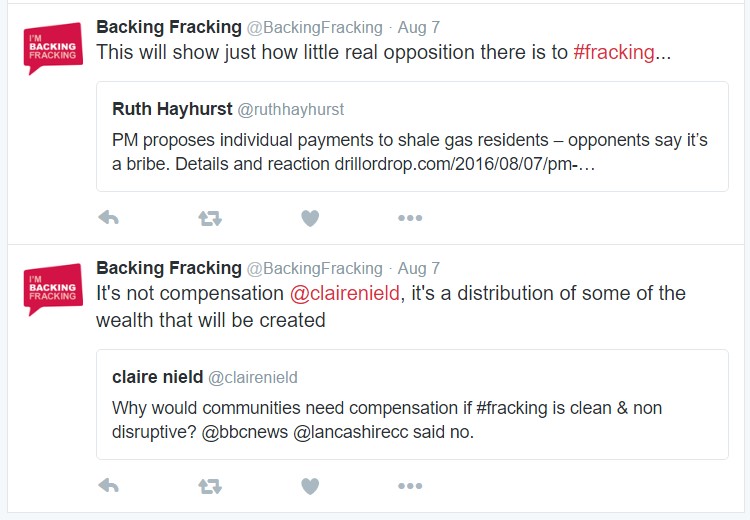
Backing fracking group
Yorkshire reaction
Sue Gough, Kirby Misperton, where Third Energy has permission to frack an existing well
“This is a cynical attempt by the Tories to bribe local people to accept fracking by offering them hard cash.
“People need to know that by accepting this money they are selling their communities down the river and condemning them to industrialisation and ruination by the frackers, who have no respect for our environment, our livelihoods or health.
“If Third Energy is allowed to frack in Ryedale it will open up the floodgates to all the other companies who are waiting in the wings to move into North Yorkshire and will bring about the widespread industrialisation of the county – we need to continue to oppose the industry and persuade people to see through this blatant bribe”.
Cllr Di Keal, Liberal Democrat member, Ryedale District Council
“This is such an obvious ploy by the Tory party, led by pro-fracker Theresa May, to try and buy support for this hugely damaging industry.
“This move smacks of desperation from a Tory government that is losing the democratic argument on fracking.
“In the current economic climate people, when many people are struggling financially, the offer of £10,000 might seem appealing, but it is little compensation for the risk to the environment, our health and well-being and the wrecking of the countryside that the industry will bring.
“While the money may sound attractive to some hard pressed families it will not even scrape the surface in terms of the compensating for the huge fall in house prices that would follow in the wake of fracking.
“All local people in the vicinity of exploited wells will also face the damage and disruption caused by lorry journeys associated with the process, the pollution risks and damage to agriculture and tourism.
“North Yorkshire is a beautiful county that relies heavily on tourism and agriculture, both of which face irreparable damage if fracking is allowed to go ahead”.
Richard Howarth, Frack Free East Yorkshire
“The public are overwhelmingly rejecting fracking, and this cash is a sign of government desperation to get fracking accepted – but it won’t work.
“Households will ask themselves, ‘How much money is worth risking my family becoming ill?’ Studies now show that if you live close to unconventional gas wells in Pennsylvania, you’re much more likely to be admitted to hospital for a whole range of conditions, and babies are more likely to be born prematurely, underweight, and suffer complications.
“Residents near West Newton gas well in Holderness suffered noxious smells, sore throats and headaches for weeks on end when a mini-frack was attempted there, and residents have struggled to sell their properties because of the well site.
“A few thousand pounds, in the future, if a well actually produces, won’t be enough to convince people to suffer the wide range of ongoing impacts over a wide area, from pollution to traffic to earthquakes that damage the well.
“Most seriously of all, it’s economically and environmentally reckless. Pursuing yet more fossil fuels will irresponsibly amass a huge carbon debt, and condemn our children and grandchildren to the devastating costs and impacts of climate change.”
Jon and Val Mager, anti-fracking campaigners in East Yorkshire
“The government has never proposed compensation for communities living next to onshore wind turbines, nuclear power stations or solar arrays.
“Apart from the fact this is only an “option” for consultation – and the proposal depends on full production and a profit which can be taxed before any payment is made – the idea of compensation to local communities proves that fracking is far more potentially dangerous disruptive than the alternatives and this before a successful exploration well in the UK let alone a full on production site.
“The question to ask is what does the Government know which makes it important to provide compensation for this source of energy compared to all others?”
Third Energy
“Third Energy, which has been producing gas and energy safely and securely in North Yorkshire for over 20 years, is a firm believer that the local community should benefit from any unconventional gas production in the local area.
“We welcome a consultation on the proposal for a shale gas wealth fund, which would be in addition to the community benefits and community charter agreed by the onshore oil and gas industry, and look forward to a successful test frack at KM8, which should lead to an expansion in gas production in North Yorkshire which in turn would deliver revenues to make any fund viable.”
Lorraine Allanson, owner of a bed and breakfast and holiday cottage business
Quoted by BBC News: The money would: “go into the homes of families and people who are less well off”. Shale gas exploration could be done “very safely, very quietly” and would boost local economies, and she accused those who opposed fracking of using “doomsday scenarios”.
Industry reaction
Ken Cronin, UK Onshore Oil and Gas
“The onshore oil and gas industry in the UK continues to believe that local people should share in the success of our industry and be rewarded for hosting sites on behalf of others in the country. That is why we launched the industry’s community benefits scheme and community engagement charter in 2013. These are additional to the proposed Shale Wealth Fund.
“The overarching objectives of secure, affordable and low carbon energy continue to be a driving force for our industry. Just 12 years ago, Britain was a net exporter of gas, but imports now make up nearly half of our gas demand, at a cost to this country of around £10 million a day. Recent estimates by National Grid are that, without shale, the UK could be importing over 90% of its gas by 2040.”
Politics
Keith Taylor, Green Party MEP South East England
“Of all the measures the new Prime Minister should be undertaking to tackle catastrophic climate change, it is astounding that Theresa May has rested on this wrong-headed policy – just days after climate experts warned that Britain, and the world, is on course to miss key climate targets
“The British public will not be swayed by a naked attempt at using bribery to divide and conquer communities. It is time for the Government to stop circumventing democracy and, finally, listen to the public.”
Updated 08/08/16-11/08/16 with additional reaction
Categories: Politics

 DRILL OR DROP?
Great News! Let us hope the Pro Fracking Community get it ! Of Course the Anti Fracking brigade will not want their share,so more for the pro fracking side! Balcombe Pro Frackers are ready for a windfall ! YIPPPEEEEEEEEEE !
Yay Malcolm – then you can waste it all on your horse racing bets! Winner!
‘Shale Wealth Fund’ sounds like an Industry that is going to make money…….I don’t think so. Let’s remind ourselves of what the Industry spokesman told the House of Lords Economic Affairs Committee regarding the cost of shale production.Bearing in mind he was out to convince the Lords how much of a cash cow shale could be his statement is hysterically funny when you look at recent wholesale value of gas and oil.
“It is very very simple the shale gas Industry in the UK. If we can bring this stuff to market for about $8 a MMBTU it is a very commercially viable Industry. If it is going to take $15 to bring to market it is not viable”
http://www.parliamentlive.tv/Event/Index/b05e83ee-5d8a-4f48-bc34-8d4b75f6a0db
So the cheapest they could bring it in is $8 (works out at 61.2p per therm) to make profit ( which concurs other UK sources and US break even averages)
Recent wholesale price under 40p per therm. Note that the price has been under the 61.2p all of 2015 as well
http://www.energybrokers.co.uk/gas/historic-price-data-graph.htm
As Mr Egan stated on Hard talk on 25/01/2016
” Forecasting the oil and gas price is a mugs game”
I think Investors will have serious concerns over the fact that gas prices are 30% less than shale can be produced for. Not knowing what your product can sell for when your’s is the dearest sounds like a ‘ mugs game’ to me.
Of course you could be in the minority who think oil and gas prices will rocket and that OPEC will give market share back to the US but none of the forecasts or common sense would suggest that is going to happen. Norway are set to lower prices to 20p per therm to insure they do not loose market share to imported LNG, running at 37p per therm.
The world is awash with cheap oil and gas with everyone rushing to make sure they sell theirs first.
As Jerome Ferrier (President of the International Gas Union) stated at the World Gas Conference in Paris 2015:
“The future of gas does not depend on shale gas – there is enough conventional gas to meet demand for more than a century”
This Ponzi scheme bubble has already burst
Great, John. Except for the small fact that you have zero evidence it is a ponzi scheme, and we have mountains of evidence that it is not.
And it is wonderful that you don’t think it will be economic to develop shale gas. I would suggest that you not develop any. Obviously some big oil and gas money disagrees with you. We’ll see who is right!
Bard / Brad / Peeny / Mr Sockpuppet – you seem to have totally missed the point about how Ponzis work – once the thing starts it’s a hamster wheel – you can’t just jump off without losing everything. THAT is why there is still money being fed into US fracking whilst more and more companies file for bankruptcy.
“Since the oil price crash of late 2014, more than 140 companies involved in North American drilling, fracking, or oilfield services have filed for bankruptcy, according to data compiled by Debtwire”
and
“North American oil & gas producers and drilling, fracking and related service providers with more than $45 billion in debt have filed for bankruptcy so far in 2016, up 80% from $25 billion in all of 2015”
http://www.debtwire.com/info/2016/07/26/debtwire-releases-energy-highlights-mid-july-bankruptcy-tracker/
So Mr Sockpuppet – we shall indeed see who is right. It won’t be you, but then we are getting quite used to that.
Yes, John, whenever firms go bankrupt it means the industry is a Ponzi. Good rational thinking, as usual, from an anti-science, anti-fact, fractivist!
So John, you failed to explain how the industry survived largely intact the period in 2009 when drilling rigs fell by some 70%. That was the defining moment to expose the Ponzi and what happened, John? Investors turned off the spigots for debt funding and the companies stopped drilling for all intents and purposes. The industry should have been exposed at that point and every single company should have gone bankrupt. It would have been a scandal of unprecedented proportion – the ENTIRE industry revealed as one giant ponzi scheme.
Yet none of that happened, did it john? Nope. Sure, a number of firms did go bankrupt, but the rest were able to lower costs and improve efficiencies such that they returned to cash flow generation WITHOUT growing producing wells at the exponential rates that a Ponzi would have dictated. How do you explain all of that?
On a planet, which will no longer support human life, money will be absolutely worthless! Our political elite have been ignoring the warning for decades, such as the message in ‘Limits to Growth’ in 1972. ‘Our Common Future’ (Brundtland report) 1987, The Stern Review 2006 and the Sustainable Development Commission’s ‘Prosperity without Growth’ 2009. We are in a period of catastrophic climate change, in which, if we do not drastically change our habits, will result in the end of human life.
“Opponents say it’s a bribe”
Of course they do! What else would they say? If the government chose to proceed in the opposite direction, the same “opposition” would rant and rave about how the government is taking money from those who most deserve compensation.
The “opposition” will never be happy. They cannot propose a workable alternative to the government’s plan, but they can still try to stall the practical plan that the government is pursuing. In so doing, they risk the lives of thousands of poor who cannot afford to heat their homes in the winter. They risk that the country will have to backtrack on its pledge to rid itself of coal generation. They risk the country becoming beholden to Russia and the Middle East for much of its energy. They risk losing tens of thousands of jobs due to energy prices moving higher than they already are. They risk greater air pollution which could kill tens of thousands.
The zealous opponents of fracking hold onto myths about the technology that have long ago been disproved in order to justify their bizarre anti-science stance.
We do the same for wind farms in the UK, there are guidelines for “Community Benefits” to be paid to local communities in the event they are lucky enough to get a windfarm nearby. Since the subsidies were reduced there are not a lot of onshore wind applications these days. But prior to this reduction there was money being offered all over the place to gain public support for windfarm applications.
It’s also why you have landowners in rural NY asking to secede from the state so that they can legally rent their land out to oil and gas companies operating in Pennsylvania. You can call it a bribe or you can just call it capitalism. Land owners have something oil and gas companies want and are willing to pay for. Land owners are inconvenienced by letting the companies operate on their property and deserve to be compensated for that inconvenience.
“they can still try to stall the practical plan that the government is pursuing. In so doing, they risk the lives of thousands of poor who cannot afford to heat their homes in the winter. ”
So can you explain please how fracking is going to reduce prices to save those lives? We’re waiting – Don’t disappoint us! Let’s have your forecasts for shale gas production volumes in the UK over the next 15 years and your expectations of wholesale prices.
……
Why sure, John. Just some basic economics for you! When you introduce more supply to any commodity, ceteris paribus, prices decline. With gas, which is naturally a local market due to the physical properties of the commodity, due to storage, and transporation, these lower prices are usually reflected in differentials. Look it up my good man!
I don’t pretend to know how much gas will be produced in the UK in 15 years. Anyone who says they know is foolish. But I do know that if we don’t get drilling we won’t extract any gas, John. And that would be a shame for the entire country as many people will die as a result, and many more will be poorer and without employment.
ooh “ceteris paribus” – get her!
We all get supply and demand 101 Peeny, but e contrario (see I can do it too!) everything else isn’t equal. The European gas price is not linked to the US gas price so much as the price of oil (but you know that surely). LNG is playing a part in making markets more interlinked but that is an evolving process, often driven by local gluts (as in the USA). However the impact of UK fracking on these prices is recognised as being likely to be very limited (by the industry itself I might add), so you still need to explain how UK fracking is going to save all those old ladies, or why they will die if we don’t do it.
Don’t just bluster – explain.
I have, John. You don’t want to understand.
Let’s approach it this way. Explain to me how adding to the supply of a commodity in a local market would not cause the price of that commodity to fall.
‘And that would be a shame for the entire country as many people will die as a result, and many more will be poorer and without employment.’
Could you please provide peer reviewed evidence for this statement please?
This comment, as always, comes to you via electricity wholly powered by wind 🙂
Nope, John, doesn’t require production forecasts – just some basic economics and common sense (I can understand why you can’t get this on your own, LOL).
When you increase the supply of a commodity, ceteris paribus, the price will decline. Price declines are good for those who suffer from fuel poverty dontcha know?
And yes, gas is a globally interconnected market, but it is subject to local influences due to supply/demand dynamics, storage availability, transportation costs, bottlenecks, and other factors. So bringing more domestic gas online will widen differentials in the UK and make gas less expensive.
There you go my friend! Not too painful I hope.
“Of course they do! What else would they say?” Well quite – what else would anyone say?
The point is that fracking is NOT a practical plan. It isn’t economically viable (without vast state subsidy) as John Powney has explained to you at length above, and without (non-existent) CCS it does not have a valid role in climate change mitigation. We need to get developing a new Plan A PDQ.
You keep going on about saving old age pensioners lives with cheap gas, but fracking is (as even Cuadrilla admit) not going to have any meaningful impacts on gas prices. You scaremonger about Putin and the Midle East but conveniently forget the growing imports from your own country and you fantasise about tens of thousands of jobs when at the LCC Inquiry it became very clear that employment on a frack pad is rather more limited than the rhetoric has suggested (but you weren’t there of course)
What myths about the technology are referred to on this page that you particularly object to? The only myths I am seeing just now are the ones propagated by you.
Fracking is extremely practical and this has been demonstrated 2 million times all over the world. Fracked gas supplies 2/3 of the US gas consumption. Gas prices are 2x as high in Europe as in the UK. How can it be profitable to take fracked gas transport it, liquify it, transport it across an ocean, deliquify it, and transport it again and not be profitable to just extract it in the UK instead? Explain please.
No one is holding onto the myths more than you hball.
Throwing money at a problem in the hope it goes away is not good business practice.
What do you propose we do Patrick? Other than stop using fossil fuels which will not change the catastrophic climate change and end of human life predicted. Do you think global population growth may have something to do with our planet’s problems? If so, what do you propose is done about it?
The Earth is a little over 4.5 billion years old, the history of life on Earth began about 3.8 billion years ago, initially with single-celled prokaryotic cells, such as bacteria. Multicellular life evolved over a billion years later and it’s only in the last 570 million years that the kind of life forms we are familiar with began to evolve, starting with arthropods, followed by fish 530 million years ago (Ma), land plants 475Ma and forests 385Ma. Mammals didn’t evolve until 200Ma and our own species, Homo sapiens, only 200,000 years ago. So humans have been around for a mere 0.004% of the Earth’s history. When we are extinct something else will replace us and the Earth will continue without us. There are any number of historical natural events which would bring us to an abrupt end if repeated. Man’s contribution to climate change is not one of them.
“Man’s contribution to climate change is not one of them.”
Really?
There will simply never be a shale gas wealth fund to share out – as shown in the USA the whole process is a massive PONZI scheme designed to enrich the financiers and wide boys.
That ponzi scheme has made money for the majority of the country as just about every pension and 401k plan is invested in the oil and gas sector. Fat cats like aunt matilda who lives on her pension checks each week.
And can you supply a single shred of evidence that it is a ponzi? Or are you just like every other windbag, fearmongering, anti-science fracktivist who posts here? Huh Harry? Just one little shred is all that i’m asking.
Mr Sockpuppet – here’s more than a shred http://www.debtwire.com/info/2016/07/26/debtwire-releases-energy-highlights-mid-july-bankruptcy-tracker/
I see, John. No hyperbole from you at all, right ? Nah. Of course under your definition, every industry in the world would be a Ponzi because when the cycle works against an industry it is always the case that many firms go bankrupt. So, I guess in your eyes the entire world is just a giant Ponzi. Good luck with that world view!!!
Interesting spelling of ‘pension checks’…US I believe?
Paul yes population growth is a primary cause of ‘climate change’. Climate change- who cares. But I do care if my water is poisioned and my food sources poisione because they drank the poisioned water from a water source contaminated even a hundred km away. This is the primary reasonable concern and if it means befriending the Russians so that we avoid the practice of forcing chemicals into the ground then so be it. When your house is worthless it might be justice from supporters like you.
c- note my comment earlier below: Several reasons not to proceed with shale gas in the UK but climate change is not one of them.
I agree, if water is poisoned etc. due to shale gas it should not be allowed. The point I am trying to make (which you appear to agree with) is that the climate change arguement against UK shale gas is not relevant / not valid.
Personally with my experience in the O & G Industry I don’t believe the water poisoning can happen. But this is a point to argue against shale gas for those without direct industry experience. As are noise, traffic, amenity etc. Mostly planning considerations.
Not sure what you mean by my house being worthless? No prospective shale under it. But I accept your point that if you live close to a shale gas site there may be issues with house prices. Just as there are if there is a wind farm several hundred meters from your house. Personally I would prefer the shale gas site over a wind farm but I like my view.
We will probably end up taking more gas from the US than Russia, but the difference is that US gas is predominantly shale, Russian is not.
“Personally I would prefer the shale gas site over a wind farm but I like my view.” – DECC’s wave research would suggest that you are nowhere near typical but then as a supporter of shale gas you must be used to that 😉
Mrs May is a graduate geographer. She must surely know and understand why “fracking”, hoping to extract shale gas unconventionally, is fraught with wide ranging problems. These will have detrimental effects on both the public and the environment, whether near any wells or nationwide and will even have consequences internationally — climate change for starters.
She seems a sensible person. I cannot believe she will ignore the warnings from scientists and continue with this rubbish which Osborne was enthusiastically promoting.
Several reasons not to proceed with shale gas in the UK but climate change is not one of them. Imported gas has a greater impact on climate change than home produced shale gas. So as a replacement gas for declining North Sea production or imports the net impact on climate change is probably beneficial (if this is something you think we can do something about).
We will see what Mrs May’s position is when the SOS determines the Cuadrilla appeals.
You have to much faith in Mrs May.
With falling gas demand across the EU as a whole and the UK, in particular, as well as a global glut of cheap gas, there is no need for fracking in the UK.
“Gas consumption is falling across Europe. Gas demand fell between 2010 and 2013 in all but
three member states (Figure 3). Demand fell the most in Scandinavia with Swedish, Finnish
and Danish gas consumption falling respectively by 35%, 25% and 25% over that time period.
The UK, Hungary and Slovenia are next with falls of 23%, 21% and 20% respectively. Only
Poland and Bulgaria have seen a growth in gas demand over the 2010-13 period with growth
of 7% and 4% respectively. In Greece, gas demand was at 2010 levels in 2013. Eurogas
estimated that every Member State saw a decrease in gas demand between 2013 and 2014, in
great part because of mild temperatures3.”
p. 8, of E3G’s June 2015 report EUROPE’S DECLINING GAS DEMAND – TRENDS AND FACTS ON EUROPEAN GAS
CONSUMPTION https://www.e3g.org/docs/E3G_Trends_EU_Gas_Demand_June2015_Final_110615.pdf
Paul I often agree with many things you write but not on this one – you only have to read the CCC report to understand why.
Any meaningful quantity of shale gas production is 10 to 15 years away, without CCS that means gas from any source should not be used for power generation beyond 2030.
Norway has just announced it will be a carbon zero economy by 2030 and no doubt you will say, as you did when I mentioned Sweden, that this isn’t relevant to the UK. I disagree, it is relevant to the entire world.
Climate change is a global issue so the entire world is concerned, hence COP21. Furthermore, shale gas will not help sort the so called “keeping the lights on” issues we have right now, being a decade or more away. The timescales are all wrong and how do the government propose hydrocarbons already flowing to be stopped in order to “allow” UK fracked gas to be burned – thus not adding to the total hydrocarbon load being combusted? This is the entire principle behind limiting climate change and the message “Keep it in the ground”
The timescales of a shale gas industry would lock the UK into a gas dependency that would be globally unacceptable. Far better to import for the shortest time possible. Not all gas imported is LNG – the gas from Norway and elsewhere I suspect will have a far greener footprint than shale.
I am optimistic that with political will and investment the dependency on fossil fuels will fall far quicker than many people think. Climate change is the greatest threat and any sensible government would have that at the forefront of energy decisions and investment.
We have to become smarter and more efficient in the way we use energy.
Energy demands have fallen in the UK – not risen. It can be done.
Hi KT, easy in Norway due to geography and hydro:
Just to highlight the difference in hydro power between Scotland and Norway, the largest hydro scheme in Scotland is Sloy. It has a capacity of 152 MW.
http://www.thegreenage.co.uk/cos/sloy-hydroelectric-plant/
In comparison Norway has 31 hydro plants larger than Sloy, ranging from 160 MW to 1,240 MW:
https://en.wikipedia.org/wiki/List_of_power_stations_in_Norway
Norway hydro power production 96.1%
UK hydro power production 1.3%
Source: http://data.worldbank.org/indicator/EG.ELC.HYRO.ZS (you can find plenty of others if you look)
They don’t use a lot of gas (for electricity) – they sell it to us. As for having a greener footprint than home produced shale gas – unlikely due to the transmission distances / compression required etc.
Let’s not forget that the USA produces just as much coal as it did before. They just ship it abroad now.
Adding to fossil fuel not displacing it. Gas prices are also rising in the States and no doubt will continue to do so.
Norway has supplied us with gas for ages and has said they are happy to continue to do so.
Our energy consumption isn’t much higher than it was in the 70’s because of efficiency. Surely banking on an unproved fossil fuel with no local benefit which could destroy agriculture and tourism is not what we want at any price. Send the lot of them back to the drawing board.
Quite frankly fracking is not an energy policy/solution. We have wasted 5 years on this nonsense and it’s about time we demanded better! What do we pay them for?
Your exertions are fracking is responsible for US coal is a bit strange because it is not fracking that cause other countries to use coal from US. They need energy to run their economy and wil use whatever the cheapest mean to do so. If US don’t frack and currently use coal other countries will also use coal not from US but elsewhere.
KT – also Norway – apparently 25% of the energy used to heat private homes comes from wood, half of which is wood chopped by private individuals. Annual consumption is just 12% of the mean annual growth; less than 0.5% of the volume of standing trees.
This works in Norway because they have a lot of people and not a lot of trees – and they were occupied by Germany in WW2.
This is how my home is heated (mostly); three wood burning stoves and 7 acres of woodland which we manage for biodiversity and fire wood plus what we collect from the river when it is in flood. We do not buy firewood. But this can never be extended across the UK because we have a large population and not many trees. In fact Lancashire, where I live, is one of the least forested counties in England. Most of the fire wood people buy here for wood burning stoves is imported from Eastern Europe by truck.
If this is something that interests you I highly recommend Lars Mytting’s book, Norwegian Wood Chopping, Stacking and Drying Wood the Scandinavian Way. A really great book. I would send you photos of my wood stores but have no idea how to upload photos on this BB.
HOpefully you’ll be happy to rely on moscow and tehran for your future gas needs, comrade? I know Mr. Putin likes your way of thinking!
Mr Sockpuppet – why do you bother? I mean really? You are just embarrassing yourself and doing your friends no favours at all
John is Mr. Sock puppet an adult?
Why do you suppose he posts comments here?
I enjoy reading comments when they offer something worthy of consideration but this chap is so ill informed it’s boring.
He doesn’t care. He has no friends so your insult don’t work on him. 🙂
UK Gas demand will fall but not as much as you think. Have a look at the four options being considered by National Grid through to 2040 and beyond. The Green option relies heavily on increasing imports, the opposite, Consumer Power uses UK shale gas. I have posted this link several times on Drill or Drop but had no feedback? Do people think the NG FES is not valid / worth reading? If so, you are fooling yourselves. Perhaps is doesn’t tell the story you want to hear?
Definitely worth looking at as it provides a lot of information on future gas requirements, decarbonisation of vehicles, renewables etc.
http://fes.nationalgrid.com/
So I followed link but now have to wait for info to come via email!
Slow…….
Sorry Paul, but I think you may not have grasped the potential scale of all the emissions from “home-produced” fracked gas, including those from haulage and all down the supply chain back to the manufacturing of equipment and (how many?) miles of steel pipes.
Also the digging up of countryside for silica sand and its transport long distances. (NO it doesn’t come from the beach but frackers never discuss the subject much — of course!) Such huge business in the US that fracking companies are acquiring their own pits/ quarries to ensure supplies. ONE fracked mile-long lateral requires about 7K tonnes of silica sand in the US, though amount varies with strata and number of stages.
462 tonnes were used on the small test fracks at the Preese Hall well in Lancs and were hauled from Chelford, Cheshire.
Do we know where the Kirkby Misperton site in Yorks will obtain suitable sand and have we details of transport plans?
How much countryside will have to be dug up to get sand if the industry were to go commercial with thousands of wells?
Or import sand or ceramic pellet substitutes? Still has to be hauled to remote rural locations.
Then also 1000 gallons of diesel a day were consumed at the Preese Hall site for the drilling and test fracks. (information given by the company to Eric Ollerenshaw MP in Jan 2012) Think about it — that’s an awful lot of fuel.
And then somehow the many millions of gallons of toxic flowback has to be taken off site to somewhere for disposal ….. and also quite apart from the health risks from diesel traffic there’s the risk of methane emissions releasing associated toxic gases.
Simply a cruel and dangerous imposition on a densely populated country.
As for what WE can do about climate change. Let’s at least try — and encourage our scientists and engineers to get on with renewables and better housing. No point wringing our hands and staying with dying fossil fuels.
I’ll be surprised if Mrs May isn’t asking some very pertinent questions.
Muriel – do you think there are no emissions from other sources of gas? Does the Troll field (Norway) not use any energy producing gas? What about our North Sea production? No emissions during the long transmission and compression system? No trucks, no boats, no helicopters, no well casing, does it just appear in our grid? And how much energy does it take to liquify and expand natural gas? Get real please.
Road transport in UK used 22.7 Million tons of petroleum fuel in 2014 (compared with 15.3 Million in 2000). I’ll let you concert to gallons.
176 million tonnes of sand and gravel were extracted in the UK in 2014. Construction sand also does not come from the beach.
A good account of what is so wrong already Muriel. Sadly TM has pro fracking Amber Rudd and Leadsome of previous departmental fracking oversight, now in cabinet. Alan Duncan and other pro frackers also supported her push for power.
In serial replies to letters I sent via my MP, to these women, I was disappointed, if not insulted, and certainly alarmed at how little these women knew about fracking, but also how badly they plucked info from reports I had already read, which clearly they hadn’t understood. I stopped writing earlier this year after one reply from Amber Rudd showed either contempt, or else a cavalier approach to answering legitimate questions, or even complete stupidity on her part.
Ironic that after years of cleaning up life endangering heavy industrialisation in the north, this government is hell bent on rolling out an even worse polluting industry, but this time across it’s most pristine landscapes.
I see the usual suspects posting here, arguing the same old stuff. On this issue the question is clear. Either the new offer is a bribe to individuals to go for fracking (in which case the inference is clear, this is an attempt to override local democracy when even when the offer of community money was offered to councils to use for the benefit of their electorate and has been largely refused as an inducement) OR it is a compensation payment. The latter begs the question, compensation for what?
Same old stuff? Please advise what is not correct in what I have posted. Or do you agree with it all? The only person who is actually on topic is hballpeen and my comment on the similarity with wind farms in UK. And now yourself. We have just won the cricket, Chelsea beat Bremen, both on BBC website so spare time to comment.
“The only person who is actually on topic is hballpeen” LOLZ – Paul – don’t let yourself down
Possibly the compensation is for the anxiety caused by all the misinformation put about by the green lobby. The green lobby might want to think about why Mrs May has come out in favour of exploring for shale gas in the UK. Could it be that she’s some sort of profiteering, uncaring, money-grabber in league with all the polluting, evil empires of the oil and gas majors. Or maybe it’s because she’s got concerns about UK energy security and the UK’s narrow energy supply margins and is looking at the long-term energy needs of the country in an inevitably mixed fuel future.
Well spotted! If fracking is so good why do people need compensating for having such brilliant industrialisation of their community? If fracking is so wonderful why did this government need to force all landowners to give up trespass rights and land entitlements to frackers for free? Surely all landowners would have welcomed them with open arms if fracking is so wonderful?
Is there compensation payments for wind farms ? How about solar farms?
Click to access FINAL_-_Community_Benefits_Guidance.pdf
https://www.regensw.co.uk/advisory-service/decc-community-benefit-and-engagement-best-practice-guidance-for-wind-energy/
http://www.communitybenefitsregister.org/
No idea about solar farms.