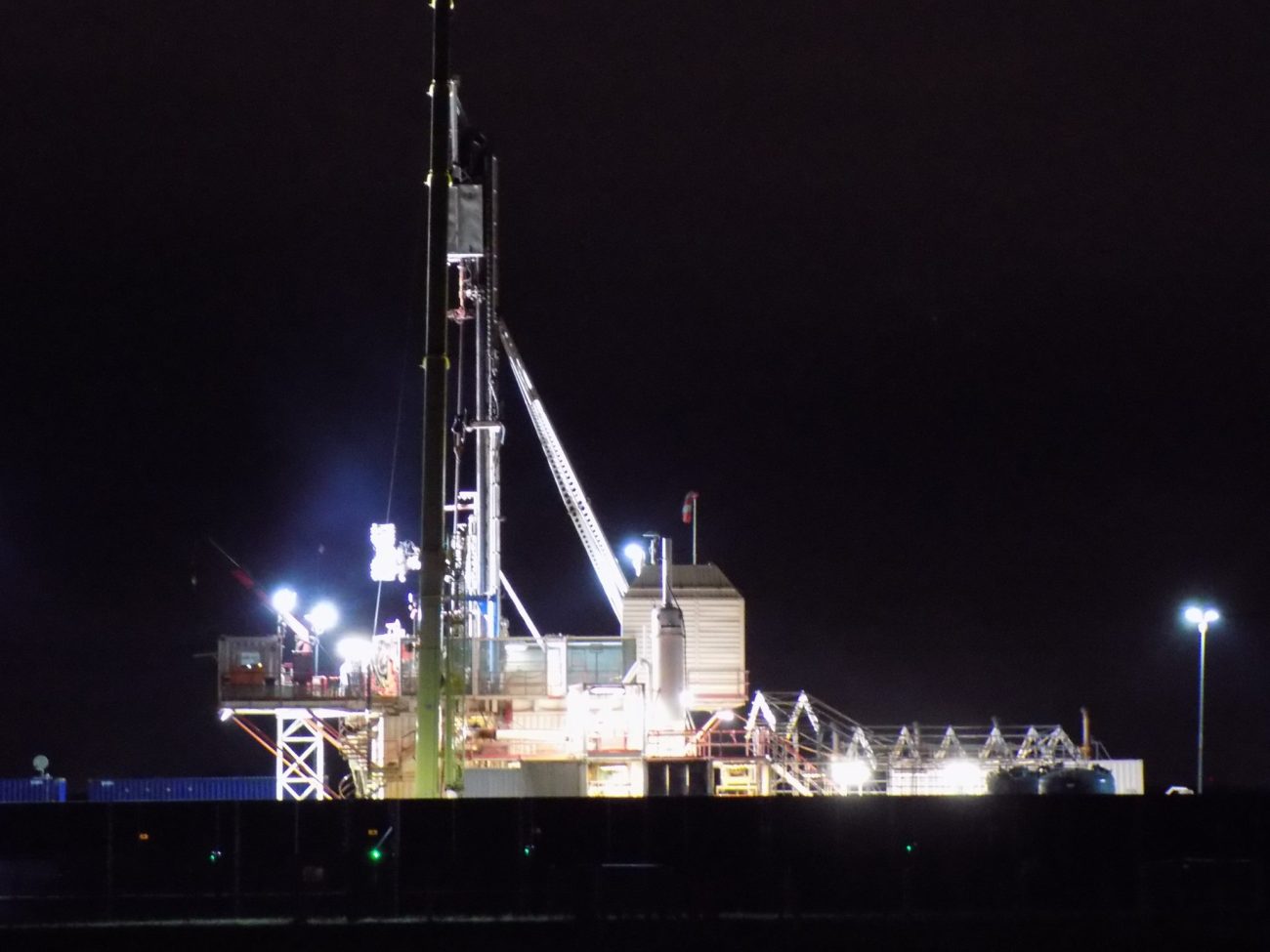
Photo: Keith
A new study, led by scientists from NASA, has shown that rising emissions from the oil and gas industry are mainly responsible for the increase in methane in the atmosphere.
After remaining fairly stable around the year 2000, atmospheric methane levels began rising in 2006.
This rise could be significant for climate change because methane is a powerful greenhouse gas. It breaks down in the atmosphere more quickly than carbon dioxide but it has a greater warming effect. Scientists estimate that over 20 years it has a global warming potential that is 86 times greater than that of carbon dioxide.
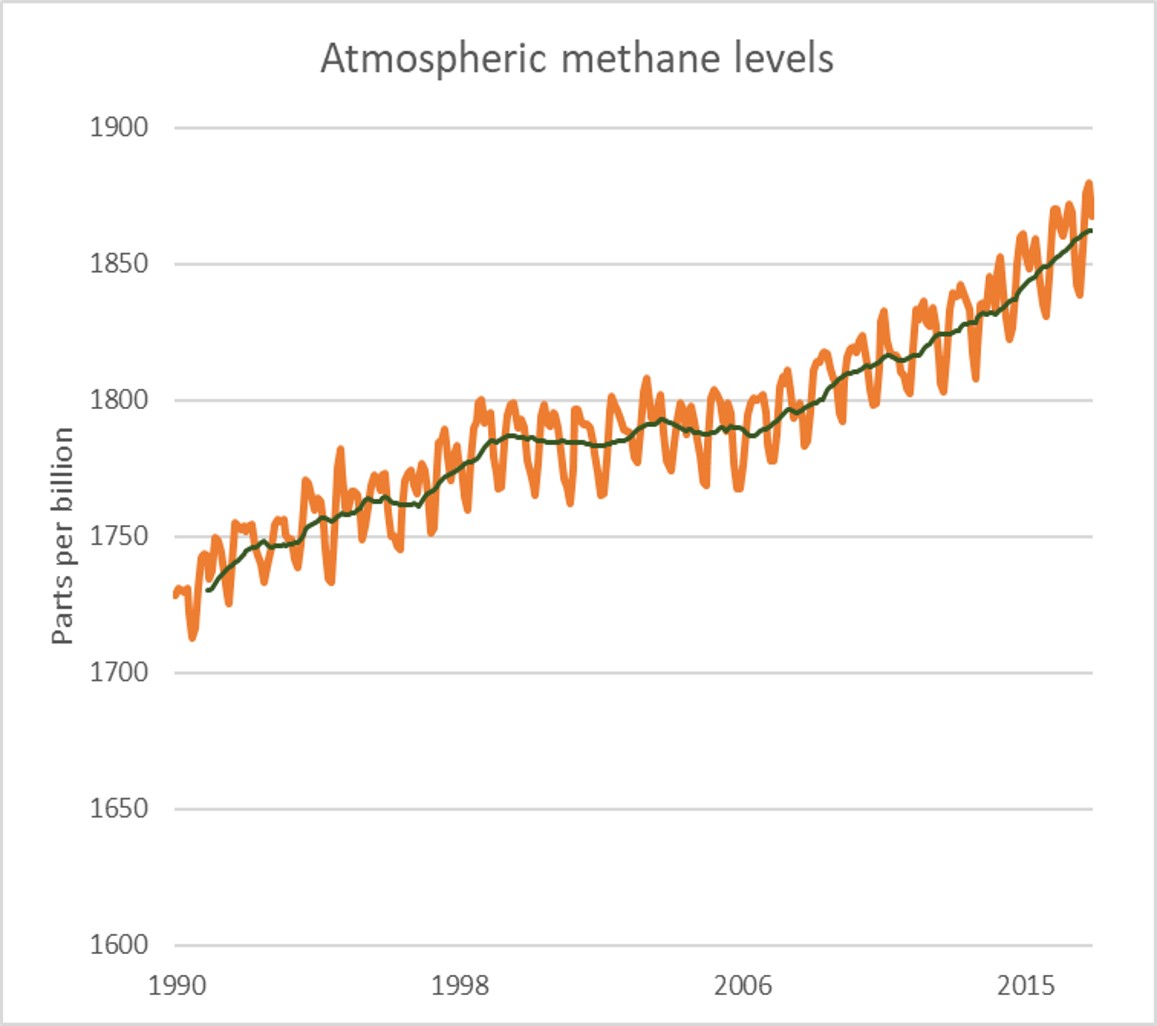
Source: National Oceanic and Atmospheric Administration (NOAA)
Researchers have long disagreed on the cause of rising methane levels.
After studying atmospheric methane levels around and over drilling sites, some scientists have argued that the fracking industry is principally to blame, with the rise in methane levels corresponding with the rise in fracking activity in the United States. Taking methane emissions into account, Robert Howarth has suggested that shale gas may have a larger greenhouse gas footprint than burning coal.
Other studies of methane molecules in the atmosphere have suggested that the rise could be due to increased microbial activity in rice paddies due to a warming climate.
If both explanations were right, the observed methane level in the atmosphere should be substantially higher than it actually is. This led some researchers to argue that only one of the suggested causes could be correct.
The new NASA research shows that both explanations are correct.
Global fires – another source of methane
Methane levels in the atmosphere are also affected by the area of land burned in fires. Satellite surveys suggest that the land area burned dropped by 12% between the early 2000’s and the period 2007 – 2014. This would suggest that methane emissions from burning would also have dropped by 12%, and scientists took this into account when calculating the expected level of methane in the atmosphere.
However, the NASA team found that the actual drop in methane from burning was almost twice what they had expected. Taking this bigger drop into account, and adding predicted increases from both fossil fuels and wetlands, they found that the calculated methane levels now matched the observed levels in the atmosphere.
Identifying methane sources
Key to the research was piecing together clues to determine the source of methane molecules. Carbon isotopes, variations in the carbon atoms in the methane, are one indicator. Methane molecules resulting from land burning contain more heavy carbon isotopes, microbial methane emissions have the fewest. Emissions from shale gas and other gas activities usually contain ethane as well as methane, while land burning causes increased carbon monoxide concentrations.
Using these clues, researchers were able to conclude that:
- Fossil fuel methane emissions are rising at 17 teragrams (Tg) per year
- Wetland and rice farming emissions are rising at 12 Tg per year
- Emissions from land burning are falling at 4 Tg per year
Adding these figures together gave an annual overall increase of 25 Tg per year, matching the observed behaviour.
(A teragram is a thousand million kilograms which is (according to NASA) the weight of 200,000 elephants. Total methane emissions are currently around 550 Tg a year)
The report notes that
“The required FF [Fossil Fuel] emission enhancement found here is substantially larger than in previous literature”.
Previous studies had concluded that fossil fuel methane emissions were rising at 5.5 Tg per year, rather than 17 Tg found in this report.
Categories: Research

 DRILL OR DROP?
Don’t worry , our joke PM watched Blue Planet , no doubt the usual pro frackers will twist this to suit their greedy views
Yes, and her response was:
‘She will say the 2042 pledge to eliminate avoidable plastic waste – that which it is “technologically, environmentally and economically practical” to do so – will be met through a string of measures..’
oops there it is, the oil and gas lobbyist statement from the puppeteers.
This virus is everywhere….
https://www.theguardian.com/environment/climate-consensus-97-per-cent/2017/mar/13/the-fossil-fuel-industrys-invisible-colonization-of-academia
Hugely significant. If anything is capable of transforming global warming into climate catastrophe it’s methane. Not only is it over 80 times more potent as a greenhouse gas in the short term it oxidises into CO2 for the longer term anyway. Currently global CO2 readings are showing an increase after leveling off for a while, I wouldn’t be at all surprised if it has plenty do with methane emissions from the acceleration of HVHF for shale gas around 8 – 10 years ago. That’s about how long it takes for a significant proportion of degradation of methane into CO2 in the atmosphere.
Seems mitigation then should be to replace cows with a fracking site and it balances out. And we have-PNR! Goodness, these Cuadrilla chappies know their onions. Gold Standard.
Why are cattle not on NASA’s charts? World wide, they represent one of the largest methane sources. Monogastrics were my area, but I sat through many a nutritionists seminar when this was under discussion. Perhaps BigMacs represent an area for NASA to avoid? (Not as silly as it sounds, as developing societies achieving more middle classes and disposable income have top of their wish list-animal protein.)
I think NASA researchers were focussing on the reasons for the 5% annual increase in methane since 2006. Cattle could not account for these increases, and research suggested that microbial activity or fracking were responsible.
The UN wasn’t afraid to call for meat-free days as far back as 2008… http://www.dailymail.co.uk/news/article-1053270/Everyone-meat-free-day-week-tackle-climate-change-says-UN.html
I wonder if we’ll see gold standards in action Martin, but we’ll surely see a lot of dismissal and denial (of industry critics) along the lines of the climate change deniers play-book (borrowed from defenders of the tobacco industry) which goes something like this … 1: Trivialize or mock issues when raised critically … 2: de-legitimize or attack the authors/scientists as lacking credibility … 3: (or) dismiss critical reports as not being from the industry therefore they don’t know what they’re talking about … 4: smear them with undesirable labels – e.g. as belonging to a group of lefty anti-capitalist activist cranks, tree-hugging nimbys etc…. 5: produce contrary ‘science’ from industry funded sources like Energy in Depth, the Global Warming Policy Foundation or the Heartland institute.
… all tried and tested formulae. American mastery of these ‘tools of the trade’ – up to and including lobbying and political debate – are unsurpassed. We’ll see much more of this sort of stuff here without a doubt especially if tests suggest there are big returns to be made. Corporatising and privatising the profits while socialising or nationalising the risks, impacts and clean-up costs is the general goal of these arguments,
GottaBeKidding, we notice, usually leaps straight to point 4, the rest can be a lot more work 🙂
NO Philip,
I think you’ll find the study from the worlds leading scientists at NASA , an impossible nut to crack for the pro-frackers.
I would expect deadly silence , as the industry and its supporters close their eyes and ears to these new findings.
Hi Jack. Hence the trivialising response (you may have missed the point). To compare the methane from a couple of acres of cow pasture to the leakage from a typical gas well pad is on a par with comparing a car tire blowout with a gas well blowout…. not only mocking it’s beyond surreal – one of Martin’s specialties. To compare those emissions to the whole of methane output from cows / other ruminants is not so trivial. There is a point there, which Paul addressed.
You’d be surprised how there’s a whole lobby of anti Nasa climate science going on in the states. Trump is de-funding that branch as we speak. However there’s a couple of EU satellites with more advanced methane sensors being launched very soon, which will give more evidence and cross-referenced data. Callibration and data modelling from remote sensing takes time though – its a tricky field and the wake-up call regarding the methane problem vis-a-vis climate change is relatively recent.
The jet propulsion laboratory changes its tune on methane sources around once every six months. These authors didn’t actually measure methane having the isotopic signature related to carbon 13, which would be a direct measurement, to come to their conclusion. Instead they made an indirect measurement, backing into an assumption based on reduced carbon with an isotopic signature from fires. So, while more accurate direct measurements continue to show declines in methane emissions from oil and gas fields, these authors made some assumptions to show more methane from oil and gas. I would favor direct measurements over indirect, and I am sure that more studies will be published with conflicting data in the future.
The researchers also looked at ethane levels – another clue that methane is coming from the gas industry.
Do you have any links to reports detailing direct measurements? Here’s one I found – http://dept.ceer.utexas.edu/methane/study/ The problem with this type of survey is that the industry gets to pick the sites which are sampled.
The NASA report worked the other way round – here is the methane in the atmosphere. Where has it come from? In the past, the problem was that the methane “budget” didn’t add up properly. With this research, it does.
What constitutes direct measurements EKT (top down)? The gas industry has never done this – leaving it up to others and then blaming their expertise when it goes against O&G interests. What are your references?
https://www.jpl.nasa.gov/m/news/news.php?release=2018-001#.Wlhy20vLiL4
There is actually quite a bit of uncertainty around ethane emissions and sources for increased emissions. As you may know, there are a number of different sources for ethane, including natural sources, and the jury is out as to how much these sources are contributing. This explains why rises in ethane didn’t clearly implicate fossil fuel flaring.
You will find more data regarding methane emission declines in oil and gas plays here: https://ghgdata.epa.gov/ghgp/main.do
Also here: http://www.ahs.dep.pa.gov/NewsRoomPublic/articleviewer.aspx?id=21283&typeid=1
And here: https://www.climate.gov/news-features/understanding-climate/after-2000-era-plateau-global-methane-levels-hitting-new-highs
You might also look here; https://www.nature.com/articles/nature10352
And here: https://www.nature.com/articles/nature19797
And here: http://onlinelibrary.wiley.com/doi/10.1002/2016GB005406/full
And here: http://science.sciencemag.org/content/early/2016/03/09/science.aad2705
Thanks for the links. The NASA research addresses some of these articles directly, arguing there is room in the methane total for increases in both wetland and gas-operations derived methane.
EKT
TALKING ABOUT EMISSIONS.
Fracking in the US causing global surge in dangerous gas, study finds
http://www.independent.co.uk/news/science/fracking-in-the-us-causing-global-surge-in-dangerous-gas-scientists-find-a7006311.html
ONE SINGLE OIL AND GAS FIELD in North Dakota and Montana, the Bakken Formation, has been found to be emitting in to the atmosphere , about 250,000 tons of Ethane Gas – about TWO per cent of the total produced WORLDWIDE.
Well, PhilipP, as PNR is yet to be anything near what a typical gas well pad is (whatever that may be) I should not get too excited about that.
Why could cattle not account for some of that increase Paul? If the base line was 2006, there is a lot of time for world cattle population to have moved (it certainly has been moving up very fast in the last couple of decades, hence the concern elsewhere for the contribution to methane output.) Additionally, methane output in cattle can be varied, within certain parameters, depending upon diet and husbandry which has also been changing quite dramatically over the same period. It just seems strange to me that a major output for methane, that has been highlighted as a (parallel) cause of concern, is absent from this data. Like, I wouldn’t feel comfortable if volcanic activity didn’t appear when CO2 output was being calculated, or measured. Maybe that’s because I’m a Virgo, and like things to be accurate.
Fair point, Martin – I did wonder the same when I first read the report.
The report says: “surface measurements of CH4 and its isotopic composition suggest a shift of methane sources toward increasing tropical biogenic (BG) sources” – so researchers who have been studying the methane that is actually in the atmosphere were finding, from the carbon isotopes present, that there was a substantial increase from “tropical biogenic sources” – wetlands and paddy fields. And increases in ethane and isotopic evidence pointed to gas operations.
There has been a suggestion that methane output from cattle is under-reported:
https://cbmjournal.springeropen.com/articles/10.1186/s13021-017-0084-y
We may have to wait for wiser heads to pick this report apart, or confirm it.
[Image removed over possible copyright issues]
Martin, your continued evasions are no surprise but the downplaying of the risks and emission factors are tantamount treating your fellow country-people, and the global warming issue, with contempt. To dismiss by saying “PNR is yet to be anything near what a typical gas well pad is” goes no way to disguising the fact that it is exactly what yourself and other pro-frackers are hoping for i.e. that it will be every bit the fully operational, full-scale productive site networked to many others in the not-too-distant future (the “yet” is the giveaway). The ruminant wetland issue is acknowledged but new data repeatedly confirms the problem of gas-field emissions, long suspected, and pointed to by earlier top-down studies (via airborne, atmospheric and satellite measurements)… studies that the energy industries simply don’t do themselves. I have little doubt that the newer, more accurate methane remote-sensors being launched soon will add further confirmation.
The data in the earlier long range studies (Paul provided immediately above) runs up to around 2006 to 2010 (various sources) but that is when the new gas-field (shale fracking) rush is just starting to kick in. The latest studies however show the upturn in methane – and the ethane component is probably the biggest tell-tale factor and signature revealing the gas-field sources. Ethane is not a product of biogenic natural gas. Meanwhile EKT’s sources don’t actually support his own conjecture.
… in case you missed JacktheLad’s recent link http://www.independent.co.uk/news/science/fracking-in-the-us-causing-global-surge-in-dangerous-gas-scientists-find-a7006311.html
“ONE SINGLE OIL AND GAS FIELD in North Dakota and Montana, the Bakken Formation, has been found to be emitting in to the atmosphere , about 250,000 tons of Ethane Gas – about TWO per cent of the total produced WORLDWIDE.”
… and to reinforce the seriousness of the climate change issue: https://www.youtube.com/watch?v=QYB6cOoA9TU&t=251s
since we have all these experts on global warming & pollution Perhaps they can explain why this is a problem now in a era where there is far less pollution then during the industrialization period where every factory & mill was spewing out smoke & the cities were smog-bound something we hardly see today or at least in the UK were actually cleaning up the buildings that were covered in grime making our city’s clean again. which in turn must mean the air is cleaner. But to listen to these experts that is not the case well I’m no expert but I do Know the cities are a damn sight cleaner than they used to be yet they claim the air is more polluted. it don,t add up.