
Third Energy’s site at Kirby Misperton. Photo: Claire Head
A policy requiring a distance of 500m between homes and fracking sites in North Yorkshire got official backing today – but the fracking industry immediately threatened to challenge it in court.
A Government-appointed planning inspector supported the idea during a hearing to scrutinise the North Yorkshire minerals plan, which will guide decisions on shale gas for the next 15 years.
Elizabeth Ord, who has to decide whether the plan is sound, told the hearing:
“I am satisfied that there should be a 500m buffer, or whatever you want to call it.”
“We have a situation with a new industry and a lot of fear about it. I accept that fear should not make planning policy but the precautionary principle is well established and there is justification of treading carefully in the first five years of the plan.”
The county council, North York Moors National Park and the City of York want a 500m gap between homes and oil and gas sites, particularly those using fracking.
The authorities said this was a reasonable distance to reduce noise, vibration, light pollution, visual impact and emissions.
The draft plan proposed:
“A minimum horizontal separation distance of 500m should be maintained between the proposed development and occupied residential property or other sensitive receptors, unless it can be clearly demonstrated in site specific circumstances that a high level protection will be provided.”
But Catherine Howard, of the law firm Herbert Smith Freehills, representing shale firms, said:
“The industry regards the 500m as unsound and would be legally challengeable at judicial review.”
The Mayor of Malton, Cllr Paul Andrews, who was representing the town council at the hearing, said he hoped the inspector was not intimidated.
Ms Ord replied:
“I am regularly threatened with legal action”.
“Ban by another name”
The industry has strongly opposed the idea of a separation distance, which is not part of national planning policy.
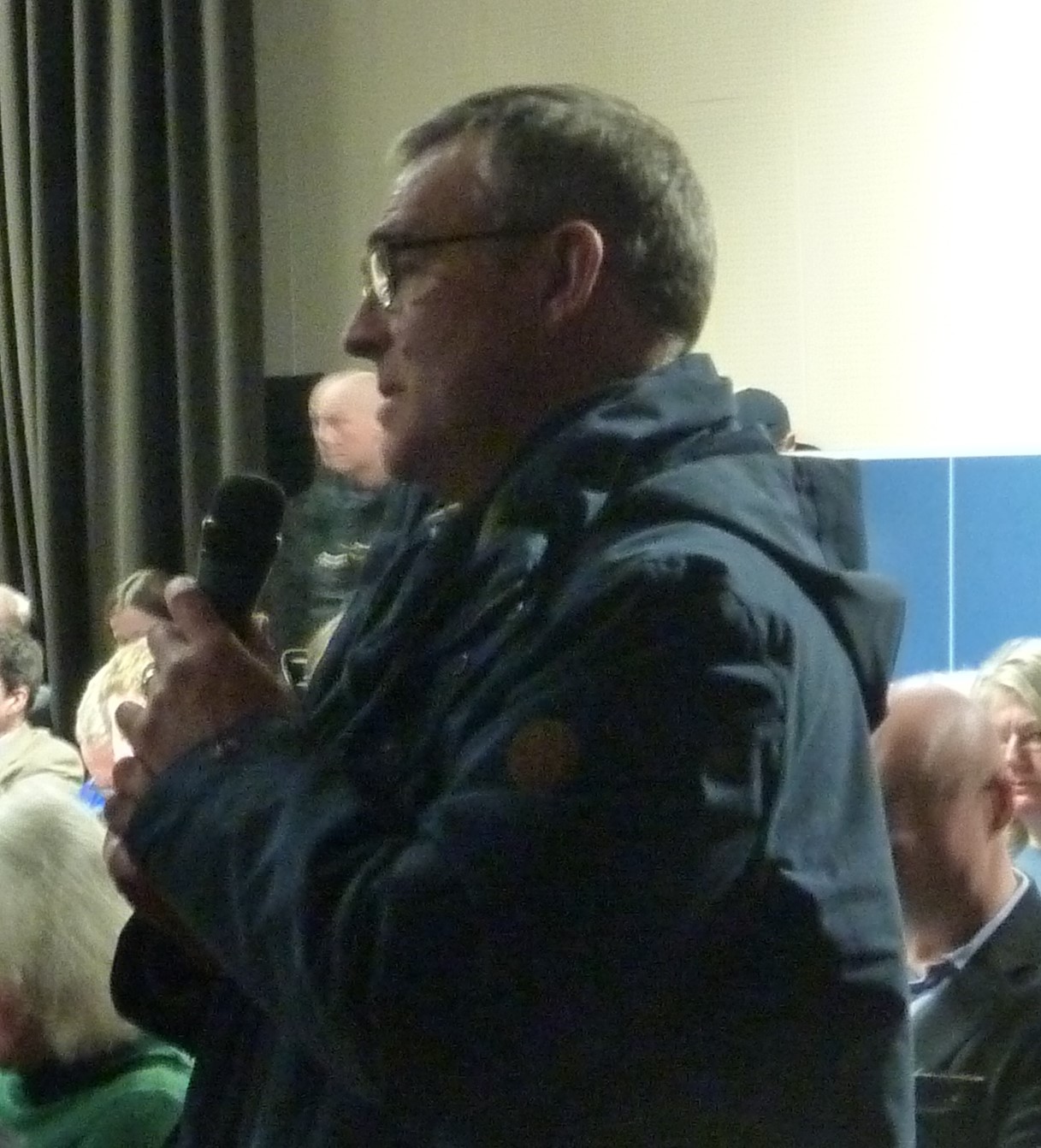
Alan Linn at a debate in Pickering, 8 March 2018. Photo: DrillOrDrop
Alan Linn, Chief Operating Officer of Third Energy, which is waiting for consent to frack at Kirby Misperton, told today’s hearing:
“When you draw a 500m radius around the properties in the area we propose to develop it doesn’t leave must space left.
“A 500m buffer zone is basically a sterilisation zone. The effect of the plan is to stop the development of unconventional hydrocarbons. I have a major concern about this approach.
“All the legislation exists and we have a gold standard for regulation.”
Lynn Calder, commercial director of INEOS, told the meeting:
“This is a ban by any other name”.
Ken Cronin, of the industry body, UKOOG, said the 500m distance was arbitrary and not justified by the minerals plan. There were already adequate protections in national policy, he said.
Local support
The 500m policy was strongly supported by local politicians and campaign groups.
 Kevin Hollinrake, the MP for Thirsk and Malton, which includes Kirby Misperton, called for minimum separation distances of 500m for one or two isolated homes and 1.5km for any settlement of three or more.
In a letter to the inspector, he said:
“I have significant concerns about any weakening of the sensible measures contained within the North Yorkshire MWJP [minerals and waste joint plan] … and strongly recommend that all these protections are maintained until we have more data on emissions to the air, noise and light pollution.”
Frack Free York and Frack Free Ryedale supported the 500m distance on planning and public health grounds. Cllr Andrews said the distance should be greater. Christopher Stratton, representing villages in south Hambleton, said:
“500m is little more than quarter of a mile.
“We cannot envisage any circumstances where less than 500m would be acceptable”.
Chris France, Director of Planning and the North York Moors National Park, said the government’s documents on shale gas included many references to the precautionary principle. He said:
“I don’t know what part of national policy the industry thinks the 500m buffer is in conflict with”.
“Very encouraging”
Frack Free Ryedale welcomed the Inspector’s decision this evening. David Davis, from the group’s planning team, said:
“It is very encouraging that representations from our community are being taken seriously. The Planning Inspector acknowledged that fracking is a new industry and that there is a need to apply the precautionary approach and “tread carefully.”
“There’s still some way to go before the Minerals & Waste Joint Plan is finalised, but Frack Free Ryedale will continue to support the authorities to achieve a robust plan”.
Russell Scott, from Frack Free Ryedale, said:
“The 500m buffer zone should be an absolute minimum and I am delighted to hear that the Inspector agreed with Frack Free Ryedale on this and several other representations aimed at protecting residents and our environment.
“The 500m setback is unfortunately not an outright ban, but a way to help safeguard residents to some extent from the impacts of fracking – and if the industry can’t operate on this basis and object to it, then they shouldn’t be allowed to frack in North Yorkshire or anywhere else.”
We want 500m too, say Lancashire residents

Lytham St Annes Express, 19 April 2018
The inspector’s decision on separation distances led to calls by Lancashire residents for the same treatment around Cuadrilla’s shale gas sites.
Dr Frank Rugman, a retired consultant haematologist, representing people in Little Plumpton, some of whom live 350m from the Preston New Road site, said:
“There is evidence from the USA that exposure to diesel exhaust emissions from the numerous on-site diesel compressors and heavy diesel truck traffic are probably significant contributory factors to the harmful impacts on health from fracking.
“Studies have also indicated that proximity to this industry is a crucial factor determining harm.
“So yes, I would entirely agree with Planning Inspector Mrs Ord that I would rather live at 500 m or more from the site, than at 350m, which is currently the case for some unfortunate residents at Little Plumpton, Lancashire.”
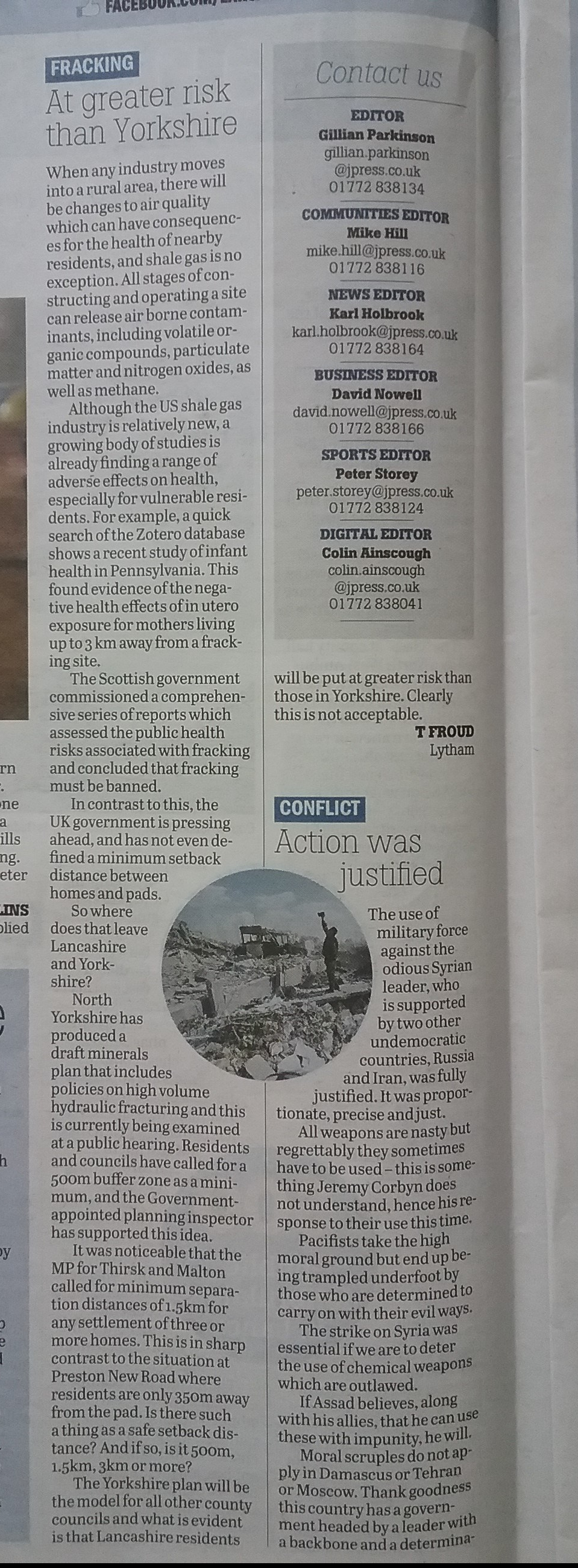
Letter to the Lancashire Evening Post, 17 April 2018
Defining fracking
The inspector also overruled industry objections on the key issue of how fracking would be defined by planners in North Yorkshire.
The industry said the plan should adopt the definition in the Infrastructure Act based on the volume of fracking fluid. But the North Yorkshire authorities were concerned that operators could seek to get round the restrictions on fracking in national parks and other protected areas by using fluid just under the limits. They proposed it would apply to any operation using hydraulic pressure to open or extend fractures in rock.
The industry said this definition extended to some forms of conventional development. It said it opposed anything that deviated from the national definition.
But Ms Ord said she regarded the proposed definition as sound:
“I am happy that the council’s definition doesn’t go along with the 2015 act.”
The inspector also approved the proposed distinction in the plan’s policies between conventional and unconventional hydrocarbon developments, despite opposition from the industry.
DrillOrDrop live updates from the hearing
Updated 14/4/2018 to include exact wording from draft plan and reaction from Frack Free Ryedale. Also updated on 20 April 2018 with newspaper cuttings
Reporting on this hearing was made possible by individual donations from DrillOrDrop readers. You can donate to DrillOrDrop by clicking here
Categories: Regulation

 DRILL OR DROP?
Well done to all of you who worked so hard to get a decent Waste and Minerals plan for North Yorkshire. It is so good to hear at last the precautionary principle being invoked. 500m is not enough to avoid t he well documented harms to populations living within 1 mile of a fracking site, but it is great that the Inspector upheld the terms in the Joint Plan. Does this mark a shift against the industry??
This is good news and needs to be rolled out to all county council waste and mineral plans. Well done everybody.
500m or 2° which is the most important measurement for the majority of people and the planet?
For Africa it is 1.5 degrees. By using what we have not only protects those who live in the area, but as a knock on effect as the shale gas stays in the ground and is neither burned nor turned into plastic, it is a step in the right direction for reducing emissions.
Glad to hear that some common sense is starting to be used , these devious companies need to understand that they do not have carte blanche and people’s lives matter more than their lust for power
Jim to Mabel: “Your bloody planning inspector is doing what she’s supposed to do. Sack her and appoint someone who will follow orders, like you did at Roseacre Wood.”
I thought that was a minimum gap, and then more work is required if it is less ( hence the comments by Ord re the wording ‘exceptional circumstances’ could be ‘to be robustly demonstrated’ ).
But this reports reads as it’s a minimum full stop, and it seems to have been taken as such by comments from frack free groups. Plus it seems that this buffer is taken to include all oil and gas development, frack or not.
So it does look like a ban by any other means, given that there are few spots less than 500m from a house ( and maybe not one more than 2km from a group of three ).
Hence the challenge I guess, being a recognition that 500m will be taken as a prescriptive distance with no exemptons.
Hi Hewes62. You make a very fair point. I’ve added the exact wording from the draft plan text to clarify.
Ruth
Thanks
Interestingly South Ribble Local Council brought in a law requiring a single wind turbine could not he sited closer than 1000 metres to a dwelling!! Effectively put an end to any/all on shore wind development in the borough.
And the fracking company is complaining about a 500 metre restriction! As they say, “You couldn’t write the script”😡
D.Kelk
Yes, one of the reasons onshore wind is struggling. Maybe INEOS should build one wind turbine per frack Site.
They have more legal clout it seems, so they could overcome the opposition and make some more money for Jim. Once thecgas has gone the site is restored, but the turbine be there forever, being replaced or refurbished as time goes on, ad infinitum I guess.
However there are less geological restrictions on the available positions for a wind turbine than fracking sites ( and even more for conventional oil and gas sites ).
“Nasty” party supporting nasty industries, led by nasty people; and they’re getting nastier.
….the call of the money god does that to a person….
AN UNFOLDING NIGHTMARE.
Avoid Gulf stream disruption at all costs, scientists warn
https://amp.theguardian.com/environment/2018/apr/13/avoid-at-all-costs-gulf-streams-record-weakening-prompts-warnings-global-warming
Russian piped gas and LNG cargos might be in shorter supply in the future?
https://www.theguardian.com/world/2018/apr/14/syria-air-strikes-us-uk-and-france-launch-attack-on-assad-regime
Obviously Germanys sweetheart deal with Russia for cheap gas has political implications… ie not standing with U.K, France and U.S.A
Surely Germanys World leading Energieweinde makes a difference, oh and the huge amounts of coal they burn; recently revealed cheap gas from Russia?
https://sputniknews.com/world/201804121063479088-germany-syria-strikes-merkel/