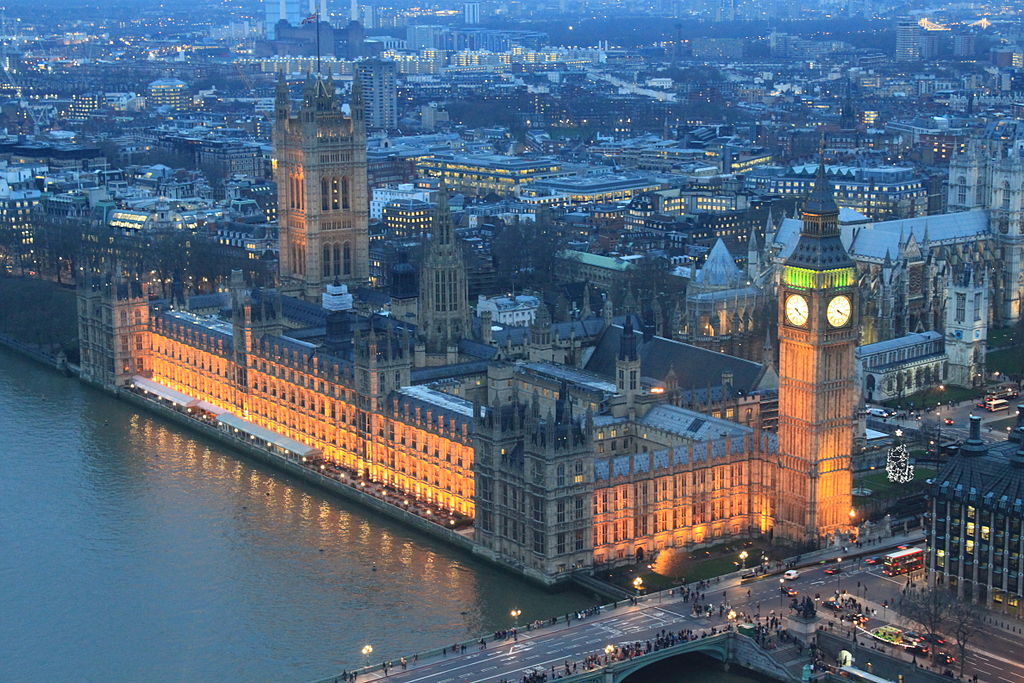
Palace of Westminster Source: By Superikonoskop [CC BY-SA 3.0], from Wikimedia Commons
In this post, Paul Seaman reports on the contrasting views at key events in Westminster: a parliamentary debate and question time on onshore oil and gas production; and the UK Investor Show at the Queen Elizabeth Conference Centre.
Peers question ministers on gas production
 The Lib Dem’s Energy Spokesperson, Baroness Featherstone, (left) asked the government:
“What is their assessment of the extent to which indigenous gas production is needed for energy security.”
 Lord Henley (right), an Energy Minister, said indigenous gas production met 46% of the country’s gas demands in 2016. Other gas came from a “diverse and flexible” system of gas sources, including Norway, Europe and via LNG gas terminals, he said.
Baroness Featherstone asked:
“Does he agree that it would be good to end the ugly and unnecessary distraction of fracking?”
Lord Henley replied:
“As regards production of domestic shale gas, I think we should do everything we can to tap into this potential resource.”
 The Conservative, Lord Polak (left) asked what the government were doing to help the shale gas industry.
Lord Henley replied:
“I hope that we are giving every possible encouragement to the shale gas industry. We think that the economic impact of shale, both locally and nationally, could be very large indeed. There will be opportunities for jobs and energy security, and in a great many other areas, through supporting that industry.
 Lord Henley failed to confirm there would no fracking in national parks or areas of outstanding natural beauty. He was replying to a question by Baroness McIntosh (right), the former Conservative MP for Thirsk and Malton, where companies have licences in the North York Moors National Park. Lord Henley would not comment on individual applications for the exploration of domestic gas.
The former Conservative Chancellor, Lord Lawson, suggested the strongest opponents of fracking, both in the UK and Europe, were the Russians, who relied on exporting their gas.
 MPs debate UK oil and gas industry
In a Westminster House debate, the Energy Minister, Claire Perry, told MPs:
“I, the Government and many industry commentators absolutely see a role for oil and gas in the mix going forward, with a shift towards gas.
“The Government are committed to gas—it is not just me; it is other international parties as well—but finding ways that can help us take carbon out to keep the energy supply flowing is also part of that mix.”
She also added:
“Could I put on record that I am a little mystified about the Scottish Government’s decision to refuse to allow exploration for gas onshore when we know it is there because it is a geologically identical strata?”
 Opening the debate, Colin Clark, Conservative MP for Gordon, quoted Lord Turner, a former chairman of the Committee on Climate Change, who said oil and gas would be a major source of energy at least into the next century.
Mr Clark said hydraulic fracturing of rock formations has been carried out safely under the North Sea for 30 years. He said he respected communities that did not want fracking but he said:
“Let us be frank: it is about nimbyism. They do not want it in their backyards. That is what it is about, rather than a denigration of the science and technology of those sectors.”
 Kirsty Blackman, SNP deputy leader at Westminster, said the benefits of fracking were not as big as they had been made out to be.
There would be little in the way of jobs or tax take, she said. It would not compensate for the upheaval caused to  local communities.
Alan Brown, the SNP’s energy spokesman, defended the Scottish government’s decision not to support applications for fracking. He said Texas, had now banned the process, despite developing modern fracking techniques.
Onshore industry is “not a priority” for ministers, says oil boss

Last week’s warm words from ministers failed to convince one industry executive speaking at the 2018 UK Investor Show.

Photo: Angus Energy
Asked whether the government was encouraging onshore development, Jonathan Tidswell, of Angus Energy , the operator of sites at Lidsey in West Sussex and Brockham in Surrey, said:
“I don’t think it’s a priority at the moment for the UK Government, whatsoever. It certainly doesn’t come across that way if you’re on the ground.”
Speaking during a panel event on exploration in southern England, Mr Tidwell said:
“We’re not exactly re-inventing the wheel. It’s all been done in the last ten or fifteen years to be sure, but the issue is being allowed to implement it correctly and safely in the UK.
“At this point that’s not happening, certainly not very quickly.”
He said most of the time it took to drill a well was spent on the planning process:
“At the moment I’d say we take eighteen months from identifying the target to drilling. The engineering part of that is a month – it’s the council and planning which takes the other 17 months.
“With the team I’ve got, I can drill probably about five wells a year without having to hire anybody else. Whether I drill one well in two years, or five wells in a year, I still have the same team, so if I can upscale that, I’m a very happy customer.”
He added that different planning authorities took very different approaches:
“The problem is not the planning itself, it’s that local authorities have different views.
“So in West Sussex, they have a very pragmatic approach. In Surrey, they take a lot of convincing.
“Literally, you drill a well one mile either way and you have a completely different set of guidelines.”
Flow testing at Balcombe
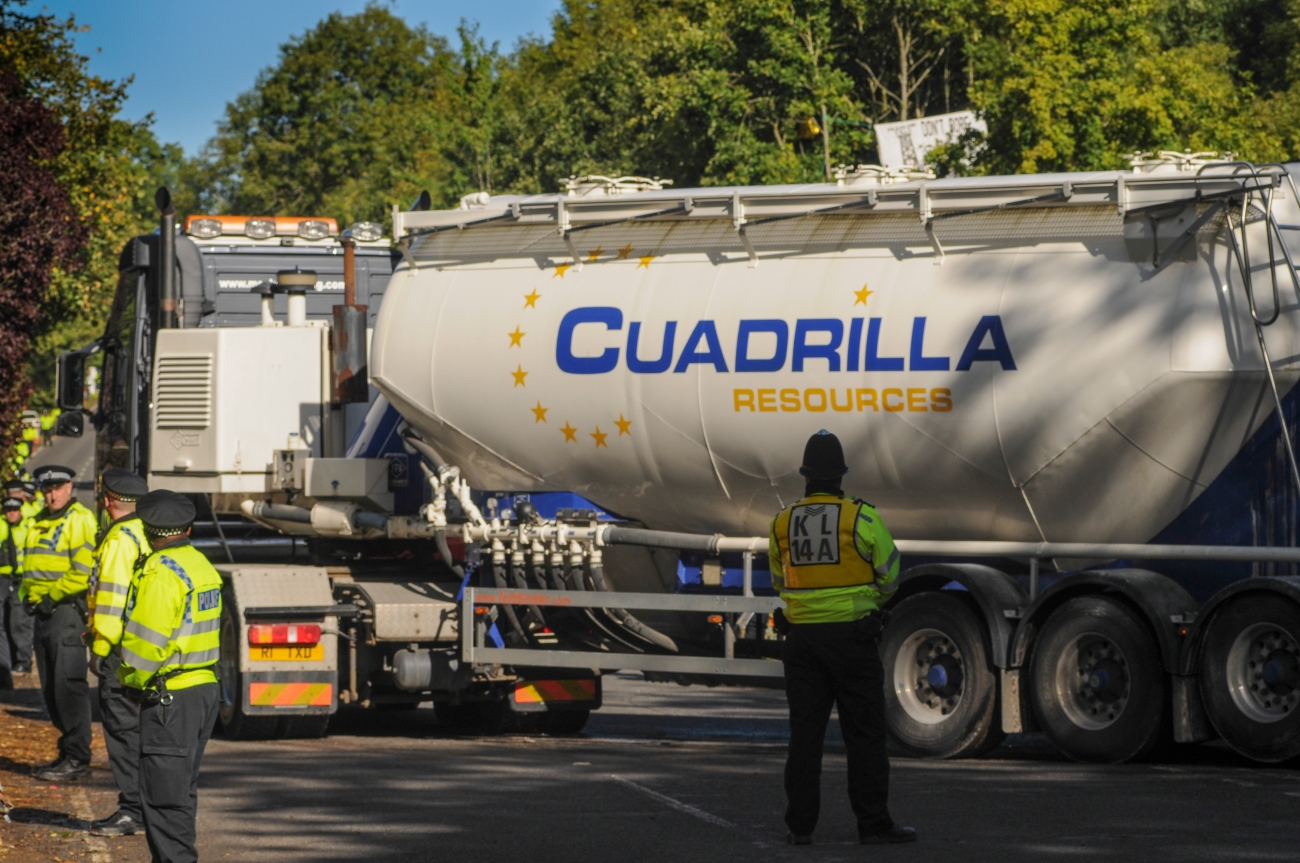
Cuadrilla tanker leaves the Balcombe site August, 2013
Angus Energy is waiting for approval to take over from Cuadrilla as operator of the Balcombe licence in West Sussex.
DrillOrDrop asked Jonathan Tidswell at the UK Investor’s Show how he planned to get acceptance from the local community for flow testing at Balcombe, due to take place this year.
He told us:
“My understanding is that the main objection is not coming from the town itself, but from a small minority of the town and external factors. The idea of taking over is that we are a non-fracking company. The idea will be to somehow convince the locals over the next few months that there will never be any fracking on the site.”
So was the fact that Angus haven’t been involved in fracking a factor in the deal? Mr Tidswell said:
“Yes, effectively, we had various discussions with them [Cuadrilla], and the idea was they are a fracking company and are not welcomed at the site. We are not a fracking company. We don’t inject into formations. Hopefully we can get that across, but until the deal concludes we haven’t really started community engagement.”
Links
Questions on onshore oil and gas 17th April 2018
Westminster House debate on UK oil and gas industry, 19 April 2018
Categories: Politics

 DRILL OR DROP?

Allow a cooling down period and a period for the OG exploration licenses to be quietly terminated – I’d say – would be the graceful way of ending this fracking nonsense. A couple of very informative links from this link give the real picture about the reality in America: https://www.desmogblog.com/finances-fracking-shale-industry-drills-more-debt-profit?utm_source=dsb%20newsletter
Philip, you want to play down the biggest energy revolution in our lifetime by giving a link to Desmogblog.com
Really???
Dream on K … see my response to you lower down – but read the pages (linked from the above page) first will you?
Read the article Phil
If any of the article was true how come America has gone from being a net importer to a net exporter due to shale?
Please read these articles…
https://www.dailysignal.com/2018/04/22/the-connection-between-russia-and-2-green-groups-fighting-fracking-in-us
https://nationalcenter.org/2018/04/23/russian-influence-may-taint-fracking-debate/
https://oilvoice.com/Opinion/14949/How-Far-Can-Shale-Go
No, it’s the linked items – from that article – that reveal the full story. You need to understand the arguments between productivity and profitability and how the public (as ever) ends up picking up the tab. Also how a ruinous lengthy period of capital expenditure get’s hedged against big promises about the next big ‘find’. There are always a few sweet spots of productivity that keep the whole machine rolling with raised hopes of the kind you’re into.
‘“Let us be frank: it is about nimbyism. They do not want it in their backyards. That is what it is about, rather than a denigration of the science and technology of those sectors.” Colin Clark Con MP – where do you live I wonder?
According to Wikipedia:
“The Gordon constituency (which Colin Clark represents) covers a central portion of the Aberdeenshire area and a northern portion of the Aberdeen City area.” Colin Clark’s website https://www.colinclark.org.uk/about-colin-clark says that he lives near OldMeldrum, which is about 10 km north of Aberdeen city centre.
Thanks Paul; no fracking in his backyard then?
It’ll go ahead eventually that’s guaranteed. May isn’t a strong leader and under her reign we’ve found that to be a fact rather than myth. She gives a good speech when someone else writes it but that’s where her strength ends. It was embarrassing to hear we sent 4 x tornados (44yr old jet) to ‘battle’. Would’ve been better staying in bed!
Unfortunately the antis and Corbyn fans are a little ‘confused’ in their ideology but once Corbyn is beat at the next election that’ll be left wing politics dead and buried for another 20 years at least and about 99% of antis with it going by their avg age.
Investors can choose to invest their money wherever they choose and the UK is starting to look a little further down the list. The weakened pound helped investment flow in the short term but we’re in for a very rude awakening now it’s stabilising an Brexit is getting closer.
The only investors I know that love this country are ‘green’ investors! I can assure you they aren’t very green in their own consumption of expensive reds and wagyu steaks all paid for by the naive British public that aren’t in the rarefied atmosphere of the rather dodgy ‘elite’!
Most foreigners that I know who have a good level of income all admit that Britain is stuck in its own past except for the lucrative parts of London which are only affordable to Eastern European gangsters. Go to the likes of Singapore and you’ll be met with a far better class of living in all aspects.
‘Go to the likes of Singapore and you’ll be met with a far better class of living in all aspects.’ – bye bye
[Comment removed by moderator]
“The former Conservative Chancellor, Lord Lawson, suggested the strongest opponents of fracking, both in the UK and Europe, were the Russians, who relied on exporting their gas.” Dog-whistle politics, echoing what Hollinrake has already said! The Russians have supplied less than 2% of our gas up until the end of March, but that doesn’t matter. Lawson is tapping in to the public’s fears of Russia in the wake of gas attacks and poisonings in order to fuel his own fracking agenda. Truth is of secondary importance to the nasty party.
Lawson is also a climate denier…..
Russia’s gas exports to Europe rose 8.1 per cent last year to a record level of 193.9bn cubic metres (bcm), despite rising competition and concerns about the country’s dominance of supply.
State-run Gazprom, the world’s largest gas producer, has a monopoly over Russia’s network of pipelines to Europe and supplies close to 40 per cent of Europe’s gas. But it has been forced to lower its prices in recent years to protect its market share in the face of moves by EU member states to buy more gas from the US, Qatar and other producers
Lord Lawson has been round the block more than any of us. He knows what he’s talking about…
After the Government’s re-election in 1983, Lawson was appointed Chancellor of the Exchequer in succession to Geoffrey Howe. The early years of Lawson’s chancellorship were associated with tax reform. The 1984 Budget reformed corporate taxes by a combination of reduced rates and reduced allowances. The 1985 Budget continued the trend of shifting from direct to indirect taxes by reducing National Insurance contributions for the lower-paid while extending the base of value added tax.
During these two years Lawson’s public image remained low-key, but from the 1986 Budget (in which he resumed the reduction of the standard rate of personal Income Tax from the 30% rate to which it had been lowered in Howe’s 1979 Budget), his stock rose as unemployment began to fall from the middle of 1986 (employment growth having resumed over three years earlier). Lawson also changed the budget deficit from £10.5 billion (3.7% of GDP) in 1983 to a budget surplus of £3.9 billion in 1988 and £4.1 billion in 1989, the year of his resignation. During his tenure the rate of taxation also came down. The basic rate was reduced from 30% in 1983 to 25% by 1988. The top rate of tax also came down from 60% to 40% in 1988 and the four other higher rates were removed, leaving a system of personal taxation in which there was no rate anywhere in excess of 40 per cent.
You’re promoting a fake ‘religion’ Kisheny, based on the past and a grand illusion that the New Right under Thatcher and Lawson is somehow repeatable, while leaving out the fact that the North Sea Oil revenues that came on stream at that time underpinned the financial boom and – what can be seen in hindsight – reckless deregulation. At the same time Britain’s manufacturing base got destabilized and sold off. Britain doesn’t have much left to sell off now and even the mighty financial services are about to take a drubbing from Brexit. The further deregulation prospects driven by Brexit hawks and dangerous climate deniers like Lawson, [edited by moderator] and the Murdoch/Dacre Press readers, are willing Britain towards an even more destructive future (with a ridiculously expensive and environmentally damaging fracking dream) – attempting to put the clock back simply won’t work.
Take a look at the link(s) I added above and start to get some perspective on your runaway beliefs please.
Waste of investors money. Get out of fracking now. Stay out of fracking. Fracking’s brand image is irrevocably tarnished (with good reason) across the political spectrum. Lifelong Tory voters are deserting the party in droves in areas targeted for shale gas development. With 500m setback as good as set in stone, this is the new benchmark. The OG players know that cannot frack safely AND make a profit, they have lost the PR war. The Government have other far more pressing issues to devote energy to dirty energy.
April 17th 2018
Australia’s Northern Territory has lifted a moratorium on fracking, the process of extracting gas from shale rock, to replicate the US shale revolution in a vast region with massive mineral resources.
The decision on Tuesday was welcomed by the oil and gas industry, which is promising to invest billions of dollars in exploration and create thousands of jobs in an underpopulated region roughly six times the size of the UK.
Australian energy companies Origin Energy and Santos have identified the Northern Territory as a potential source of gas to meet a shortage of the fossil fuel in Australia, which has led to surging energy prices and prompted Canberra to implement export controls on liquefied natural gas — one of the country’s most valuable exports.
“Member companies stand ready to invest billions of dollars in new projects in the territory,” said Malcolm Roberts, chief executive of the oil and gas industry lobby group Appea, after the territory’s government’s decision to lift the moratorium.
“We are determined to do this in a safe and sustainable manner, and to generate real benefits for all Territorians.”
China is getting better at fracking, the technology that sparked the US natural gas boom
China will nearly double its natural gas production from shale basins over the next two years, energy research firm Wood Mackenzie forecasts.The country’s national oil companies have developed homegrown technology and techniques to coax natural gas from China’s challenging shale rock formations.Despite the growth, Wood Mackenzie’s forecasts still fall short of Beijing’s target, and China remains a minnow compared to the whale that is U.S. shale gas.
Australias a fucking mess. Wrecking their greatest physical asset under their noses. Why dont you [edited by moderator] get real. Oil and gas are fucked…. Or we all are..
Congratulations Kate & William on the birth of their third child
Gas & Air, good enough for H.R.H
Gas & Air good enough for the the rest of us?
😉
I see Mr Tidswell is well acquainted (hah) with the village of Balcombe town. And they won’t get nothing out of Balcombe without some kind of stimulation, which we suspect will be initially through the injection (yes!) of acid.
I suggest Colin Clark’s knowledge of the industry is vastly inferior to the Balcombe village experts, of which there are many.
Mr Clark said hydraulic fracturing of rock formations has been carried out safely under the North Sea for 30 years.
Well that statement simply illustrates his lack of understanding of the onshore unconventional oil and gas industry versus the offshore conventional. He has most definitely been swayed by the industry’s PR.
And how many miles offshore are we talking about? Great; let’s make that the onshore buffer zone to the local population and call an immediate halt to the whole fiasco.
“Let us be frank: it is about nimbyism. They do not want it in their backyards. That is what it is about, rather than a denigration of the science and technology of those sectors.”
Oh no. We can easily denigrate every aspect of the industry which is why we don’t want it in our or anybody else’s backyard. This is not a benign industry.
“With the team I’ve got, I can drill probably about five wells a year without having to hire anybody else. Whether I drill one well in two years, or five wells in a year, I still have the same team, so if I can upscale that, I’m a very happy customer.”
Well that destroys the myth about jobs for the local community, Lord Henley.
[Comment removed by moderator]
Not just the Government. The investors too. UK shale is too much of a risk and slow to take off. There are better opportunities than UK shale which has too many hurdles and red tape.
Tis to be hoped Kisheny has a firmer grasp on fracking than he does on pain relief during labour.
Entonox (gas and air) is a colourless, odourless gas made up of half oxygen and half nitrous oxide. It’s also known as laughing gas. It can take the edge off labour pain, rather than blocking it out.
Oh… that kind of gas!
Nitrogen from natural gas
Natural gas is a naturally occurring hydrocarbon gas mixture consisting primarily of methane, but commonly including varying amounts of other higher alkanes, and sometimes a small percentage of carbon dioxide, nitrogen, hydrogen sulfide, or helium.[
Not just nitrogen for nitrous oxide
Nitrogen for nitric oxide
https://www.nursingtimes.net/news/research-and-innovation/new-device-dramatically-improves-diabetic-foot-ulcer-healing/7023970.article
Remember Natural gas won’t just heat your home, cook your food, create your electricity, make your toothbrush and make fertiliser it is used for nitrogen in helping with pain relief and new products all the time. As in a plaster that emits gas to heal wounds faster EDX110.
Now gas is kicking coal into the long grass and bringing down CO2 emissions
And before all you greens say renewables are getting rid of coal, look at today for example, coal 0% again great news
Gas 47%
Nuclear 19%
Wind 15%
Solar 6%
Biomass 5% (good old biomass with forests decimated in America and bigger co2 emitter than coal)
Gas with Renewables is the answer…
In actual fact, N2O (nitrous oxide=laughing gas) is made from ammonia using platinum as a catalyst, neither are from natural gas but are made from ammonium nitrate
https://www.thoughtco.com/make-nitrous-oxide-or-laughing-gas-608280
Dont try this at home, or indeed anywhere?
https://www.answers.com/Q/How_is_Nitrogen_Oxide_made
Its caustic and hazardous to life and a 120 year life in the atmosphere and is a greenhouse gas
Nitrous oxide requires ammonium nitrate which is made commercially and is also not made from natural gas
https://en.wikipedia.org/wiki/Ammonium_nitrate
Nitrogen oxide (not nitrous oxide = laughing gas, which manufactured from ammonium nitrate and cracked as shown above) however is what is emitted in relatively small amounts from various fuels including natural gas, the commercial sleeping gas nitrous oxide is not made from natural gas and neither is ammonium nitrate..
Sorry kish, back to the industry drawing board.
From duck duck go, not google giggle gaggle goggle gurgle gas……giggle gas? Well well?
You’ll like this one Phil
I’ll spoil the ending, it all starts with Natural Gas…
The industrial production of ammonium nitrate entails the acid-base reaction of ammonia with nitric acid:[6]
HNO3 + NH3 → NH4NO3
Ammonia is used in its anhydrous form (i.e., gas form) and the nitric acid is concentrated. This reaction is violent owing to its highly exothermic nature. After the solution is formed, typically at about 83% concentration, the excess water is evaporated to an ammonium nitrate (AN) content of 95% to 99.9% concentration (AN melt), depending on grade. The AN melt is then made into “prills” or small beads in a spray tower, or into granules by spraying and tumbling in a rotating drum. The prills or granules may be further dried, cooled, and then coated to prevent caking. These prills or granules are the typical AN products in commerce.
The ammonia required for this process is obtained by the Haber process from nitrogen and hydrogen. Ammonia produced by the Haber process is oxidized to nitric acid by the Ostwald process. Another production method is a variant of the Odda process:
Ca(NO3)2 + 2 NH3 + CO2 + H2O → 2 NH4NO3 + CaCO3
The Haber process, also called the Haber–Bosch process, is an artificial nitrogen fixation process and is the main industrial procedure for the production of ammonia today.[1] It is named after its inventors, the German chemists Fritz Haber and Carl Bosch, who developed it in the first half of the 20th century. The process converts atmospheric nitrogen (N2) to ammonia (NH3) by a reaction with hydrogen (H2) using a metal catalyst under high temperatures and pressures
This conversion is typically conducted at 15–25 MPa (150–250 atm; 2,200–3,600 psi) and between 400–500 °C (752–932 °F), as the gases (nitrogen and hydrogen) are passed over four beds of catalyst, with cooling between each pass so as to maintain a reasonable equilibrium constant. On each pass only about 15% conversion occurs, but any unreacted gases are recycled, and eventually an overall conversion of 97% is achieved.[1]
The steam reforming, shift conversion, carbon dioxide removal, and methanation steps each operate at pressures of about 2.5–3.5 MPa (25–35 bar; 360–510 psi), and the ammonia synthesis loop operates at pressures ranging from 6–18 MPa (60–180 bar; 870–2,610 psi), depending upon which proprietary process is used.[1]
Sources of hydrogenEdit
The major source of hydrogen is methane from natural gas. The conversion, steam reforming, is conducted with steam in a high temperature and pressure tube inside a reformer with a nickel catalyst, separating the carbon and hydrogen atoms in the natural gas
Interesting kish.
So hydrogen is formed from natural gas?
“The process converts atmospheric nitrogen (N2) to ammonia (NH3) by a reaction with hydrogen (H2) using a metal catalyst under high temperatures and pressures”
So hydrogen is the reactive agent to form ammonium hydroxide from from atmospheric nitrogen to form ammonia? But the ammonium oxide and nitrogen oxide are not in themselves produced from natural gas.
Natural gas is used to form the hydrogen which is the reactive agent that reacts with the atmospheric nitrogen to form ammonium hydroxide.
Not quite the same thing as claiming that nitrous oxide is made from natural gas is it? As a reactive agent,maybe. More a part of the process?
You might also claim that none of these processes could be produced without humans working with the agents and reagents?
Human beings are the vital “ingredient” in fact?
So in a very real, and probably far more fundamental way, it is human beings that are a vital element for the entire process?
Since without human beings these processes are just a bunch of chemicals?
So without the human element, Kate & William on the birth of their third child, in this case, not only would the process be pointless, but without all the other human beings to combine these elements and use their brains and hands, we are all the vital reactive agents?
This conversation would not be happening. So what is really important here?
A bit long winded but we got there.
Doesn’t spoil the ending at all kish does it, just defines it a bit more accurately.
This is fun, much better than cries of “insane” and not a Shakespeare quote in sight?
Have a nice day.
A simple yes natural gas. would have been better Phil…
A simple no is better still?
So, the Government supports on-shore oil and gas, but local planners do their best to mollify the NIMBYs to the annoyance of some of the companies. Sounds no different to what it has been for at least the last decade.
Doesn’t take much to excite the antis these days, does it?
And pain relief during labour (would be essential)-well, just go for the Tories then and smile within the energy security that on shore oil and gas policy could produce, together with cheaper energy costs. Has your energy supplier announced an increase in prices yet, is OPEC attempting to get the oil price towards $100/barrel? Perhaps that will be curtailed if Donald reduces the US Strategic Oil Reserve. How could he do that? Because of the benefits of US oil production, largely via fracking. Otherwise, look out for petrol at £1.30/litre coming to a fuel station near you, and inflation edging back upwards so that incomes fall back behind costs.
Cautious, that’s the nature of this Government, but not cold.