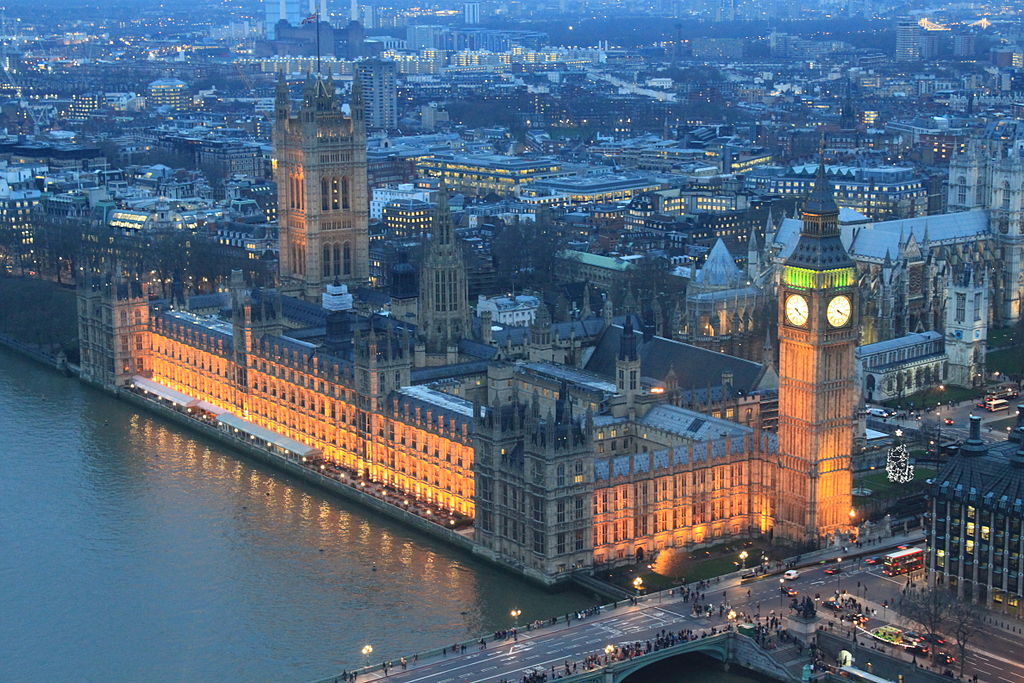
Palace of Westminster Source: By Superikonoskop [CC BY-SA 3.0], from Wikimedia Commons
In this post, Paul Seaman reports on the contrasting views at key events in Westminster: a parliamentary debate and question time on onshore oil and gas production; and the UK Investor Show at the Queen Elizabeth Conference Centre.
Peers question ministers on gas production
 The Lib Dem’s Energy Spokesperson, Baroness Featherstone, (left) asked the government:
“What is their assessment of the extent to which indigenous gas production is needed for energy security.”
 Lord Henley (right), an Energy Minister, said indigenous gas production met 46% of the country’s gas demands in 2016. Other gas came from a “diverse and flexible” system of gas sources, including Norway, Europe and via LNG gas terminals, he said.
Baroness Featherstone asked:
“Does he agree that it would be good to end the ugly and unnecessary distraction of fracking?”
Lord Henley replied:
“As regards production of domestic shale gas, I think we should do everything we can to tap into this potential resource.”
 The Conservative, Lord Polak (left) asked what the government were doing to help the shale gas industry.
Lord Henley replied:
“I hope that we are giving every possible encouragement to the shale gas industry. We think that the economic impact of shale, both locally and nationally, could be very large indeed. There will be opportunities for jobs and energy security, and in a great many other areas, through supporting that industry.
 Lord Henley failed to confirm there would no fracking in national parks or areas of outstanding natural beauty. He was replying to a question by Baroness McIntosh (right), the former Conservative MP for Thirsk and Malton, where companies have licences in the North York Moors National Park. Lord Henley would not comment on individual applications for the exploration of domestic gas.
The former Conservative Chancellor, Lord Lawson, suggested the strongest opponents of fracking, both in the UK and Europe, were the Russians, who relied on exporting their gas.
 MPs debate UK oil and gas industry
In a Westminster House debate, the Energy Minister, Claire Perry, told MPs:
“I, the Government and many industry commentators absolutely see a role for oil and gas in the mix going forward, with a shift towards gas.
“The Government are committed to gas—it is not just me; it is other international parties as well—but finding ways that can help us take carbon out to keep the energy supply flowing is also part of that mix.”
She also added:
“Could I put on record that I am a little mystified about the Scottish Government’s decision to refuse to allow exploration for gas onshore when we know it is there because it is a geologically identical strata?”
 Opening the debate, Colin Clark, Conservative MP for Gordon, quoted Lord Turner, a former chairman of the Committee on Climate Change, who said oil and gas would be a major source of energy at least into the next century.
Mr Clark said hydraulic fracturing of rock formations has been carried out safely under the North Sea for 30 years. He said he respected communities that did not want fracking but he said:
“Let us be frank: it is about nimbyism. They do not want it in their backyards. That is what it is about, rather than a denigration of the science and technology of those sectors.”
 Kirsty Blackman, SNP deputy leader at Westminster, said the benefits of fracking were not as big as they had been made out to be.
There would be little in the way of jobs or tax take, she said. It would not compensate for the upheaval caused to  local communities.
Alan Brown, the SNP’s energy spokesman, defended the Scottish government’s decision not to support applications for fracking. He said Texas, had now banned the process, despite developing modern fracking techniques.
Onshore industry is “not a priority” for ministers, says oil boss

Last week’s warm words from ministers failed to convince one industry executive speaking at the 2018 UK Investor Show.

Photo: Angus Energy
Asked whether the government was encouraging onshore development, Jonathan Tidswell, of Angus Energy , the operator of sites at Lidsey in West Sussex and Brockham in Surrey, said:
“I don’t think it’s a priority at the moment for the UK Government, whatsoever. It certainly doesn’t come across that way if you’re on the ground.”
Speaking during a panel event on exploration in southern England, Mr Tidwell said:
“We’re not exactly re-inventing the wheel. It’s all been done in the last ten or fifteen years to be sure, but the issue is being allowed to implement it correctly and safely in the UK.
“At this point that’s not happening, certainly not very quickly.”
He said most of the time it took to drill a well was spent on the planning process:
“At the moment I’d say we take eighteen months from identifying the target to drilling. The engineering part of that is a month – it’s the council and planning which takes the other 17 months.
“With the team I’ve got, I can drill probably about five wells a year without having to hire anybody else. Whether I drill one well in two years, or five wells in a year, I still have the same team, so if I can upscale that, I’m a very happy customer.”
He added that different planning authorities took very different approaches:
“The problem is not the planning itself, it’s that local authorities have different views.
“So in West Sussex, they have a very pragmatic approach. In Surrey, they take a lot of convincing.
“Literally, you drill a well one mile either way and you have a completely different set of guidelines.”
Flow testing at Balcombe
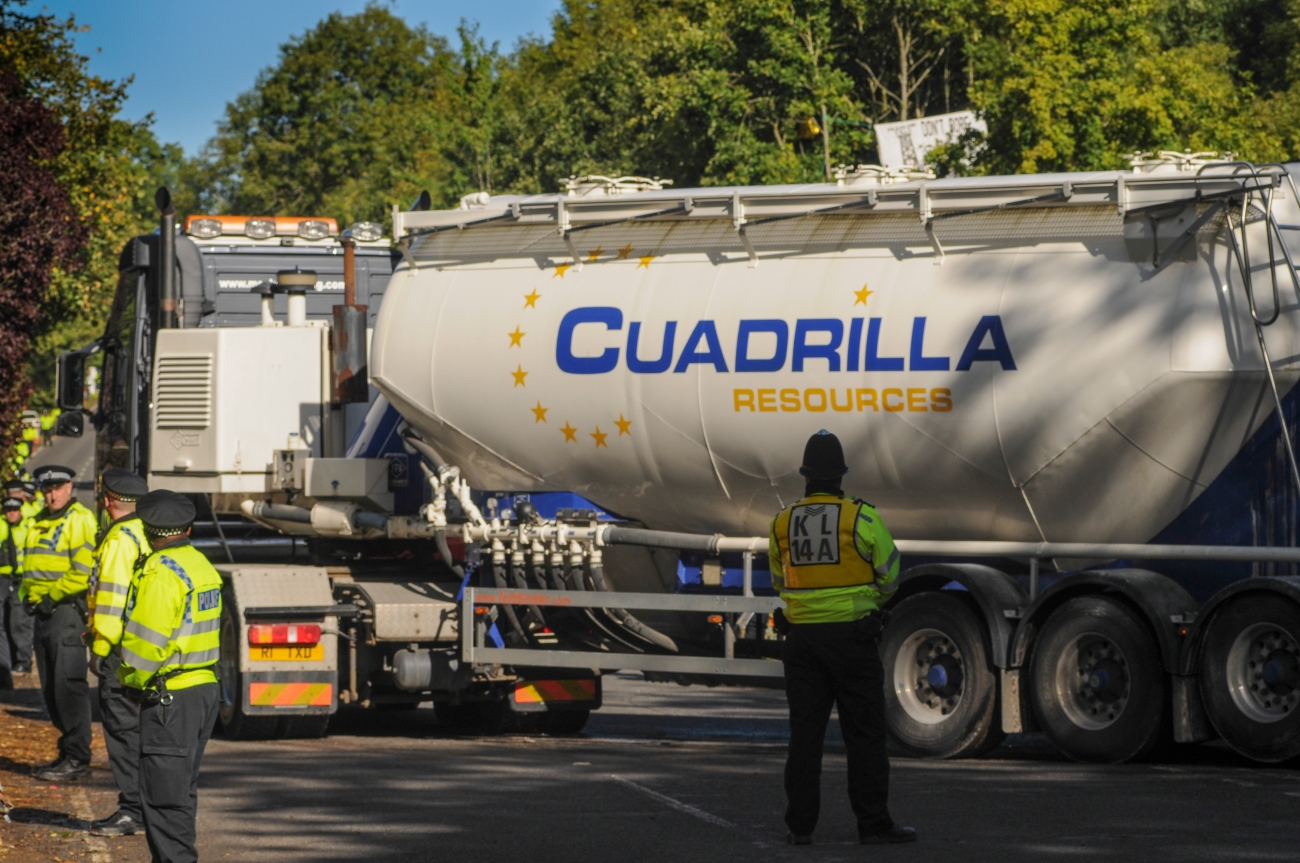
Cuadrilla tanker leaves the Balcombe site August, 2013
Angus Energy is waiting for approval to take over from Cuadrilla as operator of the Balcombe licence in West Sussex.
DrillOrDrop asked Jonathan Tidswell at the UK Investor’s Show how he planned to get acceptance from the local community for flow testing at Balcombe, due to take place this year.
He told us:
“My understanding is that the main objection is not coming from the town itself, but from a small minority of the town and external factors. The idea of taking over is that we are a non-fracking company. The idea will be to somehow convince the locals over the next few months that there will never be any fracking on the site.”
So was the fact that Angus haven’t been involved in fracking a factor in the deal? Mr Tidswell said:
“Yes, effectively, we had various discussions with them [Cuadrilla], and the idea was they are a fracking company and are not welcomed at the site. We are not a fracking company. We don’t inject into formations. Hopefully we can get that across, but until the deal concludes we haven’t really started community engagement.”
Links
Questions on onshore oil and gas 17th April 2018
Westminster House debate on UK oil and gas industry, 19 April 2018
Categories: Politics

 DRILL OR DROP?

So where are all these jobs that the industry promised ? Certainly not at Angus energy , the company that doesn’t know it’s towns from villages , that maybe explains why they couldn’t even find the right well head to drill at Brockham. Anyone with a water well near Balcombe should watch out for Angus turning up with a rig by mistake.
Drill teams and so called roughnecks are ten a penny from the industry, there will be no local employment beyond some canteen staff and cleaners, deliveries and road cleaners, the main source of revenue will go to the camp followers, the drug pushers, the prostitutes and gangsters, all looking for a fast buck and a quick fix.
Some people never learn there is no loyalty to staff, even to experienced staff and certainly none beyond the next Big Oil Frack Fix. They will be employed for a while until the next big fracking fix site becomes available, then it will up rigs and gone leaving the massive clean up job in its wake.
The off shift staff will be loose cannons knocking around pestering to local residents for the next soporific to kill the pain of an rough and empty life, all the attraction of drink, drugs, wild behaviour, violence, drug dealers, prostitution will follow closely on their money draw heels. Local quiet places will become social no go areas and no place to get away from it because it will be right on your doorstep. The police will have their work cut out just dealing with that, let alone any protest? Attitudes will harden and pretty soon our quiet little towns and villages will be social war zones, just like the cities are right now. Gone will be that peace and gentle appreciation of the countryside, it will be all money and what it can get at any price.
Who will get priority police protection based upon the present examples of police behaviour towards the public? Will the priority be toward the law abiding public or the invading fracking workers? What have we learned so far from experience at such exploration sites?
Look at any of the oil boom towns in USA, Canada, Australia, and the last few bastions of the feeble fracking empire, violence increases, street drunkenness, drugs, social disruption, prostitution, you name it, you think your nice little towns and villages will be filled with rich beautiful people with peace and love on their minds? There are plenty of examples of these locations if you care to do some research? Make up your own minds.
Wake up people the mere presence of this money grubbing industry is a threat to the local quiet little countryside towns and villages, where do you think the workers will go for fun when their shift finishes?
What is the Big Oil and Gas industry famous for? The roughest toughest hard drinkingest hard livingest bunch of hardnecks in any industry? Oh yes, they maybe rich in local terms but as for values of the local residents and respect for children, women and local people who walk their dogs late at night, horse riders and the feeling of peace and freedom of the open roads and quiet locations?
What do you think will happen to those quiet little roads and corners, open spaces and countryside? Massive HGV increase, traffic dangers, pollution from vehicles and the sites, chocked streets heavy duty noise at all hours, no rules obeyed, they will get police priority, not the people, and stinking over used deteriorating crumbling roads, cracking buildings and more accidents and no where safe to walk anymore.
Time to wake up and stop it before it starts and stop this industry illusion of all jobs and prosperity and roses and peace and love, before it all goes to hell in a rigged HGV.
It is interesting that the news about the Australia Northern Territory lifting the fracking ban last week based on independent scientific report and evidence. And not a single mention from this website or the anti frackers.
I just got back this morning, some of us dont sit behind an industry pr desk all day, i work nights sometimes and i am a little groggy yet, but since you ask BTW?
This is Ian R Cranes video for yesterday, which mentions the Australia turn about, it has not come from anywhere but from the industry pressurised government, and you know what stinkers they are?
( https://m.youtube.com/watch?v=ZcKfZ46IwSU&feature=em-lbcastemail )
This is the Fracking Nightmare web site:
http://www.frackingnightmare.com/news.php
and this is the fracking chemicals download that Ian mentions in his video blog.
http://www.frackingnightmare.com/downloads.php?download_id=1
what is interesting about Australia is that they have a 750m exclusion zone around well pads, if you guys seriously want to emulate the Australian experience, then i suggest we will impose a 750m exclusion zone here too? Seems fair?
I am off to bed for a couple of hours, have a nice day.
Well Jono, you have that to look forward to! How many sites have been developed on-shore recently? The maths are not that difficult.
Martin , there is only one thing to look forward to and that’s the end of this archaic dirty fossil fuel industry .
TW: 3 points
– 1/ Australian Northern Territories: population 0.25 million; land area 520,000 sq mile (pop density avg: 0.5 p/sqm) … 2/ England: population 55 million; land area 50,000 sq mile (pop density avg: 1000 p/sqm). Is it similar ‘up north’ in England (on average)?
– are there other ways in which you’d like to compare England and NT Australia?
– apart from the arguments about why onshore fracking will be bad news for England (well covered already here) I rest my case.
I should keep taking the supplements then Jono, as it will be here long after we are gone!
Well PhilipP, it is a good job you are not employed in the legal world then!
The population density in Australia is about land mass, and population. Within the UK we are densely populated, which means our energy requirement per square kilometre is much greater than Australia. Your “rested” case would require little UK generated energy of any sort with most being imported, or a dramatic reduction in UK population. Interesting choice!
And so is the fresh water requirement Martin. Oil and gas are more important than water to people like you it seems, or is it just the gamble on profits at others expense (for your beloved industry)?
The twenty thousand fracking wells in Queensland went down a treat didn’t they? (yes – they didn’t). Fewer people to protest up north though … funnily I heard that before somewhere.
Oh dear, so I am an investor again! When you have nothing to say you resort to that one to try and excite the anti capitalists. Goodness, can’t the antis attract some proper anti capitalists who don’t require a repetition of a false argument
… meanwhile you confuse a question for an argument.
Just read this (see link below) on Earthjustice email – maybe useful. Felicity
https://earthjustice.org/news/press/2018/glendale-hits-the-brakes-on-500-mil-gas-fired-power-plant?curation=newsletter&utm_source=crm&utm_medium=newsletter&utm_campaign=180422_ForTheRecord_April2018&utm_content=pesticides_ResponsiveBottomTakeActionButton&autologin=true#start
When you have had the question answered numerous times before then it is no longer a valid question. Either that, or memory is going or there are multiple posters using the same name. Take your pick-but I would propose my explanation was somewhat kinder.
I won’t bother explaining rhetorical questions to you Martin. Sorry to get you overexcited.