The British Geological Survey recorded a small earth tremor today near Cuadrilla’s fracking site on the edge of Blackpool. This follows three micro-seismic events yesterday.
The seismic activity, the first recorded in the area since fracking began on Monday (15 October 2018), was too small to be felt at the surface.
But today’s event had a magnitude of 0.3ML, which would have put it in the amber zone of the regulations on induced seismicity had it occurred during fracking.
Under the rules, known as the traffic light system, operators are required to “proceed at caution” in amber. Fracking must stop immediately if seismic events reach 0.5ML (the red level).
The rules were introduced after fracking at Cuadrilla’s shale gas well at Preese Hall in 2011 was linked to earthquakes measuring 2.3 and 1.5.
Yesterday’s micro-seismic events measured -0.2, -0.8 and -0.3 magnitude.
All the activity was clustered on the edge of Blackpool, near the junction of A583 and Peel Road. This is the area approximately at the end of the horizontal shale gas well, called PNR1z, currently being fracked by Cuadrilla.
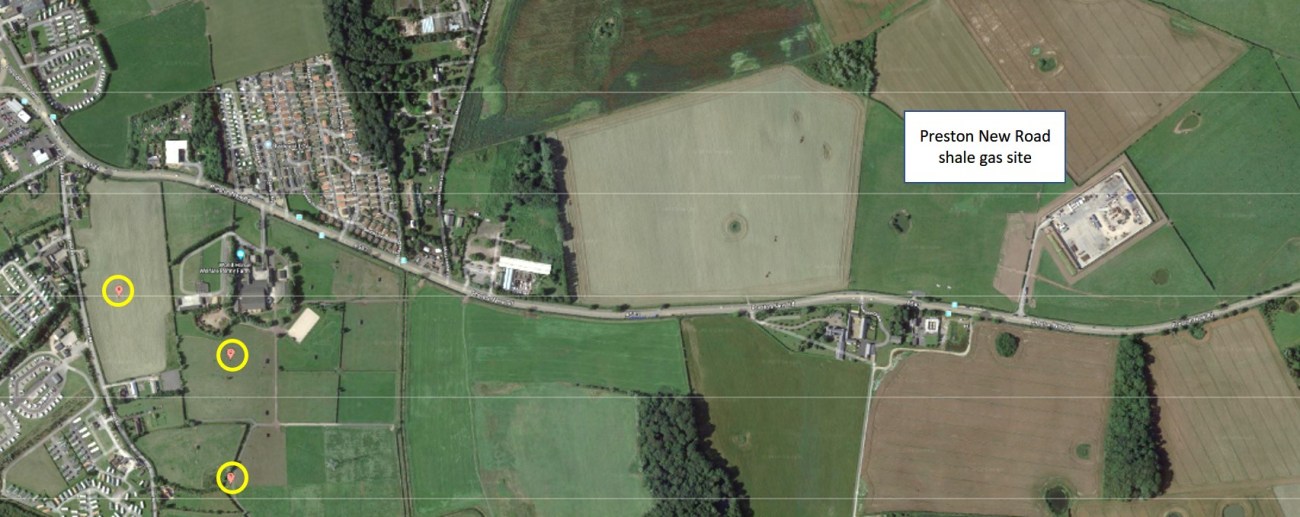
Location of seismic events (yellow circles). There were two events at the most southerly point. Source: Batch Geo using maps copyright 2019 Google Imagery
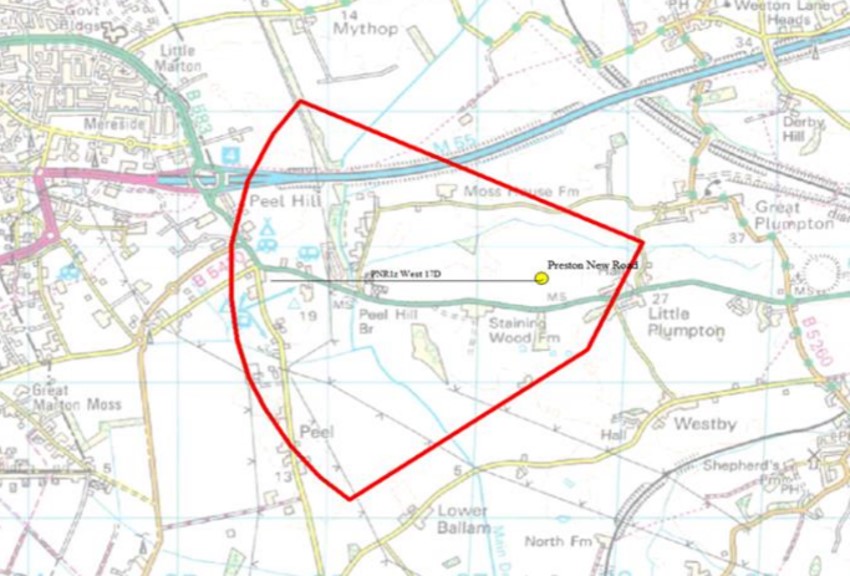
Location of Cuadrilla’s shale gas well currently being fracked. Source: Cuadrilla Resources hydraulic fracturing plan
The first event was recorded at 4.48pm (BST) yesterday, followed by two others later at night at 11.54pm and 0.44am (both also BST). The depths were estimated by the BGS at 2km and 3km. Cuadrilla is fracking at a depth of about 2.2km.
Today’s event was at 2.20pm (BST) at an estimated depth of 3km.
Yesterday’s events were too small to show up on Cuadrilla’s online display of seismic data. This shows activity only in the amber and red zones of the traffic light system.
A spokesperson for Cuadrilla told us today’s 0.3ML event would also not be shown on the display. It was classed as a “trailing event” because fracking was not actually taking place:
“If we had been pumping at that time it would have indeed been an amber event we would have confirmed it.”
On yesterday’s events the spokesperson said:
“Three microseismic events were detected yesterday by the highly sensitive Traffic Light System Cuadrilla has installed around the Preston New Road site and were very far below levels that could be felt at surface. The recordings from these seismometers are shared with the British Geological Survey to help them reassure the public that operations are continuing safely as planned.
“We take the monitoring and regulation of seismicity seriously, with daily reports sent to the regulators. The microseismic events recorded were extremely low and well within the Green Light threshold and confirm that the monitoring system is working to the highest standard.”
DrillOrDrop asked the company whether it was fair to say that the events were caused by fracking. The company’s spokesperson said:
“Events of this magnitude cannot even be described as tremors. To do so implies some felt movement at surface and micro seismic measurement confirms this is simply not the case We’ve been monitoring baseline seismicity for some time in the run up to starting hydraulic fracturing operations, and we have noted fluctuations at this very low level of microseismicty during that time. What we do know is that our detection systems are working as planned and these very low levels of seismicity are being detected.”
We also asked when the most recent hydraulic fracture treatment took place. Cuadrilla said:
“The most recent stage was completed yesterday and our hydraulic fracturing operations are continuing as planned.”
The Southampton University geologist, Dr Stephen Hicks, who has been monitoring a recent swarm of earthquakes in Surrey, tweeted:
“These are tiny “microseismic” events (not felt at the surface) and to be expected as they are probably caused by the brittle failure of small volumes of rock due to the hydraulic fracturing process. It’s good that the BGS network has such a small detection threshold.”
Dr Nick Riley, commenting on the micro-seismicity, said:
“The -0.8 event corresponds in terms of energy released to a person of average weight at 75kg jumping onto the ground from a height of 2m.”
David Smythe, emeritus professor of geophysics at University of Glasgow, who opposed Cuadrilla’s shale gas plans in Lancashire, said the events could be a warning sign:
“Recent research by Stanford University shows that these tiny tremors can be indicators of bigger quakes to follow – like canaries in a coal-mine. The problem for Cuadrilla is that if it carries on regardless, bigger earthquakes may well be triggered. To quote Cole Porter; “There may be trouble ahead”. Cuadrilla’s only safe option is to cease fracking.”
A spokesperson for the campaign group, Frack Free Lancashire said:
“We will continue to monitor these events closely. Considering the relevant past history with the Fylde Coast’s geology and having two significant seismic events which effectively shut down the fracking industry, all eyes are currently on Cuadrilla. These events may be dismissed as being minor and “can’t be felt” but what occurs under the earth is beyond anyone’s control.”
Categories: Research

 DRILL OR DROP?
I am surprised that Cuadrilla haven’t compared them to standing on Blackpool promenade when a tram passes by!
The important point I am making is that the next tram will arrive on schedule and will be the same size. The exact time and size of the next tremors/earthquakes could be any time and any size!
Hang on to your hats and kids!
Tram would be a red event if you were standing next to it.
A further quake of 0.3 ml ( 5 time stronger than the strongest of yesterday’s quakes) occurred at 1:20 today
Pumping faster.; finding the limit…. Certainly looks like it is working.
Refiction, how about the 2.0 event in May in the Forest of Bowland? That was a humdinger, huh? Except no one felt it. This must be so exciting for you!
It’s just a question of time, Cuadrilla are incompetent, could be the shortest fracking history
Shows the monitoring system working as planned, and the fracking process also working.
No one can now complain that the seismic testing system is not functional. Oh yes they will.
Come on guys surely this isn’t going to be a a standard of reporting from now on? Hobbits belly rumbles after an Indian would show a higher level of seismic activity than this.
I’ll let it pass as it’s the first time and I know antis are easily scared, hopefully back to a higher standard of blogging that I’m accustomed to going fwd.
Enjoy the weekend everyone, apparently there are some marches going on? I’ll expect some photos on Monday!
Amber baby! Amber!
Amber…
Is the next March past PNR going to involve a mass jumping up and down exercise to trigger an event???
Martin Collyer please show me data for that location, where 4 quakes happened over the space of 2 days, now increased to 0.3 today, over Cuadrilla’s pre-fracking monitoring period, I can’t seem to find that information
Cuadrilla say “We’ve been monitoring baseline seismicity for some time in the run up to starting hydraulic fracturing operations, and we have noted fluctuations at this very low level of microseismicty during that time.”
However the BGS have no records of any such seismicity locally in their database. Can Cuadrilla clarify exactly what measurements they have and why they were not shared with the BGS?
Refracktion
I guess the question is, do the BGS disagree with Cuadrilla ( ie have they said the information was not shared ). I may have missed that bit where the BGS say that information has not been shared, or they disagree with the statement by Cuadrilla, or both.
Or ask Cuadrilla, have they shared this information with the BGS, and if not, why not?
I have just plotted the four events on my Lancashire work interpretation map. They all lie between 100 and 300 m distance (in plan view) from the toe of the well, which is at OS grid position 335740,432585 and at 2240 m depth. Fracking started at the far (west) end of the well, near the toe. There is a suggestion of an approximate N-S alignment.
North – south is presumably the alignment they want / you would expect the fracture to propagate?
No. It is maybe highlighting a major fault line that is maybe under critical stress. Slip along the fault boundaries causes the tremors or earthquakes. This is why they should stop. No one knows for sure how critically stressed all the composite faulting in the region is and how this faulting interplays. Fracking in a highly fractured thick geology is likely to cause a major quake. The latency effect has also been exposed already. Once you’ve fracked then you may continue to experience quakes, even if you stop fracking. So a warning to stop fracking immediately. Jackstraws really. Eventually you’ll loose….
So which way are they trying to get the frack to propogate? The well is drilled west – east; fracks will propogate radially north – south. Not sure why they should stop? It looks like they are achieving what they set out to do, and what is approved by the authorities. There is currently no valid technical reason to stop? TLS is working.
The fracking isn’t 300m away from the toe of the well. Or at least it shouldn’t be. It should be in a radial hemisphere N /S from the injection point, presumably the first injection points will be the closest to the toe of the well. These tremors will be induced due to stressing the whole of the immediate regional geology with pressure. It is imperative to avoid this. Elsewise it is migration of the frack fluid along fault lines to the area where the quakes were. This is again not required both for safety and for frack efficiency. If the fluid progresses down fault lines or cracks then it’s not fracturing the rock as it should be. Wasted energy and more potential pollution. In north America they typically frack unfaulted thin shale beds. Not thick highly faulted ones.
Looking at the map and the wellpath sat image above the events are S of the wellbore and consistent with fracking back along the horizontal section from TD. I think this is what David Smythe is saying. If the events are not perpendicular to the well and west of the well bore then you may be correct. The other point is that the formation is not homogeneous and will vary in sand content. Cuadrilla are presumably targetting “sweet spots” which have higher sand content but this will change as the frack propogates. If the induced stress is multiplying then we will see a much larger event which is what you are predicting I think?
Page 9 of the HFP V9 indicates a average fracture height ranging from 24 – 150m and average fracture half length ranging from 64 – 313m.
These are warning signs of the brittleness of UK shale.
Brittle is exactly the reason why Gas will flow. ie Success…
Germany failed at fracking because of too much clay…
Yes Martin, the system is working, not long now before Cuadrilla won’t be. #ShortestFrackjobEver