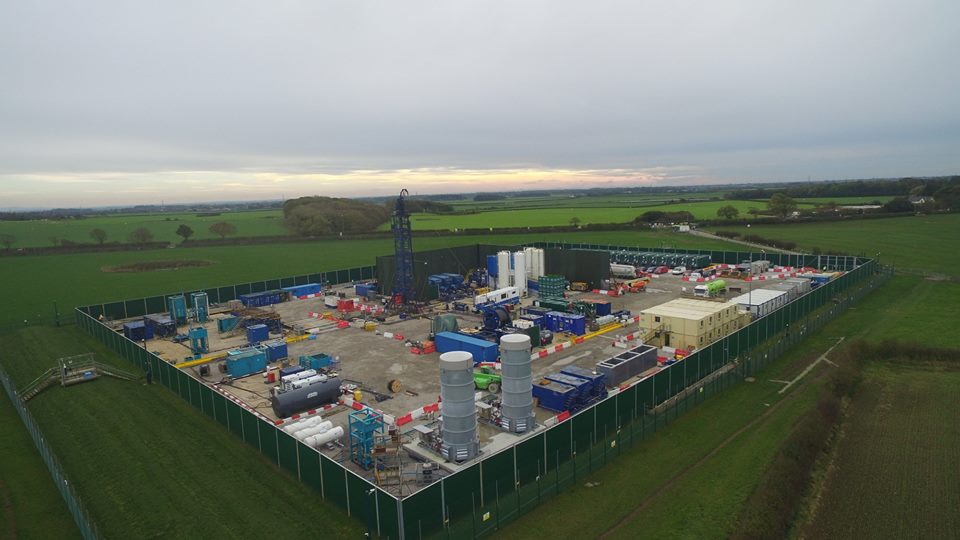
Cuadrilla’s Preston New Road fracking site, 31 October 2018. Photo: Eddie Thornton
The fracking company that warned today it was “about to choke” from regulations on earth tremors worked with government officials six years ago to develop rules that were stricter than those used in other countries.
Francis Egan, chief executive of Cuadrilla, complained in the Financial Times that the UK shale gas industry could be “strangled before birth”. In an interview with The Times, he said “we are not getting effective fractures” and that unrepresentative results could “turn off investors”.
Last week, Mr Egan told the Department for Business, Energy and Industrial Strategy that the rules on seismic events triggered by fracking needed to be relaxed to make the process commercially-viable in the UK. It looks unlikely that he got the answer he wanted. The energy minister, Claire Perry, said today a change to the regulations would be “foolish” at the moment.
But in 2012, Mr Egan appeared to take a different approach, accepting seismicity thresholds “well below levels commonly used worldwide” and “a much larger factor of safety at this exploratory stage”.
Agreed earthquake limits
In a letter dated 1 November 2012, Mr Egan answered questions put to him by the then energy minister, John Hayes, about changes implemented by Cuadrilla on monitoring and controlling seismic events during fracking.
The questions were prompted by earthquakes linked to Cuadrilla’s fracks at Preese Hall, another site near Blackpool, in 2011. Two earthquakes measured 2.3ML and 1.5ML and were felt by people in the Blackpool area. There were reports of damage on the surface and evidence of deformation of the shale gas well.
Mr Egan told Mr Hayes:
“In conjunction with industry experts and your team at DECC we have developed a “traffic light” seismic monitoring and mitigation system”.
He explained that fracking would be slowed down or stopped if seismic activity exceeded pre-determined levels “such that there are no ‘felt’ seismic events at surface.”
Mr Egan said:
“The concept of a seismic traffic light system itself is not new, having been extensively used for geothermal and other projects worldwide.
“The traffic light levels set for our potential forthcoming fracturing operation in Lancashire have, however, been set well below levels commonly used worldwide to ensure that we maintain a much larger factor of safety at this exploratory stage.”
The letter did not challenge the recommendation on seismicity controls already made in a report for the Department of Energy and Climate Change on the Blackpool earthquake. The authors, Green, Styles and Baptie, had proposed a red traffic light level of 0.5ML.
In December 2012, a month after Mr Egan’s letter, the then energy secretary, Ed Davey, issued a written ministerial statement in which he confirmed the red light should be triggered by events measuring 0.5ML or above. He described this as “an appropriately precautionary approach.” DrillOrDrop report The shadow of Preese Hall
Fracking-induced tremors
Ed Davey’s traffic light system was first used in October 2018 when Cuadrilla started fracking at Preston New Road.
In the past fortnight, there have been more than 30 seismic events recorded near the site on the edge of Blackpool. Cuadrilla has temporarily suspended fracking three times when seismic events passed thresholds in the traffic light system.
So far, the largest magnitudes of tremors during fracking, as measured by the British Geological Survey, have been 0.8ML (local magnitude) and 1.1ML.
Mr Egan has called for the red light threshold to be lifted from 0.5ML to 2.0ML, which he said was used for fracking in some other countries and was below that used in North America.
He told The Times:
“We are not getting effective fractures. We are not getting enough sand into the ground to get a good test.
“We may not want to flow test it because it’s not a totally indicative representation of what this shale rock could do if tested with sensible [earthquake] limits.”
Mr Egan told the Financial Times:
“It certainly looks like it would be — I can’t say impossible — but I could say very difficult to make this a commercial venture if you had to continue operating within a 0.5 red line.”
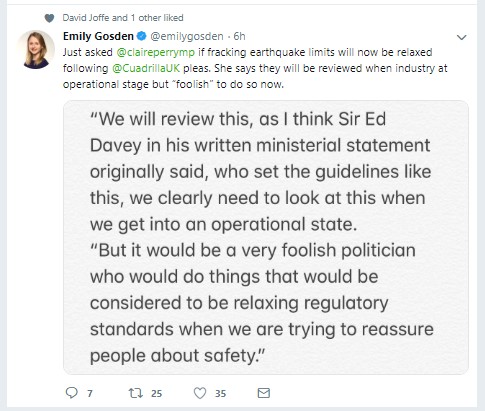
Emily Gosden, of The Times, tweeted that the energy minister, Claire Perry, looked unlikely to review the limits immediately. The minister was quoted as saying:
“We will review this, as I think Sir Ed Davey in his written ministerial statement originally said, who set the guidelines like this, we clearly need to look at this when we get into an operational state.
“But it would be a very foolish politician who would do things that would be considered to be relaxing regulatory standards when we are trying to reassure people about safety.”
DrillOrDrop asked Cuadrilla why Mr Egan offered a traffic light system “well below” worldwide levels in 2012 but was now seeking a level of 2.0ML.
A spokesperson said:
“The traffic light system was setup by DECC. Mr Egan was simply observing in the letter that the concept of a traffic light system is not new and that UK shale has a traffic light system set at far levels lower than those set worldwide. And that opinion has not changed.
“What has changed since 2012 is that we have begun fracking the first horizontal well into UK shale rock and the evidence so far is that the Traffic Light System is working, as we have said before, but the red light threshold is clearly set very low and all the seismicity created so far has a level that is way below anything that can be felt at surface and a very long way from anything that would cause damage or harm. The micro-seismic events have not impacted on well integrity and indeed the larger events at the Preese Hall well likewise did not lead to any loss of well integrity.”
The local Conservative MP for Preston New Road rejected Cuadrilla’s call for a higher red light level.
Mark Menzies, speaking in a debate on shale gas planning today, said:
“For six years the industry was not approaching me, or not approaching anyone, to say that this threshold was far too low.
“We now have calls to say that actually it needs to be a 1.5 or it needs to be a 2 in order to trigger a red event.
“I’m sorry but that ship has sailed. You had six years in order to make the case for that and no case was made.”
Categories: Regulation

 DRILL OR DROP?
What are the World Wide limits, they keep referring to?
Egan was talking about a 4.0 used in Canada where there are only 4 people per square mile.
Oh dear, earthquakes and unable to get commercial gas flow, deja Vue moment. Bye bye Cuadrilla.
The vengeance of Hell boils in my heart,
Death and despair flame about me!
If Fracking does not through you feel
The pain of death,
Then Earth will be my safe home nevermore.
Disowned may you be forever,
Abandoned may you be forever,
Destroyed be forever
All the bonds of nature,
If not through you
Fracking becomes pale!
Hear, Gods of Revenge,
Hear a human’s oath!
She’s singing now!
Mozart from the Magic Flute – Queen of the Night Aria (adapted)…
Now I know Sherwufle is Phil C.
nope; too many presumptions and misconceptions TW et al; your multiple personality is confusing itself 🙂
And we know you are TGN01 over on Hot Copper (or Eyore) as you are more affectionately known 😉
Ha! Ha! Nice one Sher, now we know TW is TW is TW is TW is……..so many others……
This does rather feel like an industry that agrees to regulation and then when it suits widens the goal posts. It is exactly the same with planning controls. The fact that the industry has lobbied government for permitted development rights and NSIP status following the Examination in Public in Yorkshire just goes to show that the U.K. industry wants to operate in the same way as fracking operates elsewhere in the world. The impacts and risks increase the more wells are drilled and fracked and especially without planning controls that control the cumulative impacts.
Drilling frack wells near faults was a very bad idea, he should know that, that’s why more safety conscious States have respect distances to prevent it. Not in England though, so Preese Hall and PNR happen. Still they choose to drill there.
Cantdrilla and the reverse Midas touch……..
This certainly spell the end of UK shale. 1.5ML level would be safe and reassuring the public. But the minister at BEIS will likely to take the instructions from their local MPs who are protesting to maintain their votes in their local constituency.
‘1.5ML level would be safe and reassuring the public.’ – nope; no level is safe and reassuring to the public…..
Sort this out @theresa_may!
I suspect Cuadrilla had little choice other than to accept the limits which were probably just pulled out of the air as a PR exercise by the then Department of the Environment. It was that or abandon the whole project for Cuadrilla.
Not a PR exercise Shalewatcher, but recommendations from the BGS and concocted by the OGA; your own people, no less. Cuadrilla don’t know what they are doing, that’s the problem, and they often believe their own half-truths and PR rhetoric. They had plenty of time to work with this, but believed they knew better despite the evidence from Preese Hall; foolish or sustained ponzi, take your pick – how much has FE been paid so far, and those who went before him from investors money I wonder?
According to Francis Egan, Cuadrilla “developed” the system themselves – hoist with their own petard I think
So, they are not getting effective fractures, but still getting tremors up to 1.1 ML. Presumably if they achieved effective fractures they would get correspondingly larger tremors. At the frequency at which these tremors occurred it would increase the danger to the integrity of the well.
If Mr Egan considered that he could work with the traffic light system over the last six years, but decided this is wrong after one weeks actual experience, it does throw considerable doubt on his grasp of the issues. This is not an industry that can afford margins for error.
A new report from climate scientists say oceans are heating up 60% more than previously estimated; we will now have to cut emissions by 25% more than the Paris Agreement. Fossil fuel, over-farming and consumerism is choking the planet. This report must make shale a non-starter.
The limit was set by Lib Dem minister at the time. And clearly the Lib Dem do not support fracking back then and still don’t.