
Gas flares at Cuadrilla’s fracking site at Preston New Road near Blackpool, 2 November 2018. Photo: Cuadrilla Resources
A publicity video used by Cuadrilla as evidence of the first shale gas production from its site in Lancashire may not be quite what it seemed.
The company sent up a drone to film a burning flare stack at the site near Blackpool in early November 2018.
It released the news to the media, describing the development as “significant” and “a good early indication of the gas potential that we have long talked about”. The pro-fracking group, Lancashire for Shale, said the gas flow was a “real credit to the expertise and tenacity of Cuadrilla”.
But an official document released this week reveals that the volume of gas reaching the surface at Preston New Road at the time was so low that the company had to feed in propane as a support fuel to light the flare.
Opponents of Cuadrilla’s operation had been sceptical about the 12-second video and the volume of gas in the well.
This week, the Environment Agency confirmed that the volume of gas coming to the surface was “very low” and that the day before the video was released methane was released unburnt into the atmosphere.

Extract from Environment Agency report, 2 November 2018
The details are in a report of a site inspection by the Environment Agency on 2 November 2018. The document, called a Compliance Assessment or CAR report, said:
“On the 1st November gas was sent to the flare from the separator. The gas was not burnt at the flare on this occasion due to the very low volume of natural gas. The gas was picked up on the onsite monitoring instruments at very low levels (5ppm over ten minute period).
“We acknowledge that the level of methane detected was significantly below anything that would have an impact on human health or constitute a risk of explosion and there was no environmental impact. Gas was managed in this way for safety purposes and does not constitute a breach of the permit.
“On the morning of 2nd November gas was again sent to the flare from the separator. On this occasion a support fuel (propane) was used to assist combustion. There was no visible increase in methane emissions on the boundary monitoring equipment.”
DrillOrDrop asked Cuadrilla what were the volumes or proportions of shale gas and support fuel burned in the flare on 2 November 2018. We also asked why Cuadrilla had not mentioned the support fuel in the press release and how long the company had continued to use a support fuel in the flare.
A spokesperson for the company said:
“As you are aware, we are now in the flow testing phase at Preston New Road and will look to publish results in due course. We are very encouraged by what we are seeing but are not providing a daily commentary on testing.”
The campaign group, Frack Free Lancashire, said today:
“It would seem that Cuadrilla’s woeful PR campaign has fallen flat on its face yet again. In November, desperate for some good news after provoking a series of earthquakes, they published a video showing the flaring of gas from their first well.
“Widely ridiculed at the time, as it only lasted a few seconds before being seen to have petered out, we now learn that far from being a “significant” find, this gas flow was so weak that they had to add patio gas to it to make it burn. No further comment is really needed, is it?”
There are several options for dealing with gas during flow testing. It can be piped into the gas grid – as Cuadrilla plans to do during the extended well test at Preston New Road. It can also be flared or – usually in emergencies – vented to the atmosphere.
The Environment Agency said in the CAR report:
“We are currently reviewing what is best practice including the benefits of using a support fuel to assist the combustion of very low levels of natural gas against the management of natural gas without combustion through the flare.”
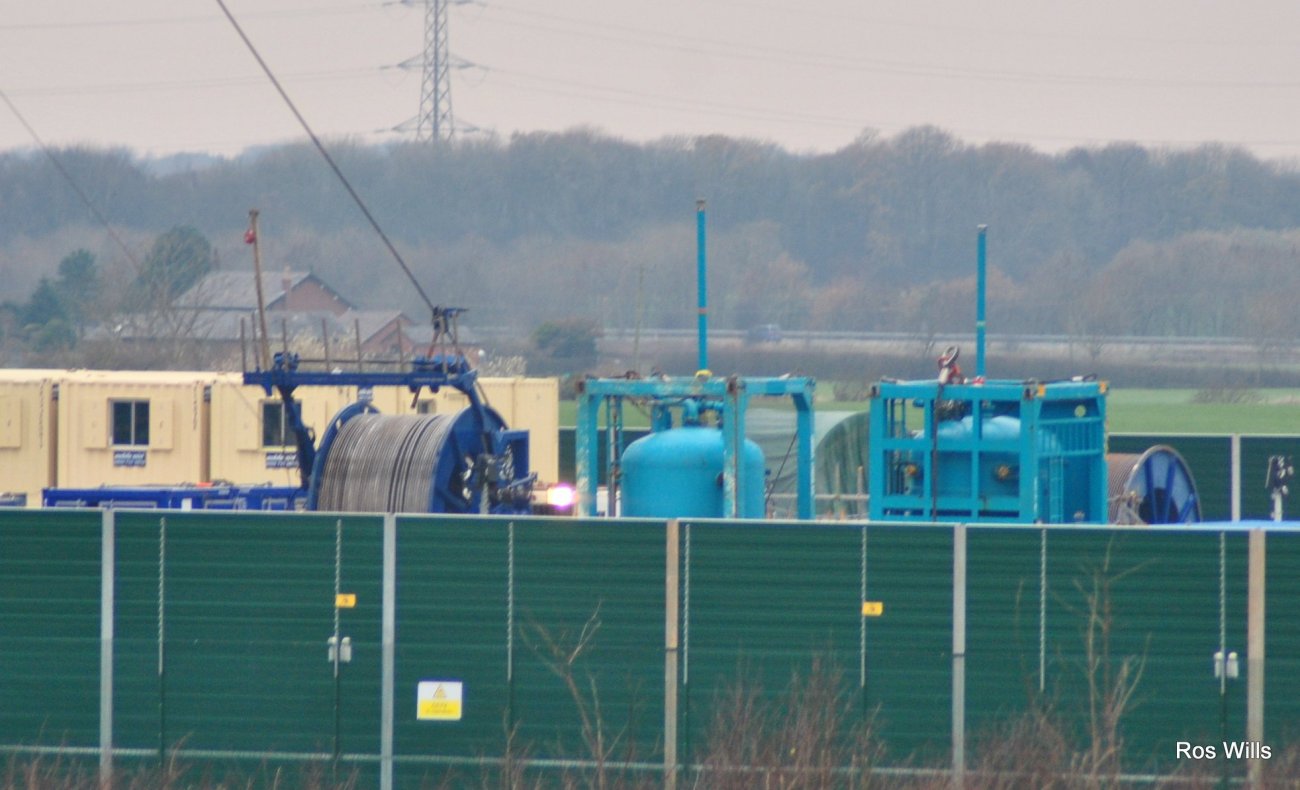
Preston New Road, 21 November 2018. Photo: Ros Wills
The gas flow press release came after a difficult fortnight for Cuadrilla.
By 2 November 2018, fracking at Preston New Road had already caused more than 30 earth tremors.
The company’s Australian partner, the mining group A J Lucas, had seen its share price fall since the start of fracking on 15 October 2018. By 2 November, the price had dropped from 0.39 to 0.26 Australian dollars.
Cuadrilla’s chief executive, Francis Egan, told the Financial Times on 30 October that UK rules on fracking-induced seismicity – known as the traffic light system – were too strict. The country’s shale gas industry could be strangled, he said.
He called for an urgent raising of the limit at which fracking should pause from 0.5ML (local magnitude) to 2.0ML.
But the energy minister, Claire Perry, responded on 31 October that this would be “foolish” while the government was trying to “reassure people about safety”.

Extract from a letter by Claire Perry to Francis Egan, 2 November 2018
It has since emerged that she also wrote to Mr Egan on 2 November, saying:
“I note that your Hydraulic Fracture Plan was developed and reviewed over several months with reference to existing regulations, including the traffic light system and at no point did you communicate that it would not be possible to proceed without a change in regulations”.
She concluded the letter, released this week in response to a freedom of information request, saying:
“The Government believes the current system is fit for purpose and has no intention of altering it”.
The A J Lucas share price rose rose after the press release, reaching 0.31 AUD on 5 November 2018 but since then it has fallen to 0.20 AUD today.
Categories: Industry

 DRILL OR DROP?
Could you clarify whether this was before or after nitrogen had been used to lift the fracking fluids from the well? This clearly makes a big difference as anyone who has working in this area will know that after nitrogen is used to lift liquids the initial gas produced is mainly nitrogen. It might well be worth the people who write this rubbish to read a few books on petroleum engineering so that their journalism is factual as well as “independent”
It’s a very good point that you make; if one looks at the initial composition of the gas from many of our offshore reservoirs you’ll find that it has a very low methane content due to the fact that nitrogen was used to lift fluids. However, in this case, the well wasn’t being tested and water imbibition will have naturally prevented gas flow in the early time behaviour of the well.
Simon – if it was water imbibition as oppose to nitrogen what do you think consituted the other 999995 ppm of the gas produced? Overall, it seems to me that there isn’t enough information come to any conclusion – it’s just guess work. Anyhow, it will keep the antis happy. I did see a figure of 0.15 m3/min in one report which equates to 0.3 MMscf/day when upscaled to the number of fracks. It’s not a great rate but very encouraging considering that it’s not been fracked to its full potential and the well hasn’t yet been cleaned up yet.
As imported expensive propane is heavier than air Maybe the nitrogen is being used to lift the expensive imported propane up the flare stack where it can mix with tiny amounts of methane and any VOC’s that are present and produce investor impressing 12 second fuel burns.
John
I missed the bit saying propane was imported, though it may well be, but cheap uk produced propane is also heavier than air.
https://www.statista.com/statistics/615945/propane-production-trade-uk/
Well Martin , have you got an opinion on this one ? Cuadrilla wouldn’t be doing a PR job would they ? Haha Patio Gas , made my evening .
I think the point is, Judith, that Cuadrilla presented this video as evidence that gas was flowing from the well, and apparently didn’t explain that they had added propane to ensure the flare would light.
The Environment Agency, who were on site reported very low quantities of natural gas, too low to light the flare on its own.
If a nitrogen lift had affected the gas recovered, Cuadrilla were free to explain that, but didn’t.
Propane is used as a pilot light in a flare to ignite any gas that is vented through the flare. Otherwise how is the gas ignited? If you cold vent methane levels rise in the area and permits are breached. But as you point out, Cuadrilla should explain this. Or perhaps they are fed up with all the negativity and are just getting on with their testing program?
Paul – I think such a subtlety would be lost on the general public. After all, the general public are so stupid that they think fracking-induced earthquakes are a serious risk
Judith, how dare you insult people who you have never met, spoken to or have any knowledge of. This is the height of arrogance and insensitivity. As a member of the “general public” I totally reject your comment .So, not only are we stupid but many thousands in the Groningen district of Holland are also supposedly stupid when their houses and and other infrastructures were damaged to the point of destruction by a cumulative effect of thousands of minor, fracking-induced earthquakes. Judith – grow up!
Keith – by saying that fracking in Groningen has caused earthquakes you seem to have demonstrated my point. Groningen is a convention gas reservoir. The earthquakes are caused by differntial compaction of the Slochteren (Netherlands equivalent to the Rotliegend) against the Carboniferous.
As you can see from the court cases Cuadrilla have been kicked out of the Netherlands. Odd considering their target formation is different to Groningen.
https://www.schaliegasvrij.nl/
Cuadrilla have not been kicked out of the Netherlands; there has been a halt to shale gas fracking there. IMO it’s quite good news for Cuadrilla in that the shale in their license had only a small to moderate chance of success. They are now suing the Dutch government and I’m told by people very senior in the Dutch industry that they are very likely to win. The extra funds should help drill a few more wells in the UK. Great news
Simon – the shale looked quite good to me. It’s maturity was relatively low so it was likely to produce a reasonable quantity of liquids, which are more profitable than gas. I agree, however, that there is a reasonable chance of them being awarded compensation from the Dutch government.
Judith – but facts have to be faced that shale exploration is pretty high risk so I’d still maintain that the chances of success were quite low even if the shale was liquid-rich.
‘Cuadrilla have not been kicked out of the Netherlands’
Cuadrilla had a licence in the Netherlands. That licence is no longer valid. See my links.
Cuadrilla have had their days in court. Their application to frack in shale is now considered against the new 2017 mining act.
If you think that a small start up company can overturn a countries mining act you are sadly mistaken.
Compensation for their troubles. Unlikely, but they may get their licence money back. I doubt that would cover their legal expenses.
How are Cuadrilla doing in Poland these days? All the big players are reported to have left but hey, what do they know?
John – I work with every gas company in the Netherlands including the one that manages the governments stakes in the various onshore and offshore assets. I have frequent meetings with people on the board of directors of all of those companies. You on the other hand have read a few online articles. I can assure you that most people I talk to think that Cuadrilla will win the court case to get compensation for the fact that the government changed their policy towards shale gas plays. You really are arguing with the wrong person with regards to this issue – let me spell it out to you – I know lots about the internal politics of this and you don’t. Good night
I wonder if the investors were told that there was only a ‘small to moderate chance of success’ before they parted with their cash?
[Edited by moderator].
Fracking is banned worldwide because, amongst other issues, it has caused swarms of earthquakes causing damage above and below ground.
Earthquakes and seismic testing have already damaged properties on the Fylde Coast and there have already been payouts with non-disclosure clauses, I understand.
Peter – are you intentionally trying to mislead people? There has been no surface damage or payouts. Of course there has been underground damage – that’s why it’s refered to as fracking. What are you doing to accuse Cuadrilla of next? – fracking eggs to make omelettes
Judith, you really need to get yourself up to speed with the local facts.
https://www.theguardian.com/environment/2013/aug/02/fracking-cuadrilla-trespassed-private-land
– Otherwise your patronising remarks just look foolish
Refraction – it’s a silly argument to imply that collection of seismic data should be counted as fracking-related damage. We have to collect seismic data for a massive number of applications including geothermal energy, rad waste storage and even building large industrial facilities.
But Juedth – you categorically stated “There has been no surface damage or payouts” in response to Peter’s point “Earthquakes and seismic testing have already damaged properties on the Fylde Coast and there have already been payouts”.
When it is pointed out that you are absolutely wrong you try to change the point. Oh very dear.
His first paragraph categorically stated that swarms of earthquakes had caused damage above ground which they have not. I must admit after reading such bullshit in his first paragraph I didn’t even bother to read his second.
But Juedith, it’s that lack of attention to detail (same as with your counting of Cuadrilla’s attempts at drilling wells) that makes you look so arrogant when you make your sweeping statements. Do carry on by the way.
Refracktion – I might get bored reading rubbish but you seem to have provided a link to support that surface damage occurred which does no such thing. The article appears to suggest that compensation and costs were paid for the trespass case but it doesn’t mention costs being paid for damage. It doesn’t like you take much of an evidence-based approach.
Judith the article clearly says “Mills has also written to the company requesting compensation for damage to his property following explosions set off on his neighbour’s property”. I thought as you know everything you’d be aware how the claim panned out?
Refraction – indeed the article does state what you what you have written. However, it does not state that the court agreed that damage was caused by seismic testing; it does not state that compensation was given for said damage and further more there is no evidence that any damage occurred. The only thing that the article states is that Mills has written to Cuadrilla claiming that there was damage; that isn’t evidence. If there was strong evidence then compensation would have been given to Mills for said damage but it hasn’t has it Refraction? [edited by moderator]
The word locally Judith is that Mr Mills got substantial compensation. Perhaps you could get your pals at Cuadrilla to comment definitively as it would be interesting to know the detail? Mind you they seem to be in self-imposed purdah right now so I guess you might find that difficult.
It did seem to me that Egan was making a big deal of the event, I hope that he hasn’t misled investors because that could be serious. Let’s face it Cuadrilla are finished.
Jono – but you don’t actually hope that he’s mislead investors do you? What you really hope for that he has lead mislead invested and that Cuadrilla go but and that we then have to buy more gas from Qatar don’t you? Santa doesn’t exist and neither does Jeremys little money tree. So the more money we send abroad the less we can spend on increasing funding to the NHS, building homes for the homeless etc. But I’m sure that’s a tiny price to pay for not producing energy in your back yard.
Judith. I remember the pain when I realized Santa did not exist [aged 4 😦 ]; I empathize with your pain now that we know UK shale gas does not exist….
Have they flow tested the well yet? I don’t believe so, but perhaps they have? The information from above is early November which was not during the testing phase? If that was the well test then clearly it is game over for Cuadrilla. But was it? More like some gas entrained in some flow back fluid which needed to be vented. If cold venting is not allowed then it is normal to use a propane igniter at a flare stack. I don’t recall a well test with a flare system which did not have a propane igniter. Perhaps in the Libyan desert where we used flare pistols – but I doubt they would go down well at PNR. Useful for getting rid of drones though.
This is a non-story – this wasn’t a flow test as the well was effectively killed by the fracking fluid. It takes a little bit of time for the gas to flow after liquids have imbibed into the pore space of the shale following a hydraulic fracture stimulation.
I thought the flow back period was very short, terminated by the seismic activity, and not enough to clean out the lift gas let alone give a real indication of productivity (but then again, I am not privy to all the data).
Let’s get real here people – enough of the apologetics. If there was a significant flow you wouldn’t get to pick and choose your venting/flaring times, it would be happening already at a highly visible scale. I suspected that clip (earlier on) was of some sort of ignition test. The only other excuse for such a poor show could be if Cuadrilla had been extremely timid with the fracking process (due to seismicity say) with the anticipation of scaling the operation up later as/when permissible.
Of course you pick and choose your flaring venting times when flow testing PhilipP. You have total control via the surface tree valve arrangement. and choke manifold. If you had a significant flow without control there would be a major problem…..There is no storage facility for gas downstream of the wellhead valves / choke manifold. Once downstream it needs to be burnt or vented. Some gas will come back entrained with the frack fluid flowback, if nitrogen is used for lifting to reduce head then nitrogen will be the dominant gas until the well is unloaded, nitrogen injection has ceased and gas flows naturally. This is the flow rate Cuadrilla are tesing the well for. It will be anything above zero……
Have you actually been around a shale gas facking site after a 10-15,000psi injection Paul? I’m not saying I have but ive got the impression from commentaries and recordings that the necessity for flaring is crucial and that options for messing around with choking or plugging are limited during the early pressure relief stages – and risky.
PhilipP, I’ve been around fracking sites and I don’t agree that the necessity for flaring is crucial. In some places, one wants to clean up the frac ASAP to avoid formation damage. However, the experience in other places is that taking more time with the clean up can save loads of money because far less flow back water is produced and the production rates aren’t affected too much. To a certain extent, so many wells are needed to properly appraise shale gas resource plays because part of that appraisal is learning how best to maximize production.
Not shale but 10k and 15k and with 28% HCl. Makes no difference. The wellhead and choke manifold are the same whatever the lithology. The control has to be in place. The risks are greater from conventional reservoirs which have much more energy, reserves and higher open flow potential. And we used propane igniters on the flare heads.
If the flow of gas was really not expected to be significant at that point (as the lovely Judith and Simon seem to be suggesting) how very silly of Cuadrilla to try to make a huge thing about flaring it for 10 seconds and claiming it WAS significant..
They must have know the truth about the propane would out and now they look as though they were desperately trying to fool everyone. Who on earth does their PR these days?
What a pile of drivel, its like trying to light a fire with out a spark! Who writes this cr@p…
Or lighting gas without gas, EK?
Maybe after tomorrow this will all just be academic; Cons worse defeat in Parliament for nearly a century……
It looks like Cuadrilla are taking their business advice, straight from the pages of a Laurel and Hardy script ……
Let’s just have a quick look at the business model …… This is a company that extracts so little gas, it has to BUY in GAS to burn in the ” flare stack ” ……….. you just couldn’t make it up.
Talk about pulling the wool over your eyes…. Investors must be feeling , well and truly had over …
MARTIN , you previously talked about tax revenue from UK sourced gas/oil . Are we talking pounds , pennies or a BIG FAT sweet nothing here ?????
[Typo corrected at poster’s request]
It’s a good job George Mitchell didn’t listen to people such as you – otherwise he’d have never ended up owning half of Woodlands. I’d like you to find me one person who really believes that one can make a great success out of the first well that one drills and fracks in a resource play. I always think in terms of 10 wells are needed to even begin to assess the economic viability and 50 wells are needed until one is confident that it’s worth pressing ahead.
Well Judith, of course this isn’t the first well that “energy giant” 😂 Cuadrilla have fracked is it?
We can definitely agree that they aren’t making a great success of PNR though can’t we?
It’s good to see you are spelling “fracking” properly anyway.
They seem to be doing a great job; they have a 100% safety record and they have managed to drill and frack a horizontal well with only one previous vertical well. Obviously, you don’t know much about this subject but in general companies drill many vertical wells before they have gained sufficient knowledge to drill and complete horizontal wells. They are clearly very confident given that they are actively seeking tenders to buy their own drilling rigs and high HP pumps.
So, as you evidently know so very very much about this subject (what ARE your qualifications exactly BTW?) how many vertical wells have Cuadrilla managed to drill without causing problems for themselves Judith? And how many have they drilled in total? It’s not actually one as you claim here is it? Can you enlighten us please Oh Wise One?
Refraction – it depends on whether you define the pilot wells to the recent horizontal wells as being vertical. I personally do not.
You haven’t answered my question Juedith. Maybe it’s because you don’t want to?
Drilling wells hasn’t caused them any problems
You haven’t answered my question Juedith. Maybe it’s because you don’t want to?
Oh – my qualifications – long time ago I did a PhD in chemistry. I’ve since worked on both production chemistry and environmental consultancy. I worked on quite a few shale-related projects when i was based in the USA. However, since returning to the UK I’ve been doing more environmental projects – currently arsenic contamination of groundwaters in Bangladesh.
Oh juedith! You haven’t answered my question about the number of wells. Maybe it’s because you don’t want to … or can’t?
Refracktion – this is a debate page – are you genuinely unaware of the number of wells or is it one of this little games that you like to play. Before answering the question, I think you need to specify the area which you are interested in, whether you consider a cored pilot well as a vertical well or simply part of the horizontal well that it is the pilot for. It might then help if you specified which particular Cuadrilla company your talking about because many companies have separate companies for different assets
Judith – no – this is not a “debate page” it is the comments section of the Drill or Drop blog.
You stated categorically above that Cuadrilla had drilled ” only one previous vertical well.”
With relation to any of the myriad companies they have set up to cover their backsides in the event of problems do you stand by that statement?
Refraction – I really can’t be bothered hunting through company house to identify the exact company which drilled the various wells. For example, I actually don’t know if the company who drilled Becconsall, Elswick, Singleton or Westby were the same legal entity who are currently drilling testing the well at PNR. From what I know, Balcombe was drilled by Cuadrilla Balcombe and that’s legally a different entity to Cuadrilla who are testing PNR. In the context of the current debate, I tend to view the key vertical well drilled by Cuadrilla in it’s current legal form as being Preese Hall; PNR are horizontal wells but as I’ve written above one could argue that the pilot was a vertical well but that’s semantics. Anyhow, the key thing is that they have a 100% safety record, they have taken their time and used state-of-the-art technologies to minimise risks. The staff at Cuadrilla deserve a massive pat on their backs for the work that they have done instead of the negative bile thrown at them by people who actually understand close to zero about this great industry.
‘and used state-of-the-art technologies to minimise risk’
Not using a 3D survey before carrying out the first ever hydraulic fracture treatment of shale in the UK.
Classic.
Ah so now we have gone from “have managed to drill and frack a horizontal well with only one previous vertical well” to them having drilled vertically, according to you, at Becconsall, Elswick, Singleton, Westby and Balcombe.
But no they didn’t drill at Elswick – they bought an existing well. I’m genuinely surprised you don’t know that.
So that’s 4 wells but for some reason you seem to prefer not to mention Preese Hall, the only one they got as far as fracking, and we all know how that turned out don’t we?
Anyway top marks for your ability to hold such contradictory statements in your head at the same without it exploding or without you even apparently realising that your statements contradict each other. Perhaps you are too busy telling us all how stupid we are?
We can though agree that Cuadrilla have indeed taken their time 😂
Refracktion – in my comment above I specifically mention Preese Hall – and you accuse me of not paying attention to detail!
My bad Judith – apologies – I read your comment too quickly. However, my point about your conflicting statements still stands. The idea that you can justify your original claim that they have only drilled one well because their “experience” is somehow compartmentalised according to companies house submissions is just to funny for words.
Sorry Ladies and Gentleman , I stsnd to be corrected.
There already has been a small tax revenue generated from the purchase of Propane gas for the ” flare stack.”
Definitely fancy Judith 😍😍
GottaBKidding – ha ha – better keep that to yourself – my partner gets very jealous. [edited by moderator]
‘They seem to be doing a great job’
9 years of high salaries using millions of other peoples money to produce a 10 second propane burst.
Sterling work
John – if you read the book “The Frackers” you will realise that it’s quite standard to take time in learning how to extract gas from shale. Although, I’m sure you’d like to think that this is an unusual case but it’s not.
‘ take time in learning how to extract gas from shale’.
Not when you are stating
‘Members of Cuadrilla’s management team have each played leading roles in the drilling and/or hydraulic fracturing of more than 3,000 natural gas and oil wells across the world.’
John – what don’t you understand about each shale gas play being different from one another? So, instead of diving in and thinking that all they have learned from drilling and/or hydraulic fracturing of more than 3,000 natural gas and oil wells across the world, the staff at Cuadrilla have taken the time to ensure that direct application of workflows used in their previous jobs is appropriate for the resource play that they are currently appraising.
‘previous jobs is appropriate for the resource play that they are currently appraising’
Little is known of the fault system of the Bowand shale. The BGS state that.
Cuadrilla did not carry out 3D imaging before the fractured their first UK shale well.
It was a technical failure.
.