
Opponents of fracking at Cuadrilla’s Preston New Road site, 24 October 2018. Photo: Eddie Thornton
Cuadrilla has called for an urgent review of the rules on earth tremors caused by fracking after revealing that it fully fractured only two of 42 planned stages at its shale gas well near Blackpool.
In a statement at midday, the company said the regulations on seismic activity induced by fracking had “severely constrained” the volume of sand that could be injected into the shale rock at its site at Preston New Road. Cuadrilla press statement (pdf)
Despite this, the company described the initial flow test results as “highly encouraging” and “great news for the UK”. It projected potential initial flow rates of 3m-8m standard cubic feet per day.
The Preston New Road (PNR) well is the UK’s first horizontal shale gas well to be fracked. It is also the first to operate under the seismicity regulations, known as the traffic light system or TLS. This requires companies to stop fracking if the operation induces earth tremors of 0.5ML (local magnitude) or more.
Cuadrilla’s Preston New Road fracking operation, which began on 15 October 2018, induced 57 earth tremors (DrillOrDrop tremor tracker).
Seismic activity reached the 0.5ML red light threshold during fracking three times. The 0.5ML limit was also passed five times after fracking had finished. The most powerful tremors, measuring 1.1ML and 1.5ML, were felt by people living or working near the site.
Opponents of the company’s operations described Cuadrilla’s comments as “desperation” and said the rules should not be adjusted “at the whim of an industry that has not yet proved its safety”. They accused the industry of “talking up its strong regulations, right up until the point when they found they couldn’t work within them”.

Gas flares at Cuadrilla’s fracking site at Preston New Road near Blackpool, 2 November 2018. Photo: Cuadrilla Resources
Cuadrilla’s chief executive, Francis Egan, said today:
“We have only partially tested this well, with just two out of the forty one stages installed along the horizontal section fractured fully as designed, and less than 14 per cent of the sand we had planned to inject into the shale rock put in place.
“Nonetheless the natural gas still flowed back from the shale at a peak rate of over 200,000 standard cubic feet per day and a stable rate of some 100,000 standard cubic feet per day.”
Cuadrilla has been taking fracking equipment off the site since before Christmas. The company said the fracked well, PNR1, was now shut in and would be monitored while the test results were assessed. A second well, PNR2, has yet to be fracked and tested.
The statement said:
“Cuadrilla has requested the Oil and Gas Authority to urgently review the TLS to enable the PNR exploration wells to be properly tested and produced effectively, without compromising safety or environmental protection.
“Subject to the outcome of such a review Cuadrilla plans to complete hydraulic fracturing of the PNR1 well, fracture the PNR2 well and carry out flow testing of both wells later this year.”
He added that there was “more than ample evidence to justify an expert technical review of the TLS and, based on the outcome of that review, a revision at the PNR site, without compromising on safety.”
Cuadrilla said ground vibration levels caused by fracking at Preston New Road were up to 30 times lower than limits applied to other UK industries, such as quarrying and construction.
Mr Egan added:
“Cuadrilla and its investors remain committed to this opportunity. The potential for Lancashire and the UK has again been clearly demonstrated by the fracturing and flow-testing carried out at Preston New Road. We look forward to completing the job.
“All we ask now is that we are treated fairly, with comparable seismic and ground vibration levels to similar industries in Lancashire and elsewhere in the UK who are able to work safely but more effectively with significantly higher thresholds for seismicity and ground vibration.”
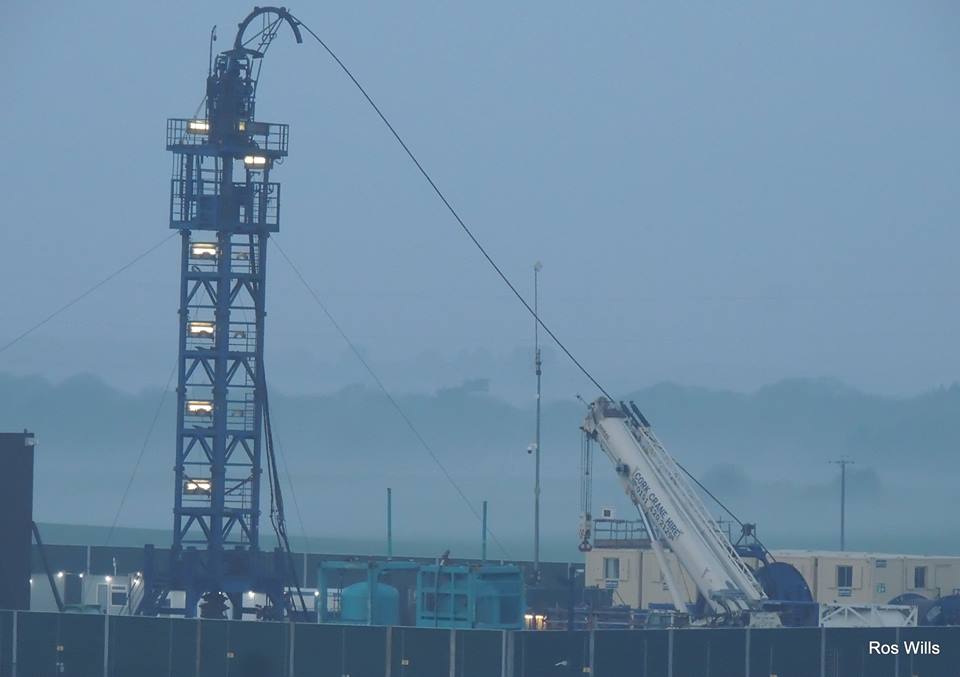
Cuadrilla’s Preston New Road shale gas site, 25 December 2018. Photo: Ros Wills
DrillOrDrop reported last year that Cuadrilla had worked with the government to develop the traffic light system. It had not objected to the 0.5ML limit in correspondence with ministers.
On Tuesday, Ineos, the country’s biggest shale gas licence-holder, described the traffic light system as “absurd” and “unworkable”.
But as recently as 14 January, the energy minister, Claire Perry, defended the 0.5ML limit in a parliamentary answer. In November 2018, in response to media comments by Mr Egan, she said the current rules were “fit for purpose” and there was “no intention of altering” them.
Opponents of fracking have threatened legal action if the traffic light system is relaxed.
The campaign group, Frack Free Lancashire, said this lunchtime:
“Frack Free Lancashire are amazed that Cuadrilla are still lobbying to adjust the seismic levels. Our local MP Mark Menzies has long-championed these levels as an example of the “gold standard” regulations which were supposed to be protecting local communities.
“The existing seismic limit of 0.5ML was arrived at after a scientific inquiry and Cuadrilla themselves claim to have developed the traffic light system in conjunction with the government.
“In spite of repeated claims that fracking would not cause any seismic activity at all, Cuadrillas’s fracking operations last year caused 57 seismic events, 17 of which were in the Amber range of 0 – 0.5ML and 8 of which exceeded the threshold of 0.5 ML.
“When it became evident that fracking in the Fylde is inevitably accompanied by earthquakes, we have seen Cuadrilla and the rest of the industry begin an intensive lobbying process.
“The levels should not be adjusted at the whim of an industry that has not yet proved its safety. In a time where we’re in a climate emergency, there is absolutely no need for a new fossil fuel industry to be pursued.”
Jamie Peters, Friends of the Earth anti-fracking campaigner, said:
“The amount of gas under our feet in Lancashire is irrelevant when we know that they cannot extract it without triggering earthquakes.
“It’s pretty insidious for the industry to suggest that if we want the shale gas ‘prize’, we have to accept weaker regulations. Particularly when that ‘prize’ means more climate chaos.
“The industry talked-up its strong regulations, right up until the point when they found they couldn’t work within them.
“Local opposition to fracking in Lancashire has never wavered and, despite today’s news attempting to give some positive spin to an otherwise flailing industry, the fight to stop fracking will continue.”
Daniel Carey-Dawes, Infrastructure Policy Manager at the Campaign to Protect Rural England, said:
‘This is nothing but an act of desperation from yet another a fracking company that knows it is on the losing team. The industry is transparent in its attempts to force the government’s hand over seismicity regulation, but regulation is there for a reason – to protect the public and our environment.
‘The government must not pander to these threats, but listen to the views and concerns of local communities who have genuine climate concerns, but will ultimately pay the price if we roll over and allow the fracking industry to do as it likes.’
Categories: Industry

 DRILL OR DROP?
two queries really:-
“Cuadrillas’s fracking operations last year caused 57 seismic events, 17 of which were in the Amber range of 0 – 0.5ML and 8 of which exceeded the threshold of 0.5 ML.”
Did any of these seismic events actually lead to any damage or any negative effect at all? Presumably enough time has now passed for effects to have been felt. if not, should this not be taken into account?
“The levels should not be adjusted at the whim of an industry that has not yet proved its safety”
Conversely, have there been any actual safety concerns? How long does an industry have to be up and running before it has “proved its safety”?
Re Q1 At PNR presumably not. (But at Preese Hall yes, damage alleged to property and also proven to well structure – which many consider as more important in the longer term). But the issue is not whether damage has been caused, the issue is of adhering to regulation, which Cuadrilla was happy to agree to earlier, and whether relaxing that regulation will cause problems.
Safety concerns? Shedloads. Unfortunately long-term health issues are not “proven” until perhaps decades after operations. Please look up the evidence that suggests even in the US, with far lower population density than the UK, health issues ARE a concern. I wouldn’t wish this risk placed upon my children or grandchildren – would you?
Thanks for this Alan. However my view is that any law / regulation is there for a purpose – to prevent a mischief. and so if a particular act causes no harm, why legislate against it? we do not live in a world where redundant regulations are adhered to for no good reason (isn’t that partly behind brexit?)
re safety, I perhaps worded it wrong. any one can be “concerned” about anything. the Gauls were concerned that the sky may fall on their heads (if Asterix is accurate!). what I should have said is have there been any safety incidents? anything happened that actually caused harm to anyone or had the realistic potential to?
Good questions indeed. I am still waiting for Cuadrilla to confirm that the seismic events did not cause any damage to the well casing. It is very hard not to be cynical when it refuses to publish the independent well examiners reports.
Why should Cuadrilla confirm structural integrity of the well casing?, structural integrity of the casing can very easily be verified and the UK regulations of the OGA are very clear as are the guidlines on O&G Well Integrity.
One would have thought that, after fracking induced seismic activity caused deformation of the Preese Hall well casing in 2011, Cuadrilla would quickly seek to reassure that there had been no such damage to the well casing at PNR.
On the contrary, Cuadrilla is currently dodging that particular question.
I predict that we will find out, in due course, that the PNR well casing has indeed been damaged.
No i don’t think there was any cause for concern, A storm in a tea cup springs to mind!
Change the record Francis, its becoming boring. You agreed the TLS, live with it.
Good point fencesitter, and the reality that will be examined. Otherwise we would all be driving along behind a guy with a red flag.
Low carbon footprint , maybe the world would be a better place if we had heeded the red flag .
Yes, and the roses would be around 1km high thanks to all that dung!
Fracking is becoming a toxic issue. Even the conservatives, who initially backed it to the hilt, are doing the usual political swerve manouvre, “not my fault blah blah”. Can’t you feel the chilly wind blowing from a new direction? Clearly the Minister and FE were/are on first name terms. But all that does is show just how pally they were. Now the minister has written to FE pointing out that, “he agreed to it all, and if you don’t like it, it’s too late now” , she’s clearly trying to put distance between them. Bit like a love affair when the flame goes out. err, fracking flame in this case. You’ve got to admit, it is amusing. And inevitable. FE really should have seen this coming.
It’s worth sharing this comment by Emeritus Professor Peter Styles, who was the government’s advisor on establishing the traffic light rules after tremors at Preese Hall fractured the well seven years ago. He said the following on a recent Drill or Drop post: “The 0.5 limit isn’t where anyone believes there will be damage or even disturbance. It is the point where we think we have a transition between fracking-related micro-earthquakes and the onset of stimulation of natural fractures which can move and generate seismic events which may be much larger depending on the scale of the fault and the associated geology.”
So, the industry’s attempts to make this all about how much damage there might be to buildings is completely and deliberately missing the point, and completely ignores the real reason why the scientists – with backing from the industry and Cuadrilla – set up the current system, and comparisons with other industries such as quarrying are spurious and misleading.
And in answer to fencesitter’s query about how long an industry has to be up and running before it’s ‘proved its safety’, there has been two wells fracked in the UK in seven years … both of which caused earth tremors that shut the industry down. So far from ‘proving its safety’, the industry is simply continuing to prove that it isnt’, and can never be, safe – which is why it is banned in so many countries and states around the world.
The point of fracking is to cause earth tremors Ellie!
The critical point is, can those tremors be controlled to a level below causing consequential harm and still be sufficient to produce decent fractures for gas production.
If you want to suggest no earth tremors then you have just removed any chance of The Swansea Lagoon, which involves blasting thousands of tonnes of granite out of the Lizard.
Whilst Peter Styles may be consulted, so will others, such as BGS-who appear to have a different view.
But, we don’t know why two sections were successful and the rest not so successful. I suspect there is some understanding of that which may be shared when this is examined.
Thanks Ellie. for the sake of clarity, I am neither for nor against fracking -I just want a clear understanding of the situation.
to be pedantic, an earth tremor, in and of itself, is not a safety issue in my view. if there was evidence for example that a tremor had caused damage to a wellhead and the actual safety issue was xxx, then we could consider that. what we seem to have however are events which could feasibly lead to a safety issue, but have not yet?
The previous tremors at Preece hall damaged the wellbore , how dangerous could that be ?
The regulations were introduced after fracking by Cuadrilla at Preese Hall in 2011 was linked to 50 earthquakes, including two measuring 2.3ML and 1.5ML. The wellbore was found to be deformed following the larger earthquake. DrillOrDrop report https://drillordrop.com/2018/10/30/government-urged-to-suspend-lancashire-fracking-over-earthquakes/
fencesitter-there are also events which could feasibly lead to safety issues of wind turbines and solar panels. Some have combusted, some (wind turbines) have blown over. Producing heat from a camp fire has also been known to cause some considerable problems, and baking bread destroyed large parts of London and killed many.
In contrast, PNR looks to be a big improvement.
Poor old Cuadrilla, they agree to the rules and then when they don’t like them they say it isn’t fair. Poor old Cuadrilla.
But, no well bore issues at PNR, Jono, so it looks as if that issue has been sorted.
It does Matron – the are being shut down before they are allowed to do any damage by the sound of it so the regulations seem to working. No need to change them is there? As you say, sorted.
https://www.blackpoolgazette.co.uk/news/business/review-into-fracking-earth-tremor-limit-will-not-happen-despite-cuadrilla-s-calls-for-change-says-government-1-9579001?
.
Quite a leap there, reaction, but the style is familiar. Speculation.
I suspect we will see what really happens over the coming weeks.
Anyone know if there was any flaring to demonstrate the quoted figures of gas coming out? Or was it just cold vented? The chemical composition of what came out?
https://drillordrop.com/2019/01/15/fracked-gas-levels-at-cuadrillas-shale-site-so-low-that-propane-needed-to-light-flare-stack-document-reveals/
Thanks. But that was for a short burn sometime ago. What’s happening to the 100,000 cubic feet of gas produced per day. No sign of any flaring each day. Where’s that gas going. So it peaked at 200,000. How long was the 100,000 for. Where did it go? What was in it. The usual half a story from Cuadrilla…
Richard. I also have been wondering what has been happening to all this gas Cuadrilla claim to have flowed. There have been no more sensational light shows like the famous 10 second wonder, with assistance from lpg, and cold venting, as Cuadrilla know, is not permitted.
Perhaps just a figment of Francis’ imagination?