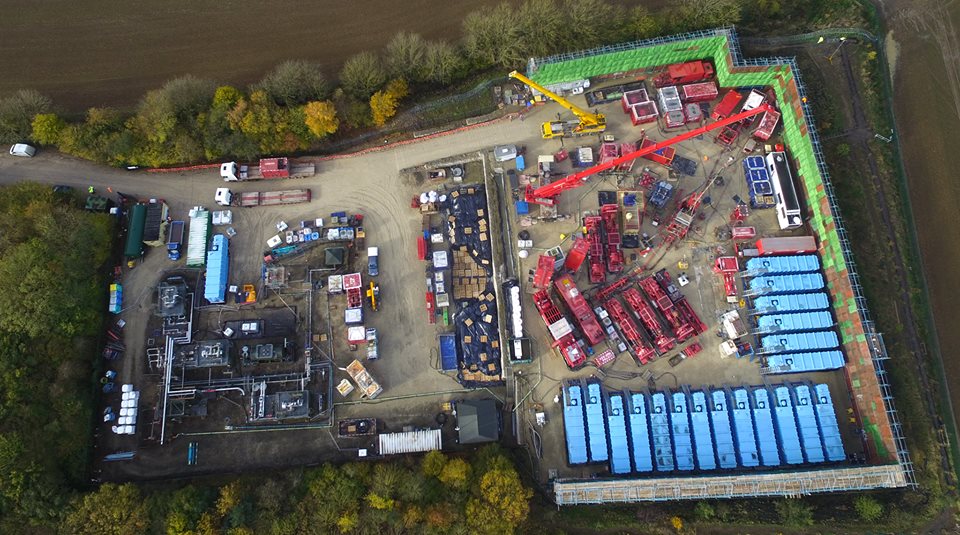
Third Energy’s Kirby Misperton site preparing for fracking in November 2017. Photo: Kirby Misperton Protection Camp
The concentration of climate-changing methane peaked when Third Energy carried out maintenance on a North Yorkshire gas site, researchers have found.
Monitoring by the Environment Agency showed levels of the powerful greenhouse gas around the KMA wellsite near Kirby Misperton were more than 40 times above average levels during a weekend in August 2018.
Another peak in December 2017, measured more than 10 times average levels.
Both peaks coincided with planned activity by Third Energy at KMA.
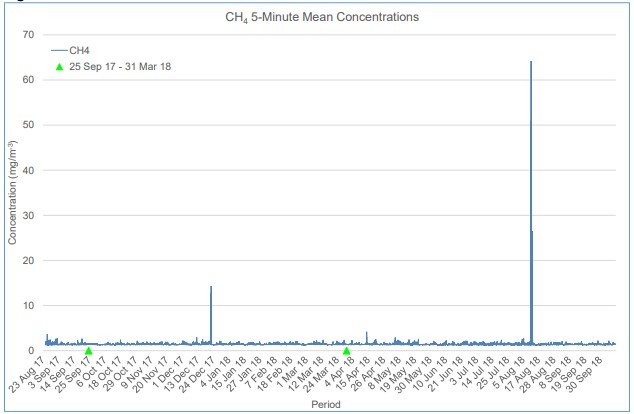
Methane concentrations at KMA, August 2017-October 2018. Source: Environment Agency
A report by the Environment Agency (EA), published online this week, showed large peaks on 11 August from 11.50am-5.30pm and on 12 August from 08:30am – 4:30pm.
According to the findings, the 5-minute mean methane concentrations exceeded more than 60 milligrams per cubic meter (mg/m3), compared with the long-term average of 1.41mg/m3.
This peak had also been identified by separate monitoring by the British Geological Survey (BGS).
The EA also recorded peaks at 09.45am and 8pm on 22 December 2017. Then, the 5-minute mean reached about 15mg/m3.
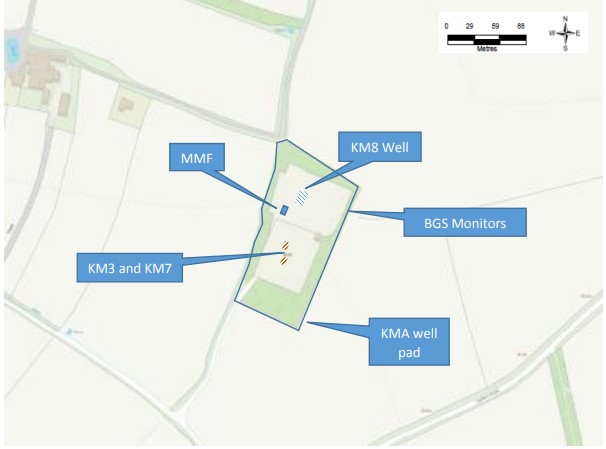
Monitoring station (MMF) at Third Energy’s KMA well pad near Kirby Misperton. Source: Environment Agency
Third Energy said in a statement:
“We have checked our operations records and can confirm that both spikes were associated with planned maintenance. There have been no methane leaks.”
The company said of the August peak:
“The increase in methane concentration was due to the depressurisation of process equipment (separators, site pipework etc) ahead of a large-scale infrastructure shutdown workscope where all the pressure systems are inspected by independent examiners as per the Pressure System Safety Regulations 2000.
“This workscope is a three-yearly requirement and residents were notified. All works were carried out in line with standard industry and legislative practices. The work was not on the wells.”
On the December 2017 peak, Third Energy said:
“The KM3 injection well occasionally experiences a build-up of low levels of pressure and this needs to be let down via a controlled operation. The well is not a gas producer being a liquid injector only. The activities are carried out in line with standard industry and legislative practices.”
Asked whether the releases were allowed by the environmental permit, Third Energy said:
“These maintenance activities are carried out in compliance with our environmental permits and all health, safety and environmental factors are assessed and controlled via our permit to work system.”
Monitoring at KMA was designed to provide baseline measurements because the site’s KM8 well had been earmarked for fracking. KM8 has not yet been fracked because Third Energy failed the required financial assessment.
Methane concentrations were measured at 2m above the ground for 415 days between 23 August 2017 and 11 October 2018.
The research found that 95% of methane concentrations during the monitoring period were below 1.61mg/m-3. The average concentration, of 1.41mg/m3, was close to the expected background concentration in the northern hemisphere of 1.21mg/m3, the report said.
The highest concentrations were when the wind was from the direction of the KM3 and KM7 wells and pipelines. These average concentrations were above 1.44mg/m3.
Monitoring by both the BGS and EA also revealed increases in nitrogen oxides air pollutants, when KMA was preparing for fracking. This was likely to be caused by exhaust from generators and vehicles on the site.
DrillOrDrop previously reported findings by York University that air quality at KMA changed from that typical of a rural setting to what you would expect in an urban area when equipment was mobilised.
A resident in Kirby Misperton told DrillOrDrop today:
“As in previous EA reports, the monitoring shows significant increases in nitrogen oxides when equipment was brought on and off site and plant and machinery was running in preparation for fracking.
“These levels have been previously compared by the University of York to those of a city centre. This is obviously a concern for local residents in Kirby Misperton if fracking is to return, particularly those with underlying breathing difficulties, such as emphysema and asthma.
“However, I was more perturbed to see a high methane spike in August 2018 which was ‘probably’ related to maintenance on the conventional sites at KM3 and 7.
“The village has regularly been affected by ‘odours’ coming off the site during maintenance in the past, with one villager being hospitalised. What worries me is that this was only picked up because of baseline monitoring for fracking.
“The EA no longer monitors so how do we know what is polluting our air? The report also shows that the predominant wind comes from the south west – directly from the site to our village.
“There are no gold standards in monitoring the emissions of the oil and gas industry and we cannot afford to allow this to continue if we are to combat climate change.”
Categories: Regulation

 DRILL OR DROP?
For God’s sake stop making excuses for avoiding the uncomfortable truth that our present ways of living are utterly unsustainable – ultimately suicidal. Summon courage, face the horror and be positive. Better still, join Just Stop Oil on the streets in October against this corrupt, sclerotic government of third-raters.