A climate campaigner says her three-year legal challenge over oil extraction in Surrey has been vindicated with a hearing at the UK’s highest court.
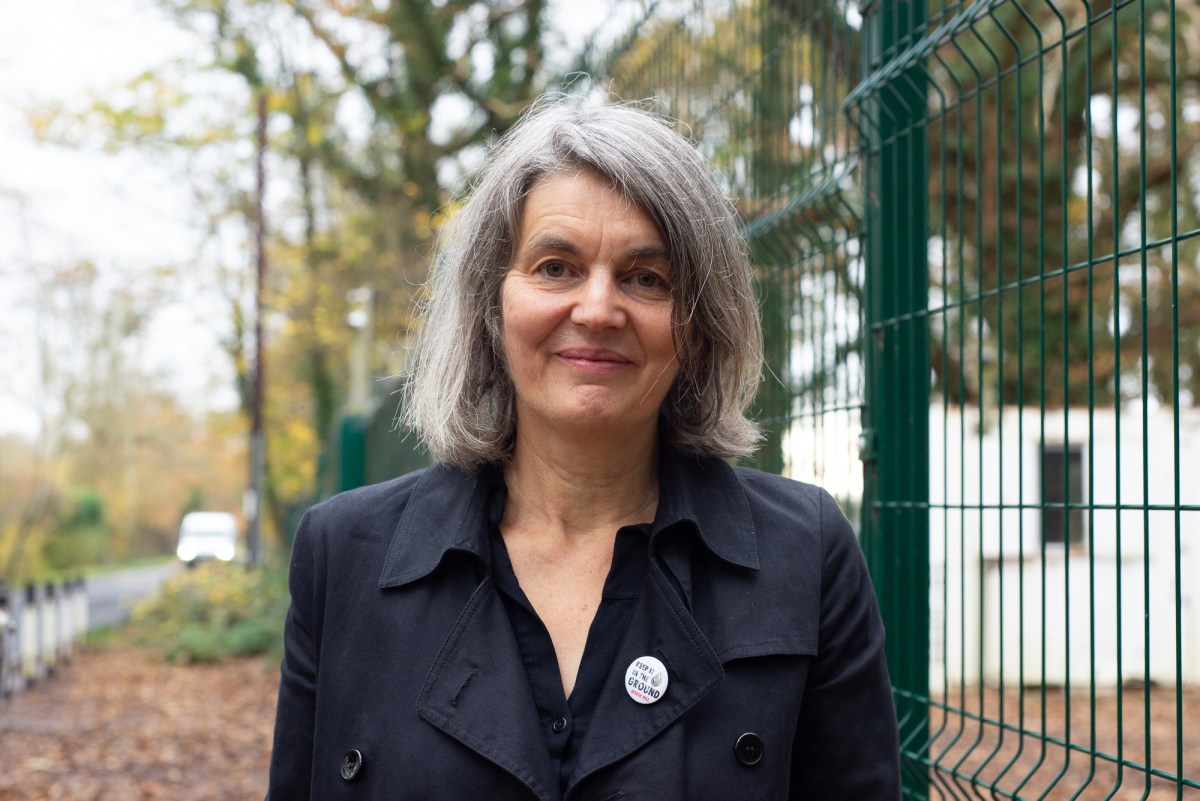
Sarah Finch announced today that the Supreme Court has agreed to make a landmark ruling in her case on the climate impacts of onshore oil production.
In an interview with DrillOrDrop, she said:
“I feel vindicated because I always thought this was a nationally-important case.”
Her challenge centres on planning permission for oil extraction at the Horse Hill well site near Gatwick, granted in 2019 by Surrey County Council.
Ms Finch, who opposed the application, has argued at the High Court and Court of Appeal that the council acted unlawfully in failing to take into account greenhouse emissions resulting from the use of Horse Hill oil.
The council argued that it needed to consider only the emissions from production operations at the site.
She has now successfully appealed to the Supreme Court.
Ms Finch, a freelance editor, said:
“I know my case could be seen as just a little local planning dispute.
“But the Supreme Court is the highest court in the land and it deals with matters which are of public and constitutional importance.
“I think the fact that it has agreed to hear the case shows that it knows the issue needs to be resolved one way or another.”
The Horse Hill site could produce an estimated 3.3 million tonnes of oil over the 20 years of permitted extraction. When burned, this could result in 10 million tonnes of carbon dioxide equivalent.
Currently councils do not have to take into account climate impacts like this.
But if Ms Finch wins her case, there could be major implications for the fossil fuel industry. She said:
“If we win, then all fossil fuel developments will have to look at the end-use emissions at the planning application stage, not just the emissions involved in the production itself.”
The hearing at the Supreme Court, expected next year, will focus on three parts of the Environmental Impact Regulations. These set out what should be considered in an Environmental Impact Assessment (EIA) before a decision is made on planning permission.
Ms Finch said:
“We’re arguing that for a fossil fuel production development, the emissions caused by the end use of the fossil fuels should be part of that assessment. They should be quantified and assessed and then measured against targets.
“If councils don’t assess these at the time of giving planning permission, they never will be assessed because there is no other mechanism for that to happen.
“We know that the oil from Horse Hill could go anywhere. It could go abroad to be refined, come back, or be refined here. It could be burned in cars, in people’s heaters.
“It could be so dispersed that there is no way of calculating that impact once it has left Horse Hill.”
Ms Finch’s opposition to oil operations at Horse Hill dates back to 2010, when she first saw a notice about the first planning application at the site.
She objected to this application and a second one in 2017.
The third application, this time for oil production, came before Surrey County Council in September 2019.
By then, the UK government had committed to meeting a legally-binding target of net zero greenhouse gas emissions by 2050. Ms Finch said:
“We felt we were in a different place and there were much clearer legal reasons for the council to refuse the application because there had been so much progress in national policy and public awareness on the issue of climate change.
“Surrey County Council had itself declared a climate emergency and was writing a climate action plan. So that buoyed us up to write objections.”
But the council approved the application by seven votes to two. Mis Finch, who attended the planning committee meeting, said:
“I was shocked that the climate issue barely got a mention. There was a mention of the net zero 2050 target and one of the councillors said ‘oh, it’s only a target’ – implying it’s not something we really have to try to meet.”
The Weald Action Group, a network of organisations opposing oil and gas operations in southern England, decided to bring a legal challenge to the council’s decision.
The group needed an individual to take the case. Ms Finch, then living nearby in Redhill, said:
“I’d never expected that to be me. But when we looked around at people who were willing and able to do it, it turned out I was possibly in the best position.
“I don’t think that legal fights are necessarily the only way or the best way to deal with issues like this.
“But in the fight against climate change, we have to do what we can do. And this was something I could do, which is why I’m doing it.”
At the High Court in 2020, both sides quoted previous cases to support their arguments. But the judge, Mr Justice Holgate, dismissed her case, ruling that Surrey County Council could not take account of end-use emissions.
Ms Finch said:
“I felt there were enough previous cases that Judge Holgate was wrong when he said the council couldn’t possibly take account of end use emissions. I thought it was a really unsatisfying judgement and I couldn’t leave it there. So, it was worth taking the next step, to the Court of Appeal.”
At the appeal court in 2021, there were legal advances towards Ms Finch’s argument. One judge ruled in her favour. Two others said it was at the council’s discretion whether to take account of downstream emissions.
There is a risk that the Supreme Court could rule that the High Court position was right after all. But Ms Finch said it was a risk worth taking:
“It just seems too important to leave any avenues unexplored. I’m not a lawyer but to me it seems obvious that if the Environmental Impact Assessment is meant to look at all the likely, predictable environmental impacts, you can’t leave the climate impact of burning the fossil fuels out of a fossil fuel application because that is the biggest environmental impact.
“I still feel I was right all along: Surrey County Council should have considered those emissions and that’s why I’m taking it a step further.
“We definitely need clarification of the law and we hope that is what the Supreme Court will bring. The court will rule and we hope that end-use emissions will be part of an Environmental Impact Assessment for all fossil fuel production projects.”
She described her case as “a symbol of everything that’s wrong with the planning regime”:
“Planning decisions are made without looking at the wider implications.
“Each fossil fuel development is treated as a one-off. There is no reference to the fact there are a dozen more developments, what the cumulative emissions will be, or that there is a net zero target and that oil is going to stop being used.
“What on earth is the point of starting a 25-year operation to get it out of the ground?”
She said all the recent cases brought against public bodies on climate change and energy issues had key benefits:
“All of them are educating the judiciary and buying time, slowing things down.
“Even if we ultimately lose at Horse Hill, we’ve slowed down the development of the site, preventing oil extraction from going ahead.
“The law is far too slow and clumsy and I think we need drastic change, much faster. But anything we can do to slow down this particular development and other developments is worth doing.
“In time, perhaps, sanity will prevail and we won’t be digging up fossil fuels anymore. I think what we can do is to slow it down, educate the judges, and buy time. That’s really important and worth doing.”
Her case has been supported by the Weald Action Group (“a big tower of strength”) and Norwood Hill Residents’ Association, representing people living around the Horse Hill site.
“They are a huge rock solid base of support who have lived with it and are personally threatened by the plans in the way that I’m not”, she said.
Local supporters have donated and raised money about £60,000 for the previous court cases.
For the Supreme Court hearing, the newly-formed Law for Change Fund will pay for lawyers and court fees. She welcomed its funding and support:
“That an organisation made up of lawyers has looked at us and thought the case was worth supporting is very validating.”
Ms Finch also has costs protection under the Arhus Convention, which limits the costs Surrey County Council and UK Oil & Gas can claim against her if she loses to £7,500.

 DRILL OR DROP?
The entire planning policy for oil and gas development needs overhauling where fossil fuels are concerned. It is a nonsense to have a planning system is not compatible with the legal obligation to achieve net zero, nor our international agreements. Irrespective of what the Court finds, the planning system needs updating. How can it be sensible to have a planning system incapable of taking into account the obvious, wider impact of greenhouse gasses? There has to be a better way of evaluating the impact of fossil fuel development that can be taken into the decision making process at local level. Incorporating the CCC’s advice and timescales would be a good starting point. This would give greater clarity for the industry and planning authorities.
Whilst we are all suffering from the energy crisis caused by the high cost of gas and the war in Ukraine, this crisis will eventually ease but the impacts from increased greenhouse gasses will not.
As the majority of the world is now committed to achieving net zero and some well before the UK’s target of 2050, almost 80% of the world’s GDP is now being targeted to net zero. The U.K. must therefore accept this change as not only essential but inevitable. And we can either be at the forefront and benefit from the economic upside of leading the technological advance or have to change anyway and miss out on the wider economic benefits.
We have already wasted decades because of false denial and delay. This is why we now find ourselves in the present situation. We cannot afford to waste the next decade or the costs will make those we face now seem small in comparison. And what will the quality of life be for our future generations?
https://www.ucl.ac.uk/news/2021/sep/economic-cost-climate-change-could-be-six-times-higher-previously-thought
https://www.world-nuclear-news.org/Articles/Climate-inaction-could-cost-world-USD178-trillion
https://www.instituteforgovernment.org.uk/explainers/paying-net-zero
Wise words, KatT!
An excellent result. We owe a debt of gratitude to Ms Finch for her willingness
to have this case go forward in her name.
Anyone who can’t see the end result of fossil fuel use on the climate needs to give their head a wobble, extreme heat and drought on a regular basis , even the weather forecasters have to get more red hues to show it on the maps. Well done Sarah and thank you.
The Horse Hill site could produce an estimated 3.3 million tonnes of oil over the 20 years of permitted extraction. What a huge benefit to the UK at a time when there is an energy crisis! Well Done Horse Hill,
I wonder how these protesters live life abstaining from hydrocarbons use, in food produce, pharmaceuticals, travel
and surgery, it really is quite amazing or ironic or moronic! Pure Lunacy!
I don’t abstain from using the products of hydrocarbon exploitation, but I, and millions of others, can see that we now have to find other ways as we cannot expect the planet to foot the bill for our addiction.
We don’t have 20 years to transition while exacerbating the problem with support for the industry, cutting off the wherewithal to effect transition, and while making it increasingly impossible to get out of the death spiral.
Don’t forget the often repeated definition of the lunacy to which you refer – carrying on doing the same thing, all the while hoping for a different result.
You are being played, Eli-Goth.wake up.
The planet is burning.
Nope, E-G is not being played. I am certainly not.
Those who state other ways should be found, well, they should find them and follow them. They don’t. Why is that? Is it that other ways are not what they are cracked up to be? Or, is it that other ways are being found, amongst a host of ways that have been shown not to be valid alternatives, and that to bring the other ways to fruition requires in many situations the fossil fuel companies to do so? Footing bills? How about getting rid of plastic keyboards and donating the proceeds to help find alternatives?
Some idiotic politicians should think a little more about that when they glibly talk about windfall taxes. That is the reality of cutting off the wherewithal to effect transition. What area of business is trimmed when companies are taxed more? Oh yes, first research and development then second, staff numbers. Then, the companies just move out of UK. Same old Labour, seriously curtail research and end up with higher unemployment. Lunacy. Thanks for reminding “us” about how it goes, 1720. Come on Liz, get some sanity back into decision making.
Oh the irony.
2022 + 20 years makes 2042 for production time for Horse Hill long before Net Zero 2050.
This is as stated by Sarah Lunch just another aim at disrupting this project.
I did not hear anything new in her arguments ready for the Supreme court from the High court or Court of Appeals!
I noted over recent days two announcements far more important than this one.
Firstly, a joint venture in Australia for a total cost of $560m for two new solar farms.
Secondly, a start to a CCS as part of a blue hydrogen joint venture production system from natural gas, with the proposed CCS having an capacity of 15mln tonnes.
One of the partners?
BP. Now, that is also ironic.
Yes, well spotted. The FF companies have been forced to take note and then to act, initially merely greenwashing, then a bit more seriously as public awareness increases.
Not so well spotted however by the protagonists of continuing despoliation is precisely that, continuing despoliation.The FF companies remain committed to that which provides the match to the planet’s burning, the exploitation of oil and gas, playing the gullible in support, those who can’t recognise an irony if it hits them on the nose. The more gullible the industry can locate, the longer they can operate.
It’s going to take a bit more than playing with figures down under and at home to convince me, perhaps even us, that the liars are no longer liars, especially when 40 years of lies are still not acknowledged, and incendiary activities continue.
The fact is, the planet is burning, and the arsonists are still playing with their matches. Some weeks ago in The Guardian, John Harris cited singer Tamara Lindeman’s song ‘Loss’ – “What was it last night she said? At some point you’d have to live as if the truth was true”.
At some point we will, and other ways will more urgently be pursued.
Except, no offer to invest yourself urgently 1720. Just more use of the plastic provided-to whinge.
No, not even well spotted. There are many such examples alive and well, and underway whilst the best some can do is check their pamphlet and decide, oh yes, this is where “we” are supposed to quote greenwashing. Some others believe it would be a good idea to take money off those investing and ignore they would not continue to do so.
(Ironic really that truth is being quoted by someone who didn’t realize it defined fact! That’s a Guardian reader for you.)
The facts are that increased hydrogen production is required. It is being tackled-by BP, Ineos and others. (Even UKOG have offered to step up to the plate!) No “we’s” to be seen doing their bit. CCS is required as part of that. No “we’s” to be seen, but BP are there.
Solar in Australia. Who is making the investment? Not the “we’s”, but BP.
CCS in Australia for a coal fired power station? Any “we’s” spending money on that? Nope, Glencore who have just racked up huge profits from COAL, because countries tried to placate “we’s”, were caught with their trousers round their ankles, dragged there by the “we’s”, and drove the coal market into orbit.
Meanwhile, it can be seen from above what the “we’s” are spending their money on. Doesn’t look likely they will step up to the plate. Simply whinge about others doing so because it isn’t exactly the plate they like, or they just need to whinge. An interesting (pre)occupation, whilst many others will be more occupied with why gas was $7 per MMBtu in July on the Henry Hub but was $47 per MMBtu on the Dutch TTF. Trousers round the ankles, folks. Maybe the German householders will be wondering why they are being asked to pay a levy on their gas bills, why the coal fired power stations are restarting, why their swimming pools are unheated and why they are having to buy extra bedding for when their heating is turned off at night? Trousers round the ankles, folks. And the “we’s” are still at it, trying to pull down those trousers. Others are gullible? Nope, they have a belt! Others get cold with trousers round the ankles.
You’ve missed the point of course. Did you intend to?
Not sure who your ‘we’ are, – possibly the myriad agencies pushing governments to act. If so, then their contribution to mitigating some of the damage the polluters and their gullible friends have perpetrated is considerable, even were it to be limited only to forcing apparently friendly (if interested) action from the industry. On the whole of course these agencies do not have the financial resources available to the FF industry and to government: their power of agency is accordingly limited, as a little thought might make clear.
Or perhaps your ‘we’ refers to any other than the FF industry and hacks. (I can’t help but comment on the impoverishment of the language consequent upon the failure to recognise ‘we’ in the sense of ‘I and others’.) I suppose, on the other hand, it is a convenient abbreviation for ‘those who oppose self-enriching fossil fuel exploitation which continues to contribute enormously to ecocide whilst passing itself off as environmentally friendly and planet-saving’!
I suspect your use of the word ‘whinge’ to describe any sensible comment from these agencies, constructive or not, is intended to be pejorative. But then you’d probably accuse of ‘whinging’ those parts of the planet most affected by and therefore objecting to the combined efforts of the industry and its misled acolytes to keep them burning. I think we can view your intended slander as a badge of honour and integrity given the circumstances. Let’s redefine ‘whinge’ as comment which you can’t cope with, for whatever reason. Takes some of the unpleasantness away from the term.
Once again I have to confess that the final paragraph of your post fails for me in its obvious objective to rise above the inconsequential and irrelevant. It certainly does not touch my argument, – that liars are liars, at least until they admit the lie, and that ostentatious displays of the new political correctness should be regarded with a degree of scepticism – merely pointing to the fact of which most people are aware, that the FF industry’s lies have got us where it wants us, almost totally dependent on it, to their benefit and our cost. (Apologies for the long sentence.)
Meanwhile, backed into a corner by the force of your argument, I’m signing off – again.
Ahh, not sure who the “we’s” are-and then reference them a bit further on in support, even giving them a badge of honour as an incentive to join the club! Very poor, 1720. That was a game I saw in my primary school, all sorts of badges on offer-for the gullible. When you called upon them recently for support, 1720, they were absent altogether. There must be better “gangs” or less who want to be part of your collective. Perhaps being 1721, 1722, 1723 etc. is just too much 1984 for most?
One of my sons, when a child, had a mythical friend called Barrack, and he was so real to him the rest of the family were denied using the bath because Barrack was having his bath! I do trust you are not so restricted. He grew out of it. Fortunately, “we” had a shower, as well.
Looks as if “they” might be a figment of your imagination based upon that. And, perhaps best not to call people liars just because they provide a different viewpoint. That is a step beyond “interpretation” that a deceased scientist would have changed his scientific opinion-or is it?
If you paint the floor from the corner to the doorway, 1720, you can continue, rather than have to sign off whilst the paint dries. That is the problem with DIY, when it goes wrong it is always possible to blame someone else, but not very convincing.
Dependency is dependent upon other alternatives, 1720. Choices can still be made to be dependent, or independent. Much easier if other alternatives are acceptable. You appear to have made the same decision that they are not, or you are gullible regarding marketing. I trust if and when you need treatment in a hospital, you will be able to bring yourself to make the same decision and not have to refuse treatment because alternatives, such as leeches, are rather limited but a plastic syringe is not. “Just the leeches, nurse.” I hope not, 1720. And, nurses without PPE seemed pretty scarce at my local NHS hospital yesterday. Off for my blood test later. Heaven forbid that those terrible plastic syringes will be used! Back to the glass ones? Oh, what about the energy cost to sterilize, the staff costs? Lot of holes in these buckets, Lisa. Maybe the answer is to find a bucket that is so cheap, that repairing it is not that much of a concern?
Martyn, you forgot to remind the we’s that the cheap buckets are made of plastic, because the paper ones don’t work very well, and the wooden ones have to be made from the planet saving trees, oh heck, the paper ones are also made from trees. Well we’ll have to use the plastic ones but that’s ok because they are already there and they were made in China, ( those pesky Chinese) it’s all their fault.Still because we didn’t make them it’s not our fault, the earth will know it wasn’t us that made them, so I’m sure it will be kinder to us.
What if we fall out with China, we won’t get any more buckets, we’re doomed i tell you, were doomed.What about the plastic bottles we use, i know we’ll replace them with millions of glass ones, we’ll easily be able to produce them, it will be easy to get the energy needed to do the job won’t it, won’t it…….er won’t it. Do China make glass bottles as well.
Here endeth the great solution……I think ……..where’s Greta, she’ll know.
Greta and plastic buckets and the Atlantic? Not a very savoury concept, and pretty disturbing to Surfers against Sewage. Maybe those funny things that fly through the air and take their passenger’s waste for treatment have something to be said for them?
I did go shopping for microwave proof small earthenware to make individual crumble in last week and found just what I was looking for. Wasn’t until I got home I noted they were made in China! Why can UK not make such things? Could it be uncompetitive labour costs plus high energy prices? One from two could be manageable, but both together? Nope.
Never mind, I have them lined up ready to be filled with my own apples and blackberries, but will have to delay whilst I take out a mortgage to afford the crumble!
However, my water barrels have been supplying me with more produce over the summer. Guess what? Made from recycled plastic!