The developer of the Horse Hill oil site in Surrey said it was working to restore planning permission following this morning’s decision by the UK’s highest court.
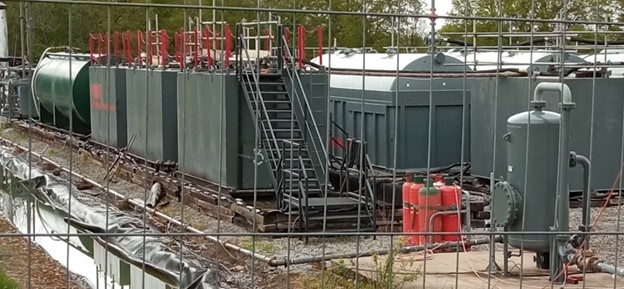
A majority judgement at the Supreme Court judgement quashed planning permission for long-term oil production at Horse Hill after allowing Sarah Finch’s legal challenge against Surrey County Council.
The court’s judgement cannot be appealed. It requires that carbon emissions from the use of Horse Hill oil must be included in any future environmental impact assessment (EIA). DrillOrDrop’s report on the judgement
A statement from UK Oil & Gas (UKOG), the major investor in the site operator, described the judgement as “perplexing”. It said the planned volume of oil production at Horse Hill would fall below the threshold for an EIA.
UKOG said:
“the Company now plans to work closely with SCC [Surrey County Council] to promptly rectify the situation, either via an amendment to the original 2018 planning application’s EIA or via a new retrospective planning submission, for which there is recent planning precedent within Surrey.
“In the case of a retrospective planning solution, the field’s historic and future expected production volumes would fall below the 500 tonnes/day (c. 3,700 barrels/day) production threshold for which an EIA is mandatory for petroleum extraction developments.
“It should be noted that the original 2018 planning submission and 2019 consent were subject to the prevailing 2017 Planning Act EIA Regulations and precedents, which were interpreted by SCC to require consideration of only those emissions derived from the actual development. It being reasonably considered that any end-use derived emissions would be subject to other end-use emissions controls (e.g., at refineries or in vehicle use) which lie beyond the developer’s control.
“This position was upheld by numerous judges in prior hearings from 2020 to 2022, including England’s two most senior planning judges, Lord Justices Holgate (2020) and Lindblom (2021) and the Court of Appeal (2022).
“The Company has at all times operated the field in full regulatory and legal compliance.”
Stephen Sanderson, UKOG’s chief executive, said:
“The Court’s rather perplexing retrospective ruling, which is counter to all prior judgements, further underscores why the company’s focus over the past few years has shifted away from oil and gas and firmly towards creating and delivering strategic underground hydrogen storage, an essential element of the UK’s future low carbon energy system.
“These projects have the potential to create far greater sustainable value for the Company and the UK than any small onshore field such as Horse Hill. They also have the added benefit of making a positive contribution to Net Zero.
“However, although Horse Hill is a small part of our portfolio, it still has a role to play in both the Company’s and UK’s future transitional energy mix and thus we look forward to working closely with the local planning authority to rectify this retrospective change to EIA requirements.”
UKOG share price fell this morning more than 16% but at the time of writing it was up just over 2% at 0.022p.
Surrey County Council, which was defending Ms Finch’s challenge, said today:
“The long awaited judgement of the Supreme Court in the case of R (on the application of Finch on behalf of the Weald Action Group) v Surrey County Council and others has found that the Environmental Impact Assessment undertaken for the planning application at Horse Hill to extract petroleum did not assess the effect on climate of the combustion of the oil to be produced.
“Council officers at the time of the planning application assessment believed that they acted in compliance with the law. The judgement makes it clear that local planning authorities must have regard to downstream emissions. The council was unsuccessful in defending its decision.
“The planning permission remains to be determined in due course.”
The levelling up department also defended the challenge. It said this morning:
“We have noted the decision from the Supreme Court and will carefully consider its implications.”
Reaction from campaigners behind the legal challenge
DrillOrDrop has closed the comments section on this and future articles. We are doing this because of the risk of liability for copyright infringement in comments. We still want to hear about your reaction to DrillOrDrop articles. You can contact us by clicking here.

 DRILL OR DROP?