The onshore well site at the centre of a recent landmark legal judgement has continued to produce oil, according to official data, even though it has no planning permission.
The Supreme Court quashed the planning consent for the Horse Hill site on 20 June 2024, following a lengthy challenge by campaigner Sarah Finch against Surrey County Council.
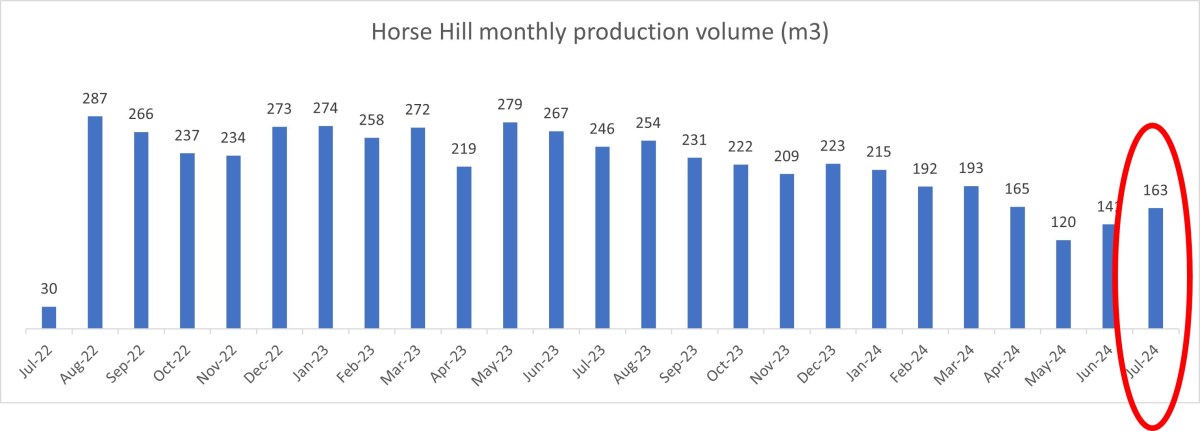
Despite this, figures published by the industry regulator today show that Horse Hill produced 163m3 (138 tonnes) of oil during July 2024, at a rate of 33 barrels/day.
These latest Horse Hill production figures, submitted by the site’s parent company, UK Oil & Gas plc (UKOG), are slightly higher than the previous two months before the court judgement.

Sarah Finch, who represented the Weald Action Group, said today:
“It’s not clear why UKOG are still producing oil at Horse Hill despite having no planning permission to do so.
“I trust that Surrey County Council’s enforcement officers will take this up and work with UKOG to get the site restored to a condition suitable for agricultural use, as required by the previous planning permissions, as quickly as possible.”
We asked UKOG why production was continuing without planning permission.
A company spokesperson said:
“We are in constant communication with Surrey County Council and are working with them about submitting a retrospective planning permission.
“There is precedent for this, as per your article.”
The spokesperson referred to a DrillOrDrop article written more than seven years ago about equipment and offices, rather than site operation, at the Brockham oil field, also in Surrey.
The now quashed planning permission for Horse Hill, granted in 2019, had allowed the operator to run the site, drill four more wells, and produce oil for 25 years and restore it.
UKOG must reapply for permission if it wants to continue at Horse Hill, planners confirmed last week.
“Council acted unlawfully”
The Horse Hill legal challenge centred on whether Surrey County Council should have taken into account the climate emissions from combustion of the oil when it granted planning permission.
The council had argued that it needed to consider only the emissions from operating the site.
But the Supreme Court ruled that the council had acted unlawfully by not considering greenhouse gases from oil combustion, known as indirect or downstream emissions.
The court said there were established methodologies for calculating greenhouse gas emissions. It said there was no technical reason why the indirect emissions could not have been taken into account when deciding planning permission.
“Complicated picture”
A meeting of Surrey County Council’s planning committee last week discussed the implications of the Supreme Court judgement.
Sian Saadeh, the planning development manager, said the council was “very conscious” that Horse Hill was operating without planning permission.
“There isn’t anything I can say to the committee by way of an update per se.
“Clearly the [planning permission] decision has been quashed. The application … we need to determine it at some point.
“There is no permission. It is a complicated picture. Yes, I am very conscious of the fact that things have happened with the site so that is something that the planning team that I manage are mindful of. I am sure at some point we will have a more concrete update on … where the next steps go.”
Previous planning permissions, granted for Horse Hill in 2012 and 2017, have expired.
Caroline Smith, the council’s planning group manager, told the meeting the 2019 planning application would need to be “redetermined in due course”.
She said according to legal advice, the Horse Hill operator would need to update its environmental impact assessment (EIA) to include new information and details of indirect greenhouse gas emissions. She said:
“Once this information has been submitted to the satisfaction of the minerals planning authority, there will need to be further consultation and neighbour notification.”
Ms Smith said the operator had implemented the 2019 planning permission and discharged some of the conditions.
“This was at their own risk whilst the legal process was ongoing. Had they not implemented, however, their planning permission may have lapsed. The planning application will need to be amended to take the works undertaken in account and to make it part retrospective.”
“Difficult position for planning authorities”
Ms Smith said the council had asked the government for more guidance on the implications of the Supreme Court judgement. She said:
“It puts planning authorities in a difficult position, frankly”.
Ms Smith said the “broader effect” of the judgement meant that planning authorities would need to take a “precautionary approach to indirect effects” for future EIA developments. She said:
“Where there is an inevitability of consequence and the ability to make a meaningful assessment [of indirect emissions] it must be included in the EIA. And any separation from the project, which in our case the oil had to be refined, does not negate this requirement.”
She said it was unclear how the ruling would affect other types of development. But she added:
“It is conceivable that it will have implications for other types of mineral development and potentially highway schemes which require environmental impact assessments.”
These could include proposals for concrete and aggregates developments, Ms Smith said.
Costs
Surrey County Council must pay the legal costs of Sarah Finch and the Weald Action Group.
The level of costs is not yet known, Ms Smith told councillors. But it could be up to a maximum of £70,000. She said:
“No order has yet been made in relation to costs which have been the subject of separate submissions. As the losing party, the county council will be required to pay some or all of the appellant’s costs.”
The committee’s chair, Edward Hawkins (Conservative), told the meeting:
“I feel quite annoyed that the county has to pay costs for something that we felt we did in good faith in accordance with the law.”
A member of the committee, Ernest Mallett (Residents’ Association and Independents), had supported UKOG’s planning application in 2019. He accused the Supreme Court of “making law on the hoof”. He said:
“The council behaved in a perfectly satisfactory and straightforward way according to the law.”
Another member of the committee, Jeffrey Gray (Lib Dem), said the council’s “culpability should be mitigated by the absence of case law and therefore it was quite difficult for us”.
He said the issues raised by the case had “deserved serious consideration” and he did not resent that the Supreme Court had reached its decision.
Key Horse Hill planning permissions
Number: RE10/2089, SCC ref 2010/0197
Approved: January 2012
Permitted: Construction of an exploratory well site, use of the site for drilling one exploratory borehole and short-term testing for hydrocarbons
Duration: 3 years
Status: Expired
Number: RE 16/02556/CON SCC ref 2016/0189
Approved: October 2017
Permitted: Retention of well site and vehicle access, appraisal and further flow testing of Horse Hill-1 borehole, further flow testing of HH-1, drilling a deviated sidetrack and flow testing, drilling a second deviated borehole and flow testing
Duration: 3 years
Status: Expired
Number: RE18/02667/CON, SCC Ref 2018/0152
Approved September 2019
Permitted: Retention and extension of the existing well site, HH1 and HH2 wells, drilling four new hydrocarbon wells, one water reinjection well, process and storage area, loading facility, production of hydrocarbons from six wells for 25 years.
Status: Quashed by Supreme Court
DrillOrDrop has closed the comments section on this and future articles. We are doing this because of the risk of liability for copyright infringement in comments. We still want to hear about your reaction to DrillOrDrop articles. You can contact us by clicking here.
Categories: Legal, Regulation, slider

 DRILL OR DROP?