The government is to consider all volumes of hydraulic fracturing when it introduces its ban on the process, an energy minister has said.
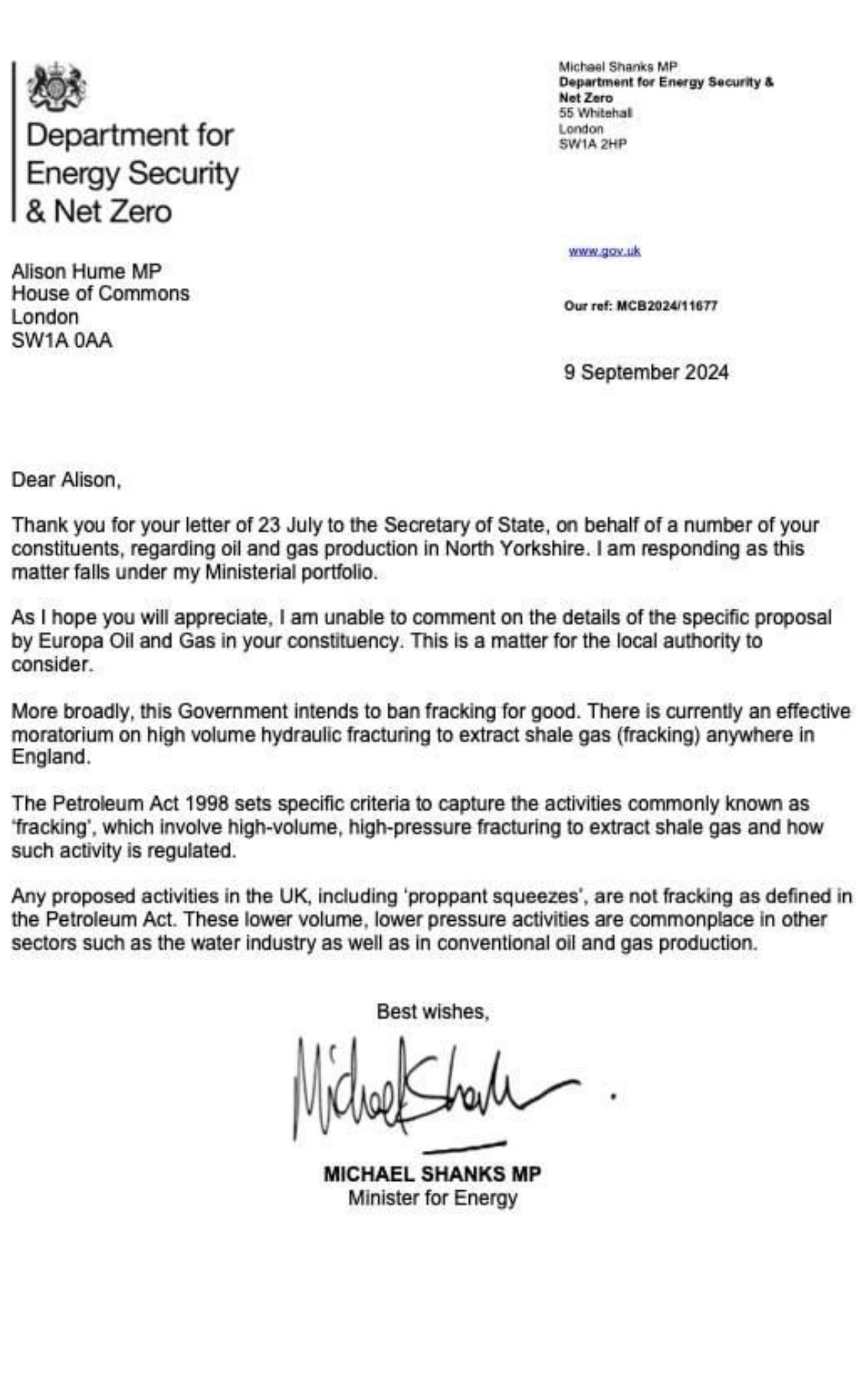
Michael Shanks wrote in a parliamentary answer, published yesterday:
“We are committed to banning fracking for good and any future decision on national planning policy for fracking will take into account all volumes of hydraulic fracturing.”
He was responding to a question from the Labour MP, Alison Hume. She represents the village of Burniston, near Scarborough, where Europa Oil & Gas want to carry out a form of fracking.
The company has submitted a planning application for proppant squeeze, a process that generally uses lower volumes of water than high volume fracking for shale gas, that is currently subject to a moratorium in England.
Ms Hume asked the minister:
“will [he] bring forward legislative proposals to ban the proppant squeeze process of gas extraction.
She also asked:
“whether his Department has made an assessment of the potential merits of banning the proppant squeeze process of gas extraction”.
Mr Shanks acknowledged that proppant squeeze was not included in legislation. But he hinted that the operation could be in future.
Currently, the sole statutory definition related to fracking is for associated hydraulic fracturing, which is controlled by the Petroleum Act and prevented by the moratorium.
The act sets a volume threshold for associated hydraulic fracturing: 1,000m3 per stage or 10,000m2 per hydraulic fracture operation.
This excludes processes which use lower volumes of fluids but still fracture rocks to release hydrocarbons.
Opponents of hydraulic fracturing have described the threshold as a legislative loophole that must be closed.
Their argument has been supported by Cuadrilla’s fracks at its Preston New Road site in Lancashire, particularly in 2019.
The company’s planned volumes of fracking fluid met the threshold to qualify for associated hydraulic fracturing. But the company actually used lower volumes of fluid than those proposed for Burniston* and caused multiple earthquakes, including the largest ever induced by onshore fracking.
Chris Garforth, of Frack Free Coastal Communities, which is campaigning against gas plans in Burniston, said:
“After Alison Hume’s recent public support for the campaign against Europa’s drilling and fracking plans at Burniston, it’s great to see her pressing the government to clarify its position on a more inclusive fracking ban.
“Good also to see minister Michael Shanks beginning to distance himself from the gas industry’s misrepresentations of ‘proppant squeeze’. Local campaigning plus parliamentary pressure – what we need now is for North Yorkshire’s planning committee members also to get on the right side of history and reject Europa’s planning application.”
Steve Mason, of Frack Free United, a coalition opposed to fracking, said today:
“Finally, it seems the government may be listening. The proposal in Scarborough is using the same technique, with similar volumes of fluid, as that which caused earthquakes in Lancashire.
“Closing this loophole will reinforce the government’s wish to protect communities from the impacts of the oil and gas speculators.”
Mr Shanks’ reply to Ms Hume suggests for the first time that the government will use planning policy to ban fracking.
It also appears to mark a change in the government’s approach on the definition of fracking.
He had previously written to Ms Hume stating that:
“Any proposed activities in the UK, including ‘proppant squeeze’ are not fracking as defined in the Petroleum Act. These lower volume, lower pressure activities are commonplace in other sectors such as the water industry as well as in conventional oil and gas production”.
*Cuadrilla actually used fluid volumes as low as 143m3 per fracking stage at Preston New Road. Europa has said it intends to use 500m3 per fracking stage at Burniston . The North Yorkshire Minerals Plan, which will be used to decide the Burniston planning application does not use volume to define fracking (more details here)

 DRILL OR DROP?