The North Yorkshire village of Foxholes has opposed plans by Egdon Resources to explore for gas.
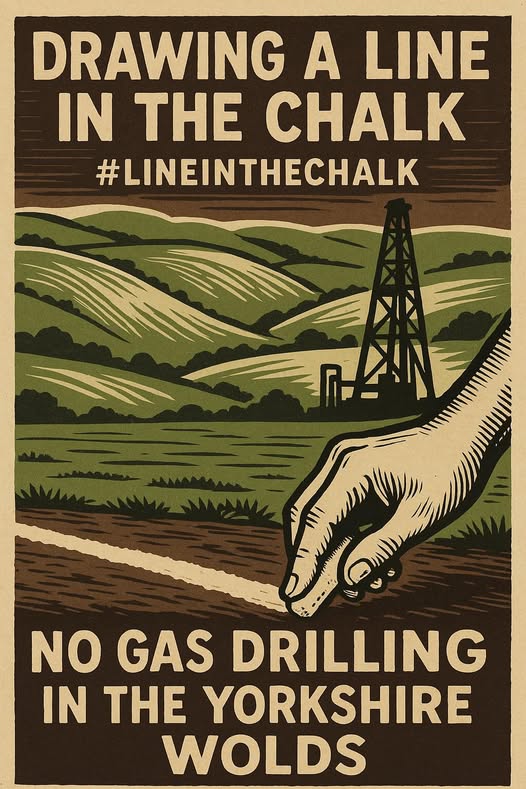
The parish council voted unanimously last night to object to the company’s planning application, which proposes to drill through a chalk aquifer in the Yorkshire Wolds.
The council is now working on its formal response to the application.
A survey of residents, also announced last night, found that 90% were against the proposal. 2% supported it and 8% said they didn’t know.
A briefing document, published this morning, recommended objection to the application because of risks to contamination of the chalk aquifer. The decision on Egdon’s application will be made by North Yorkshire Council.
The document, prepared to help Foxholes and Butterwick Parish Council respond to the application, concluded:
“Can we afford to take the risk with our water and food security and the health of our community?
“The Yorkshire Wolds are a living landscape. This isn’t just land. It’s history, memories, identity, and home.
“We’re drawing a line in the chalk.”
The document, produced by a working group of parish councillors, said North Yorkshire Council and other regulators “must apply the precautionary principle”.
“Where there is scientific uncertainty about potentially serious or irreversible environmental or health harm, decisions should err on the side of caution, and development should not proceed unless risks can be clearly ruled out or mitigated.”
Water concerns
“For me, it’s all about the water. It MUST not become polluted” – Foxholes resident
The briefing document, said the application should not be approved unless all hydrogeological risks had been “fully and independently assessed”.
Foxholes is in a source protection zone 3, where pollution or changes to groundwater could affect water being abstracted for drinking and other uses, the document said.
The Cretaceous Chalk formation is classified as a Principal Aquifer and Drinking Water Protected Area under UK law.
The chalk aquifer is particularly vulnerable to contamination, the briefing document said, because it is permeable and the structure is fractured. Pollution could be transported rapidly underground, it said.
Egdon plans to drill NW, opposite to the natural groundwater flow, the document said. It said this could help reverse migration of pollutants towards cleaner aquifer zones and increase pressure gradients that would push contaminants into freshwater supplies.
Fractures in the chalk could spread unpredictably because of changes to pressure balances. Artificial pathways created during drilling could act as routes for the rapid movement of pollutants.
Edgon’s application does not propose hydraulic fracturing. But the briefing document urged North Yorkshire Council to “treat this activity with the same caution as traditional fracking, particularly in light of geological sensitivity”.
It also raised concern about risks from failure of cement barriers isolating the well from the aquifer. It said the proposed impermeable membrane, designed to prevent site spills reaching groundwater, would be only as reliable at the installation, maintenance and management.
One resident told the authors:
“Any breach of the chalk aquifer would be catastrophic for 900,000 residents, farmers and businesses. Especially when monitoring is like marking your own homework and is certainly not scrutiny.”
The document also raised concerns about the impact on the nearby Gypsey Race. This is a chalk-fed intermittent stream, which supports rare water habitats that are vulnerable to changes in groundwater chemistry, temperature and flow.
Other concerns
Public health impacts
The briefing document called for more information on:
- Impact on local air quality and dust
- Risks of prevailing winds carrying pollutants over the local primary school
- Likelihood of gas high in hydrogen sulphide, which is toxic and corrosive
- Use of flaring on air pollution and noise.
It called for: a full health impact assessment; independent air quality and dust monitoring with real time reporting; assessment of the impact of prevailing winds; full acoustic and flaring modelling data to show the impact on schools and residents; and clean outline of inspection frequency and transparency procedures by the Environment Agency and local authorities.
“Without these assurances, the proposed development represents an unacceptable risk to local air quality and public health, particularly for vulnerable groups such as schoolchildren and the elderly.”
Noise
The briefing document urged North Yorkshire Council to commission an “immediate environmental noise survey”.
It said:
“Without baseline environmental noise data and independent acoustic monitoring, the proposal risks compounding existing road noise impacts in a highly sensitive rural setting. The Wold Valley’s unique acoustic characteristics mean that even moderate industrial activity may result in severe perceptual impacts on local residents and vulnerable receptors such as schools.”
Light
The document said the area prided itself on dark skies, silence and starlit tourism. If the proposal were approved, residents could be “lawfully subjected to intrusive light pollution, without recourse under nuisance legislation”.
Some may find this “deeply disruptive to sleep, wellbeing and the peaceful enjoyment of their home”.
The document added:
“Rural communities like Foxholes should not be expected to absorb the full environmental cost of industrial activity without robust safeguards. Light pollution, though often overlooked, can be as harmful and intrusive as noise or traffic, particularly in quiet landscapes valued for their dark skies.”
It called for no permanent lighting columns, minimal use of temporary lighting towers, controls over light shielding, direction, height and intensity, as well monitoring and community reporting.
Traffic
The document said Egdon’s estimated figures for heavy goods vehicle movements (512) underreported by 100 per cent (1,386).
It said:
“This proposal would substantially increase the proportion of HGV traffic, placing additional stress on already burdened infrastructure and safety conditions in the village.”
It added:
“Combined with longstanding safety issues, the proposal poses unacceptable risks to residents, schoolchildren, and vulnerable road users without clear, enforceable safeguards.”
It urged North Yorkshire Council to “ensure that local safety concerns are fully addressed, not just acknowledged.”
Agriculture
The document said gas development has been shown to have an impact on agricultural soils, including loss of microbial diversity, reduction in soil fertility, potential contamination.
Landscape
The document said the proposed drilling site is in an area of high landscape sensitivity and ecological values.
The Yorkshire Wolds is due to be designated as a national landscape (formerly known as an area of outstanding natural beauty).
Egdon’s plans could undermine local conservation efforts, chalk stream restoration progress, environmental policy and public support for protected landscapes, the document said.
It also said the temporary period when the drilling rig would be on site does not “negate its potential to cause unacceptable harm to the setting and character of the surrounding landscape”.
Seismicity
The document said seismic risks in the Foxholes area were “historically low”. But it said gas exploration would introduce uncertainties and potential sensitivities.
Community impact
The document said Foxholes’ position near the Yorkshire Wolds National Landscape, increased potential for “sustainable, tourism-driven prosperity”.
“A short-term, speculative gas exploration scheme threatens to undermine this future for uncertain, minimal, and largely external benefits.
“Gas drilling proposals are inherently contentious. Where they arise, clear, enforceable safeguards, genuine community engagement, and environmental integrity must take precedence. Failing that, communities must be empowered to say no. Loudly, legally, and collectively.”
Policy
The document said:
“This development raises serious and unresolved questions concerning landscape impact, climate law compliance, community welfare, and environmental risk. It conflicts with multiple strands of planning policy at local, regional, and national levels.”
Climate change
The document said exploratory drilling must fully address the cumulative climate impacts, particularly because of the landmark Supreme Court ruling on carbon emissions (Finch V Surrey County Council 2024).
It said downstream emissions must be “fully and transparently assessed”.
“Should the applicant fail to provide such an assessment, the application should be rejected outright or, at a minimum, be deemed incomplete and invalid pending a revised submission with a legally compliant Environmental Impact Statement.”
Challenge to Egdon’s claims
The document also challenged the justification for the proposal in Egdon’s planning application.
It said Edon’s claim that gas from Foxholes would enhance UK energy security was “overstated”. It said:
“Small-scale UK onshore gas has a negligible impact on national energy security”.
On Egdon’s claim that the proposal aligned with UK government energy strategy, the document said:
“There is weak alignment seen. UK policy increasingly prioritises net zero over fossil expansion, especially onshore.”
The document said Egdon’s claim that its proposals would bring economic and environmental benefits was “partially true at best, but incomplete”.
“Whilst there may be some short-term economic activity, climate and emissions trade-offs remain significant.”
Egdon also claimed that gas was a transition fuel supporting renewables.
The document said:
“The logic is increasingly outdated and short sighted. In 2025 onwards, the grid needs clean flexibility, not new fossil extraction.”
Drop-in sessions
Councillors from Foxholes and Butterwick Parish Council will be at a series of meetings in August and September at Foxholes Community Hall, including support sessions on commenting on the application:
23rd August 2025 – Fellas at Foxholes, 9.30-11.00 am
26th August 2025 – Drop in Support session – Response and Letter Writing
30th August 2025 – Coffee Morning: 10.30 – 12.00 pm
2nd September 2025 – Drop in Support session – Response and Letter Writing
9th September 2025 – Drop in Support session – Response and Letter Writing
13th September 2025 – Coffee Morning: 10.30 – 12.00 pm
16th September 2025 – Drop in Support session – Response and Letter Writing
20th September 2025 – Fellas at Foxholes: 9.30-11.00 am
27th September 2025 – Coffee Morning: 10.30 – 12.00 pm
Other meetings are also planned.
Categories: Opposition, slider

 DRILL OR DROP?