The decision on expansion of oil production in rural Dorset was deferred this morning because councillors wanted more information on the climate impact.
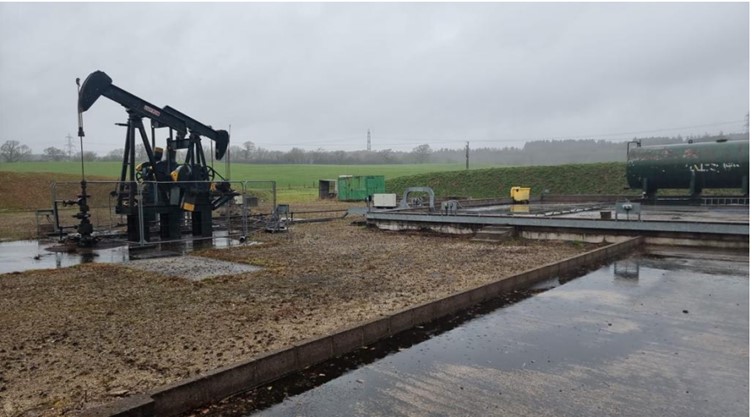
Dorset Council planners had recommended approval of an application by Egdon Resources for the Waddock Cross site, between Dorchester and Wareham.
But the council’s planning committee voted by seven to three in favour of a deferral.
The failure to make a decision centred on questions about the impact that carbon emissions from Waddock Cross oil would have on climate change.
A landmark Supreme Court ruling in 2024 in a case brought by campaigner, Sarah Finch, required decision-makers to assess the emissions from burning oil or gas, as well as emissions from the production process.
Egdon and Dorset planners had agreed that the climate impact of these combustion emissions would not be significant.
But members of the public and some councillors questioned this interpretation and some of Egdon’s figures.
The meeting adjourned to allow senior planning officer, Eleanor Godesar, to find information to answer councillors’ questions.
But after a 15-minute break she said:
“I think that we have not got enough information on hand to be able to answer comprehensively. We would like to work with the applicant to get that information to reassure the committee.”
“Deeply flawed”
A statement to the committee from Sarah Finch said Egdon’s framing of the climate impact as not significant was “deeply flawed”.
She said:
“Any individual project can claim to be “not significant” when compared in this way. Indeed, the same argument was made about a third runway at Heathrow Airport. But climate change is not driven by isolated percentages; it is driven by cumulative emissions across all sectors and projects. Also, a comparison only against national carbon budgets is meaningless.”
She said the assessment of greenhouse gas emissions “must consider the cumulative effects of the proposed project with other existing and planned future projects, in a global context”.
She said:
“The applicant has failed to do this. They have ignored the current state of the climate, disregarded global emissions pathways, and omitted any consideration of cumulative impacts. As a result, their conclusion—that the project’s climate impact is not significant—is demonstrably false.”
The Waddock Cross site has been mothballed since 2014, after producing oil for less than a year. The oil had a high water content and the wells were considered commercially unviable.
Egdon’s application sought to extend the site’s life until 2033 to carry out work allowed under a previous planning permission but never started. This included enlarging the site, drilling a sidetrack and two additional wells and continuing oil production.
Egdon has estimated that Waddock Cross, with the new wells, could produce 138,000 tonnes of oil by 2033. It also estimated that carbon emissions from Waddock Cross oil would be 350,000 tonnes, about 0.02% of each relevant UK carbon budget.
Dorset resident, Vicki Elcoate, told the committee:
“If approved, this site could become the second-largest onshore oil production facility in the UK. The applicant estimates that emissions arising from this application could release around 350,000 tonnes of CO₂ equivalent – I could take a return flight to New York over 200,000 times for that amount of carbon emissions.
“That’s a major environmental impact in terms of releasing a pollutant that would otherwise not be in the atmosphere. If you refuse permission today the oil will stay in the ground.”
A statement Kirsty Clough. on behalf of the Weald Action Group, a campaign network in southern England, said there was “no strategic imperative to retain or expand” the Waddock Cross site.
She said there was no guarantee that oil produced from Waddock Cross would stay in the UK and contribute directly to security of supply.
UK national energy policy had changed since permission was granted for site expansion in 2013, she said.
“Today there is a clear intention to transition away from oil and gas, and to stop issuing new licences. This site is out of step with national priorities.”
She also said:
“The application has provided no substantiated evidence that this wellsite would now be commercially viable. Given that it was not deemed viable in 2014 when the average global oil price was much higher than it is now, it is hard to see how it could be viable now.”
A member of the committee, Belinda Bawden (Green), questioned the accuracy of Egdon’s data and the conclusion that emissions would be insignificant. She also said there were mistakes in the officer’s report.
Another member of the committee, David Tooke (Lib Dem) asked whether Egdon intended to begin oil extraction at the earliest opportunity or whether the application was “a holding operation”.
Eleanor Godesar said if the application were approved Egdon would have about two years to decide what it wanted to do with Waddock Cross. She said the company planned to seek a separate permission to reinject water produced along with the oil back into the rock formation.
Cllr David Taylor (Lib Dem) said this raised concerns about groundwater and the impact on the river Frome and Poole Harbour. He asked:
“Have we safeguarded the area?”
Ms Godesar said the application would return to Dorset Council’s planning committee when information had been provided to answer councillors’ questions.
Categories: Regulation, slider

 DRILL OR DROP?