An environmental campaigner is challenging the government over what he says are “misleading” and “inaccurate” claims about the controversial issue of fracking.
The energy minister, Michael Shanks, said publicly that lower volume hydraulic fracturing – where rocks are fractured under pressure – was “commonplace” in the water industry, as well as the oil and gas sector.
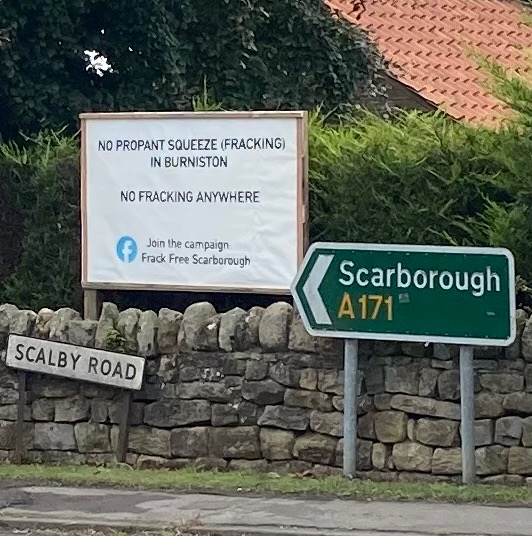
The claim was made last year in a letter to a North Yorkshire MP about contentious plans for proppant squeeze, a form of lower volume fracking, at Burniston, near Scarborough.
The letter has since been used by Europa Oil & Gas, the company behind the Burniston scheme, to support its proposals.

But Dennis May, of the campaign group, Frack Free Misson, said he has evidence that the minister’s claim about the water industry was “ill-founded” at best and potentially “factually inaccurate”.
He said 13 water companies and the Environment Agency had confirmed in response to freedom of information requests (FOIs) they had no records of any form of hydraulic fracturing operations on water wells in the public supply over the past 20 years.
One company, supplying the Weald oil and gas area, said:
“Southern Water has not conducted any hydraulic fracturing of wet wells since 2005, and there are currently no plans to undertake such activities in relation to public water supply wells or bores in the future.”
Another, supplying north-west England, said:
“United Utilities has never used hydraulic fracturing, which is a technology primarily used for the development of hydrocarbon resources, rather than for potable groundwater supply.”
Mr May is now challenging the government to reveal the source of information behind the minister’s claim.
Last month, the government refused to release it.
The information came from internal communication between departments, the government said. Releasing the information was “likely to have an adverse impact on the quality of decision making”, it added.
“The public has a right to know”
This month, Mr May criticised the government’s refusal to release the information source. He said:
“The public have a right to know why a minister is citing misleading information in an attempt to justify policy to a backbench MP, to whose constituents the issue of hydraulic fracturing is of great concern. The disclosure of relevant information is key to such an understanding.”
He said the information was either unknowingly factually incorrect or there was a decision to “wilfully distribute misleading information about the use of hydraulic fracturing in the water industry”.
Mr May said the claim may also have been intended to “’normalise’ such activities with a view of making them more acceptable to the public”.
He said:
“Hydraulic fracturing is already a contentious issue. It is in the public interest to know what sources of information the government is relying on to formulate policy and legislation.
“Any public concern regarding decision-making processes will likely be compounded following publication that the minister’s assertion was misleading, along with the obfuscation in order to justify refusal of disclosure.”
He told DrillOrDrop:
“The purpose of fracking is to cause geological disruption to extract a finite material from the strata.
“Why would you unnecessarily and haphazardly risk disturbing the geology that provides, in some areas of Southern England, up to 100% of a public water supply which is replenished through the natural flow of groundwaters?
“The only possible beneficiary of such government misinformation is the onshore oil and gas sector.”
Ministerial information
This is not the first time a government minister has argued that oil and gas techniques are commonly used in the water industry.
In 2022, the then business minister, Kwasi Kwarteng, told Brockham Oil Watch:
“Acidisation is a common technique carried out to clean and develop wells. It is widely used in the water industry as well as the oil and gas industry”.
Acidisation is, in fact, an umbrella term for activities that include acid hydraulic fracturing.
Mr May said:
“It is inaccurate to state in that context that it is ‘widely used across the water industry’”.
In response to an FOI request, Mr Shanks’ department said there were well stimulation techniques – widely used across the water industry, oil and gas, and geothermal – that aimed to enhance permeability and increase flow. It said these included proppant squeeze, acid washes, and other mechanical or chemical stimulation methods.
Mr May said:
“In light of the evidence supplied to the minister (that hydraulic fracturing is not carried out in the water industry), it is misleading to conflate that sector with activities that reach or exceed the fracture pressure of relevant strata, such as proppant squeeze.”
He added:
“Evidence would suggest that the government had an established behaviour of supplying misinformation in defence of hydraulic fracturing”.
DrillOrDrop asked the energy security department (DESNZ) to comment on the claims that one of its ministers had given inaccurate information. We provided evidence from 14 FOI responses from the water sector. The department said “low volume hydraulic fracturing has been used for the abstraction of groundwater”.
A department spokesperson said:
“Low volume hydraulic fracturing has been used in water, geothermal and oil and gas operations.
“We will ban fracking for shale gas extraction. Through our Plan for Change, we will reignite our industrial heartlands as we seize the opportunities of the clean energy transition, and will continue to drive investment for businesses and communities in the UK.”
Burniston fracking debate
The proposed use of proppant squeeze at Burniston and other onshore oil and gas sites has reignited the debate about fracking and its definition.
Mr Shanks’ letter said the 1998 Petroleum Act set criteria for activities commonly known as fracking.
In fact, the act defined only associated hydraulic fracturing. This is a process which pumps more than 1,000m3 of fluid into a well per fracking stage or 10,000m3 in total.
Europa has cited the letter in defence of its plans at Burniston.
It accused local opponents of “a high level of misinformation” by referring to the proposed proppant squeeze operation as fracking.
But in an email to the industry regulator, the company itself referred to proppant squeeze as fracking.
DrillOrDrop asked Europa whether it continued to support Mr Shanks’ claim that hydraulic fracturing operations were commonplace in the water industry and what evidence it had to support the claim.
We also asked whether, in the absence of any evidence to support the claim, would the company continue to quote from the minister’s letter.
Europa replied:
“We continue to note the very important thrust of the Minister’s words relating to the distinction between a proppant squeeze and high-volume hydraulic fracturing.
“That is the fundamental issue here and the reason we referenced his letter. We are not in a position to comment on the water industry specifically.”
The Burniston project is expected to be decided by North Yorkshire Council by the end of the year.

 DRILL OR DROP?