The campaign group which won a landmark Supreme Court ruling over the climate impact of onshore oil and gas has launched a new legal action over methane emissions from the industry.
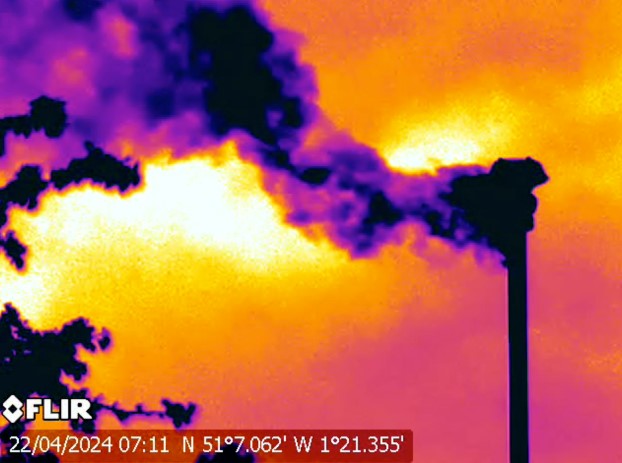
The Weald Action Group (WAG), which opposes fossil fuel operations in southern England, issued a formal pre-action legal challenge accusing the government and officials of failing to regulate methane emissions properly.
In 2024, the group successfully argued at the UK’s highest court that decisionmakers must take into account greenhouse gas emissions from the combustion of fossil fuels, as well as from the production process. The decision has had widespread implications for fossil fuel industries.
Today WAG announced that its lawyers, Leigh Day, had written to the Secretary of State for Energy Security and Net Zero (DESNZ) and the Environment Agency. The legal letter cites failures in the UK’s recent Methane Action Plan and what WAG called “long-running weak regulation” at active oil sites, such as Horndean, in West Sussex.
WAG said its challenge centres on the government’s failure to set binding methane limits as well as the approval of permits by the Environment Agency that allow ongoing venting and flaring.
The latest official data (for October 2025) shows that of the 27 UK onshore oil producing sites, methane was vented at 16 and flared at nine.
According to the data, a total of 846ksm3 of methane was flared at UK onshore oil producing sites in October 2025. The largest volume was 564ksm3 from the Singleton oil site in West Sussex, followed by 123ksm3 at Wressle in North Lincolnshire.
Nearly 100ksm3 of methane was vented from UK onshore oil producing sites in October 2025. The largest volume was from Horndean (27ksm3), followed by Gainsborough (15ksm3) and Beckingham (14ksm3) in Lincolnshire.
There is no equivalent published monthly data for flaring and venting from oil and gas exploration or appraisal sites. But if these sites were included, total methane flaring and venting in the UK is likely to be higher than the production sites alone.
Methane is one of the most potent greenhouse gases with a global heating impact around 80 times greater than carbon dioxide over a 20-year period.
WAG described current government policy as “not fit for purpose”. It allows routine methane venting and flaring to continue onshore, the group said, without enforceable limits or requirements to use best available technology to capture gas and prevent pollution.
Emily Mott, of the Weald Action Group, said:
“Reducing methane emissions is crucial for slowing climate breakdown, yet it’s still not being treated with the urgency needed.
“Regulators must not only ban routine venting and flaring for onshore sites to align with offshore but also require robust monitoring, measurement and reporting, and mandate frequent and rapid leak detection and repair.”
WAG said its case went beyond a single oil facility. The group said it raised “fundamental questions about whether the UK can meet its climate commitments while continuing to allow avoidable methane pollution from fossil fuel extraction”.
Ann Stewart, from the group, said:
“The UK has shown international leadership on methane by becoming co-chair of the Climate and Clean Air Coalition and a Global Methane Pledge Champion, committing to help drive a 30% global reduction in methane emissions by 2030.
“But you can’t claim climate leadership internationally whilst allowing avoidable emissions to continue at home”.
Categories: climate, Opposition

 DRILL OR DROP?