Two sides in a planning dispute over gas drilling and lower volume fracking near Scarborough have accused each other of making misleading claims, just ten days before a decision is due.
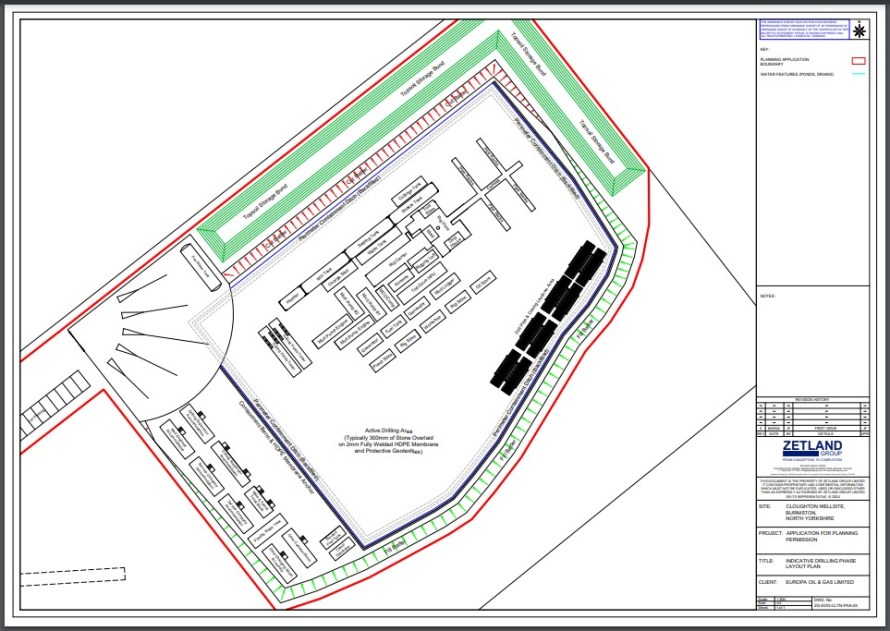
Europa Oil & Gas Limited, the company behind the scheme at Burniston, said in letter to North Yorkshire Council, released today:
“Campaign groups and activists are spreading misleading, false and defamatory material and information which has led to unnecessary alarm and concern among the public.”
In response, a campaign group said Europa’s chief executive, William Holland, had been “spreading misinformation about his proposed gas well for over 15 months”.
Frack Free Coastal Communities said Europa’s Burniston planning application, which has attracted more than 1,600 objections, “contained errors, gaps and misrepresentations”.
The group’s Professor Chris Garforth said:
“Let’s be clear: it is not campaign groups who have been causing alarm and concern among the public but Europa Oil and Gas.”
Mr Holland’s letter was sent to Andy Paraskos, chair of the council’s strategic planning committee, which will consider the application at the end of this month.
Mr Holland said:
“As we look to secure vital domestic energy supply, it is important we have a transparent and honest debate about how best to deliver this, without certain stakeholders trying to influence the conversation with misleading information.”
But Professor Garforth said Mr Holland’s “PR persona has taken its gloves off” and was “now resorting to cheap insults”.
We examine below the four issues raised in Mr Holland’s letter and the response to his comments.
Proppant squeeze and fracking
Europa has repeatedly said its plans for a proppant squeeze, which fractures rocks to release gas, is not fracking.
Mr Holland said:
“’Fracking’ as understood nationally is related specifically to large volume hydraulic fracturing in pursuit of shale gas development.”
But a leading environmental barrister, Estelle Dehon KC, said in a legal opinion that proppant squeeze would qualify as fracking under the North Yorkshire minerals and waste joint plan (MWJP).
The minerals plan has a wider definition of fracking than that used for associated hydraulic fracturing in the Petroleum Act. The Act’s definition was used to specify which operations would be outlawed by the 2019 moratorium on fracking: those that used 1,000m3 of fluid per stage or 10,000m3 in total.
Mr Holland said:
“She [Ms Dehon] does not at any time in her advice suggest that low volume hydraulic fracturing is illegal or is covered by the ban on “fracking”.”
He said the minerals plan recognised that lower volume hydraulic fracturing was legal. He added:
“It is therefore misleading to suggest that Estelle Dehon KC has in some form presented a legal argument based on the MWJP that the proppant squeeze is ‘fracking’.”
Professor Garforth responded:
“No one is saying that low volume hydraulic fracturing (fracking) is illegal. We say it should be. After all, it was low volume fracking that caused the damaging tremors [at Cuadrilla’s Preston New Road site] in Lancashire that prompted the current, limited moratorium.
Mr Holland also said:
“The current evidence base, both nationally and internationally, proves the proposed operation at Burniston is safe and environmentally sound.”
Professor Garforth described this as “disingenuous”. He said:
“If there is such evidence, we would love to see it. We have looked for it. It’s not in the planning application. We have scanned the scientific literature. We cannot find Mr Holland’s evidence.”
So far, Europa has not carried out a 3D seismic survey of the geological faults or features of the area.
Professor Garforth said:
“We do not know – Europa do not know – what faults there are two kilometres below the field in Scalby where they propose to frack sandstone formations at four different depths.”
He said the North Yorkshire minerals plan required “high standards of information and evidence for proposals that involved hydraulic fracturing. He said:
“We expect the Planning Committee to be looking for that in the application”.
Seismicity
The risks of small earthquakes or tremors caused by Europa’s planned proppant squeeze operations have been a key concern of objectors to the Burniston application. Many people were particularly worried about damage to fragile sea cliffs on the heritage coast.
Mr Holland said the well deviated inland away from the coastal cliffs. He added that statutory consultees Natural England and the Environment Agency had not expressed concern about the impact on the cliffs.
He also said:
“The risks associated with potential seismic activity fall outside of planning”.
But Professor Garforth said this statement was wrong. Mineral planning authorities were expected to satisfy themselves that the mitigation of seismic risks can be or will be addressed, he said.
He added that the North Yorkshire minerals plan required that hydraulic fracturing proposals should include“compelling evidence” that seismicity can be managed and mitigated to an acceptable level.
Mr Holland also referred to a parliamentary statement by the energy minister, Michael Shanks, in December 2025.
The minister said: “the evidence base is not there at the moment, to suggest that low volume hydraulic fracturing activities have the same associated risks as fracking for shale gas”.
Mr Holland added that the UK onshore oil and gas industry had “a good record for health, safety and the environment”.
Professor Garforth said the tremors at Preston New Road occurred despite the oversight of regulatory bodies.
Local impact
Mr Holland said “understandable concerns of the local community” had been “aggravated by activists”.
He said residents of Broughton near Scunthorpe, where Europa is a partner in the Wressle oil production site had “identical initial fears and concerns” as the communities around Burniston. But he said these concerns turned out to be “misplaced”.
The well site operation was seen as a “considerate and community focussed neighbour”, he said.
Professor Garforth said Mr Holland’s letter did not detail any benefits of the Wressle site to the local community.
He added:
“We see no benefits in the [Burniston] proposal. The application instead promises us noise, dust, pollutants, floodlights and HGV traffic.”
Policy changes prompt call for delay
DrillOrDrop has reported calls for the Burniston planning meeting to be delayed because of proposed changes to national planning policy.
A draft revised National Planning Policy Framework (NPPF) has removed a requirement for decisionmakers to give “great weight” to the benefits of onshore oil and gas.
Campaigners and residents have called for the Burniston decision meeting to be postponed until after a public consultation and confirmation of the revisions.
Mr Holland conceded in his letter that the new draft NPPF was a material consideration which should be given weight in the determination of any relevant planning application.
But he added:
“the details of the proposed changes may change when the consultation responses have been considered by Government. As a result, any decision-maker should not rely upon specific changes proposed in a draft document.”
He said there was “no justification for delaying a decision on the application”. He said:
“The planning balance for this application remains firmly in favour of granting planning permission.”
He also added:
“There is not a single political party or rational authority in the UK which does not project a requirement for natural gas up to and beyond the current net zero target in 2050. As to whether this comes from domestic supply or overseas import has not only important implications for the UK’s security and economic stability but also our overall contribution to Global Emissions.”
Professor Garforth said Frack Free Coastal Communities expected North Yorkshire planners to treat the draft revisions as material considerations when weighing up the planning balance.
On Mr Holland’s comments on the continuing need for gas, Professor Garforth said they continued to be:
“devoid of any figures, avoid any acknowledgement of the way the market for gas works … and do not reference the accelerating downward trend in the demand for gas in the UK”.
He said Burniston gas was just as likely to be sent to Ireland or mainland Europe as used in local homes.
Meeting details
North Yorkshire Council’s strategic planning meeting is due to discuss the Burniston application at 1.30pm on Friday 30 January 2026 at Scarborough Town Hall. It is likely to be webcast.
The meeting’s agenda is likely to be published a week before, probably on Friday 23 January 2026. This is expected to include a recommendation from planners to the committee to either approve or refuse the application.
Europa company profile
Documents
Categories: Regulation, slider

 DRILL OR DROP?