Plans for more drilling and another 10 years of production at an oil site in Dorset are likely to have “significant effects” on the environment, the government has ruled.
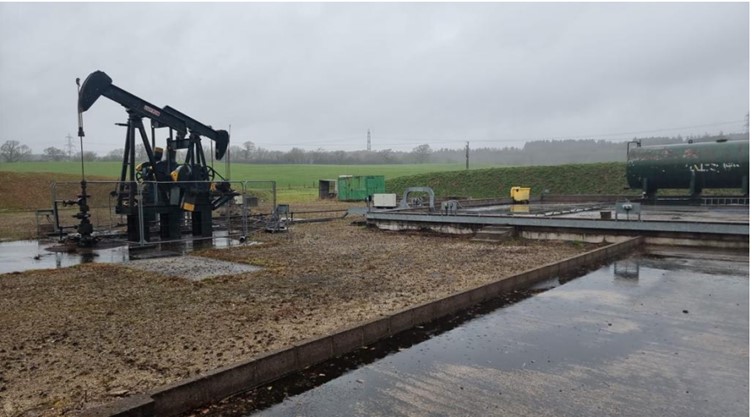
In a decision issued today, the local government department decided proposals at Waddock Cross near Dorchester must include an Environmental Impact Assessment (EIA).
A decision on the site’s planning application is now likely to be delayed.
Dorset Council had previously ruled that the site operator, Egdon Resources, would not need an EIA for its application for three new wells and continued production until 2033.
But the Weald Action Group, which campaigns against onshore oil and gas developments in southern England, asked the government to review Dorset’s EIA ruling.
The group said Dorset Council’s ruling contradicted a similar recent EIA decision by Lincolnshire County Council for the Whisby site near Lincoln.
Weald Action Group had successfully brought a landmark legal challenge at the Supreme Court on climate emissions from onshore oil and gas.
The government concluded today:
“Based on the available information and implications of the proposal, the Secretary of State considers there is likelihood of significant effects primarily in relation to the use of natural resources, air emissions, ecology and biodiversity and transboundary greenhouse gas emissions. EIA is therefore required.”
The government’s ruling detailed the impact of oil operations on the climate.
Egdon has estimated that Waddock Cross, with the new wells, could produce 138,000 tonnes of oil by 2033. It also estimated that carbon emissions from Waddock Cross oil would be 350,000 tonnes, about 0.02% of each relevant UK carbon budget.
But the government concluded that the extraction and use of crude oil would result in a net increase of greenhouse gas emissions. It said the company had proposed no mitigations for reducing these emissions that were consistent with the UK’s net zero target.
Based on guidance, the government said:
“it is not possible to conclude that there will be no likely significant transboundary effects on climate change”.
The Weald Action Group had previously argued that Egdon had “ignored the current state of the climate, disregarded global emissions pathways and omitted any consideration of cumulative impacts”.
The government was also concerned about the impact of oil operations on nearby protected wildlife sites.
It said there could be construction impacts on the adjacent Oakers Wood, a site of special scientific interest, considered to be of “high ecological value” and a “habitat of principal importance”.
The government said the impact of air pollution on rare lichen in the wood could not be ruled out.
It also said oilfield combustion was “likely to contribute nitrogen emissions” to the Dorset Heathlands, designated as a Ramsar site, Special Protection Area and Special Area of Conservation, 865m away.
Decision delay
The Waddock Cross site has been mothballed since 2014, after producing oil for less than a year. The oil had a high water content and the wells were considered commercially unviable.
In September 2025, Dorset planners recommended Egdon’s expansion application should be approved. But a week later, councillors failed to make a decision because they said they wanted more information on the climate impact.
They sought to delay the decision until late January 2026. But the Weald Action Group asked the authority to wait until the government’s ruling on the EIA.
Egdon Resources must now submit a detailed environmental study, known as an environmental statement (ES).
An ES can run to hundreds of pages and several volumes, detailing the environmental consequences of the proposed development. This would include the climate impact of burning any oil produced at Waddock Cross.
The public is normally consulted on an ES and the document should be taken into account in a decision on planning permission.
Categories: Regulation, slider

 DRILL OR DROP?