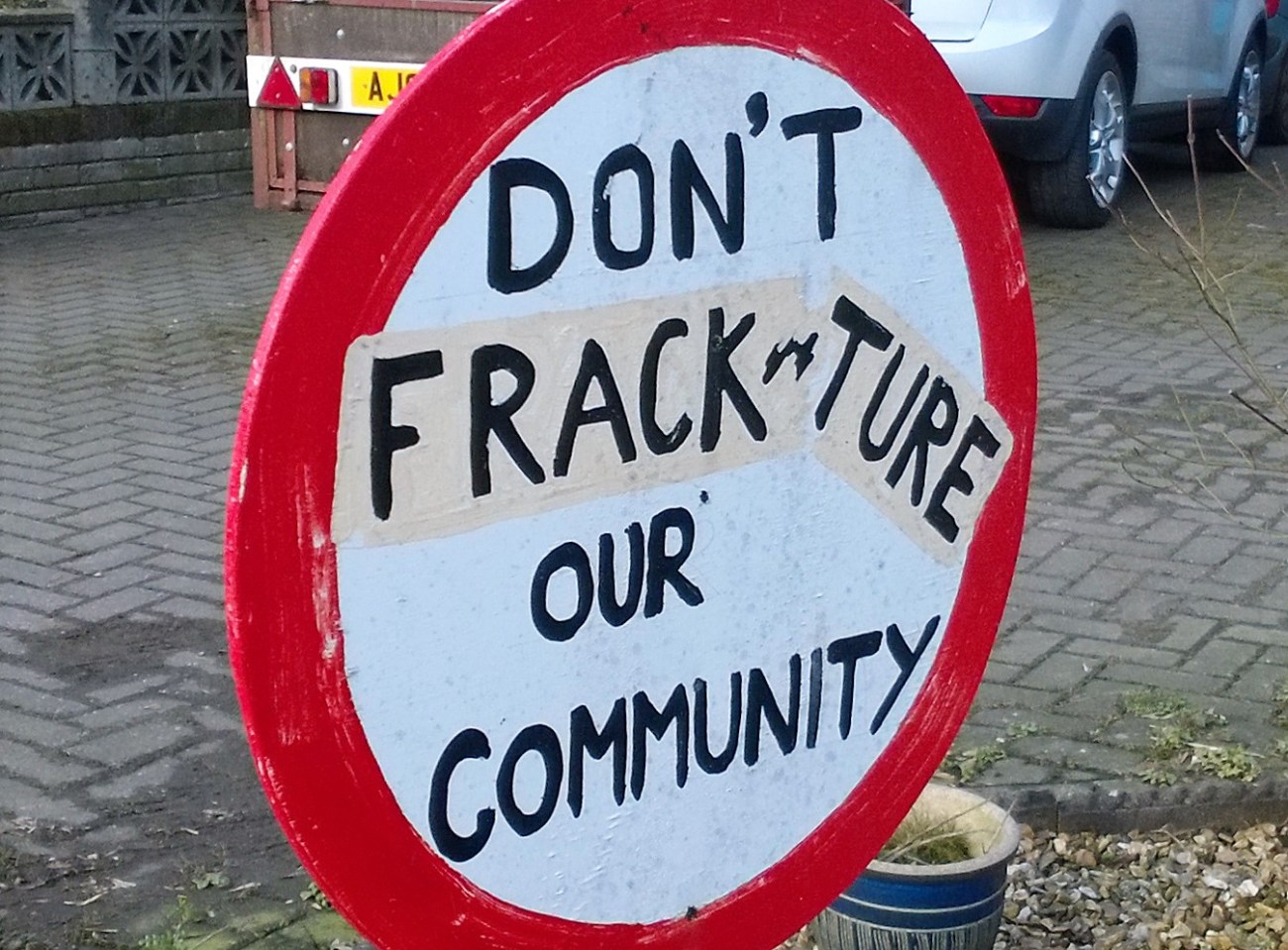
The prospect of fracking for shale gas in Lancashire has already had a profound effect on local people, according to new research.
A study by Anna Szolucha, of the University of Bergan in Norway, found that even before exploration had begun residents living near proposed sites had experienced stress and anxiety.
Much of this was caused by what she described as “a profound sense of moral outrage” at the activities of the gas company, local authorities and the government.
This had led to depression, annoyance and feelings of disenfranchisement, she said.
Residents also reported:
- Atmosphere of intimidation and fear
- Feelings of powerlessness
- Conflicts between former friends
- Disillusionment with politics and politicians
- Lack of confidence in the shale gas company, Cuadrilla
- Distrust of council officers and regulators
- Changed perceptions of the police
The 123-page report, The Human Dimension of Shale Gas Developments in Lancashire, concluded that Cuadrilla and decision-makers in Lancashire had failed to take account of social and psychological factors when considering plans for fracking at two sites in the county. This “significantly understated” the actual and potential impacts, she said.
“From a social point of view, assessing shale gas exploration as a low-impact activity is unsupported by evidence”.
Dr Szolucha argued that
“The anxiety and deep feelings against shale gas exploration and extraction in Lancashire have shown that it is not considered a desirable and necessary development.
“It is unlikely at this point that any assurance from the government or the proposed regulation and mitigation measures will convince the residents to support shale gas development”.
The report comes as the Communities and Local Government Secretary, Sajid Javid, is considering whether to approve Cuadrilla’s application to frack at Preston New Road and Roseacre Wood. In June 2015, Lancashire County Council refused both applications. The decision on Preston New Road was against the advice of the council’s planning officer. The final outcome is expected before 6 October.
Stress and fear
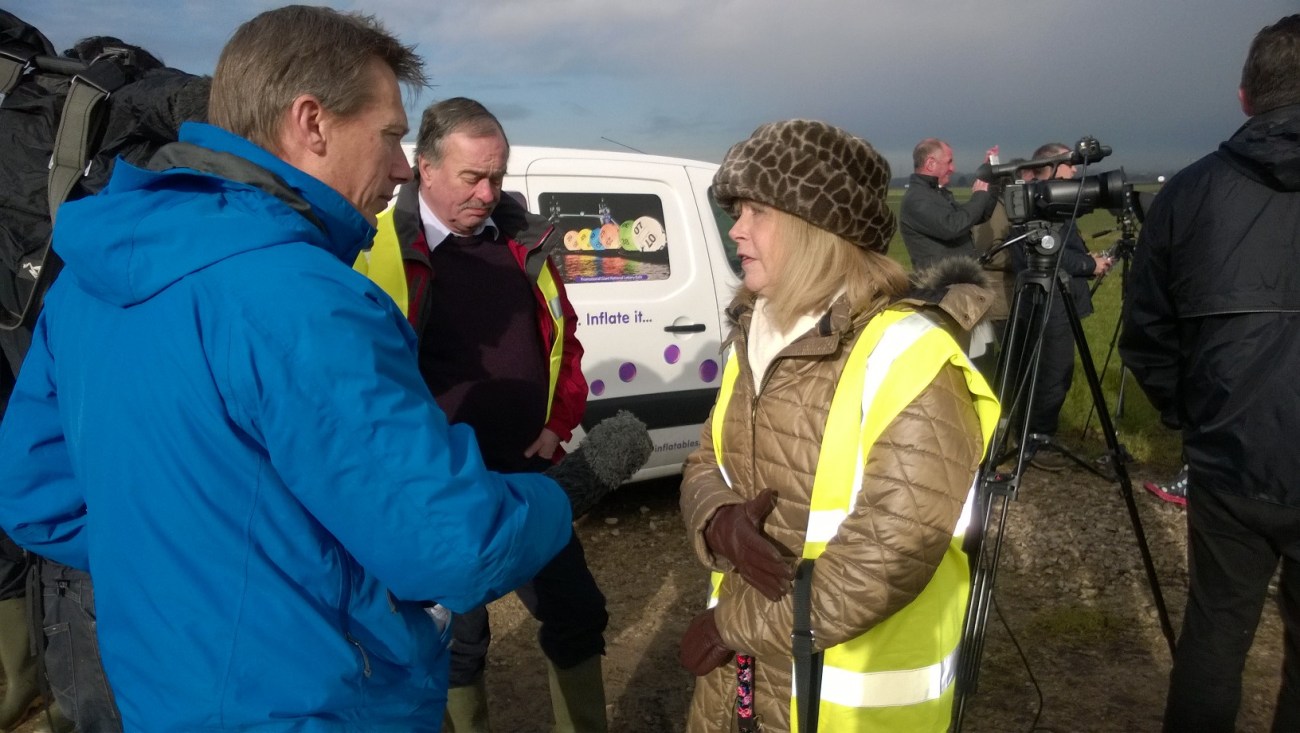
Dr Szolucha’s research concluded:
“Without exception, all members of the communities that were engaged in the planning process and grassroots activism reported significant levels of stress and anxiety”.
She said sources of stress included public speaking and working with the police, media and stakeholders. Residents talked of the “constant struggle for money” and the need to be able to read, understand and co-ordinate a response to documents from Cuadrilla and the authorities, often at short notice.
The planning process had “taken over their lives”, she said, but at the same time, it had led them to value their local landscape more.
Dr Szolucha said residents reported feelings of fear and stress about the potential impacts that exploration and extraction could have on social well-being and health in local communities.
“Anxiety has been amplified by a widespread sense of annoyance, disenfranchisement and powerlessness caused by the attitudes of the company and the UK government.”
Government statements supporting shale gas and the focus of the planning system on material considerations had made people feel their concerns were not being addressed, she said. This has led to, and exacerbated, a range of health effects.
“Even if stringent regulatory regimes and robust mitigation measures aiming to minimise the risk of pollution or accident were to be applied, they may not be sufficient in alleviating local fears and in reducing the level of perceived risk by the residents.”
Safety and security
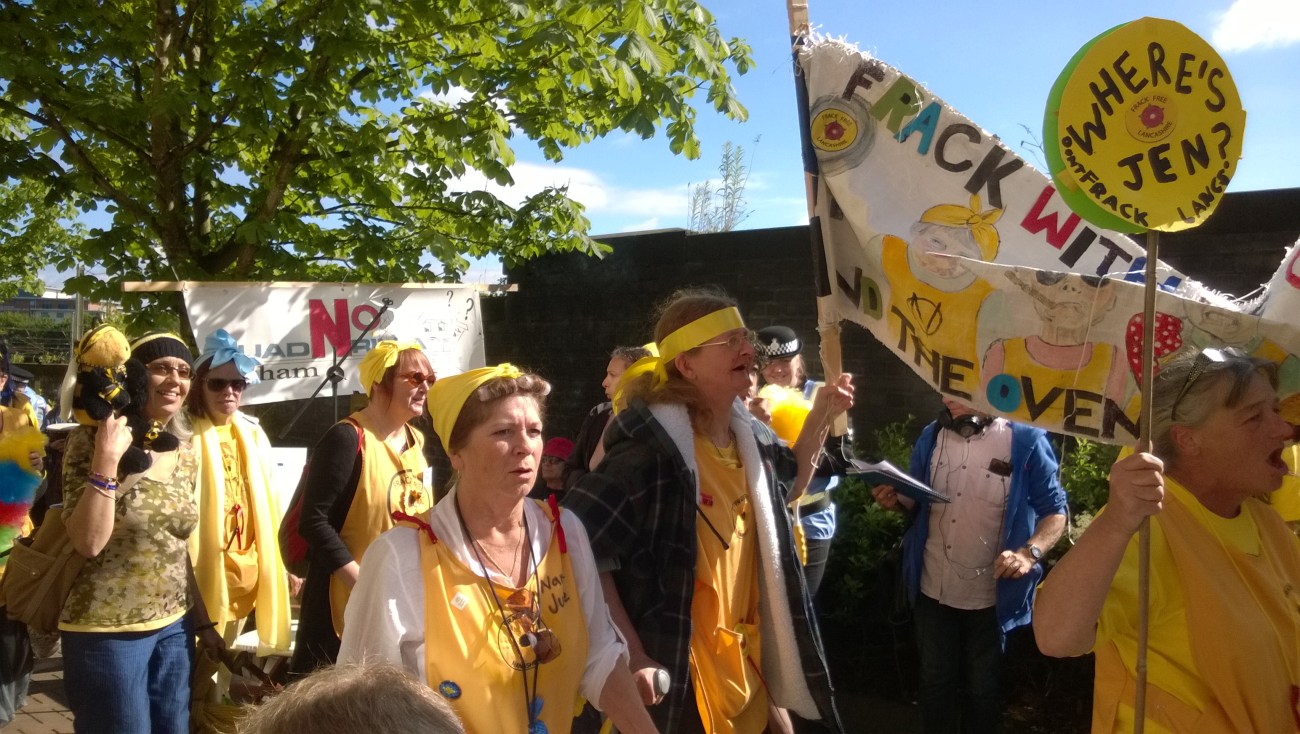
Dr Szolucha said the prospect of shale gas had “significantly undermined feelings of personal safety”. She said some people reported an atmosphere of intimidation, distrust and secret surveillance. Some felt the legal system was not adequately protecting them from restrictions on their democratic rights.
“Residents feel that the shale gas development introduced unnecessary security personnel and a higher police presence in the area. They also led to securitisation of places directly adjacent to the shale gas sites where residents were photographed while approaching the fields”.
According to the research, people no longer trusted the police generally, feeling that they put the interests of companies and government above the rights of residents. But many residents said they had a good relationship with local Lancashire police officers and wanted this to continue.
People involved in the research had experienced the effects of criminalisation of protests and protesters. Yet despite this, most said they would take part or support direct action against fracking.
Fractured community and grassroots mobilisation
The research found that the prospect of shale gas development in Lancashire had already disrupted relations within local communities.
Residents reported that the proposals had “reopened fractures between certain members of the communities and has isolated some of the landowners”.
But the local campaign against shale gas had created a new sense of community and for some people this had helped alleviate stress.
Social impacts “inadequately assessed”
Cuadrilla carried out an Environmental Impact Assessment of its proposed sites and produced an environmental statement running to hundreds of pages.
But Dr Szolucha said local residents believed the social impacts of shale gas had been “inadequately assessed” during public consultations and the planning and appeal process.
They thought the planning process prevented the consideration of social and health information alongside the technical and environmental data provided by regulators and the company. This could, the study concluded, influence the outcomes of planning and political decision-making, against the interests of local communities.
The study also found that residents perceived that staff from the council and regulators as influenced by the government and/or the company and unable to make impartial decisions.
An independently produced social impact assessment, which analysed the human consequences of a development, should be taken into account in all decisions about shale gas, the study concluded.
Cuadrilla
Dr Szolucha said there were “feelings of deep distrust” towards Cuadrilla. Residents lacked confidence in the company and had contested its data and analysis.
“They are also dissatisfied with the way the company has been dealing with their concerns. … The company’s failure to consider the possibility of accidents amplifies the perceived level of risk”.
Local donations made by the company were seen as aimed at convincing communities to support shale gas exploration rather than as contributing to local development, she said.
Compensation to landowners was viewed as a way to “overcome local resistance and could potentially constitute a socially divisive conduct by the company”.
People also felt that proposed community benefit payments of £100,000 per exploration site and 1% of shale gas revenues were aimed primarily at convincing communities to support shale gas.
“Local residents are not convinced that the payment would necessarily directly benefit the communities as it could be administered as charity and any organisation might apply to it for funds”.
The study said it had invited Cuadrilla to take part in the study, along with the Lancashire County Council planning officer, the industry-funded North West Energy Task Force and landowners who had leased land but none had agreed.
We asked Cuadrilla to respond to Dr Szolucha’s findings but the company declined.
“Decision pre-determined”
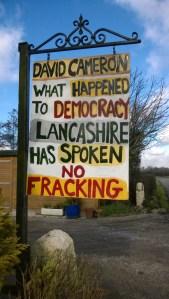
According to the research, shale gas developments in Lancashire had made some residents disillusioned with politics and politicians.
For some, the experience had challenged their long-held political beliefs. Former Conservative voters said they had stopped supporting the party, Dr Szolucha said.
“The UK government is perceived as imposing shale gas extraction on recalcitrant citizens, which nullifies its democratic mandate”.
Councillors also described pressures on them to consider only certain aspects or impacts – contributing a sense of imbalance of power between local authorities and the gas industry, Dr Szolucha said
The move by the then Communities and Local Government Secretary, Greg Clark to take the final decision on Cuadrilla’s applications was seen by Lancashire residents who took part in the research as “a denial of democracy and human rights”. One said: “It’s no longer about fracking, it’s about democracy”.
Dr Szolucha added: “There is a sense that the government has already pre-determined its decisions”
“Residents are receivers of information”
The research also reported criticism of Cuadrilla’s community engagement process.
It said residents felt “they have been treated as mere receivers of information rather than serious consultees”.
“The lack of evidence that the company has taken the concerns of the local residents into account in readjusting their plans has amplified feelings of being dismissed by the industry and has fostered the view that the consultations organised by Cuadrilla were not meaningful”.
Link to report
www.repowerdemocracy.net/report
Categories: Opposition

 DRILL OR DROP?
And in communities around the world where fracking for shale or other unconventional gas extraction has taken place, often for a decade or more, the conclusions and research show the negative impacts on communities.
Click to access Ogge%202015%20Be%20careful%20what%20you%20wish%20for%20FINAL.pdf
https://www.earthworksaction.org/media/detail/lawsuit_over_fracking_near_schools_in_mars_school_district_could_have_state#.V8bLeRQomdA
https://stateimpact.npr.org/pennsylvania/2016/06/06/dont-frack-the-rich-comment-puts-focus-on-environmental-justice/
http://www.ecowatch.com/10000-march-in-philly-calling-for-a-clean-energy-revolution-1943067458.html
Another round of propaganda masquerading as science.
A cursory look at Dr. Szoulcha’s website at the University of Bergen confirms that she is a self-proclaimed fracktivist.
Her study is such a joke that it doesn’t merit serious discussion.
KT, citing propaganda isn’t going to convince anyone of anything. The fact is that fracking can be undertaken safely. End of story.
Are you here again my anonymous little friend?
The fact that Dr Szolucha’s web page at the University of Bergen shows she has researched anti-fracking and activism does NOT make her a self-proclaimed fracktivist. (Actually I assume you meant anti-fracktivist – you are the fracktivist Sock Puppet Guy). She is a social scientist for goodness’ sake.
What exactly is it about her study that you find to be “such a joke” Peeny? Do tell us – Oh and while you are at it do let us know who you are, or at least why you are scared to tell us.
Ah, its the man without a plan, John Hobson. The man criticizes those who offer practical solutions while he can offer none.
“She is a social scientist for goodness’ sake” LOL. Yes, a social scientist fracktivist, my good boy. Just look at her twitter feed and you’ll soon grow an appreciation for her biases.
Junk science is the name of the game for the anti-fract-anti-fact crowd, and this is no different.
My anonymous little friend, the fact that you don’t agree with my plan doesn’t mean it doesn’t exist, but as I explained it’s not actually my job to decide UK energy policy (thank goodness given the parlous state it’s been left in. We clearly have to deal with the trilemma described by Prof Bradshaw at the meeting, at the same time as meeting our obligations under the 5th Carbon Budget. Without CCS just how do you propose we square that particular circle Peeny? I’m all ears.
Cuadrilla’s Twitter feed is all about youth football just now – are they changing the focus of their exploration now?
You still haven’t explained what you actually disagee with in Dr Szolucha’s thesis – all you’ve down is hurl your usual inane insults.
If you paid closer attention you would understand that I have completely destroyed the good Doctor’s thesis, John. “There’s nothing to fear but fear itself” sums the point very well, John. The anti-factivists have sown the discord that the good Doctor reports, with their lies and misinformation. It’s pretty simple.
“I have completely destroyed the good Doctor’s thesis”
I think you are quite delusional Peeny. Have a nice day now!
John, you buffoon, take a look at her website which declares: “This project is about community energy and anti-fracking.”
Sure, she’s a perfectly objective scientist, doing perfectly objective work!
That’s why her paper included studies of the towns surrounding the 200 other fracking sites in the UK and noted that residents of these towns had not suffered any long-term ill-effects from fracking. It also included a study of the 250 currently operating oil and gas extraction sites in the UK, right John?
What I found most interesting about Dr. Szolucha’s work was the multi-variate correlation work that demonstrated how fear, despondency, and anger was related to misinformation from the same anti-frack groups which Dr. Szolucha retweets from her Twitter account. It turns out that when anti-factivists cite “research” showing that fracking causes cancer, premature birth, and migraines, people get upset. Of course they’re never told that the “research” is bogus, and that it has never shown a causal relationship. Nor are they told that the data actually demonstrate that fracking is not responsible, but because the authors are employed by political activist groups with an anti-fracking agenda, they must produce scary headlines.
I would propose that you and Dr. Szolucha form a task force to explore this issue further, John. How much damage to the psyche of Lancs residents is being done by the anti-factivist movement. There is certainly a rich data set of misinformation to get you started!
Strange there is so much opposition to fracking/unconventional gas in countries where it has operated for a decade or so. I think any intelligent person can see if there were no issues with this industry any opposition caused by those opposed to fracking would long since have disappeared – but instead opposition grows – even in the US.
John Hopkins peer reviewed studies are bogus – really?
Peeny, there is no need to be any ruder than you have to be.
Take a look at her website which declares: “This project is about community energy and anti-fracking.” – it describes what her thesis subject is not who she is. Dear me!
I don’t think it’s very fair of you to criticise somebody for not including in a study towns where 200 wells were allegedly fracked that we don’t even know for sure exist . Even DECC (RIP) can’t tell you where they are. You seem to be pretending to know better so do let us know which towns she should have included in your next post – I’ll be sure to remind you should you forget.
I think if any damage to anyone’s psyche is apparent, it manifests itself most clearly in your rather paranoid posts, which are becoming increasingly tedious.
What did you say your name was and who do you work for? I think I missed that one.
Oh sure, John. She’s not anti-fracking, right? Just like wind and solar can power the economy, right John? LOL
I’m sure that the oil and gas companies would be happy to share the locations of some of their many successful UK fracking operations with this very objective social scientist. We already know a few including Wytch Farm. She could start there. I saw that they had over 100 wells at that location, so it obviously would have caused high trauma to the local citizenry with such intensive activity, right John?
;0)
Yawn, conventional v unconventional, yawn.
And yeah – you can name 1 – brilliant!
Why not quote Elswick while you are at it Peeny LOL You might as well totally discredit yourself – no half measures now
Allow me to quote your pal Backing Fracking on the difference between convention tight sandstone wells and modern multilateral fracking in to shale:
“It’s also worth re-stating that the Jonah gas field, discovered in the 1990’s, is a tight sandstone reservoir (not shale) and was developed by drilling closely spaced vertical wells (with as little as 10 acre centres) and multiple fracture stimulation treatments “stacked” on top of one another.
Basically, it bears no relation to modern-day shale gas extraction with multiple horizontal wells from a single pad – except for the fact that the length of the well is fracked in sections in the same way as the vertical wells saw multiple stacked fracks in the Jonah field.
To suggest otherwise, and that this is what Lancashire and North Yorkshire could one day look like, is frankly dishonest in the extreme..”
So he’s clearly saying anyone who tries to claim the 200 other fracking sites in the UK (which if they exist were all drilled into conventional resources, probably into sandstone), are in any way representative of “modern day shale gas extraction is “frankly dishonest in the extreme”.
He’s talking about you Penny isn’t he? For once he and I agree.
I disagree, John. No two wells are exactly the same. But Wytch farm was fracked, just as another couple hundred wells have been fracked in the UK. We don’t know the specifics of those fracking operations, but we have no reason to believe that mechanically they would be dramatically different from what third energy and cuadrilla are about to start doing. Do you have information that would indicate that the impact of those 200 fracking operations would be different, John?
BTW, you have been very very silent when asked to provide proof that fracking causes system damage to water supplies or human health. Cat got your tongue, John?
Oh and by the way Peeny (or should I call you Jim?) you are aware, are you not, that Perenco’s existing planning permission means they are not allowed to frack into shale for hydrocarbons at Wytch Farm – so anybody trying to use Wytch Farm as an analog for HVHF shale gas fracking (as you are clearly trying to do) is not just dishonest they are also ignorant.
I believe that fracking has taken place at Wytch farm.
Not into shale it hasn’t, and DECC’s chief geologist was very clear that “these non-shale fracs are not comparable” – do stop trying to defend the indefensible – when even your own side say what you are doing is being “frankly dishonest in the extreme” then even you ought to start getting the message.
“Do you have information that would indicate that the impact of those 200 fracking operations would be different, John?”
Er yes – shall we start with the huge differences in fluid volumes and the consequent impact of trick movements? Didn’t you remember from last time you asked that question LOL? It is irritating to have to constantly answer the same questions form you because you don’t read what people tell you.
As explained several times I have not made a claim that impacts on health or water are proven to be systemic – that is you doing your habitual reframing of arguments to suit your limited repertoire of argument. I have pointed out several times that the EPA’s conclusion that there is *not* a systemic impact on water supplies is not based on the evidence they provided and is thus bad science. It’s not hard, Dick. Try to keep up.
Can you explain why the impact of the 200 fracked wells that have not been drilled in shale would be different from shale wells? Do you have any empirical evidence to back your contention? Some of the fluid volumes may have been lower, and the horizontals smaller, but I have yet to hear you give a convincing explanation as to why a fracked well that had a shorter horizontal, requiring less fluid, should be dramatically “safer” than one that covered a longer horizontal distance. Are you arguing that short laterals are safe while long laterals are dangerous? I don’t believe that I have seen any science to support that contention, John. So, I am more likely to believe the experts who believe that the new wells wouldn’t have appreciably different environmental impacts.
As to the EPA report, if the evidence that the EPA provided shows that there was a systemic impact, can you point us to that evidence, John? The EPA obviously feel that the conclusion was based upon the evidence, or they would not have made the statement. You will also have to explain why the SAB letter said the following: “While the report could have articulated the agency’s statistical assessments more clearly, there has not been any facts or evidence demonstrating a systemic impact to existing drinking water resources.” Are members of the SAB lying when they make this statement, John. If that is your claim, how do you support it? What evidence do you have?
You have gotten awfully confused regarding this subject, John. There isn’t any evidence of systemic impact, but the SAB has asked that the agency provide more quantitative data to make its point that impacts are not systemic. Hopefully this helps!
John, I still await your response on these issues. Thank you!
I disrespect people such as you hballpeeny – the Australia Institute is not propaganda neither was the 10,000 that marched through Philadelphia, the lawsuit against parents that didn’t want fracking near their children’s school or the fact a fracking executive publicly stated they avoid the rich as they have funds to fight industry.
It seems you cannot deal with facts and reality and just discredit anyone that doesn’t swallow industry propaganda or agree with you.
And I have not discussed fracking being done safely. End of story!
KT – I think you meant “try to discredit” – he makes a pretty poor fist of it
“Study Finds That Anti-Frack Propaganda Masquerading as Science Causes Stress, Anger, and Mild Bowel Discomfort in Lancashire Residents” Exhibit 1 of 689: http://www.forbes.com/sites/michaelkrancer/2016/08/30/johns-hopkins-universitys-dismaying-fact-challenged-attack-on-fracturing/#38940c623239
Cross-posting again Peeny – learn some manners!
As in Lancashire, so in Balcombe.
Trouble with the Balcombe protestor’s was they did not & still do not know the difference between fracking for shale gas or oil extraction by conventional mean’s! The 300 member’s of FFBRA did not have a clue what they were protesting about! Just happy to RUIN a village by division! As i have said many time’s in ’86 Conoco drilled same site for oil without one protestor in site! Yet in 2013 the FFBRA (A MINORITY of 1800 resident’s) were all for banning fracking in Balcombe,yet were not able to read a letter sent to all resident’s in may 2013 that they (Cuadrilla) would not be fracking!
For goodness’ sake Malcolm. Learn how to use an apostrophe please.
It’s funny how you lay the accusation of dividing a village at FFBRA’s door – the evidence suggests that the division starts with the fracking companies, not with people protesting against them.
It is interesting to read that Cuadrilla’s attempts to buy community acceptance seem to be backfiring on them – Interestingly 16 of the last 20 tweets / retweets from @cuadrillauk have been about their tie in with the AFC Fylde’s kids team. Talk about scraping the barrel. I found this one particularly nauseous https://twitter.com/afcfct/status/768482027947655168
It was also interesting to read the defamatory and grossly inaccurate Press Release on this event issued by the industry front group “Backing Fracking” this morning. I don’t imagine the local press will give their grousing any coverage, but it does demonstrate just how desperate they are and how hugely worried they are that the social licence to operate is getting ever more elusive for them.
Yes rather like Ineos sponsoring fun runs for children – I recall the tobacco industry did similar things and am I correct in thinking many of the fracking companies use the same PR company that the tobacco industry used? Thought I’d read that somewhere if I’m not mistaken.
Fossil fuels have had their day and are on their way out – we now know whether it is air pollution from diesel cars, devastating impacts from climate change – they can no longer be remotely considered healthy. They all do harm. The sooner we can move away from them the better.
Indeed KT – Hill and Knowlton – now known as H&K Strategies, who provided £81,001 to £82,500 in secretariat services to the APPG on Unconventional Oil & Gas. That’s an awful lot of photocopying isn’t it? A quick scan of the register suggests that the next highest is about £50,000 and that is highly atypical, with most APPG’s receiving either zero or benefits in kind in the range of £1501-£3,000.
In January Kevin Hollinrake resigned from the vice-chairmanship of the All Party Parliamentary Group on Unconventional Oil and Gas claiming he had not previously been aware of any potential conflicts of interests in the way the group was funded. According to the website of the Association of Professional Political Consultants H&K Strategies do have Cuadrilla as a client.
This is them http://powerbase.info/index.php/Hill_and_Knowlton
Thank you John that is very interesting and rather socking.
Hi KT – have a look at the facts and figures in this article from Resilience:
http://www.resilience.org/stories/2016-09-01/intermittent-renewables-can-t-favorably-transform-grid-electricity
She is from Norway and of course Norwegian don’t want us to develop shale gas as our North Sea production is decline and become more dependent on buying more gas from Norway and contribute to their big fat national wealth fund.
It is the government fault. Either approve exploration get some idea of what the fuss is about or reject it and let people get on with their lives. No good for anyone to drag on and leave thing in suspension.
I think she is Polish. But her background tells it all. Occupy this, that and the other……but don’t do anything productive.
Paul – Norwegian? Polish? what does it matter as long as your friends can find an angle to try to discredit her findings? Honestly, I thought you were better than that.
It would appear that Dr Szolucha is a highly qualified social scientist with a doctorate, and an MA Hons. in International Relations (First Class) from St Andrews. I think her academic background is impressive enough to give her findings some serious attention.
Hello John. Nothing personal with her, I just have no time for social “scientists” in general, particularly wasting EU money. Perhaps it is because I am an engineer? She could draw the same conclusions for any development proposal that is hung up in the planning system, housing, windfarms, HS2, infrastructure……. They give Sociology degrees away free with cornflakes these days – in fact they did in the 70’s when I was at Uni.
She has been on Drill or Drop before.
https://drillordrop.com/2016/02/09/fracking-through-our-eyes-photo-exhibition-premiers-in-blackpool/
And comment about Occupy is valid:
Again Paul – I would point out that what you study does not necessarily define who you are, (although the prejudices people display in posting may be quite enlightening 🙂 )
TW – I thought we were supposed to believe all our gas comes from Mr Putin and those horrid Qataris. Suddenly we are now funding Norway too. Goodness where will it end?
So TW’s response to this very worrying research is an ad hominem attack on the researcher, based on her nationality. What a pathetic attempt to smear a very important paper, and I’m surprised that it was included in the comments section.
Anyone with any on-the-ground knowledge of the effect of fracking on people in Lancashire, Yorkshire and other threatened areas would probably agree with her findings, based on their own experience and that of others involved in the campaigns to stop fracking around the country.
TW’s ridiculous, childish response, namely a personal attack on the researcher shows the pro-frackers are really getting rattled and are definitely losing the argument. It’s a pity some feel the need to use these posts as an opportunity to ridicule and belittle anyone concerned by the threat of fracking and treat it as a kind of hobby.
I live in the Fylde, close to Cuadrilla’s proposed sites and also close to where Halite are planning to create 19 underground salt caverns to store millions of cubic metres of gas. I know first hand what damage the gas industry is already doing to our community.
Dr Szoulcha findings are very true. If anything they probably underestimate the dreadful blight fracking brings to communities.
I also find it very telling that Cuadrilla has refused to take part in this research. I’d say they had a guilty conscience, if I thought they had a conscience.
It is interesting that when a study is from a source or organizations that linked or have some indirect benefits from industry the anti fracking claims the findings are biased and now the same argument put on them they start to jump up and down like a fired in their pant.
TW But the same argument has not been made – Backing Fracking is, for some reason, accusing Dr Szolucha of being biased against fracking because her University has received money from a company involved in fracking. Yes, I find that a bit difficult to fathom as well, but then most of what Backing Fracking posts is a bit lacking in the logic department.
i have been watching the Fukushima documentaries and how they are totally failing to deal with the worst nuclear disaster the world has ever seen. What has that to do with fracking? Well it has to do with enforceable legal controls, lack of enforceable safety procedures, the race to produce short term gains at the expense of our long term future, and the sheer incompetence of the operators and the subsequent disastrous attempts to clean it up. None of this was foreseen when the nuclear reactors were constructed.
I see a similar laissez faire attitude with the legal controls and monitoring of the fracking industry. We have enough problems to deal with without indulging in a process that would endanger what will be left of our usable environment.
Why do we keep fouling our own nest? because it is good economic practice to do so. Go figure.
Hi Ruth, is there an electronic copy of this report available anywhere do you know, I haven’t been able to find anything?
Do you know if she interviewed Lancashire residents from elsewhere on the Fylde and beyond, for balance?
And has any comparable research been done for other major local energy and infrastructure developments that you’re aware of? It would be interesting to see whether her findings are limited to shale or actually something you could expect to encounter across the board – only, I can tell you from personal experience that you see these sorts of effects in communities whenever a large scale waste-to-energy incineration development is proposed, not least because of organised opposition groups like this http://ukwin.org.uk pumping out misleading information designed to stoke opposition.
It would be very interesting to get a sense of the root causes and spatial distribution of concerns.
Thanks.
@environmentor, you should also inquire as to whether the fear and distress the study’s author reports is correlated with the publishing of mock scientific studies that are sponsored by anti-frack groups such as the one cited in this article….. http://www.forbes.com/sites/michaelkrancer/2016/08/30/johns-hopkins-universitys-dismaying-fact-challenged-attack-on-fracturing/#38940c623239
But since the author of the study is busy retweeting information from anti-frack groups who are themselves guilty of promoting the very mock science referenced above, I wouldn’t expect much objectivity from said author!
Hi Lee
Thanks for you comment. I understand that the author plans to put her study on her website and I’ll link to it as soon as its available. I’ll let you know when that happens. Best wishes, Ruth
Thanks Ruth, appreciated.
Does it offer any suggestions for how the identified problems could be overcome in the future?
Lee
Hi Lee. The key recommendation in the report is for a social impact assessment: an analysis of the human consequences of a development before decisions are made. Best wishes, Ruth
Well we could ban fracking for starters Lee 😉
Lee – you can contact Dr Szolucha via Anna.Szolucha@uib.no (the address is from her University of Bergen web page) and ask her yourself for a copy. I’m sure she’ll oblige, although she may, of course, not be too well disposed towards you after having read the Backing Fracking press release about last night’s event.
I haven’t found an easy link to the research report but if the conclusion is as stated by Ruth “Without exception, all members of the communities that were engaged in the planning process and grassroots activism reported significant levels of stress and anxiety” then this would be hardly news. It’s saying that people active in the anti-fracking movement who are stressed by the prospect of fracking tend to show signs of stress! Not really surprising and I guess that would be true of anyone stressed by some perceived external threat whether realistic or not.
A true measure of the effect on the local community would have been a comparison, using standard measures of current mental state, of a random sample of the local population perhaps within a certain radius of the proposed site which would need to be compared at least with a similar group in an unaffected area. These types of studies are full of potential methodological problems. I do wonder what “peer reviewed” meant in the context of this study. Looking from the other side I find myself getting sometimes getting twitchy and aggitated (“stressed”) by what I perceive as the “powerlessness” of the small shale gas industry in the UK against the weight of the green movement. I guess it’s all in your point of view.
Mark – ‘the “powerlessness” of the small shale gas industry in the UK’ – that one actually made me laugh 🙂
Well John, it’s nice to know I’ve made a small contribution to reducing your stress.
Absolutely – I bet you’d make more money as a comedian than a fracking advocate 😉
“Study Finds That Anti-Frack Propaganda Masquerading as Science Causes Stress, Anger, and Mild Bowel Discomfort in Lancashire Residents” Exhibit 1 of 689: http://www.forbes.com/sites/michaelkrancer/2016/08/30/johns-hopkins-universitys-dismaying-fact-challenged-attack-on-fracturing/#38940c623239
Er Peeny – even your Forbes frack-attack dog has to admit that “The study does not and cannot claim that any adverse heath impacts are caused by fracturing.” – This is how science works though my anonymous little chum – somebody comes up with a hypothesis, it gets chewed around, either data is found to support it or it doesn’t. Remember how we learned quite slowly that smoking causes cancer? Would you deny that now? I doubt it – but there were shills just like you poo-pooing the idea back then, indeed there probably still are. I think the stress and anger are mostly evident in your reaction to Dr Szolucha’s study, and I can read the results of your mild bowel discomfort.
So who are you my American chum and what is your interest in a UK based fracking page about UK fracking?