
Third Energy’s KMA wellsite at Kirby Misperton, North Yorkshire. Photo: Eddie Thornton
As Third Energy prepares for high volume hydraulic fracturing in North Yorkshire – the first in the UK for more than six years – campaigners Jon and Val Mager argue there are serious flaws in the regulatory regime.
In this guest post, the couple report on what they found out from the Environment Agency about the plans and why they have urged the Business Secretary to stop the frack going ahead.

Jon and Val Mager outside the Kirby Misperton fracking site.
We spent over an hour talking to three officers from the Environment Agency at a drop-in event on 7 September 2017 in Kirby Misperton. This is the village close to the KM8 well which Third Energy is to frack.
We attended the meeting because we have experienced gas exploration in the East Riding of Yorkshire and because our research into environmental permits issued by the EA did not reassure us.
We also went because Val was born and educated in Ryedale, the area which includes Kirby Misperton, and both her parents are buried there. She fears that if industrial-scale fracking is allowed, Ryedale will change forever and a unique rural landscape and community will be lost.
We appreciated the honesty of the EA officers. Some of their answers may surprise those who have followed the campaign against high-volume, unconventional fracturing to obtain shale gas.
But from what we learned, we concluded that the full implications of fracking at Kirby Misperton have not been discussed in one democratically-accountable forum. Instead, it has been fragmented into three different regulatory agencies. No one has taken overall responsibility to communicate and consult about the local, regional and global implications of decisions made by different officers and councillors.
Similarly, there is no single independent inspectorate. The current combination of desktop assessment of plans by the HSE, the use of audits by the EA and the way both organisations rely on self-reporting by the shale gas companies is not fit for purpose. There is no independent real-time monitoring of the well sites which could easily and cheaply be achieved with video and infra-red cameras open to public view.
The fundamental objection to fracking will always be that if anything goes wrong miles underground during fracking, consequent significant pollution may not be known for weeks, months or years afterwards. It will be the local population and wider environment that suffer the consequences and it will be the public purse that covers the cost of remedial action.
We do not believe fracking would now be starting in Ryedale if information from EA sources, shared here, had been fully publicised and open for consultation in a single forum with all parties and open to questions.
That’s why we have written to the Business Secretary, Greg Clark, who will give final go-ahead to the KM8 frack, asking him to stop all fracking exploration in the UK immediately.
In the rest of this post, we give more detail of what we found out from the Environment Agency.
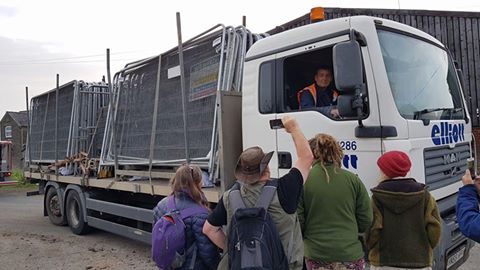
Delivery of fencing to the KM8 wellsite earlier this month.
Detection of gas leaks
We were concerned about how gas leaks would be detected and dealt with.
A leak in September 2014 at the West Newton A well site in the East Riding was first reported by residents, rather than the operator, Rathlin Energy UK. It took time for the EA to respond and Rathlin initially described residents’ concerns as “false allegations”.
In March 2017, John Dewar, chief operator officer of Third Energy, reportedly told a Ryedale councillor that a strong smell from the Kirby Misperton well site was merely mercaptan. This is a product added to odourless methane to help detect leaks. The implication was that this was normal and nothing to worry about.
From our questions at the meeting, we discovered that officers from the EA and the HSE were unaware of mercaptan. They were unable to say at what point of the Kirby Misperton well testing mercaptan would be added. This issue must be clarified by the regulators before fracking starts at KM8 or at Cuadrilla’s Preston New Road site near Blackpool.
We also asked about the impact of faulting on potential leaks. In a presentation on 31 August 2017, Third Energy said:
“The aquifer under the KMA site is geologically separated by a series of faults from the nearest aquifer that supplies water for public consumption.”
The fault lines could offer a route for gas, released by fracking or well failure, to reach the air. We wanted to know what steps would be taken to monitor leaks of gas along the known fault lines.
An EA geologist said the compression faults in the area were unlikely to allow gas to escape to the surface. The risk depended on the extent of potential energy in faults which might be released by fracking. According to the EA assessment of local geology, this was not a justification for refusing permits to frack.
But the EA officers acknowledged that the faulting around KM8 could, theoretically, present a pathway for gas to reach the surface. They confirmed the only gas monitoring in place was adjacent to the KM8 well. There are no arrangements to monitor fault lines where they meet the surface in Ryedale.
In the light of very limited experience of onshore fracking onshore in the UK, we argue it would seem wise to set up arrangements to monitor fugitive emissions of methane from known faults connected to fracking well sites. The pattern of local faults as they occur at the surface should be notified to local residents so that tell-tale signs of surface leaks might be observed.
Emissions to air
The EA permit for the Kirby Misperton site (known as KMA) stated: “There shall be no point source emissions to water, air or land”.
We established that no gas from the test of the KM8 well would deliberately be emitted to air on the KMA wellsite.
But there will be emissions to air. Gas will be sent down the existing pipeline to the Knapton generating station, where it will be either burnt to generate electricity or flared. So, the point source for emissions from the gas will be at Knapton as the product of combustion.
This was not made clear in the EA permit for the KM8 frack. People may have been misled to believe that frack tests and the consequent industrial application of fracking to existing Third Energy wells would not require emissions of methane or other hydrocarbons. We believe this is an example of the failure of planning procedure and the EA permits to consider system-wide and cumulative impacts.
The EA team confirmed that the permit variation notice for the Knapton Generating Station (Section IC5 p.18) referred to known fugitive emissions of methane and NOx from the gas conditioning plant and combustion plant.
The team also said there was an assumption that all equipment involved in gas transmission and processing would leak under pressure. There were standards set for these leaks based on tests of each item of equipment at a range of pressures. The equipment at Knapton was assessed against these standards for performance within the expected range of emissions. This was normal industry practice which, according to the EA team, was based on “a methodology which has been tested”.
This raises the question of whether the pipes, flanges and pumps used for managing gas released during frack tests at Preston New Road and Kirby Misperton are subject to the same standards of testing and therefore a specified amount of fugitive emission to air has been assumed in the EA permits. Methane is considered to be as much as 20 times more influential than CO2 for climate change. This issue must be clarified immediately before any further progress towards frack testing in the UK.
Flaring of gas
We feel Third Energy gave the impression in its planning application and publicity that the Knapton generator was the only method of emitting gas from conventional wells or the planned frack test at KM8.
We established from the EA team that gas would be stored under pressure in the supply pipelines so that it was available when needed at Knapton. These pipelines, as the EA explained, would leak under pressure.
We also know that gas can be burned in the flare at Knapton, as it was in November 2015 when there was a complaint about odour at the Malton well site.
The EA team confirmed that the permit variation for the Knapton site, issued in January 2016, allowed Knapton to operate for up to 1,500 hours, or just over 62 days, a year. The EA team did not disagree with our assertion that it was inaccurate to describe the flare as an alternative, “emergency” facility when the generator was used only for limited hours.
We argue that it was inaccurate for Third Energy to suggest that the planned frack test at KM8 would not lead to emissions of methane or other hydrocarbon gases.
The planned frack test may release large quantities of gas beyond the storage capacity of the existing pipelines. It is clear there would be emissions to air during the test via three possible routes:
- Permitted fugitive emissions from pumps, valves and pipe flanges allowed by EA standards;
- Combustion in the “emergency” flare, which in reality was a route that could deal with gas for over 300 days a year;
- Combustion in the generator providing there was a commercial basis for switching it on, which depends on demand, within the 1,500 hours it was permitted to run each year.
We also established from the EA that there will be no real-time monitoring or regulation of gas emitted or combusted as part of the frack tests. There are no plans for independent 24/7 monitoring of the flare or the generator at Knapton by, for example, video link.
The EA officer responsible for monitoring explained that regular audits of records kept at Knapton would reveal any impacts from additional gas from frack tests at KM8 and records would show up any problems with the “emergency flare” there. Third Energy would be expected to report problems and issues would also be covered in weekly monitoring reports – though we pointed out that the Malton complaint in November 2015 was not subject to an EA visit until January 2016.
Future greenhouse gas impacts
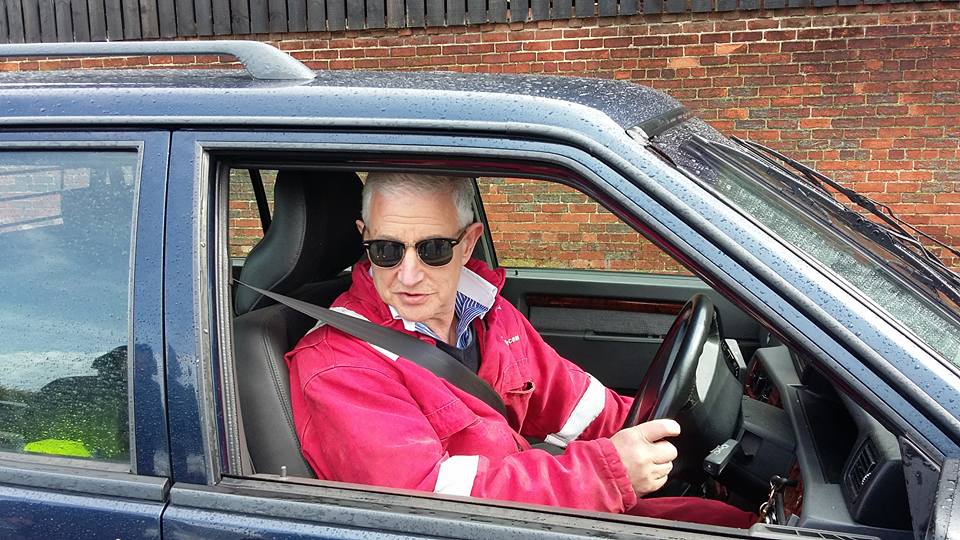
Third Energy’s operation’s director, John Dewar, arriving at the KM8 wellsite earlier this year. Photo: Caroline Haywood
Third Energy does not acknowledge that there would be increased emissions of potent greenhouse gases as a result of the test frack at KM8.
But if the company successfully established fracking to increase production from all its wells in Ryedale then industrial scale fracking would have a significant impact on emissions to air with a consequent impact on greenhouse gases.
Third Energy claimed its successful fracking would support the work of the Knapton Generator, which has the capacity to provide electricity for 40,000 homes. The company did not reveal that the station operated only during peak periods of demand if the price were right.
We believe no further activity at any fracking site in the UK should be allowed until the full extent of permitted emissions to air from frack tests and the planned industrial scale fracking has been assessed using the EA standards for emission of methane and NOx to air and their impacts have been subject to public consultation and scrutiny.
Short notice unannounced inspections
We have experience of unannounced inspection by independent inspectorates, such as Ofsted and the Care Quality Commission, and think there should be the same approach for shale gas exploration sites.

The EA can do spot checks as part of regulatory enforcement under the Environment Act 1995, Sect 108. But we established from the EA team that there have been no unannounced inspections of shale gas sites. (The EA team did not count exploration sites at Crawberry Hill and West Newton-A because officers did not regard them as fracking.)
In contrast to other inspectorates, the EA does not publish the procedure for unannounced inspections. There is currently no record of whether or not inspections are unannounced.
The EA team could not tell us precisely how many inspectors were employed. The team said this was because colleagues from outside the organisation’s EA onshore oil and gas programme might become involved if their particular expertise was needed.
The EA has the key role in issuing permits and inspecting the effectiveness of such permissions. There is no independent inspection of the industry, the regulators and the effectiveness of the relationship between the two.
Without public background information supported by open availability of reports of unannounced inspections, there cannot be any confidence in the robustness of the EA’s regulatory regime for fracking which depends mostly on information provided by the operator. Self-reporting implies self-regulation if breaches are only uncovered sometime after the event.
Given the several regulators involved in fracking permissions and inspection, there is a strong case for a single, independent inspectorate reporting to Parliament.
Trust in Third Energy by the Environment Agency
The strategy for regulation in the UK assumes that current local planning permission, EA and HSE permits and inspections are adequate. Given our experience of how gas exploration in the East Riding was not effectively regulated, we wanted to understand the relationship between the EA and operator and how the EA deals with breaches in permits.
We asked about recent incidents involving Third Energy, including the Malton leak, the company’s changes without notification to groundwater monitoring and the incorrect mean monthly figures for stack emissions at Knapton.
The team explained that the EA has “a culture of regular shared team briefings”, which included incidents such as the Malton leak.
Response to breaches had to be in proportion to the impact, the team said. There was a four-point scale to record the seriousness of the breach in the Compliance Assessment Report. Enforcement action would be taken if necessary. The operator paid a fee to cover the cost of regulation by the EA and if there was a high level of breaches then the fee would be increased so there is also a financial penalty for non-compliance.
The team said it had to work within the current Environment Act and the statutory guidance which provided the remit and context for the Agency. The officers acknowledged that self-reporting by the industry was the basis of the audit process, which was the core of the EA approach to regulation. They confirmed there was no independent real-time visual monitoring e.g. using video cameras, but there was an air-monitoring unit beside the KM8 well.
We concluded that there is a close working relationship between the EA and the onshore oil, gas and shale gas industry underpinned by a fee structure which means the industry contributes to the funding of the regulator.
There is no single, authoritative and independent inspection regime which can, not only “speak truth to power” about failures of regulations, but also be held directly to account by Parliament if there are shortcomings in the inspection regime, putting people and the environment at risk.
Categories: Regulation

 DRILL OR DROP?
North Yorkshire County Council is quite clear about the site operator breaching the Fracking Permit: “the planning conditions must be FULLY discharged and monitored” (Fracking Decision Official Statement) https://www.northyorks.gov.uk/kirby-misperton-fracking-operations
That is quite interesting. More against any gas production per se than fracking alone, but just my opinion.
A couple of issues of interest outwith those discussed quite a lot on the site …..
1. Fitting video cameras in company premises for public viewing is an interesting idea. Some comment from the locals who work on the site would help balance that thought. I have come across it in Russia and other ex Russian Federation States. But only the local police got to monitor it I believe.
Quite a radical step I guess for the UK?
2. That the industry pay for regulatory activities is not an issue as I see it. I have to pay tax, but the tax department are not friendly towards me on account of that. The industry is charged for activity, it does seek a service which it then pays for. Hence the fee structure does not underpin a close working relationship.
What is the alternative ( for industry, not fracking specifically )?
IN YOUR ABOVE POST YOU QUOTE .
” Methane is considered to be as much as 20 times more influential than CO2 for climate change. ”
In an article by Scientific American, How Bad of a Greenhouse Gas Is Methane ?
They say, quote, ” methane warms the planet by . …. 86 TIMES as much as CO2, according to the Intergovernmental Panel on Climate Change.”
https://www.scientificamerican.com/article/how-bad-of-a-greenhouse-gas-is-methane/
yes exactly which is why the whole climate change bs argument is bs – it discounts / does not include METHANE emissions. Last year there was a methane leak Porter Ranch Pasadena California. Hundreds of people were forced from their homes for months. There is still a leak and home values have plumetted. Is this what we want to happen in England? I am against climate change crazies but so completely against fracking as well. Clean coal is better than fracking especially with the horizontal drill impact.
Cindy, ” the climate change bs argument ” does come from a reliable source…….. NASA
2017 is so far the SECOND HOTTEST YEAR ON RECORD thanks to global warming.
https://www.theguardian.com/environment/climate-consensus-97-per-cent/2017/jul/31/2017-is-so-far-the-second-hottest-year-on-record-thanks-to-global-warming
Cindy
I believe that the Porter Ranch leak relates to a gas storage well, not a frack well. There are no comparable wells onshore in the U.K as far as I am aware that would cause that amount of trouble. Indeed Centrica are closing their offshore gas storage field ( Rough ) as, inter alia, the wells are old and ‘worn out’.
We do have LPG storage in caverns, at Killingholm for example. The HSE report RR605 is interesting in terms of the risks from such storage caverns.
Hewes62 – correct, it’s an old gas storage field that has been used from the 1970’s – and has absolutely nothing to do with frac’ing. It also has ‘single mode failure points’ – in other words, a single piece of equipment going breaking or going wrong can lead to a large system failure (i.e. release of gas) unconstrained by any safety systems – and that’s exactly what happened. This cannot happen in the UK – multiple things need to go wrong.
I believe the old Humbly Grove Field has been converted over to gas storage several years ago. In addition, there are other gas storage sites in underground caverns leached from salt in Hornsea and Aldbrough.
The difference between the 80x and the 20x figure for the potency of methane comes from looking at its short-term versus its long-term impact. Scientists use the 20x figure because that is the most sensible figure to use in the models. You cannot just plug the short-term figure of 80x into a longterm model and expect it to be accurate. It would hugely overestimate the impact of methane if you did that. Even the IPCC use the 20x figure. If you catch anyone saying that methane is 80x more potent a greenhouse gas than CO2 you know they are only using the larger figure because it is, well, larger.
The article refers to the very cosy relationship between Third Energy and the EA. The EA Pension Fund is made up from investments in coal, and oil and gas. The same industries that it is supposed to impartially regulate. When they were caught out in 2015, they produced the following statement:
“The £2.9bn UK’s Environment Agency pension fund (EAFP) has become the first in the world to change its investment choices to help meet the internationally-agreed target of limiting global warming to 2C. The move will include divestment of 90% of its coal assets and 50% of its oil and gas stocks by 2020.
It is going to take FIVE years to divest ONLY 50% of it’s investments from oil and gas! Much larger companies and agencies in the UK (most Universities for example) managed to divest from fossil fuel investments within a 2 year timescale.
Is the EA inefficient and can’t sort out it’s Pension Fund or is there just something a little ‘unhealthy’ about their relationships with oil and gas companies? Any rational person would assume that they should not have invested Pension Fund money in a business that they are supposed to regulate in the first place.
Yet the EA (and other agencies) cannot understand why we the Public have so little faith in their ability to regulate oil and gas companies (or their own Pension Pot for that matter).
Waffle
The fund may be dragging its feet in divesting from HC companies, but to say that an inspector or the EA may go easy on third energy, because the pension fund has an investment in Coal etc is a bit of a stretch.
No wonder the public laugh at those who would link pension investments to their day to day activities.
If the pension pit invests in wind, will the EA go easy on wind farm owners?
Obviously selling shares to someone else doesn’t do anything. The companies would still have the same number of shares in issue if A sells to B. Divestment at this time remains nothing more than virtue signalling.
Talking about regulation, did Mr.Dewar give permission for his photograph to be publicised? Just interested,. as so many seem to feel their rights might be imposed upon.
When I come across an article like this I can predict what it’s contents will be as we’ve heard the same story too many times prior.
Fracking is going ahead so just get on board, if doesn’t prove viable then we shall pack up and leave but that will be a few years down the line. The anti campaign has failed and all of their issues with the industry fall short.
There seems to be a consensus we can just press a button and get energy from using no fossil fuel whatsoever…. Load of baloney. Let’s first get the world to move away from using coal.
[Edited by moderator] Lets see all of this ‘nothing to worry about!’ translate into comprehensive INDEPENDANT unwavering liability coverage for landowners… And trigger points for planning breaches. If there will be no planning breaches then these terms are nothing to worry about eh?
[Comment removed]
[Comment removed by moderator]
Interesting about the Mercaptan. Had that query myself with local potential frackers – One can just imagine the frackers with their Apocalypse Now moment.. “I love the smell of Mercaptan in the Morning… that Mercaptan smell .. it smells like Victory”. except this f**kup just happened in Ireland.. Odourless gas in the network with users being told to turn off their gas supply. https://www.rte.ie/news/connacht/2017/0921/906624-flaring/
thegasmancometh
Yes, mercaptans free gas could be an issue. But it’s not frack specific. That it has been ‘discovered’ just now and a real cause of concern is a mystery to me. You could have asked any gas supplier in the U.K over the past 50 or so years since we moved off coal gas to N sea gas. And you still can ask as that gas flows 365/24/7
There are issues specific to fracking but mercaptans is not one of them.
I am very surprised that the EA & HSE officers were unaware of Mercaptans.
These have been added to the UK gas network since the 1960’s because North Sea gas has no odour, and it was added precisely to aid in the detection of leaks throughout the gas network – right up to the burner on your gas cooker.
I don’t know if or when they would be added to the KM stream, since it’s producing direct to a power plant.
There are some Wells in the East Midlands area that also produce condensate which contains naturally occurring mercaptans.
When the first exploration well to encounter this was tested in the 1980’s (I forget who drilled it, though Taylor Woodrow or Kelt Energy come to mind), all was fine until the end of the test. The surface equipment was depressurised and opened for cleaning. There was a small amount of condensate remaining in the test separator and when it was opened up, the mercaptans vapourised – cue mass projectile vomiting on site and complaints about the smell from 10 miles downwind..
So be careful what you wish for…
And as Hewes62 said, in any case it has absolutely nothing to do with Frac’ing.