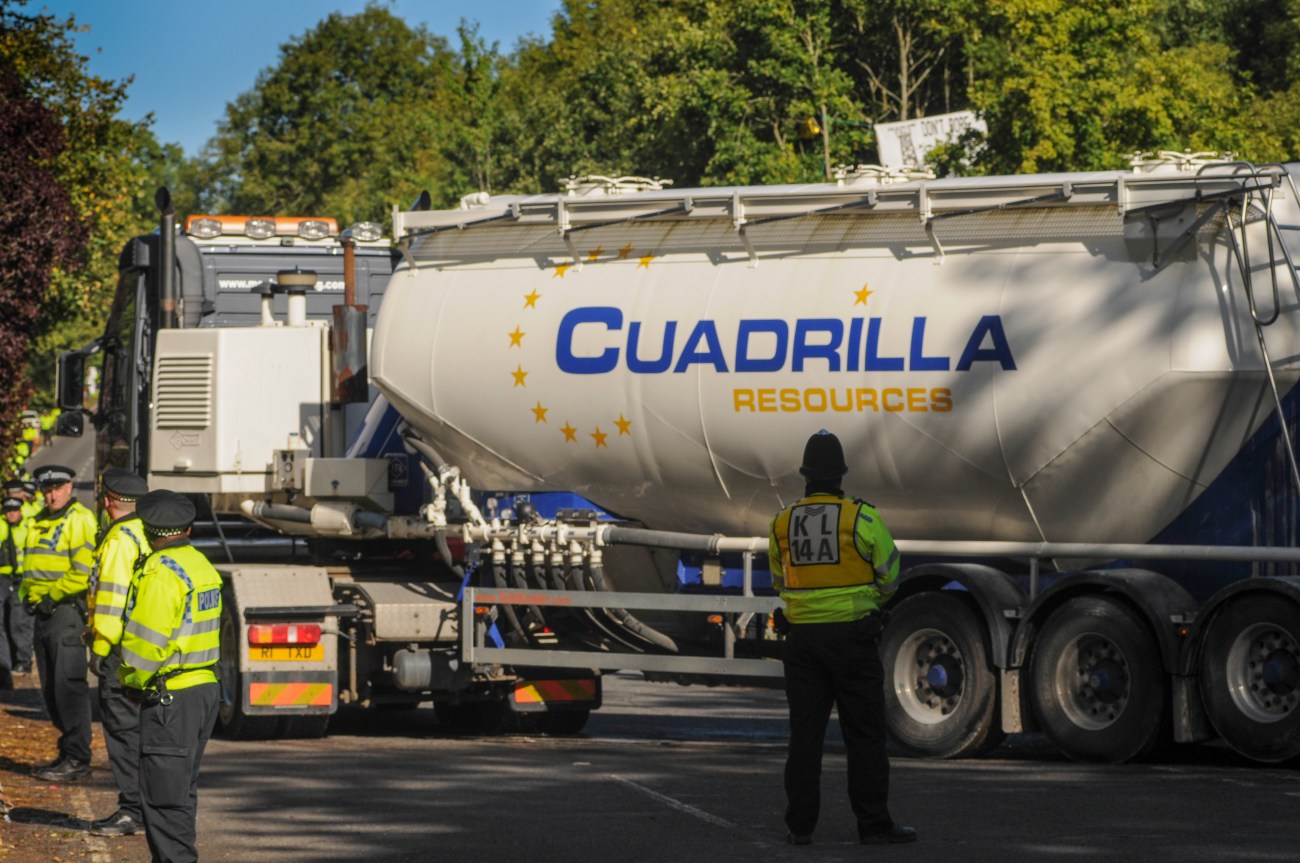
Cuadrilla tanker leaving the company’s Balcombe site in West Sussex, 2013. Photo: David Burr
The company preparing to frack for shale gas in Lancashire announced this morning it was applying for planning permission to test the flow of oil in its exploration well in West Sussex.
Cuadrilla drilled the well at Balcombe in summer 2013, attracting three months of protest.
The company ran out of time to do the flow testing and was granted a new permission in May 2014. This was unsuccessfully challenged by local people in a judicial review. The permission expired when Cuadrilla did not start work by May 2017.
Cuadrilla said a new draft planning application had been sent to West Sussex County Council today. If the council had no concerns with it, the final version would be submitted next week, the company said. The application would then be published on the council and company websites. Link to planning application
Cuadrilla Chief Executive, Francis Egan, said in a statement today:
“We were unable to undertake the permitted exploration well testing works within the allocated time, primarily due to the length of time and resource it has required for us to commence operational activities in our Lancashire exploration licence area.
“The new planning application will cover the same scope of work as the previous permission: a flow test of the existing exploration well followed by plugging the well with cement, and fully restoring the site.”
The company said it had contacted Balcombe Parish Council about the application. A letter, dated 18 October, has been written to residents. Cuadrilla said a community liaison group, which was a condition of the May 2014 planning application, had not been established because no work was carried out. But a spokesperson said:
“If granted planning permission for this new application we would, of course, establish a CLG ahead of any proposed works once we know they are going to start.”

Arrest at Balcombe on September 10th 2013. Photo: David Burr
Well testing and acidising
Cuadrilla said it was seeking temporary permission for six months of work. If the application were approved, the company said it expected West Sussex County Council would require the work to be completed within three years.
The company proposes to acidize the horizontal section of the wellbore at Balcombe before testing the flow rate of the oil. It said acidizing would involve circulating an estimated 15-20m3 of 10% solution of hydrochloric acid into the well. The solution would be pumped at pressures below those needed to fracture the rocks, Cuadrilla said.
The purpose was to remove any drilling mud from the wellbore and clean the limestone source rock within six inches of the well, the company said.
In March 2017, Cuadrilla applied to the Environment Agency to vary its permits for the site in woodland at Lower Stumble, Balcombe. A public consultation closed in April 2017 and the company awaits the decision. DrillOrDrop report
In the permit application, Cuadrilla said gases produced during the flow testing, estimated to be up to 35,000m3, would be burned in a 45ft flare.
“No fracking”
Cuadrilla told the government in 2011 (DrillOrDrop report) that to be successful in the Weald Basin it would
“need to rely, to a significant degree on being able to undertake hydraulic fracture stimulation(s).”
In a letter to the then Department of Energy and Climate Change, an executive said that without the ability to undertake hydraulic fracture operations the company would not be able to attempt to achieve commercial production.
However, since then the company has repeatedly said fracking would not be necessary because it said the Kimmeridge limestone where it is exploring for oil is naturally fractured. It repeated this statement today.
Reaction
Kathryn McWhirter, of No Fracking in Balcombe Society, said the village had expected the application in September and would oppose it.
“The local community does not want any oil exploration and most particularly we do not want exploration for ‘tight oil’, whether by fracking or by acidising.
“Other Sussex and Surrey communities are already facing the same issue, at Broadford Bridge, Horse Hill and Brockham. Oil-bearing geology is similar across the Weald. These are the first wells in what could become an oil field across the South East. This affects everyone around here, not just the people of Balcombe.
“Like the other oil companies, Cuadrilla continues to manipulate language for PR purposes.
“In 2013 Cuadrilla drilled into a narrow band of limestone within the shale. This micrite rock (Kimmeridge limestone) here in Balcombe is indeed naturally fractured, as Cuadrilla says, but what they don’t say is that those ancient fractures, so deep underground, are held tightly closed by pressure and stresses. This is not rock through which oil will flow without dissolving the rock with acid and/or. fracking.
“At test stage they will not need to frack. At production stage they would acid frack.
“So they are not fracking yet. And when they do acid frack the limestone, it will no longer be legally defined as fracking. Westminster changed the definition of fracking in the Infrastructure Act of 2015, dividing fracking from not fracking according to the amount of water used. Today, 88% of the oil wells that have been fracked in the USA would not count as having been fracked under UK law. And once they have acid fracked the limestone, they will hydraulically frack the shale.”
Categories: Regulation

 DRILL OR DROP?
Interesting that they are able to utilise the experience gained by other operators in the area over the last few years, to propose a revised approach.
I’m sure some will jump upon this as being inconsistent but that is a bit like saying a motor manufacturer didn’t make electric cars a few years ago, but now sees that they can be made utilising recent technology. It’s called progress.
Mr Egan’s statement makes it clear that Cuadrilla can’t cope with the size of the licence areas they have secured.
“We were unable to undertake the permitted exploration well testing works within the allocated time, primarily due to the length of time and resource it has required for us to commence operational activities in our Lancashire exploration licence area”
Let’s have a look at the other sites in Lancashire they can’t cope with.
At the Becconsall site this is what they stated
“In accordance with the planning consent well plugging and site restoration work WILL be carried out after the wintering bird’s season, ending 31st March 2016 and BEFORE THE DEADLINE SET BY LANCASHIRE COUNTY COUNCIL OF 31st OCTOBER 2016”
No works whatsoever carried out in 2016.
A similar story at their Singleton site. No works whatsoever carried out.
If they do not have the skills or finances to complete works in agreed time frames they should be denied all new planning consent.
I totally agree. The comment below was meant to be in response to Martin C
They couldn’t restore the Becconsall site because of some birds nesting there, as reported on Drill or Drop;
https://drillordrop.com/2017/08/11/nesting-birds-prompt-fifth-delay-for-restoration-at-becconsall-shale-site-lancs/
Or would you have preferred they destroy the nesting site to get the work done?
IGas Energy is the operator of the Singleton Oil Field, so what has that got to do with Cuadrilla?
The Grange Hill site at Singleton.
Land owned by the RIchard Dumbreck Trust. ( I doubt that this was what Mr Dumbreck had this in mind for this small village)
I wonder if any of the Trustees have other connections with Cuadrilla ?
Another site where Cuadrilla are choosing not to restore the site within a time frame that is consistent with the requirements of policy DM2.
Regarding Becconsall.
The land was legally accessible on the 6th of August. they have permission to be on site till 31st October.
Plenty of time to complete a plug and abandonment job of 2-5 weeks.
Money problems or total disregard for policy DM2 ?
JP,
As far as I can see, the future of the Grange Hill site is still under appeal?
As for Becconsall, no, it takes considerably longer to moblise the equipment, do the P&A work, move off and then actually restore the site.
Remember, there are a limited number of Rigs capable of doing the job and they have to find a slot in the Rig’s schedule.
No, it’s PR spin. Clearly Cuadrilla’s end game (and UKOG’s) is fracking the shale above and below the narrow bands of limestone – just as they bleated at the beginning. There’s a limited amount of oil in those shallow Kimmeridge limestone/micrite strata. Great excuse, however, not to use the F word, for now. Anyway, at production stage, if they get that far, they would have to acid frack to get deep enough into the micrite to release commercial quantities of oil. Only thing is, they won’t need to call it fracking, since the 2015 change in definition of fracking. 88% of wells fracked in the USA would not count as having been fracked under current UK law. Naturally fractured Kimmeridge limestone/micrite? Yes, but held tight by pressure and stresses. Conventional? No. Tight. Unless you are taken in by the false definition of ‘conventional’ in the 2014 version of National Minerals Planning Guidance, where everything in limestone and sandstone has been magically turned ‘conventional’. A little trick by DECC, admitted by the BGS, while BEIS, DCLG and the OGA bat the responsibility around their friendly little circle.
Sorry, you are not correct.
You cannot frac a formation that is already naturally fractured – it’s like trying to fill a bucket that is already riddled with holes.
Claiming that the fractures are held closed tight by pressure and stresses is wrong. If they were, then they wouldn’t contain any oil or gas and no amount of acid washes would get them to flow.
You also are not aware of the difference between an acid wash and an acid frac. An acid wash (which is what they will do here) is used to clean out the perforation debris, LCM and cement from the fractures to allow the oil (and gas) to flow into the well.
Incidentally, acid washes are often used in the UK by the Water Companies on their water wells for exactly the same reason.
Where does the 88% figure come from? It’s wrong, but I’d like to know the source.
‘You cannot frac a formation that is already naturally fractured’
Unless you are a company called Cuadrilla fracking in the Bowland shale at Preese Hall.
‘The analyses failed to identify a causative fault, and detailed knowledge of faulting
in the basin is poor. In the present state of knowledge it is entirely possible that there are
critically stressed faults elsewhere in the basin’
Click to access 5055-preese-hall-shale-gas-fracturing-review-and-recomm.pdf
JP, A fault and a fracture are two completely different things.
No, you are wrong. The 88% figure comes from Professor Stuart Haszeldine et al, university of Edinburgh. And yes, I do totally understand the difference between an acid wash, matrix acidising and an acid frack (see here https://drillordrop.com/2017/01/10/guest-post-by-kathryn-mcwhirter-everything-you-always-wanted-to-know-about-acidising/). There is no statutory divide between an acid wash/matrix acidisation, only an always-understood division in the minds of oil men. Now they want to make everything sound like an acid wash. Great PR, assuming that no one understands. I suspect that what they want to do at exploration stage is matrix acidising. No, I more than suspect – Cuadrilla has explained to us in the past that they intend to acidise into the formation as less than formation pressure. This will be sufficient for them to see what kind of flow they might get when, at production stage, they acid frack (without call it acid fracking, because the law has changed).
I have talked about this to a geology professor who specialises in fractures and stresses. He/she says the fractures are held tight. So does another academic who likewise does not wish to be named. You have to be quite brave, like David Smythe, to blow whistles on a discipline that depends on the oil and gas industry for its livelihood.
There is a difference here between major faults and the fractures you get in Kimmeridge limestone – visible on the beach at Kimmeridge. Difference is, on the beach they are at the surface, deep below, there are pressures and stresses. And those blocky fractures are held tight.
The Kimmeridge limestone that we all previously called micrite lies in narrow bands within the impermeable shale. Back in the geological day when oil migrated into it from the shale below, it was permeable. But the oil failed to escape to surface because of the shale above. Now the oil is trapped in tiny gobs in pores within the micrite. The micrite is porous but barely permeable, and the oil is going nowhere upwards because of the shale above – unless, that is, man-made fractures or indeed the wellbore link the micrite layer to natural fractures or the surface.
Incidentally, I have spoken to various water companies. Turns out they rarely acidise. And then they do it’s only to clean the wellbore, never out into the formation. They are drilling into different kinds of formation. Now why do I believe them and not the oil industry? I wonder…
Sorry, you are not correct. There’s a hole in your bucket, not in mine.
I have not been able to find any paper on Frac volumes by Professor Haszeldine – can you provide a link please? He’s still wrong, but I’d love to see his methodology about how he arrives at that figure.
I’ve read your post, and sorry, you don’t ‘totally understand’ the difference – you know the words, but do not comprehend what actually happens downhole.
Particularly in Carbonates, as well as cleaning up perforation debris, acid washes use 15% HCL and often go more than 1m into the formation via natural fractures – which is what it’s primarily used for in this context – to ensure the fractures are cleaned up of LCM & cement and so can connect to the well bore.
Matrix acidisation uses a much higher concentration of HCL (typically around 28%) and is designed to dissolve the entire volume of rock around the well – thereby increasing the surface area of formation that is exposed – and normally isn’t used where natural fractures already exist.
Acid Fracs are used where the formation contains oil but the effective permeability needs enhancing because there are no natural fractures – not the case here, because the Kimmeridge Limestones are naturally fractured.
I strongly recommend you go back to the Geology Professor you talked to, because you have not understood what he is explaining. I suspect he was trying to explain that the oil (or gas) is held tightly in the pore spaces because of the very low permeability of the Limestone
The KL outcrops are very useful in visualising what actually happens downhole (I walked the ‘Jurassic coast’ on a Geology Field trip as part of my degree).
[Image removed over possible copyright issues]
You can clearly see the natural fracturing in the rock and how it creates pathways, not only within a layer, but also between the various layers. These natural fractures are what are present in the Kimmeridge Limestones in the HH and BB Wells. Cuadrilla clearly think that they are present on their Balcombe Well too. Bear in mind that Balcombe was drilled prior to HH, so the KL sequence may not have been fully recognised as a potential production zone.
Yes, the natural fractures will be more compressed deeper down, so the gap between the fracture faces is smaller, but the gap is still there and it is this connective channel that allows the oil (and gas) to flow so freely.
Faults and natural fractures are not the same thing. The difference between faults and fractures is – to greatly simplify – faults require a displacement of the rock relative to each other either vertically or horizontally. Natural fractures require no such displacement – they are opened up due to internal stresses within the rock itself.
Your paragraph attempting to explain why oil migrated into the KL section shows just how poor your understanding is. You say the shale allows the oil to flow up into the KL zones and then the same shale is impermeable – when actually it is the Kimmeridge shale itself which is the main source rock (the Lias & Corallian are secondary in this context), not just for the Weld basin, but for most of the Northern North Sea fields as well. You even admit that there are natural fractures in the rock..
The main regional seal for the Weald & Wessex Basins is actually the Weald Clay. This has been eroded away in areas and is why, for example, Tunbridge Wells has six naturally occurring oil seeps. It’s also why some wells are producing from the Portland Sandstone and Purbeck Anyhdrites.
Now, why are acid washes needed in naturally fractured formations, like the KL sequences in HH and BB?
Well, when these wells are being drilled through the sequence, every time a fracture is encountered, drilling fluid (‘mud’) will be lost into the fracture. This is bad from a couple of points of view. Firstly, as the mud flows into the fracture, it pushes the oil (or gas) further away from the wellbore and secondly, it can get expensive both in materials and the cost of rig-time (UK regulations do not permit drilling to continue without curing these types of losses).
So you have to stop (‘cure’) the lost circulation with Lost Circulation Material (‘LCM’) before you can continue. The LCM essentially wedges itself into the fracture and builds a wall of LCM, which stops the mud being lost into the fracture. You can then continue drilling on until the next fracture is encountered and repeat the process.
On BB & HH, the LCM used was Calcium Carbonate. It’s a favourite because it’s acid soluble and does not affect the E-Logs when they are run, unlike other types of LCM. The Calcium Carbonate used comes in different sizes, so that the bigger grains cause an initial ‘wall’ to be built and then the smaller grains plug the remaining gaps in the wall to form a seal. Frequently this LCM is added in a constant stream into the mud system, so that the wall is built up much more quickly.
So once the Well has been finished and the final casing (Liner string on BB-1z) has been cemented and the well is ready for testing, this ‘wall’ of LCM now has to be removed, to allow the oil in the fractures to flow into the well bore.
How is this done? By using an acid wash to dissolve the Calcium Carbonate. The acid is placed (‘spotted’) opposite where the well has been perforated and allowed to soak into the wellbore for a short period of time. At this stage, the Well is underbablanced (i.e. at the depth of the perforations, the pressure inside the Liner is lower than the pressure in the formation), to create a pressure differential which encourages the oil to help break down the LCM wall and flow into the well bore.
When you have indications that the Well is either flowing, or trying to flow, the spent acid is brought back to surface where it is diverted into a separate tank. The pH is checked (for any ‘unspent’ acid) and if required, an alkali (frequently lime) added to ensure a neutral pH.
It’s fairly common that the LCM has penetrated quite deeply into the fracture (i.e. if it’s a larger fracture), so the process has to be repeated until the well starts to flow. This happened on HH, when it took some time for the Well to ‘come in’, but the larger fractures resulted in exceptionally high flow rates.
Sometimes the LCM wall can be broken down during the cementing of the Liner, as the cement is much denser (therefore resulting in a higher pressure downhole) than the mud used. This allows cement to go into the fracture and seal it up.
In these cases, sometimes several acid washes may not be enough to allow the well to come in if the cement has penetrated the fracture deeply enough. What generally happens then is that the section is re-perforated with a different type of perforating charge, which penetrates much more deeply (can be over 100 cm) into the formation and then the acid washes are repeated
I suspect that this is what happened in at least one of the KL 1, 2 & 3 sections on BB-1z, especially since UKOG have stated that there is a lack of zonal isolation between the KL 4 & 5 sections higher in the well bore, indicating that the top of cement may be lower than planned.
As for the water companies, they use acid washes on their many wells in Surrey and Hampshire which are completed in the Cretaceous chalk.
These Wells produce their water through natural fractures.
Chalk is classified as a Carbonate, same as the Kimmeridge Limestones….
Here’s an excellent read for those anti-frackers such as Refracktion, who believe the best way forward is to continue to rely on imported natural gas. This may help the UK’s carbon emissions statistics, through a loophole in the system, but it is certainly an environmental disaster when domestic gas is available. https://www.linkedin.com/pulse/imported-home-grown-gas-environment-why-what-youve-been-robottom/
Very slow and boring progress by Cuadrilla indeed. By the time they start to flow test oil would have become stranded asset and renewables would rule.
Not sure if their one well Balcombe will prove anything for their asset value.
TW, my guess is that the market is a wee bit better at discounting future cashflows than you are. Otherwise you would just set the price for all traded equities. I don’t see that happening anytime soon!
And their PEDL licence here requires them to drill another well before too long! We think they’ll flow test, hype (IMO) the results and sell on. Would UKOG be gullible enough, would their investors?? Geology apart, the political risks currently are huge. Labour talks of banning fracking, but shadow Labour energy and climate are thoroughly aware of the issues around acidising in the Weald. Oh, Jeremy Corbyn…………………..
How pathetic is that lil tune? If that’s what it takes to motivate you then you need say no more.
Well if (God forbid!) Labour do get in and ban frac’ing, that still won’t affect the likes of UKOG & Cuadrillas operations in the Weald, because they aren’t frac’ing anyway…
god will have nothing to do with it Injuneer; the increasing poverty, suppression of human rights and lack of credible policies will make the change.
Watershed moment. Good for them not to give into the nimby’s. The several dozen by the side of the road will need a bigger bus. KM, PNR, Balcombe, Leith Hill, Billinghurst etc etc. Even people like Kathryn McWhirter who believe in unicorns can’t be everywhere at once, and if you don’t think there are only a few hundred hardcore antis, then look at the 966 followers Ruth gets here. Of which at least a couple of hundred are pro’s by the way.
I am sure they will use the fossil fuel buses and cars to keep up their appearances between sites. They will drive, fly and train to these sites.
You know, we all have to crack this habit. You too. I only have to walk half a mile to Lower Stumble.
“You’re a hard habit to break.” Chicago (one of their top song).
Foolish of Cuadrilla for so many reasons to come back to Balcombe! It is becoming increasingly clear, Nick, my dear, that the illusory visions are on the oily side.
Exciting times for the here and now
RenewableUK chief executive Hugh McNeal said the Hywind project was being “watched around the world” as floating offshore wind had the potential to be exported globally.
Statoil is also planning to install a large lithium battery array named Batwind to store the energy produced by the turbines, which can regulate their output and cover any shortfalls.
Read more at: https://inews.co.uk/essentials/news/technology/worlds-first-floating-offshore-wind-farm-opens-off-scotland/
Pro frackers will soon be driving their morris marinas ( they don’t do imports) and heading to the local phone box where there is plenty of room to hold their
‘failed mission’ party.
Remember the tortoise and the hare!
I suspect it is dawning that there is much greater potential for oil in this area than envisaged a few years ago, and those who progress their assets now may produce an asset either returning considerable cash flow, attract a JV or a buy out. It also fits the jigsaw that was suggested a long while ago that exploration should be conducted across a much wider area in this particular part of the country, although Prof. Smythe seemed to have missed that.
Or, perhaps they just want to give Ms. Lucas some publicity, once she has finished trying to find her half million missing voters.
Strange though-I thought Cuadrilla were being drained of money by the protestors and would have to pack their tucker bags shortly!
‘Exploration should be conducted across a much wider area in this particular part of the country’ – that is exactly what we have been saying – the intention is to drill a great many wells across this area. Look at Sanderson of UKOG promising ‘wells back to back, so that it becomes almost an industrial process’. Delete almost.
What do you mean Prof Smythe seemed to have missed that? Untrue and nonsensical.
True, Cuadrilla’s accounts make interesting reading. And what confidence can we have in little, local Cuadrilla Balcombe, should anything go wrong? And yes, before you say, much could go wrong. Cuadrilla’s track record makes interesting reading too.
Cuadrilla’s track record? What problem do you have with it? Has anyone died due to safety violations? Have they had massive spills that contaminated an aquifer? They caused two minor tremors years ago, that were hardly felt by anyone. Seriously.
Refriction, i think you would make a great community liaison officer for the CLG Cuadrilla are hoping to set up.You are certainly showing us how good you are at doing it in an unofficial capacity.
.
You mention two minor earthquakes Cuadrilla caused that were hardly felt by anyone. Please tell us what they did to the integrity of the well? Seriously.
Happy that you have acknowledged the tremors were caused by Cuadrilla. Those who ‘hardly felt’ the tremors were the beginnings of the ever increasing opposition to shale gas extraction.
There have been a great many Wells drilled across the Weald already. There are around a dozen oil fields which have been producing safely for several decades – most of which used acid washes to bring the Wells onto production. Drive along the M25 past the junction with the A22 and you are driving over a producing oil field (Palmers Wood).
The comment from SS was taken out of context (no surprises there – a favourite trick) – he was talking about operations on a well pad, where it is indeed more cost-effective to drill wells back to back. That way you don’t have to go through the time, effort and cost of demobilising and then remobilising all the equipment every time.
But we do agree on one thing, much of what Prof Smythe has said is untrue and nonsensical and I’m not surprised that Glasgow University have disassociated themselves from his views.
I suspect John that Cuadrilla simply wish to concentrate on each asset at the appropriate time, so they are not diluting their management too much at any one time, and in Lancashire check the results from one site to refine where to proceed from there.
Not any different from any exploration company in that respect. Sound management approach-almost Gold Standard.
https://www.youtube.com/watch?v=q_br3FnbCjw&feature=youtu.be I forgot the link
True, Cuadrilla are a very small operation, spread thin (since we were discussing spreading thin!). A matter of opinion whether Cuadrilla’s approach is ‘gold standard’. Approaches are all very well, it’s the results that count, and Cuadrilla has… shall we say ‘been unlucky’ on numerous occasions. Just ask the rest of the oil and gas industry. I heard such a funny exchange around a breakfast coffee table.
[Comment removed by moderator]
Kathryn-try toning down the excitement and check what is actually stated. Your post of 9.41 showed you recognised the word “exploration” as you stated it-then you decided to ignore the meaning of that word and off into your own world. Is it too much to understand that no one will know what development scale is appropriate, or worthwhile, until EXPLORATION has been conducted across a wider area?
Jumping ahead into speculation on this aspect and then into what is currently fabrication regarding fracking is par for the course-but pure fantasy.
John-you “conveniently” ignore the very recent comments from BP regarding renewables. Shame people do their own research.
That’s BP the ‘fossil fuel’ company? Why not add the link Martin?
If we let them do the foreplay, how can we stop them doing full monty? You are either naive or complicit in the permission creep/grandmother’s footsteps planning system that prevents planners from considering the future implications of the current stage. Get permission to build a garage on a plot, and once it’s built apply for the house to stand alongside. Planners go along with it and tick the boxes because their jobs depend on it. You, MC, want to make us sleep-walk into an oil field!
OMG BP with their paid Twitter slots! No doubt they advertise their PR stunts or future-proofing elsewhere, but I see them on Twitter. Just Google BP, leaks, transgressions… And hey, those are the ones we know about. Did you work for BP?
As a Balcombe resident I can assure Kathryn McWhirter or Metcalfe that she doe’s not speak for many Balcombe resident’s! Many more than she think’s are happy to have Cuadrilla at Lower Stumble! It is just the Nimby protestor’s we do not like! Of course CONOCO drilled same site in ’81 with NO PROTEST! If Ms Melcalfe or McWhirter had done some RESEARCH before moving to Balcombe she would of known about the site……but obviously she did not bother! Strange that she complained about noise in 2013 from the Cuadrilla drill,failing to mention she live’s on top of the main London to Brighton Railway line with train’s passing through at 100mph !
Why bother with a link Sherwulfe, when you indicate you have little knowledge of the overall subject from your comment?
BP have invested $billions into alternative energy. At one point they were the third largest solar manufacturer in the world, but now, they state “there will be no billion-dollar bets on green energy because it is too early to tell which technologies will triumph. The evolution of the energy market is going to take decades.”
John would love the fact they own wind farms in USA, but would forget that whilst profitable, they did not make “a material difference to the bottom line”.
Revolutions driven by a small number of people, however committed, fail. Evolution takes a lot longer, but tends to come up with the right answer. Large companies usually recognise this, governments not so much.
If you wish to do some Giggling, try Oil & Money Conference, Bob Dudley(BP).
so you don’t have a link then?
Martin, perhaps you should have listened to mum…
From BP’s own website:
‘Our future growth includes an expected 800,000 barrels of oil equivalent per day of production from new projects by 2020, with 500,000 barrels of oil equivalent per day of this new capacity planned to be online by end of 2017. This, combined with our recent portfolio additions, is expected to increase our new production by around 1 million barrels per day by 2021’
…indeed a fossil fuel company.
Malcolm, you live in a bubble within Balcombe. A large majority of the village has always voted against the presence of Cuadrilla in our village. I think you are the NIMBY! No newcomers in your village whose grandparents were not born here? I hope, were I still in my homeland of Derbyshire, I would welcome you as an incomer. In Derbyshire, I would be protecting my community against INEOS, and i hope you would do so too. Malcolm, I am married to a Metcalfe, but have always worked as McWhirter, nothing sinister about that. Conoco acidised Balcombe 1 well in the mid-1980s. it was not sufficiently ‘naturally fractured’, at least the fractures were not sufficinetly open and permeable, to flow at commercial rates. Now the difference is lateral drilling. But that doesn’t make the rock any more permeable, just gives greater surface area for minimal flow. They will still have to acid frack at a later stage. Incidentally, though I am an insomniac, listneing right now to a snoring Metcalfe above my head!, I did not hear the drilling at Lower Stumble in 2013, and did not complain. The noise was carried on the prevailing wind, up the valley towards the village. I am on the north eastern side of the village, just north of the drill site. Peope in the village were driven crazy by the drilling noise. Someone in the village bought sound testing equipment, because the authorities would take no action. Cuadrilla were found to be exceeding agreed sound limits, and drilling was stopped until they installed sound buffers. I hope that none of us in the village will ever become so accustomed to the noise of drilling that our sleeping consciousness ignores the sound! With the sound come fugitive gases, toxic waste, wasted raw materials, steel, cement, water, energy… potentially health issues for you and your family. I fail to see what is bugging you. Why not come round for a glass of wine or beer or whisky and talk about it?
I’m pretty confident the Conoco Well would have been targeting the Middle Jurassic Great & Inferior Oolites, the Kimmeridge Limestone was not widely recognised (if at all) as a target back in those days.
Horizontal drilling is done to intersect more fractures – the surface area of the well itself is inconsequential compared to the surface area of the fracture face.
You cannot frac a Well that already has natural fractures in it – it would be like trying to fill a bucket that is already riddled with holes.
Interesting about your noise comments – I cannot find anywhere where Cuadrilla actually exceeded the night time noise limit of 42 db, just that there was a concern they might.
And if 42 dB drives people crazy, how do they manage with the noise of a train on the railway line, which probably has 70+ dB at their houses – i.e. almost 10,000 times the sound energy of the Rig, since the dB scale is logarithmic.
If steel, cement, water and energy are potential health issues, do you live in a tent and walk everywhere?
No, the Conoco well targeted also the micrite, and acidised Balcombe 1 with 15% hydrochloric acid, and no doubt other chemicals. it failed to flow at commercial rate. We bought the drilling records.
Yes, but intersecting more fractures that are held closed by pressures and stresses will get you only so far. At production stage you are going to want to apply more pressure. We are not stupid, even if the planners are obliged to be stupid by stupid planning law. Planning law truly is an ass.
Your bucket tale again. Dealt with that above.
We need a circular economy, no waste of materials, otherwise there will be nothing left for our descendents. So yes, wasrte fo steel, water, cement and energy are hugely important. Steel and cement are so energy-intensive. I live by the station, take trains, yes, walk, and rarely use my car. I have solar panels and a solar-assisted air source heat pump, and am currently planning more solar over my chicken houses, at which point we shall get an electric car.
And these are the noise section of our previous objection to Cuadrilla’s planning application to flow-test the Balcombe 2 well:
3.4 Noise
Noise is one of those impacts that cannot later be undone. People have to put up with it, lose sleep, suffer stress etc. These are our concerns re noise:
• It will be constant, day and night, from a combination of industrial diesel generators, pumps, flaring and vehicles.
• Noise from the flaring, which can be very loud, is excluded from the noise assessment.
• Cuadrilla exceeded the noise limits set as a condition of their planning permission last summer.
• A village resident had to purchase sound equipment to monitor these breaches.
• There was little on-site regulation of noise by West Sussex County Council or the Environment Agency. WSCC admitted it ‘did not have either the trained staff or equipment to undertake its own monitoring’.
• Noise will be more noticeable during the (ambient) stillness of night and in the early dawn hours. Prevailing winds will carry noise – the village is downwind from the site.
• Cuadrilla’s projected noise levels do not take into account wind direction and the natural contours of the land.
• Noise has a serious impact on our lives and the peace of the village.
The Planning Practice Guidance (revised March 6, 2014) says minerals operators should:
• identify proposals to minimise, mitigate or remove noise emissions
• monitor noise to check compliance with any proposed or imposed conditions
Clearly, the current application does not satisfy the second aim of the Noise Policy Statement for England 2010 and National Planning Policy Framework (NPPF) para 123, that they should: ‘mitigate and minimise adverse impacts on health and quality of life from environmental, neighbourhood noise within the context of Government Policy on sustainable development.’ Cuadrilla’s Noise Impact Assessment is disgracefully weak. It does not fully and robustly assess noise impact. It does not address all noise sources. It underestimates impact of noise.
The current application also does not comply with NPPF paragraph 144: ‘When determining planning applications, local planning authorities should ensure that any unavoidable noise, dust and particle emissions and any blasting vibrations are controlled, mitigated or removed at source, and establish appropriate noise limits for extraction in proximity to noise sensitive areas.’
The current application does not address the requirements of the Technical Guidance of the National Planning Policy Framework – paragraph 28: ‘Minerals planning authorities should ensure that unavoidable noise emissions are controlled, mitigated or removed at source.’ Nor does it address paragraph 29: ‘Those making development proposals should carry out a noise emissions assessment, which should identify all sources of noise and, for each source, consider the proposed operating locations, procedures, schedules and duration of work for the life of the operation.’
There is a compelling case for tighter standards to be imposed through planning conditions, and we need assurance that the WSCC would attend and check compliance, regularly and unannounced.
3.4.1 Noise levels
Section 4.4 of the Planning Statement and the Noise Impact Assessment (NIA) deal with noise. Both the Planning Statement and the NIA give the impression that the noise levels of the operations are unlikely to have significant impacts.
According to Acoustic Associates Sussex Ltd, in their report to WSCC (WSCC/J1476/02/ 14): ‘The noise impact assessment provided by the Applicant in support of an application for planning consent for well pre-test and testing operations at the Lower Stumble Hydro-carbons Exploration Site has been inspected. On the basis of the inspection and appraisal of the information provided, it is concluded that the noise affecting nearby noise-sensitive receptors, in particular Kemps House and Kemps Farm, is likely to be at a level which complies with the guidance criteria set by the National Planning Policy Framework 2012 document: Technical Guidance to the NPPF 2012 Paragraphs 30-31 Noise Standards.’
The starting point for Cuadrilla and their noise assessor is that they will comply with maximum noise figures set out in the NPPF Technical Guidance. This is unacceptable. Those figures (55dBA daytime and 42dBA night-time) are meant to be maxima that must not be exceeded. In practice, daytime noise levels should be 10dBA above ambient. Noise cannot be considered acceptable so long as it falls below last-ditch limits.
Without knowing the background ambient noise levels or actual noise levels generated during the works, Cuadrilla has not reasonably considered the burden of noise attenuation prior to proposing a daytime limit of 55dB(A) and night time limit of 42dB(A).
The application does not comply in this respect with the Technical Guidance for the National Planning Policy Framework paragraph 29: ‘Those making a development proposal should assess the existing noise climate around the site of the proposed operations, including background noise levels at nearby noise- sensitive properties’. The application also fails to comply with the initial assessment requirements of Technical Guidance for the national Planning Policy Framework paragraph 30. Cuadrilla has also failed to establish a noise limit at ‘the noise-sensitive property’ that does not exceed the background level by more than 10dB(A), and has failed to consider what would be needed to achieve a +10dB(A) limit.
The Noise Impact Assessment assumes a -5dB(A) noise reduction thanks to the natural screening provided by the topography and intervening areas of copse. ‘This noise loss,’ it says, ‘ has been verified by measurements taken during recent drilling operations.’ But the drilling happened in summer while foliage cover was at its greatest. The NIA must take into account the possibility that the flow test would not occur in the middle of summer. The NIA also fails to take into account wind speed and direction, which could significantly increase noise levels at the nearest property; and it fails to recognise that primary sources of noise are 14m above ground level, and some 12m above the copse, which is thus unable to provide sound-screening.
From the previous works at Lower Stumble, it was established that the tree line and topography to the east of the site channelled noise into the centre of the village. This must be considered within the noise assessment.
3.4.2 British Standard 5228
BS 5228-1:2009 is generally used to assess noise levels during the construction phase of a proposed development. Because greater protection of amenity is normally considered appropriate for the 24-hour, seven-day production and testing phases, BS5228 is not normally applied to noise assessment during a testing phase. However, since BS 5228 has been used in this case, we demonstrate below how the Noise Impact Assessment does not comply with BS 5228-1:2009.
BS 5228 states than an applicant should include noise from of the main items of plant and equipment used on the site, yet within section 3.4 (Noise appraisal) of this planning application, Cuadrilla state that they have deliberately excluded the noise generated by the flare stack.
BS 5228–1:2009 states: ‘Local authorities need to know the expected levels of site noise in order that assessments can be made as to whether potential problems exist and whether controls are necessary. They also need to ensure that any noise limits proposed are practicable for the developments concerned and that the limits are capable of protecting the community from excessive noise’.
Recommendation: Since the noise from the flare stack has been excluded, it is not possible to assess the noise impact with any accuracy, in accordance with BS 5228. We would recommend refusal of this application due to the failure to comply with the NPPF.
Annex F2 of the British Standard assesses the adjustment to be made to a noise source based upon the local ground conditions and the distance between the noise source and the nearest property. In Cuadrilla’s application, a 5dB(A) deduction was made due to the tree-screening, and a 60dB(A) deduction due to the distance of 400m from the noise source to Kemps Farm. These reductions were calculated according to Annex F2.3 of BS 5228 – but this does not in fact apply to Cuadrilla’s site. Cuadrilla’s application clearly states that the plant will be permanently ‘on’ and in a fixed position. It should therefore have been classified as an ‘activity’ and should have been assessed in accordance with the more stringent Annex F2.2, intended specifically for calculating noise reduction for stationary and near-stationary plant, such as the power generator, beam pump and flare stack.
The BS 5228 allows a reduction to be made because screening is in place only if the top of the equipment is barely visible to the ‘receiver’ over the noise barrier. The flare will be 14 metres high. Any screening is provided by a field of Christmas trees less than 2m high. As the land rises up towards Kemps Farm, whence there is a fine view of the entire exploration site, it is most unlikely that noise would in reality be reduced by 5dBA.
BS 5228 also advises against combining attenuation due to screening and due to soft ground. It advises applying whichever figure is greater. Cuadrilla has used both. Moreover, the current Noise Assessment does not consider the possibility of simultaneous noise from more than one source, which could raise noise levels by 3dB(A), as stated within table F.3 of Annex F.2.6.1 of BS 5228. If at this stage we exclude noise from the flare stack and use Cuadrilla’s figures for the rest of the plant and equipment, the anticipated noise level at Kemps House would already exceed the maximum night-time guideline level of 42db(A). Clearly screening and noise mitigation should be installed before work begins.
Wind and weather must also be taken into account when making predictions using BS5228; special caution is required in this respect for distances over 300 metres. Meteorological data used to generate a five-year frequency distribution of wind speed and direction shown as a Wind Rose Diagram for Gatwick 2005–2009 (Cuadrilla Technical Report: Air Dispersion Model of Exploration Drilling and Well Testing at Balcombe – appendix H page 4) clearly shows a dominant south westerly wind that would carry the noise and increase the noise level at Kemps Farm.
It flowed at 48 BOPD, which wasn’t commercially of interest to Conoco at that time. If you have bought the complete Well records (and if you did, I’d like to know how – only summaries are made available), then you will know exactly which other chemicals were used, so why not say so – or would you rather try to imply that something more ‘toxic’ was used?
Your second paragraph is nonsense, you do not understand that the KL sequence is naturally fractured, as I’ve explained above. At least the SCC understand – having actually read all the evidence – that Frac’ing (acid or otherwise) is not going to take place.
Is all that information about noise supposed to intimidate, or impress me? Because it does neither.
I would have been impressed if you had picked up my mistake, in that going from 40dB to 70dB results in 1,000 times the sound energy, not 10,000 (I shouldn’t do mental arithmetic while still hung over…).
As I noted previously, Cuadrilla in fact did not exceed the noise limits – this was confirmed by the EPA. There was concern that they might, hence why the additional barriers were out in place.
I presume you had access to the noise maps that Cuadrilla should have included in their submission to the HSE? I have yet to see one that did not include different scenarios for wind speed and direction. Incidentally, the assumption that higher wind speed means the noise travels further is only correct for low wind speeds. As the wind speed increases, the noise level generated by the wind itself drowns out other ambient noises. I forget the exact cross-over point – I think it was in the region of 20 mph.
I’m pretty sure that Cuadrilla would have paid for at least one noise monitoring station to be installed. The problem with these then becomes noting exceptions in the data, such as when a train goes by, or a plane flies overhead, or the demonstrators state chanting for the cameras, or one of them flies a drone over the site to take photos…
As you will have seen from the video of gas flaring on the BB-1z well, the flare is shrouded which greatly reduces the visibility and noise. The flow rates would have to be much more significant before the noise becomes noticeable – very unlikely in the Weald Basin.
The reason the gas flare is excluded is that gas flaring will only take place on a limited basis during testing and it recognises that that is the only way to safely dispose of gas during testing.
Yes, sound tends to carry further at night – which is why the allowable limit is dropped from 55dB during the day to 42dB at night.
There are several free Apps that can be installed on your smart phone which will show the sound levels you are experiencing – not calibrated, but close enough.
In fact, I encourage people to install it on their phones to see just how quiet 55dB and 42dB is.
If the good people of Balcombe were driven crazy by the drilling noise, I’d hate to think what happens every time a train goes past, or a plane to / from LGW flies overhead, or a motor bike goes down the high street. Or what they would think if a 1.5 MW Wind turbine (212’ high plus 162’ dia propellers) was installed.
I agree, we need to recycle as much as possible (100% is simply not possible) – but is it environmentally friendly to have a car that you hardly ever use? And have you investigated the environmental cost of your solar panels – especially how the rare earth minerals in them are mined and processed?
Do you have Roosters in your chicken houses? I wonder what the noise level of them crowing is?
BTW, yes, I do believe in climate change – as do the majority of those working in the Oil Industry (outside the US anyway..), and that we should do as much as possible to reduce hydrocarbon consumption in things like vehicles & power generation to preserve it for long term use in vital industries such as pharmaceuticals.
But we also recognise that the use of oil is so pervasive in our society in many different forms that we cannot simply switch over to an alternative in a few years.
It has to be a long term plan with joined up thinking and co-operation between UN Agencies and Governments (which also means a new US Govt…), while also recognising that there are several Billion people who still aspire to a Western standard lifestyle.
Obviously you feel you are making a point, but what it is and to whom is another matter. Try learning something away from Giggle. [Edited by moderator]
Sherwulfe …
Martin has NEVER provided any links WHY is that Martin ???
He does though suggest you POP ON DOWN to your local library or take out a subscription to an online newpaper to back up what he is saying ….
YES, the National Trust debate was interesting Martin , I’m sorry that you still feel a liitle bitter about it .
[Edited by moderator]
In your own words Martin , taken from your Drill Or Drop post at 9.08am on the 18 October , I quote, ” I simply refuse to read their posts anymore as my interest is for a reasoned debate.”
I, like others, WANT reasoned debate , you obviously don’t .
Sherwulfe, how can you possibly have a ” reasoned debate ” with someone who has already decided to close their eyes and ears to what you are saying …… They have already decided that they are RIGHT and YOU are wrong .
Even when you prove them wrong, they ignore the facts .
[Edited by moderator]
Ladies and Gentlemen, we are all on here for ” reasoned debate.”
That is why we all use this forum….. I for one read ALL the comments put forward, whether they are Pro or Anti Fracking /Oil and Gas exploration as it does help me to sometimes see things from a different angle ….. Angles that I may not of considered when forming my original opinions.
I have learnt a lot from reading members posts, in fact , dare I say it, in some cases it has helped sway my opinions or sympathise with the Oil and Gas industry on certain matters .
AND YES I have learnt a thing or two and even agreed ” occasionally ” with what you have said Martin .
The point was BP
is a ‘fossil fuel’ C;
which you disputed,
and I refuted,
again.
I asked for a link
for the ‘facts’ to your ‘think’
which failed to arrive,
again.