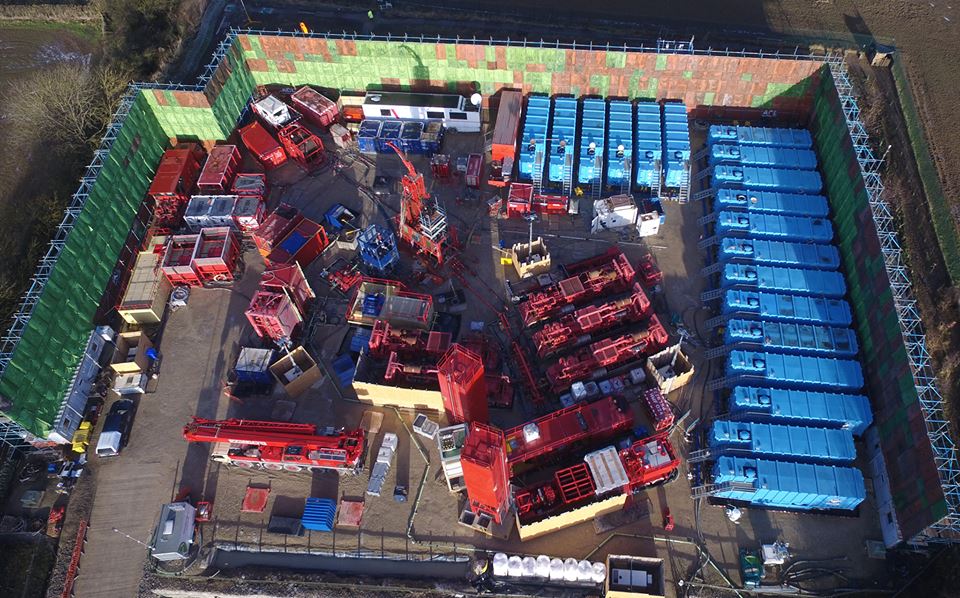
Third Energy’s KM8 fracking site at Kirby Misperton, North Yorkshire, 16 December 2017. Photo: Eddie Thornton
Researchers at Edinburgh University have warned that cost of waste treatment and a shortage of specialist facilities could limit the development of fracking in the UK.
A team from the university’s School of Geosciences estimated that treating the salinity and other chemicals in fracking wastewater at existing facilities could cost between £100,000 and £1 million per well under current treatment regulations. This represented between 2% and 26% of the expected total revenue from each well, they said.
Operators could face additional costs of about £163,000 per well to dispose of concentrated sludge containing naturally occurring radioactive material, known as NORM.
The study, published in the journal Environmental Science Water Research & Technology, looked at wastewaters from wells in the US to better understand the volume and make-up of wastewater that would be generated by a UK shale gas industry. It also reviewed the methods used to treat waste from the fracking process.
Only one shale gas well in the UK has produced waste from high volume hydraulic fracturing so far. But the researchers said the fluid could be several times saltier than seawater and contain NORM.
They found that the capacity for treatment of NORM was currently limited in the UK and could restrict multiple fracking operations if not addressed. Under current regulations, NORM concentrated sludge must be disposed in permitted landfill sites, adding to costs of dealing with waste.
The lead researcher, Megan O’Donnell, said:
“Treating wastewater could require a large outlay of the expected revenue from each well, affecting industry profitability.
“The UK’s capacity to treat the radioactive material in wastewater is currently limited, which could pose serious waste management issues if the shale gas industry expands at a faster rate than the increase in treatment facilities.”
There are currently four treatment facilities in the UK that had permits to handle liquid waste containing NORM. The facilities are: FCC Knostrop in Leeds, Bran Sands in Middlesbrough, Castle Environmental in Stoke-on-Trent and FCC Ecclesfield in Sheffield.
The study said there was a limit of 826m3 on the volume of waste containing NORM that could be received each day by these plants.
it said:
“If the volume of FP [fracking waste] water produced during fracturing exceeds this the capacity of the available treatment facilities could become critically stressed.
“Without alternative storage options or emergency treatment capacity, operations would be forced to cease until the fluids can be appropriately handled.”
The study concluded that there was no co-ordinated strategy for the management of liquid fracking waste in the UK.
It also said options for disposal without treatment were limited. The viability of injecting fracking waste underground looked uncertain and there was no comprehensive assessment of suitable sites.
The study’s coordinator, Dr Stuart Gilfillan, said:
“We suggest that industry, wastewater treatment plant operators and UK regulatory bodies work together to produce a coherent strategy for managing wastewater.
“This would serve to assure the public of its safety and prepare for the expansion of treatment capacity required should a shale gas industry develop in the UK.”
Industry reaction
Ken Cronin, chief executive of the industry body, UK Onshore Oil and Gas, said:
“At this early stage in the development of the industry there are an appropriate number of Environment Agency approved facilities in the UK for the treatment of our waste water.
“The industry has been working with the Environment Agency and a number of leading institutions and companies in the waste management sector to bring techniques to the UK that enable fluids to be recycled on site and NORM wastes to be managed appropriately. Through this strategic work on waste with regulators, the supply chain and professional institutions, we believe the UK can lead the way on reducing wastes and achieving wider environmental outcomes for the onshore oil and gas industry. It is surprising, therefore, that the researchers did not make contact with the industry, as if they had they would then have understood the extensive work, research and planning we are doing in this area.
“There are some poor assumptions made in the research around revenue per well. The 1.8 billion cubic feet (bcf) estimated ultimate recovery (EUR) assumption includes some of the poorer performing wells of the US, while analysis of the top 6 performing shale gas plays of the US reveals an average EUR of 5bcf, over double the authors estimate(1). The use of this data noticeably reduces the inflated percentage cost projections conducted in this study.
“In the UK, optimal geologies are and will be mapped and explored with state of the art techniques and methods. The same attention and innovation will be paid to the disposal of the waste from these sites.”
Lee Petts, managing director of the consultancy Remsol, said:
“The UK waste management sector has a proud history of responding to market demand, investing in innovation and capacity-building where needed. A good example concerns incinerator fly ash – prior to the practice being banned, this hazardous residue from municipal waste incineration was simply sent to landfill but is now typically used either for its alkalinity value as a reagent in the treatment of acidic wastes or is ‘washed’ to remove insoluble metals and other constituents in order to enable it to be recycled into concrete block manufacture. Waste industry treatment capacity for fly ash has grown in-step with the expansion of waste-to-energy incineration, which would have been hampered otherwise.”
- Wastewater from hydraulic fracturing in the UK: assessing the viability and cost of management. M C O’Donnell, S M V Gilfillan, K Edlmann and C I McDermott in Environmental Science Water Research & Technology Online link
Categories: Research

 DRILL OR DROP?
Why is the solution to “investment risk” not the responsibility of the investors? Why is a “coordinated” (government bureaucracy?) the solution?
At last some scientifically informed realism on this matter. Whether the EA can monitor, catch and fine wayward dumpers is another issue. It’s a common source of fines in the USA (for that proportion of operators who actually get caught).
“Between £100k and £1m” looks a bit removed from scientifically informed realism to me! If I had a builder supply me with that sort of “estimate” I suspect the estimate would be in the bin. “You will get 10-100 miles per gallon out of this vehicle.” Not sure I would find that very useful either. But, then, I suppose, we should be used to Scotland being in the Diane Abbott school of economic statistics.
Surely the estimates reflect the unpredictability and non controllable variables of shale extraction. Rather like when the industry state there could be a wide variation in the amount of flow back and waste water produced when they submit planning applications. There is bound to be variation per site in terms of volume and content. You cannot compare that to a mass produced product such as a car engine’s fuel consumption.
Good point KatT. It would depend on the geology. But then again it is good for business with water waste management services. Good for local economy and businesses.
The industry knew this already. Wastewater treatement and disposal is too costly for anybody but the taxpayer to ‘invest’ into and such facilities are too costly for the shale industry to do themselves. Hence the “chuck it in the sea, off the British coastline” rhetoric last year from Ineos
Martin, you forget your own rule book – ‘wait and see what we find’ in the ground. Then of course there’s easily a 10x variability waste products – from vertical and short lateral bore-holes up to super-laterals that can be over 2 miles long.
As ever, you’re quick to find a victim for your misplaced accusations.
That ‘told you so’ moment (numerous times over several years) that gives me no pleasure. I raised this with Kevin Hollinrake MP only a few months ago and got the same old bland assurances – no open ponds, no reinjection, all waste water to be treated as mineral waste and must be taken to a licensed treatment plant. No answer to my grave concern that the cost of fracking waste transportation and treatment will be the Achilles heel of the industry, the only real solution to which would be reinjection at huge risk. Only time will tell. As will the Infrastructure Act wording ‘and putting ANY SUBSTANCE into deep level land…’, which of course could include NORM, or even nuclear waste.
Ian R Crane’s video today relating to the fact that by law, Third Energy must be disbanded today, they no longer have any more legal validity to exist, it will be interesting to see how they get around that, or perhaps are assisted out of that legally enforceable failure.
Also some interesting comments on the Sunday Mail article and what may be revealed if similar private investigator reports were done on the operators, their staff, the government individuals that promote and rubber stamp this industrial invasion into our country.
As always, Enjoy!
Why is this an issue? There are facilities to dispose of the waste and procedures have to be followed. If its not economic then the industry will fail.
If it is economic then there will be new plants set up to deal with it and that will bring jobs, development and economic activity. Its a great chance for the desolate north which needs these types of high tech jobs.
There are insufficient facilities, as identified during the Cuadrilla planning application, that is part of the issue, the other is cost. To open new contaminated waste treatment centres will take time, likely to be very controversial (in terms of planning/location) and will be expensive. So there currently there is insufficient capacity and then the ongoing problems of return on investment and the high cost of treating the waste. This waste problem was identified in the RS/RAE report of 2012 and the industry and government have continued to slow walk into it.
The north is not desolate.
If it is not economic the industry will fail….eventually….in the meantime it could do a lot of damage. As has been reported often enough the US fracking industry has accumulated losses and debts for almost a decade and it has taken a long time for some of the companies to die while others are still going and still accumulating debts – because of the credulity of American investors and the fact that Wall Street earns fees by organising the finance that other suckers will lose. Fortunately there are signs that there are fewer investors in the UK who are such suckers as to be drawn into funding fracking – and this news about waste disposal should a warning to anyone thinking of funding it. Of course quantitative easing also makes cheap finance available to the likes of Ineos to gamble – and they are desperate too.
I think I will add to my comment, (which was directed at Ken Wilkinson’s remark) that strictly speaking “economic” is supposed to include a calculation of “externalities” too. While there are conceptual problems with giving money valuations of public health and environmental “external costs” fracking is not economic also because these “externalities” weigh the scales so that costs exceed benefits. Of course, in the way our society manages these things these external costs are underestimated, misrepresented and denied – so the are not properly “taken into a count/taken into account.
Very good points Brian Davey. I agree. Then there’s the other elephant in the room – climate impacts. Methane is overtaking CO2 as the major temperature influencer – given that it also oxidises into CO2 in 10 years or so, after being 80x more potent as a greenhouse gas in it’s early life in the atmosphere…. a very significant ‘externality’. The untold costs of extreme weather, catastrophic climate breakdown (already affecting some parts of the world), ocean acidification and deoxygenation, and sea level rise should be enough in themselves to make any politician think twice about sanctioning any advance of fracking.
[Comment removed by moderator]
Ken.
For the avoidance of doubt:
Some examples of The ‘Desolate North’
Forest of Bowland ( A fabulous area full of little gems of tourist fun and important agriculture)
[Image removed over possible copyright issues]
Windermere. (Amazing scenery and thriving tourism industry)
[Image removed over possible copyright issues]
Manchester Business (lots of high tech jobs here!)
[Image removed over possible copyright issues]
Also
Media City Manchester (even more high tech jobs here!)
[Image removed over possible copyright issues]
The beautiful and historic city of York (What can you say, just so much history and a tourist heaven)
[Image removed over possible copyright issues]
And, of course, not forgetting:
Ribble Coast National Reserve (One of the most important reserves in Europe)
http://www.ribblecoastandwetlands.com/att_rib_est_nat_reserve
Stunning Fylde Countryside. (Excellent agriculture and important food growing area for all of the UK)
http://www.fylde.gov.uk/tourism/leisure/fyldecountryside/
and here maybe
Stunning Fylde Countryside. (Excellent agriculture and important food growing area for all of the UK)
http://www.fylde.gov.uk/tourism/leisure/fyldecountryside/
or here
Castle Howard Yorkshire (You must visit; a historical seat, filled with stories of times now past).
https://www.castlehoward.co.uk/
and last but not least….
Ribble Coast National Reserve (One of the most important reserves in Europe)
https://www.rspb.org.uk/our-work/conservation/landscape-scale-conservation/sites/ribble-estuary-national-reserve/
Ha Ha you overly sensitive plonkers! I was born in the North and educated there. The ‘desolate north’ was a joke FFS. I am not a Southern Lord who made that comment. Lighten up. Its Christmas! Honestly…
Merry Christmas to you too, peace and goodwill to ALL; even those who call us names –
Enjoy, here’s hoping for a light and white Christmas!
[Image removed over possible copyright issues]
and pleased to say that even the ‘Southern Lord’ took back his foul mouthed words…..
[Image removed over possible copyright issues]
Perhaps you are missing the hidden agenda.
Maybe the strategy is to dump the waste ad-hoc untreated and make the north into a desolate north.
This is the latest Ian R Crane video on The Fracking Nightmare reporting on the fracking waste disposal myth, we never did have the capacity or the ability to even handle the inevitable volume of fracking waste, let alone the ability to deal with it safely.
This report from Pennsylvania on the fracking waste problem in the USA as reported by
Journeyman Pictures
Published on 26 May 2015
Fractured Earth: The Pennsylvania towns polluted and poisoned by Shale Gas extraction
Misplaced accusations?? Hardly PhilipP.
I have commissioned research and had to manage a research budget. If I had done so for “research” which comes up with that sort of spread I would have been sacked on the spot, and so would anyone else in the commercial world. I’m sure the research was done diligently and I’m sure it demonstrates that there are indeed many variables which could result in a ten fold cost difference, but it certainly is not “scientifically informed realism”, unless you consider a dart board provides that as well. I would be amazed if any of the exploration companies have not obtained much more accurate data than this already.
The only thing it demonstrates to me is how some antis can become excited by items of “information” which are not informative at all. Next, you will speculating on the potential replacement costs of protective clothing, taking all weather and accidental damage scenarios into account.
I expect you could find a course on the subject if you wanted to understand the science Martin. For the time being your say-so will hold no sway against an evidence-based study that has examined the metrics of over 3000 cases, including the UK’s one (and only one – of any relevance so far). If you don’t believe wells can have such a wide range of potential outputs, upon which those cost ranges are based, than I suggest you haven’t been around the industry long enough.
– actually there were more UK cases amongst the datasets examined than just the shale (Preese Hall) example.
It seems that even Cuadrilla aren’t too precise when it comes to flowback figures. At the public enquiry into the Roseacre and PNR applications, it emerged that Cuadrilla quoted figures differing by a factor of 4 in two different application documents – see point 6 at https://drillordrop.com/2016/02/26/top-10-points-on-waste-cuadrilla-fracking-inquiry-day-12/