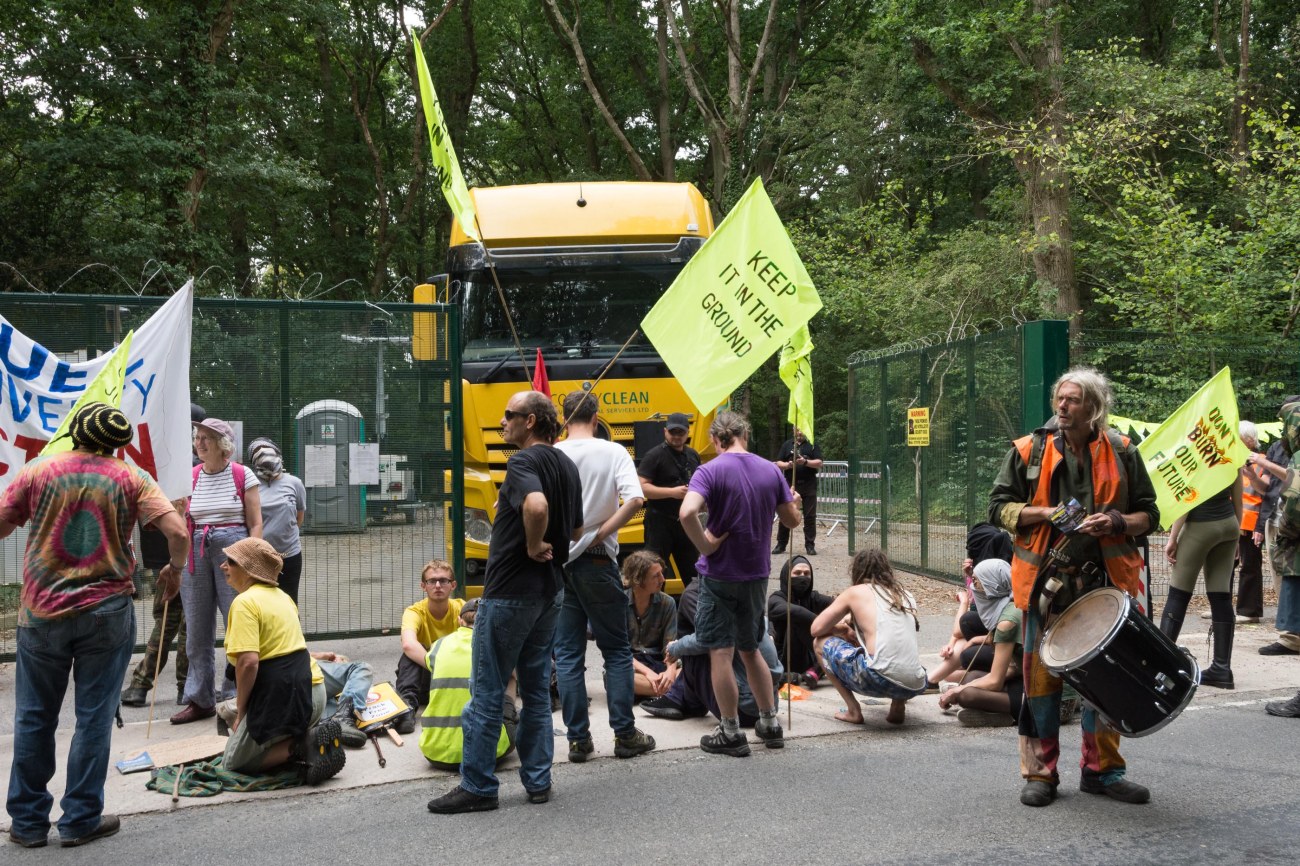
Blockade of the Horse Hill site in Surrey, 20 August 2018. Photo: RodHarbinson.com
Ten people were arrested when opponents of operations to explore for oil in southern England blocked the entrance to the site of the so-called Gatwick Gusher at Horse Hill in Surrey.
The site operator, Horse Hill Developments Ltd, is testing the flow of the well. There is planning permission for additional wells at the site if the tests are successful. The major investor, UK Oil & Gas (UKOG) said in June it was preparing to submit a further planning application to seek consent to produce oil from the existing and future wells.
UKOG said yesterday it had increased its stake in the Horse Hill operation and the exploration licence areas PEDL 137 and 246.


Last winter, protesters occupied the Horse Hill site for two nights. UKOG has sought an injunction against protests at Horse Hill and another site at Broadford Bridge in West Sussex. A decision on the High Court application is expected soon.
Campaign speakers at Preston New Road
Campaigners against Cuadrilla’s shale gas operation at Preston New Road near Blackpool gathered outside the site to hear speeches from John Ashton, a former Foreign Office climate change ambassador, and Jamie Bartlett, author and director of the Demos Centre for the Analysis of Social Media.
The gathering was part of the weekly Green Monday event, which has been running outside Preston New Road for more than a year.
Cuadrilla is expected to begin fracking at the site shortly. This will be the first high volume hydraulic fracturing in the UK since 2011 and the first frack of a horizontal shale gas well.
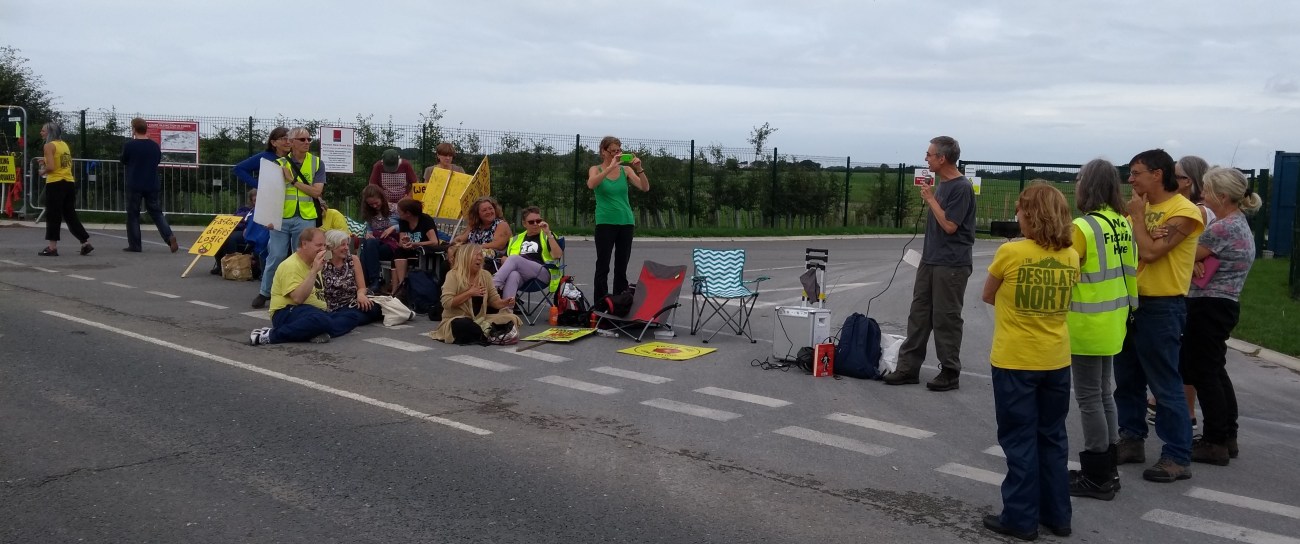
John Ashton speaking at Green Monday event at Preston New Road, 20 August 2018. Photo: Barbara Richardson
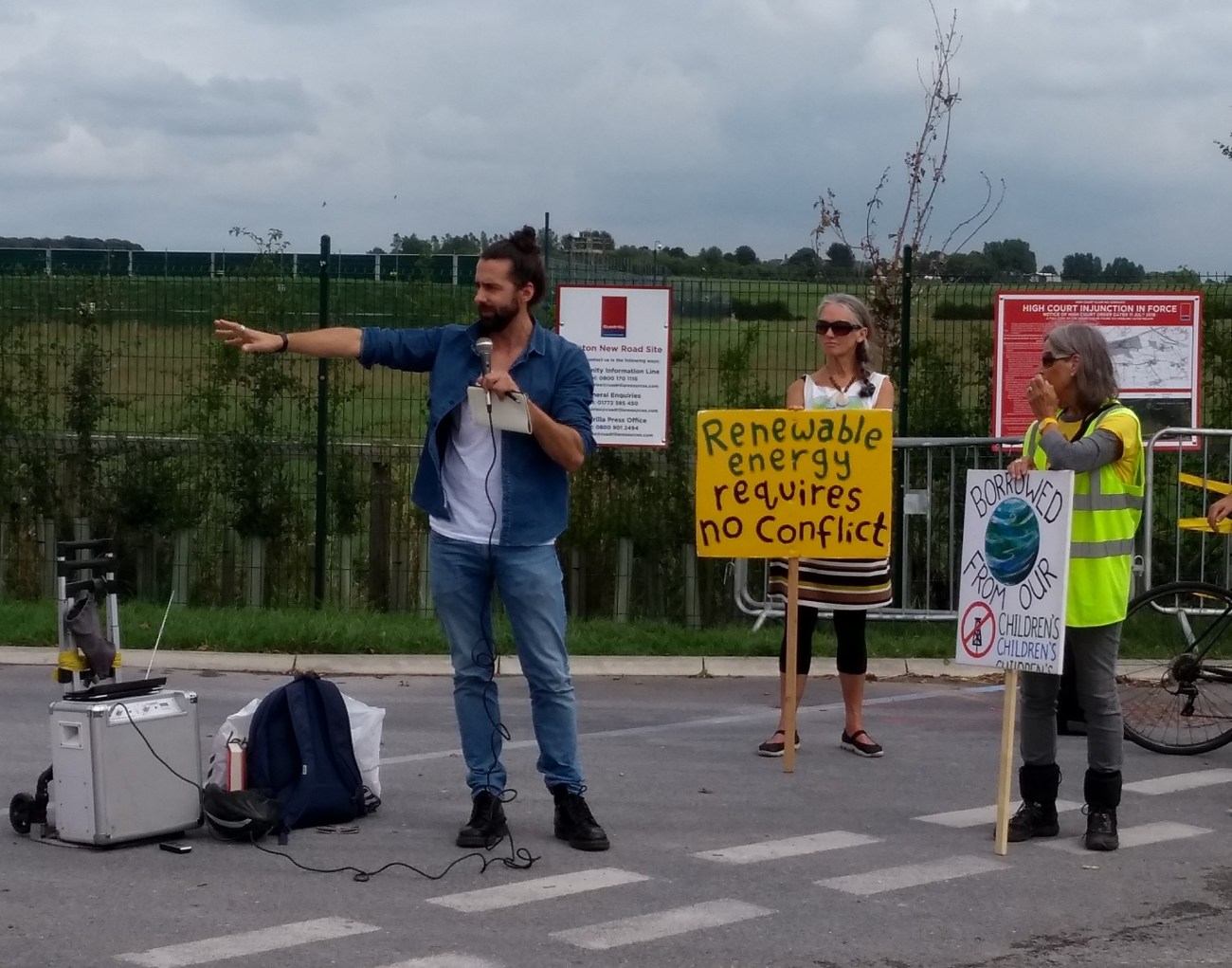
Jamie Bartlett speaking at Green Monday event at Preston New Road, 20 August 2018. Photo: Barbara Richardson
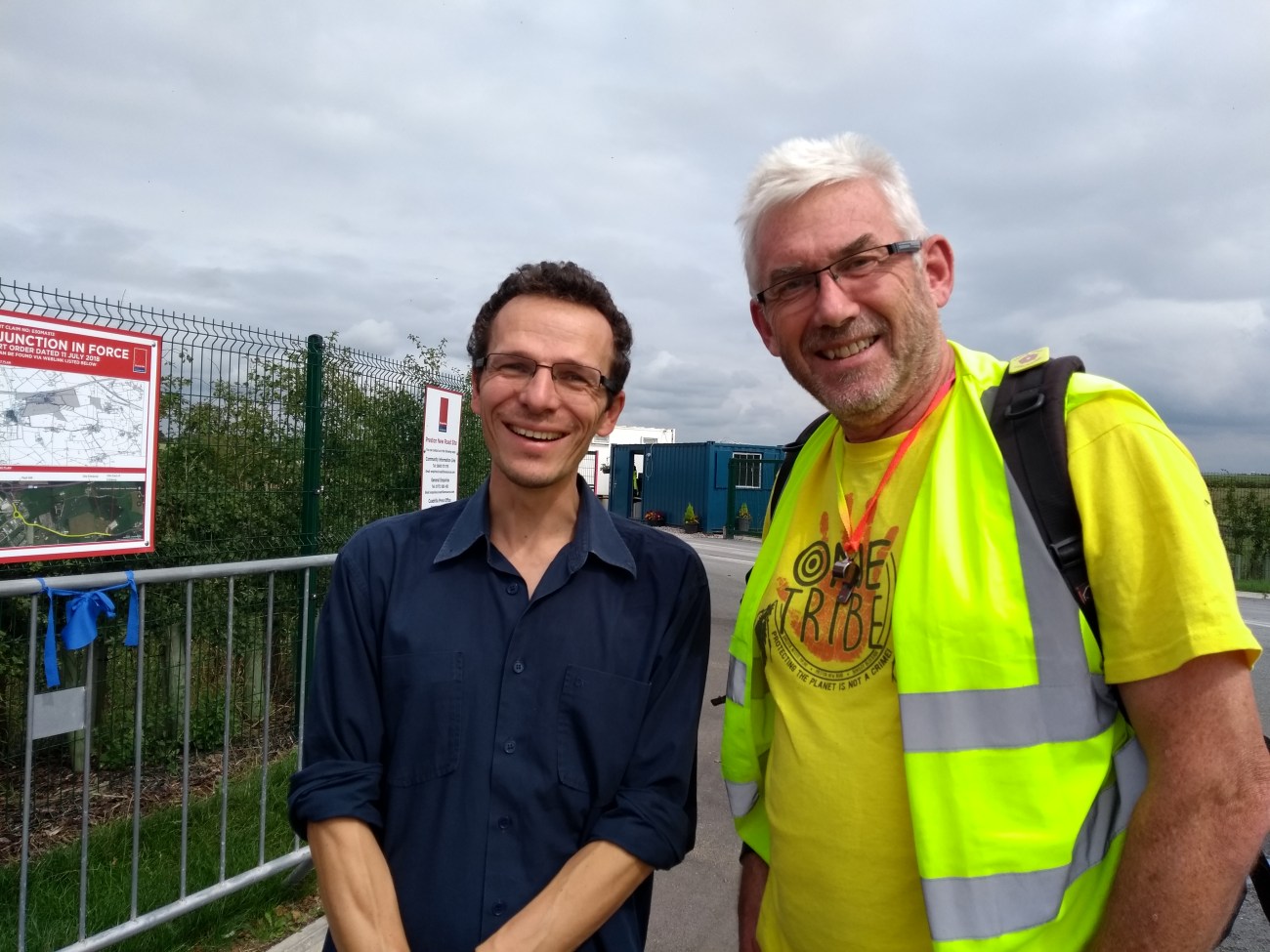
Lancashire campaigner, John Hobson (right) with Eric Albert of Le Monde at Green Monday event at Preston New Road, 20 August 2018. Photo: Barbara Richardson
Categories: protest

 DRILL OR DROP?
I take your point martin but like you, I was in denial regarding EV’s, but you must consider the commitment that all of the major vehicle manufactures are throwing shed loads of development cash at EV production, the Saudi’s want a part of Tesla, the American market is expanding at an amazing rate and they are the land of oil and gas (petrol) production.
I agree that the early EV’s are not able to compare with mileage longevity, YET. but mark my words, its moving at an incredible rate and is evolving before our eyes daily. Hybrids and true EV’s are completely different animals. Having a hybrid is like being half pregnant, thoroughbred EV’s are coming and the costs and technology are improving quickly.
Listen in on EV News Daily and educate yourself, its free.
Exxon tried to hide scientific evidence of accelerating climate change from relying primarily on Fossil fuels in 1976 and has been trying to bury the scientific evidence in the courts ever since.
Now it has been revealed that Shell and it’s associated companies also had scientific evidence that primarily relying on Fossil fuels would accelerate climate change in the 1980’s and buried that evidence too.
https://desmog.co.uk/2018/08/20/exclusive-company-docs-show-shell-secretly-studied-climate-risks-10-years-warning-investors
You have to ask yourself how much evidence of the dangers and consequences to the environment and climate change from fracking and it’s associated avoidances of the word methods including acidification and the scientifically unaccountable definition of the elusive “proppant squeeze” has been similarly hidden and buried out of view.
And whether the entire industry can be trusted to tell the truth at all?
I think we all know the answer to that don’t we?
Always a pleasure.
Have a nice day.
The link to The Climate Files has the link to the 1988 Shell Confidential Report “The Greenhouse Effect” is here:
http://www.climatefiles.com/
There are many other documents that were revealed here too for your own research:
1988 Shell Confidential Report “The Greenhouse Effect”
This 1988 Shell report, discovered by Jelmer Mommers of De Correspondent, shines light on what the company knew about climate science, its own role in driving global CO2 emissions, the range of potential political and social responses to a warming world. The confidential report, “The Greenhouse Effect,” was authored by members of Shell’s Greenhouse Effect
This is “The Greenhouse Effect” link:
http://www.climatefiles.com/shell/1988-shell-report-greenhouse/
Actually John, I did educate myself. I researched EVs and then tried two. The current ones do not tick too many boxes. Indeed, the delivery driver told me most he delivered were for commuters into London because they could avoid the congestion charges-although by the time they arrived in London they were running on petrol!
We have Mr. Musk struggling to manufacture in one month what Ford makes in 6 hours, and he is cornered to do so due to the spin he has given investors whilst it appears he is losing money on every vehicle. It now appears the Saudis are maybe not so interested in baling him out either. I believe their Sovereign Wealth Fund is there to invest and return a PROFIT. Bit like the Norwegian one. Perhaps UK should have one? Wonder where the funds could come from for that?
I am sure they will improve but, like most alternative technology, there is a lot of hype and a long way to go before practical reality. It is easy to excite some-hence Tesla not making a profit in it’s existence but still currently enjoying a high share price-but much more difficult to deal with the requirements of the market.
All seems rather hypocritical to me. Have any of you considered that it is better for the Global Environment if the UK to source it’s Oil locally (whilst needed for your medicines, phones, clothes, household appliances and your cars) rather than import it thousands of miles by sea, thus increasing it’s carbon footprint and impact on the climate?
I don’t drive, don’t own a car and use public transport when I have to…. and you?
….by the way, don’t forget that all these things are tied into trade deals….if you want to go one better, be selective, use only those items that are necessary and can be produced using clean energy…..and of course, walking’s good
Keep the protests legal, especially while the judge is still considering his decision on the injunction. I contributed to funding the case so legal protest would not be curtailed.
Too late Adrian. Not too sure your qualifying second phrase will have won over the judge either! If he decides for the injunction, I suspect we will hear the howls of outrage, but there will be a decreasing number of people willing to listen.
Agree with you completely cperkin. Gatwick and Heathrow about to be expanded because of increased demand, 22 million tonnes of oil shipped in/out of Fawley Refinery/year to help “fuel” that demand. Wonder why these individuals are not at Gatwick trying to prevent families flying off on their holidays? Could it be that HH is a much easier target?
Hmm, “compulsory purchase”? Called “eminent domain” in USA, Is this a sign of things to come in UK?
Yes, an American reference for you to complain about, isn’t that nice?
https://www.desmogblog.com/2018/08/01/ellen-gerhart-pennsylvania-arrested-sunoco-mariner-east-pipeline-dispute
“On Tuesday, July 26, Sunoco Pipeline L.P. filed paperwork with a Pennsylvania court claiming that retired special education teacher Ellen Gerhart, 63, had violated an injunction. Three days later, Gerhart was arrested and jailed.
After being held on $25,000 bail for a week, Ellen Gerhart was on Friday, August 3 sentenced to two to six months by Pennsylvania Court of Common Pleas Judge George Zanic.*
Sunoco Pipeline obtained a right of way through the Gerharts’ land using the controversial legal doctrine of eminent domain, which allows private companies to seize land people refuse to sell that’s in the planned path of a pipeline project.
In the complaint that led to her jailing, Sunoco claimed Gerhart interfered with construction by, among other things, luring mountain lions and bears onto her property.
“Mrs. Gerhart’s efforts to bait the property was [sic] successful and, on June, 24, 2018, a mountain lion was spotted on the edge of the easement,” the complaint filed by Sunoco Pipeline, L.P., which merged with Dakota Access builder Energy Transfer Partners in 2017, alleges. “Four days later, two bears were on the easement and fresh mountain lion tracks discovered.”
These allegations have drawn ridicule from Gerhart’s supporters, who say the company’s claims that she is to blame for wildlife near construction are absurd. A MoveOn petition calling the charges “outlandish and unprovable” and urging her release has attracted over 2,000 signatures.
The Gerharts have their own view of what led to Ellen’s arrest.
“Energy Transfer Partners is yet again fabricating charges against my mom in attempt to silence her,” Ellen’s daughter Elise said in a statement. “Look at who has actually inflicted damage here: ETP has poisoned dozens of families’ wells across the state, spilled over 100 times, and harassed and intimidated anyone who opposes them.”
Bear Habitat
Indirect criminal contempt, the charge listed against Gerhart, generally carries a maximum penalty of 15 days imprisonment and a $100 fine. By the time Sunoco’s claims against Gerhart were heard on Friday, she had served roughly seven days, much of that period in solitary confinement, according to her supporters.
A court docket listed the charge against Gerhart as a summary offense, a type of criminal charge that most often results in the issuance of a ticket and no jail time. She was facing two other charges, her lawyer said, but those were sheduled for trial at a different hearing.
The state’s game commission reports the last recorded killing of a mountain lion in Pennsylvania dates back to the late 1800s. Mountain lions are considered extinct east of the Mississippi River and north of Florida (though other large cats like the endangered Florida Panther have at times ranged far from their homes or escaped captivity).
Gerhart’s daughter Elise dismissed Sunoco’s claims as entirely unfounded.
For her, the explanation of what happened was simple. “We live in bear habitat,” she said. “There are bears.”
What Rights Remain After Eminent Domain?
The charge listed against Gerhart was a low-level contempt charge, but her case could also implicate much larger questions about property rights and eminent domain, questions that boil down to this: What can you do on your own land after a private company seizes a slice using eminent domain?
If Sunoco’s charges are upheld, that could potentially set precedents affecting others who live near pipeline projects, especially those who wind up in disputes with a company over the use of their land. What if, for example, a landowner keeps a compost pile for their garden near land seized for a pipeline — could that person wind up accused of using their kitchen scraps to attract dangerous wildlife? The two activities might look pretty similar from a distance.
What if you have a campfire out back — is that criminal conduct intended to menace with fire or just a normal, everyday activity?
Can a private company seek to have you jailed if you shout at construction workers — or should that run afoul of the First Amendment’s protections for free speech?
And what happens when a company brings in security guards to keep trespassers out, but those guards wind up routinely photographing you walking around your own land and keeping detailed daily logs of your activities — should their eminent domain rights to use your land extend that far? Or should the daily photographing of a person on their own property cross a line into an invasion of privacy, what the courts in Pennsylvania might call an “intrusion upon seclusion”?
These are the sorts of thorny legal questions that are only beginning to emerge amid two separate developments, which highlight the problems that arrive when a doctrine originally intended to promote public works projects and utilities is increasingly applied in ways that benefit large corporations, who use land very differently than, say, a town building a public park or a phone company installing a telephone pole — and who are more likely to be confronted by landowners outraged by the seizure of their land for someone else’s profit.
The first development happened in 2005, when the Supreme Court’s decision in Kelo v. City of New London broadened the government’s authority to condemn land through eminent domain for purposes like economic development — meaning that private companies are increasingly able to have people’s land condemned.
The second development, the explosion of shale gas drilling, has brought pipeline companies into more and more backyards, farms, and neighborhoods nationwide. This rush of construction is making questions about which pipelines should be considered “public utilities” — or which companies may have the right to seize private lands — all the more pressing.
The pipeline industry plans to construct over 3,200 miles of oil and gas pipelines this year, more than double the number of miles built in 2017.
Legal challenges to the “public utility” status of Mariner East projects, which will carry natural gas liquids like propane, ethane, and butane for export and use in the petrochemical and plastics industry, have repeatedly failed in Pennsylvania.
While the courts may be convinced that Mariner East is a public utility, some public interest groups remain very skeptical, arguing that it violates common sense to classify exports of a petrochemical ingredient as a “utility.” In other words, your utility bills might include a power bill, a water bill, or a phone bill — and the power company, water company, and phone company all have a right to run their pipes and lines across your land, even if you object — but who pays a monthly ethane bill?
And if people aren’t convinced that land seizure is justified, they’re more likely to push back. “The growing use of eminent domain to seize property for pipelines has generated opposition from an unusual coalition of liberal environmentalists and conservative and libertarian property rights advocates,” a 2016 Washington Post column noted.
‘Prioritization of Profit’
Back in 2015, Sunoco approached the Gerharts with an offer to buy a portion of their land — an offer that the Gerharts refused. The company responded by seizing that land through eminent domain.
In January, the state Supreme Court rejected an appeal of a 2017 ruling granting Sunoco 1.4 acres out of the Gerhart’s 27 acres of land.
However, environmental and safety concerns, rather than property rights, have fueled much of the opposition to Sunoco’s Mariner East plans.
“We started really doing some research on this company and on the product it was carrying,” Ellen Gerhart told PBS Newshour, which profiled the family and their supporters last year. “The more research you do, the worse the picture gets.”
Pipeline opponents had at one point set up a protest encampment on the Gerharts’ land, using civil disobedience tactics to stall construction — until in April, a “predawn timbering raid” by Sunoco, which had hired controversial private security firm TigerSwan, felled the trees while they were unoccupied. (There is no mention of any protesters remaining present at the Gerhart property in Sunoco’s complaint filed last week.)
For Sunoco’s part, Mariner East’s track record during construction statewide has proved troubling, involving not just accidents but also what one state judge called “deliberate managerial decisions.”
“Sunoco has made deliberate managerial decisions to proceed in what appears to be a rushed manner,” the administrative law judge wrote in a May 21 shutdown order, “in an apparent prioritization of profit over the best engineering practices available in our time that might best ensure public safety.”
“The pipeline project has been plagued by spills and mishaps, racking up over 100 spills and creating huge sinkholes in suburban subdevelopments,” DeSmog previously reported. “In addition, it has been blamed for the contamination of a dozen water wells and hit with fines as high as $12.6 million by state regulators over permit violations.”
In February, the Pennsylvania Department of Environmental Protection took the rare step of labeling some of Sunoco’s environmental lawbreaking “willful and egregious,” and construction has been repeatedly suspended by the state and then resumed.
Judge Zanic, who sentenced Gerhart on Friday, worked as a District Attorney (or prosecutor) before being elected to the bench in November 2013. His current term runs for another five years, to 2023. He made headlines two years ago for holding pipeline protesters on bails up to $200,000.
A GoFundMe page to help with legal expenses from today’s trial had raised roughly $8,000 of a $25,000 goal as of Friday afternoon.”
It is worth remembering that this injunction and prosecution was for activities on retired special education teacher Ellen Gerhart, 63 own private land and for the frankly bizarre accusation that Sunoco claimed Gerhart interfered with construction by, among other things, luring mountain lions and bears onto her property…..
I am sure that the operators in UK are watching closely to see if this “eminent domain” equivalent of “Compulsory Purchase” order claim sticks in the good old US of A and whether we will see “Compulsory Purchase” for oil and gas exploration and extraction enforced here?
Well ladies and gentlemen, one thing is for sure, you couldn’t make stuff like this up could you? Injunctions are nothing more than the first step on the slide down the slippery oily slope aren’t they.
The lunatics have well and truly taken over the asylum in the USA and are already coming to an operation near you sooner than you think.
This is why protest is absolutely necessary before we see such gross corporate insanity perpetrated here as well.
We ain’t seen nothing yet folks, we had better stop this before it starts, if you want to know how it is handled here, then you need look no further than the “compulsory purchase” of property for the HS2 rail link compulsory purchase debacle and just see how it will be handled in relation to the oil and gas operations here.
Perhaps DOD should introduce a maximum number of words per posts?
Perhaps you could take out an injunction?
….would say that would be censorship Paul; do you know Claire P?
Paul / Ruth – no articles on the following two topics? Much more interesting than articles about protestors / possible injunction breakers.
“From Cuadrilla’s website:
“In July 2018, Cuadrilla started work to restore the Grange Hill shale gas exploration site. The well will be plugged with cement and the site returned to its original pre-exploration use as agricultural land. ”
The rig will be plugging and abandoning the well. I am surprised there are not protesters there? Slow walking etc.”
And:
Click to access OR18020.pdf
I would have thought there would be a great deal of anti interest in the linked document? The PNR wells are probably the most monitored in the world…..
Or a compulsory purchase order on Drill Or Drop?
Hi Paul
Thanks for your suggestions. Pieces on Grange Hill and Becconsall, and the BGS baseline study are on Ruth’s to-do list.
Will frack eat itself?
https://www.desmogblog.com/2018/08/10/fracking-industry-cannibalizing-own-production-increasing-spill-risks?utm_source=dsb%20newsletter
Looks good for UK where dense well spacing will be a challenge due to surface constraints.
I say, that comment [Looks good for UK where dense well spacing will be a challenge due to surface constraints.]should be redacted!
Though i think bears and big cats would be more difficult to turn into flat bear frack hats than little cats? Probably its more likely that the bears and big cats would wear fat human frack hats? A sort of eminent “domemain” that humans would not be so keen on?
I believe that might be called “roooouuuuugh justice”? Somewhat rougher than even an attempt at eminent domemain or compulsory purchase would be prepared for?
Such fun!
Always a pleasure!
Have a nice roooouuuugh day!