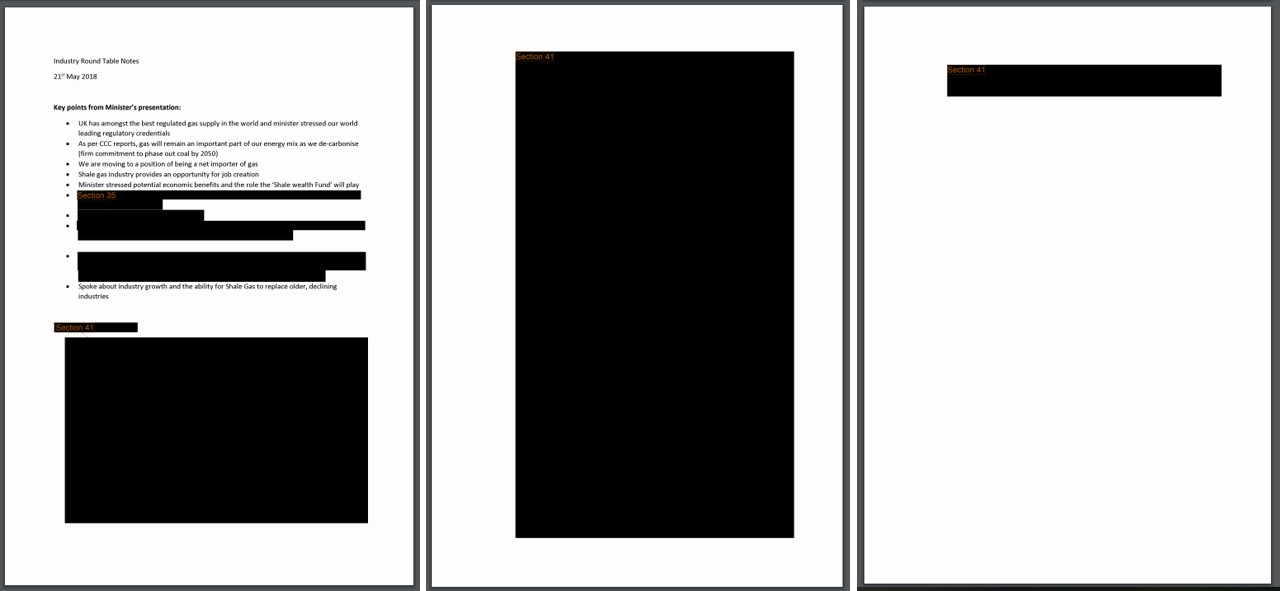
Redacted notes of a meeting between Claire Perry and the shale gas industry
Most of the notes about a recent meeting between a minister and the shale gas industry have been redacted “in the public interest” or because they contained confidential information, a government department has said.
Information about the meeting, first publicly referred to during a parliamentary debate, was released following a Freedom of Information request.
But in its response, the Department of Business, Energy and Industrial Strategy (BEIS) published only the agenda and the first eight lines of the two-plus pages of meeting notes. Even the second half of the notes of the minister’s presentations was blanked out “in the public interest”. Redacted notes of industry meeting with Claire Perry (pdf)
BEIS also said there was no list of the industry representatives attending the meeting.
The meeting was held at lunchtime on 21 May 2018. Later that day, Ms Perry and the then housing minister, Dominic Raab appeared before a committee of MPs to answer questions on proposals to change planning rules for shale gas.
The week before, on 17 May 2018, the business and local government secretaries had released written ministerial statements about the changes. These proposed to classify non-fracking shale gas proposals as permitted development, avoiding the need for planning applications. Shale gas production schemes would become nationally-significant infrastructure projects to be decided by a Secretary of State.
Ms Perry’s meeting came to light last month when she said in a debate that she’d had “a very effective shale industry roundtable”.
This was followed up with the FOI request by Richard Bales, who lives in Ryedale, where Third Energy is still waiting to hear whether it has permission to frack at well at Kirby Misperton.
Mr Bales said:
“I was intrigued by Claire Perry’s so-pleased reference in Parliament to her ‘Shale Gas Round Table’ with Industry Operators, I made polite FOI enquiry as to what this was.
“I didn’t expect much, which is exactly what I got. They admit there was a meeting, but nobody has a list of attendees and won’t tell me what was discussed.”
Mr Bales told DrillOrDrop:
“There is an undisguised arrogance and disdain for the community evident in the Government position on shale gas and the succession of unilateral decisions that have been taken. Operators clearly have open access to lobby Ministers and their departments, whereas the public have little representation, particularly when very few MPs appear willing to place their constituents wishes ahead of their own career prospects.”
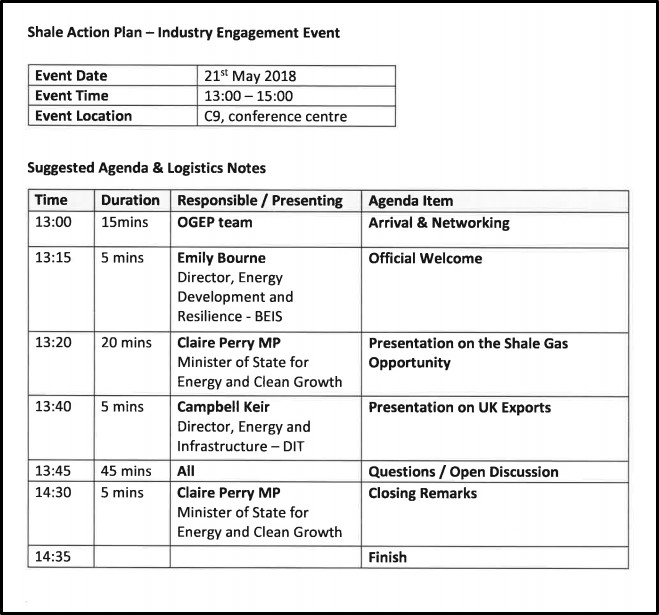
Agenda from the meeting
BEIS said withholding some of the information from the meeting notes was in the public interest.
It said it had used exemptions to the Freedom of Information Act on disclosure of material relating to the formulation of government policy.
In its response to Mr Bales, BEIS said:
“Whilst there is a public interest in favour of disclosing information relating to the Government’s policy, we consider that releasing this information also poses a risk to the protection of the decision-making process and the Government’s preparation of the review.
“There is a public interest in ensuring that government has a safe space to develop ideas, debate live issues, and reach decisions away from external interference and distraction, as well as ensuring that the UK can obtain the best possible outcome for our policy regarding Shale Gas extraction.
“We judge that disclosing this information would inhibit the frankness of future discussions, inhibit policy formulation and development, which would not be in the public interest. In our view, taking account of these factors, there is a strong public interest in withholding information.”
BEIS also said it had used an exemption under the act on providing confidential information. On these details, BEIS said no public interest test was required.
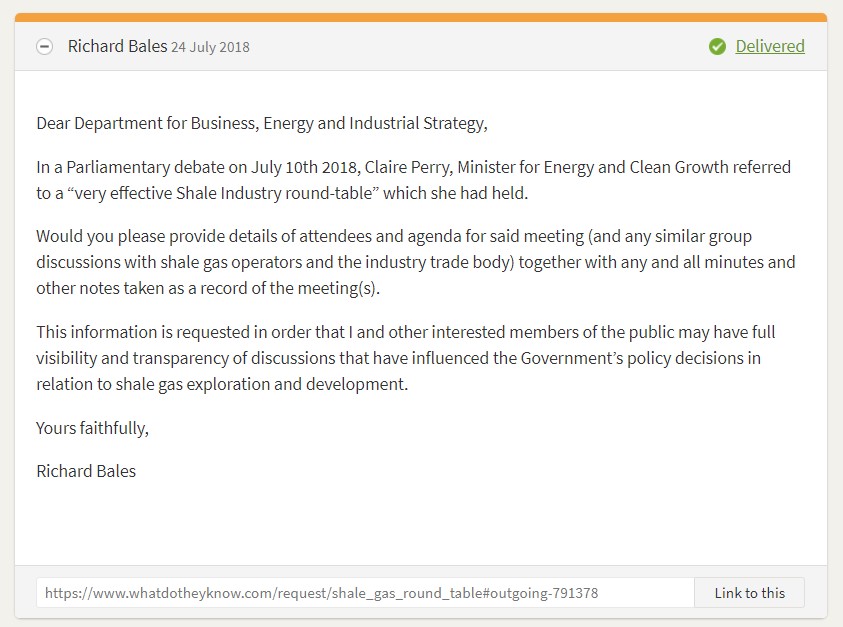
FOI request by Richard Bales
Mr Bales said:
“The response is clumsy, brutal and insensitive and makes no attempt to disguise the gulf which now exists between the Government and its public. It implies that transparency of decision-making is primarily to be discouraged and that the public are to be excluded from the decision-making process for their own good. It cannot be accepted.”
Internal review
He has asked BEIS to carry out an internal review of its decision. He said it was “inconceivable” that a minister would hold a scheduled meeting with a formal agenda and attended by senior officials without a record being kept of attendees.
“Security alone should dictate that attendees would sign-in, with prior notification of expected attendance, to ensure that participation is limited to those with a valid invitation or reason to be there. I would suggest that insufficient attempts have been made to identify and disclose the requested information.”
He also challenged BEIS’s use of the exemptions.
“The argument used is that the public’s interest in information being disclosed for reasons of transparency and understanding of Government policy is in itself an impediment to the decision making process.
“The implication is therefore that no visibility of the decision-making process is to be allowed and that the public interest in disclosure of relevant Government process is to be continually denied.”
Mr Bales said this was not intention of the exemption in the Act. He also described the exemption on confidential information as “a catch-all response that is only justifiable if all such notes relate to input from third parties to whom disclosure would represent a breach of confidence”.
He said:
“One wonders what information might have been shared at the Round Table that was not disclosed by the WMS [Written Ministerial Statement] or in the later testimony to the Committee, at which Claire Perry made several references to Government’s intention to ‘work to eliminate distrust’.
DrillOrDrop asked BEIS to respond to these arguments. A spokesperson said:
“As the review is ongoing we will not be commenting on this at this time. More information will be available once the review is complete.”
Facilitating communication
Last month, the government advertised for a shale gas commissioner to “facilitate communication” with residents in fracking areas.
The role aimed to:
“improve local understanding of shale gas operations by directing concerned local parties to relevant and impartial fact based information”.
There is a growing list of official documents on UK shale gas development that have been redacted, unpublished or delayed.
Earlier this month, a government report revealing that shale gas extraction increased air pollution was finally published three years after its submission. Also this month, anti-fracking campaigners criticised the government for dropping questions about shale gas from a quarterly public attitudes survey.
In February 2018, it emerged that another report, which was not published, had scaled back estimates on the number of UK unconventional oil and gas sites in the 2020s. (DrillOrDrop report)
In July 2015, the government finally released a full version of the previously redacted report on the impacts of fracking in rural areas after an instruction from the Information Commissioner.
Categories: Politics

 DRILL OR DROP?
Thank you Ruth, well I am a member of the public and I am interested in the complete unredacted report being published in the public interest, and I want it now, not years in the future..
[Typo corrected at poster’s request]
Agree, we must see everything. They are blatantly frackshodding their way to fracking dispelling with planning permissions, despite no risk assessments with coal mines being in the northern licence areas.
Well, I think this decision is completely [redacted].
Good going Claire!
Definitely a progressive, rather than a processive. Careful-an unusual attribute in Westminster, but will soon be in great demand.
famous last words…
What has happened to democracy? Whether you are for or against fracking this is not an example of a transparent, open government. Reports being delayed, heavily redacted information. It smacks of industry being given preferential treatment as well as access to the highest level of government and of decisions being made behind closed doors. Decisions that are of significant importance and interest to the public and parliament. This behaviour pattern has far reaching ramifications beyond fracking.
And its here; the truth behind the absurdity….
https://www.theguardian.com/environment/2018/aug/22/uk-fracking-push-could-fuel-global-plastics-crisis-say-campaigners
‘However, last year the Guardian revealed that a huge boom in the US shale gas industry has resulted in a £180bn investment in plastic production facilities by fossil fuel giants such as ExxonMobil Chemical and Shell Chemical – contributing to a 40% rise in global plastic production over the next decade.’
That’s what your local MP is for KatT!
Perhaps you would like Mrs. May to give you a word by word account of her recent discussions with Donald, or Nato, the G7, Macron, Merkel etc. etc?
Think you will find a lot of government decisions are made behind closed doors. The electorate can then hold to account if they go wrong. That’s democracy.
‘The electorate can then hold to account if they go wrong.’ – would be better served by the truth now, then perhaps we can avoid the repercussions for all when it does.
‘That’s democracy’ – no that’s fascism
No Martin, a backbench MP does not neccisarily know what goes on behind closed doors either. Hence my point about parliament and the public should be informed about significant decisions that impact climate change and the U.K. and where there is high public interest. An accountable and transparent government is called a democracy. Where the state makes decisions and excludes public and parliamentary scrutiny is more in line with a dictatorship and fascism. Of course I don’t think Mrs May should report to me or anyone else in the manner you describe. But neither do I think reports commissioned by the government that conclude fracking worsens air pollution and the economic benefits have been exaggerated should be withheld deliberately from the public and parliament either. The economic benefits report was only released after a FOI appeal, which is quite frankly disgraceful. And likewise I consider, when a member of the public submits a FOI request regarding this meeting they should not be treated in this way. As I wrote earlier, this behaviour goes beyond fracking and I consider it a dangerous attitude for a government to have in what is a democratic country.
I agree, Kat T. Richard Bales, who lives in Ryedale, made an FOI request on the Shale Gas Round Table meeting. (A meeting held behind closed doors between Government and unnamed Oil and Gas Industry representatives.) This FOI Request resulted in a useless, almost completely redacted document being released to Mr Bales. The reason for this redaction, according to the BEIS, was “There is a public interest in ensuring that government has a safe space to develop ideas, debate live issues and reach decisions away from external interference and distraction.”
What hypocritical arrogance. They are claiming they should be allowed to debate and decide issues which directly affect the public without interference or distraction from the public. At the same time they have positively welcomed external distraction and interference from the Oil and Gas Companies.
It really is quite apparent who is running this country and in whose interest decisions are made.
We who live in proposed fracking sites are the ones who will suffer most and surely deserve to be considered in any proposals. Those who are not directly affected may well hold their pseudo-intellectual debates in the knowledge that you , your family and future generations will be safe from the proven effects of fracking. Stop being so selfish and think of others – profit is not a god.
YES MARTIN , I can agree with you on that one , decisions really are being made behind closed doors… BAD ONES
Here’s one for ya.
After it had been shown that the AIR quality in the Davyhulme area of Manchester is highly toxic and regularly breaches legal guidelines .
The local council refused planning permissionr for Peel Energy to build and run an incinerator in that particular area .
Peel Energy appealed to the government……. A public inquiry was held and a minister in London, living far away from the area, rubber stamped its approval to be built .
NOW LETS RECAP HERE ……..Although it has been shown that the air quality in the area was highly toxic and above LEGAL GUIDELINE LIMITS , a government minister in 2012 still thought it was acceptable to poison the air further and even went as far as to allow the company to use BEST PRACTICE technology and NOT BEST AVAILABLE technology ( basically that means they were allowed to use second class technology ) when it comes to its filtration system …. Using BEST AVAILABLE filtration technology would of cut in to the companies PROFITS
Now here’s the punchline, the minister even gave the company permission to lower the chimney stack height by 50% below a recommended guideline to further facilitate a PRIVATE AIRPORT that was owned by the same company
YES I SEE what goes on behind CLOSED DOORS MARTIN .
REGARDING the ABOVE POST and the fight against the INCINERATOR and an application for COAL BED METHANE ( CBM ) extraction on the same land .
Please see……..
Breath Clean Air Group website.
https://bcag.co.uk/about/
Information on attendees redacted? What are you trying to hide Claire?
…and how long must the taxpayer wait to find out? Do your constituents know what you are up to? Do your job, complete the request in full from those who pay your wages…..
These idiots will be out soon enough , ” Nothing to see here ” [Edited by moderator]
Reblogged this on Unique Hand-made Patchwork DRESSES JACKETS SKIRTS KIMONOS. and commented:
Government blatantly frack-shodding over everyone. On with their fracking plan. Deplorable.
Absolute disgrace.This has nothing to do with national security and everything to do with transparency.