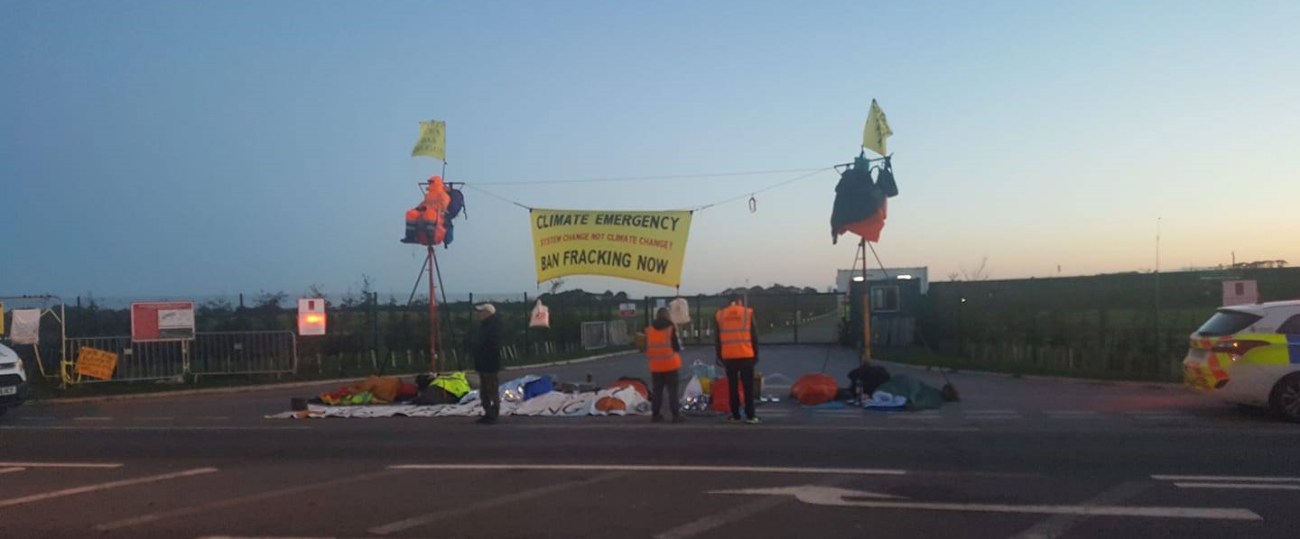
Protest involving nine people outside Cuadrilla’s fracking site at Preston New Road, near Blackpool, 1 October 2018. Photo: Katrina Lawrie
A group of anti-fracking campaigners blocked the entrance of Cuadrilla’s shale gas site near Blackpool early this morning.
The protest involved seven people locked together on the ground and two people on tripods.
They said they were taking part in solidarity with three men who were jailed last week for a 99-hour protest near the site in July 2017.

9-person protest outside Cuadrilla’s Preston New Road shale gas site near Blackpool, 1 October 2018. Photo: Debs Whiteside

9-person protest outside Cuadrilla’s Preston New Road shale gas site near Blackpool, 1 October 2018. Photo: Debs Whiteside

Lock-on protest outside Cuadrilla’s Preston New Road site near Blackpool, 1 October 2018. Used with the owner’s consent
A group of anti-fracking campaigners travelling to a rally at the Conservative Party conference passed the protest and shouted support.

9-person protest outside Cuadrilla’s Preston New Road shale gas site near Blackpool, 1 October 2018. Photo: Ros Wills

9-person protest outside Cuadrilla’s Preston New Road shale gas site near Blackpool, 1 October 2018. Photo: Ros Wills

9-person protest outside Cuadrilla’s Preston New Road shale gas site near Blackpool, 1 October 2018. Photo: Ros Wills

9-person protest outside Cuadrilla’s Preston New Road shale gas site near Blackpool, 1 October 2018. Photo: Ros Wills

9-person protest outside Cuadrilla’s Preston New Road shale gas site near Blackpool, 1 October 2018. Photo: Ros Wills

9-person protest outside Cuadrilla’s Preston New Road shale gas site near Blackpool, 1 October 2018. Photo: Ros Wills
Lancashire Police said on its Facebook page it had set up a contraflow on Preston New Road. The force said:
“This will cause some traffic disruption so please avoid the area where you can and expect some delays if you are travelling through. We will re-open the road as soon as it is safe to do so. Local businesses are open as usual.”
At 7pm today, police began dismantling the tripod but the occupant locked himself to the tubing.
Categories: Opposition
Tagged as: Cuadrilla, Fracking, lock-on, nine, people, Preston New Road, prison, protest, shale gas, solidarity, tripod

 DRILL OR DROP?
Perhaps the solidarity extends to these seven joining the other three in prison….
Paul Fresco,
When will you realise that sacrificing the wellbeing of the 100plus nearby schoolchildren to create a database proving that the List of the Harmed will include their names is totally wicked and criminal?
[Edited by moderator]
What better way than to support your comrades? I thought there was an injunction? Now there is a sentencing precedent for causing contraflows / delays?
Here’s hoping it rains heavily today.
Amen to that R8, Maybe early snow.
The “list of the harmed” those who claim to have been harmed by hydraulic fracturing in Pennsylvania. The list relies on people self reporting and links to articles from environmentalist activist sources of news, rather than any scientific studies.
Since many antifracking New Yorkers, where there is no fracking have added their names to the list, you might as well add a few more from Lancashire. I can’t see it making the list a bigger farce than it already is.
Peter Roberts
Would that be Weeton School?
It looks as if the health of the village and school have long been sacrificed to the insane desire to get tourists to Blackpool. The M55 being quite close to the school ( closer than the well Site ) and village and downwind. What plans are in place at present to get them ( school and village ) off the list of harmed due to tourism?
Now… two wrongs do not make a right, but are you sure that some flaring from the Preston Road Site will be the major source of pollution for the school?
Plus, maybe it is not an insane desire for tourism, but one can get carried away with the rhetoric I guess.
My children go to a nearby school to the PNR site
Stop scare mongering
When U.K Shale Gas is going through your boiler will you switch it off???
Or is the limit to your protest tapping BS on your plastic phone???
For a longer sentence.
Reblogged this on nearlydead.
[Comment removed by moderator]
Good job the site has everything already in place!
The outdated pointless gesture seems to be the hallmark of the antis now.
Martin, everything on site already! Who told you that?
Does that include all the toxic contents of fracking fluids? That will soon be added to our Environment? And you think that’s a good thing?
You obviously are not a local resident.
Therefore you must be industry!
Peter Roberts – in accordance with Mr. Tootill’s request for debate, shall we discuss “Does that include all the toxic contents of fracking fluids?”. Please can you let the BB know what fluids / chemicals Cuadrilla intend to use (and what the EA must have sanctioned) in their upcoming hydraulic fracture stimulations and how these are toxic to your environment? I have tried to debate this several times before but no one seems interested in discussing the subject in any detail.
To help you please find below a summary from the Environment Agency in response (2015) to my request to them for clarity on what was used previously at the Preese Hall well:
How do we regulate which chemicals may be used in fracking fluids?
We have the powers to require full disclosure of chemicals used in hydraulic fracturing. We assess the hazards presented by fracking fluid additives on a case-by-case basis. We will not permit the use of ‘hazardous substances’ for any activity, including hydraulic fracturing, where they would or might enter groundwater and cause pollution.
The environment agencies of UK and Ireland (JAGDAG, Joint Agency Groundwater Directive Advisory Group) work together to peer review chemicals assessments before we submit proposals to public consultation. You can find out more on which substances have been assessed on the JAGDAG website
Flowback fluids, which include fracking fluids, are deemed to be a mining waste and require an environmental permit for management on site. Disposal of flowback fluids must be at a regulated waste treatment works, which will also be regulated by us.
What is the assessment process for defining whether a chemicals is hazardous to groundwater or not?
The way we assess whether a chemical is hazardous or not to groundwater has been developed under European Union environmental legislation. You can find more information on this methodology here.
As part of the methodology for the assessment of chemicals, we consulted on a number of chemicals in 2013. You can find the results here, which includes our assessment of polyacrylamide (the chemical used by Cuadrilla in Preese Hall in 2011).
“Do companies have to publically disclose which chemicals they will use?
In its document Onshore Oil and Gas Exploration in England: Regulation and Best Practice, the Government states that operators should disclose the chemical additives of fracturing fluids on a well-by-well basis. This also is promoted in the guidelines set out by industry that operators must publically disclose all chemical additives to fracturing fluids on a well-by-well basis, including regulatory authorisations, safety data and maximum concentrations and volumes.
Which chemicals were used by Cuadrilla in Preese Hall?
Preese Hall site is the only shale gas site to have been hydraulic fractured to date in the UK. Details of the chemicals which we assessed as non hazardous and permitted for use are listed on Cuadrilla’s website. They are:
• 99.75% of the shale gas fracking fluid is made up of water and sand, beyond that a very limited number of chemicals are used:
• Polyacrylamide friction reducers (0.075%), commonly used in cosmetics and facial creams, suspended in a hydrocarbon carrier;
• Hydrochloric acid (0.125%), frequently found in swimming pools and used in developing drinking water wells,
• Biocide (0.005%), used on rare occasions when the water provided from the local supplier needs to be further purified.
Cuadrilla only utilised the polyacrylamide friction reducer in their operations.
Does the Environment Agency put information about chemicals into the public domain? What about commercial confidentiality?
If the chemicals are mentioned in the application for an environmental permit, we would place this information on the public register, subject to consideration of commercial confidentiality. If commercial confidentiality applied, this information would be excluded from the public register.
Any request we received for environmental information would be covered under the Environmental Information Regulations. There is a statutory presumption in favour of the disclosure. There is an exception for commercial confidentiality but where this relates to information on emissions, this cannot be used. The injection of fracking fluid would be considered to be an emission and therefore we would release information on chemicals used for hydraulic fracturing. “
Lots of talk about on Cuadrilla and minimal chemical usage.
Now the reality
In the US they tip millions of gallons of toxic chemicals down shale wells. They do it to maximise recovery rates.
Maybe Cuadrilla could try and recover some of it’s lost millions by writing to the big US fracking companies and selling their secret sand, water, and a cupful of friction reducer recipe.
Maybe Haliburton, Chesapeake, and schlumberger are unaware of this recipe formed through years of secret research. I should imagine Cuadrilla would patent such a complicated formula and think of all the money people would pay to use it.
So John, are you saying the EA are misleading me, not telling the truth? Are the submissions for the two PNR wells about to be stimulated incorrect, not disclosing all the items to be pumped in the job? If it doesn’t work as you are predicting then you should be happy?
What do they need in addition to water, sand, friction reducer, HCl, soap and possibly oxygen scavenger?
Waiting for Peter to respond with something sensible aka Mr. Tootill’s request..,..
[Comment removed by moderator]
Apparently there was 2 antis who witnessed the trucks arrive
Hardly a mass opposition…
These activists are laughing the face of the court injunction order. They know the government is weak on their laws and they are challenging if anyone dare to takee any action.
The court orders are now a jokes for those who dare to take matter into their own hands.
I am pretty sure they get sent to prison now for breaking the law?
[Comment removed by moderator]
You can contact DOD under the contact page to voice your concerns and if you wish ask for a poster to be banned.
I do not think that the comments page of DOD should be disabled as it would stifle the many interesting points raised on here by both for and against, some of which are quite rational.
Plus, I suspect that posters also contribute ( well I would hope so ).
I can get all the anti fracking propaganda direct from anti fracking sites ( and vica versa for pro fracking ) but not the debate.
My concerns are best expressed in public, which is why I choose this route. There are NO interesting points raised by comments, in general. in my opinion, because any news item is immediately seized and pounced on by those who oppose DoD’s relatively factual accounts of news items. Contribute in what way? There are those here who want to disrupt any reasonable discussion by introducing irrelevant or diverting comments. If you are wanting to avoid any pro- or anti- fracking propaganda then the solution is to avoid reading comments, which are posted by those with vested interests. So chuck the comments – if you trusts DoD let’s just have the independent news.
There is NO debate here. It is merely confrontation.
Alan
Contributions would be financial, to keep DOD going.
[Edited by moderator]
No, I am not industry, Peter. You do have problems with anything other than simplistic dogma, but that is your problem. Try not to find comfortable definitions for those who don’t agree with you. I have yet to see one from you that is accurate, even when individuals have explained their motives.
Two individuals who have difficulty with free debate and want to edit it. I wonder why that is, if their position is so strong?
[Comment removed by moderator]
Obviously a balanced opinion there!
Just to point out I have never abused an individual on this site. I have identified when a poster has posted nonsense, which is pretty frequent.
You seem to want to be able to continue to do both, and good luck with that.
You might also find that not all young people are as blinkered as you assume they are.
I expect your post will be edited-but not PDQ. Older people are not blinkered either.
Just a couple of points to think about.
1. The protest is taking place within the bell entrance to the site. The decision to close the road is totally unnecessary and is done purely to inconvenience road users thus making them blame the protectors.
2. Usual uninformed rubbish spouted by John Harrison and his friends who clearly can’t be bothered to investigate reports before offering their ignorant and irrelevant opinions. Consider just one of the studies done in Pennsylvania which Mr Harrison claims has no basis in science. This is a peer-reviewed investigation whose findings were published on Wednesday 13th December 2017 in the journal Science Advances. This study was conducted by researchers from the Energy Policy Institute at the University of Chicago and Princeton University. In order to assess the accuracy of claims that fracking affected new-born infants and children, they examined the birth progression of every child born in all Pennsylvania counties between 2004 – 2013, some 1.1 million births. The data revealed that babies born to mothers who lived within one kilometer of a well site (0.6 miles) were 25 per cent more likely to have a low birth weight than if they lived beyond 3 kilometers (about two miles). Children living within this 1km – 3 km radius were also more likely to experience retarded development of their respiratory organs together with an increased risk of eye and skin conditions and a significantly greater risk of developing cancers – particularly lung cancer – and coronary conditions. I have no doubt that Mr Harrison and his friends will try to attack these findings however what they fail to realise is simply shouting “That’s Not Right” doesn’t alter the scientific fact.
Jules, ignorant and irrelevant opinions?
Colorado’s health department, in its large scale review of research on how living near oil and gas drilling and fracking affects health, concluded that there is, at best, limited evidence for harm.
What the review data shows is that from a registry standpoint, based on a number of health conditions, cancer, birth defects, etc. Is that the rates of these different health concerns or issues in the oil and gas rich communities were no different from those that were not in oil and gas rich communities.
Out of all the peer-reviewed studies published from 2000 through 2017, that the antifracking campaign claim, show a direct health impacts of hydraulic fracturing.
The Journal of Occupational and Environmental Medicine, could only find 18 studies that were suitable and worthy for inclusion in their review.
Most of these studies resulted in mixed findings of health outcomes.
They came to the conclusion that the studies reflected the difficulty in drawing direct connections between HVHF and human health outcomes.
Public Health England continuously review the literature on the potential public health impacts of exposures to chemical and radioactive pollutants as a result of shale gas extraction.
They continue to state “We conclude that the currently available evidence indicates that the potential risks to public health in the vicinity of shale gas extraction sites will be low if shale gas extraction is properly run and regulated.”
My partner was delayed on the PNR yesterday due to the protest.
My partner sent me photos that show the protesters were high up and the police vans were positioned around them so if they fell on the road no passing vehicles would hit them. The road was set up with traffic lights so no vehicles were near them. The police were making sure there were no injuries or fatalities to the protesters or the general public. Believe me people are blaming the protestors quite rightly. I am sure when the protesters appear in court there addresses will not be local, just like the last 3 who were jailed. Think they were from London?