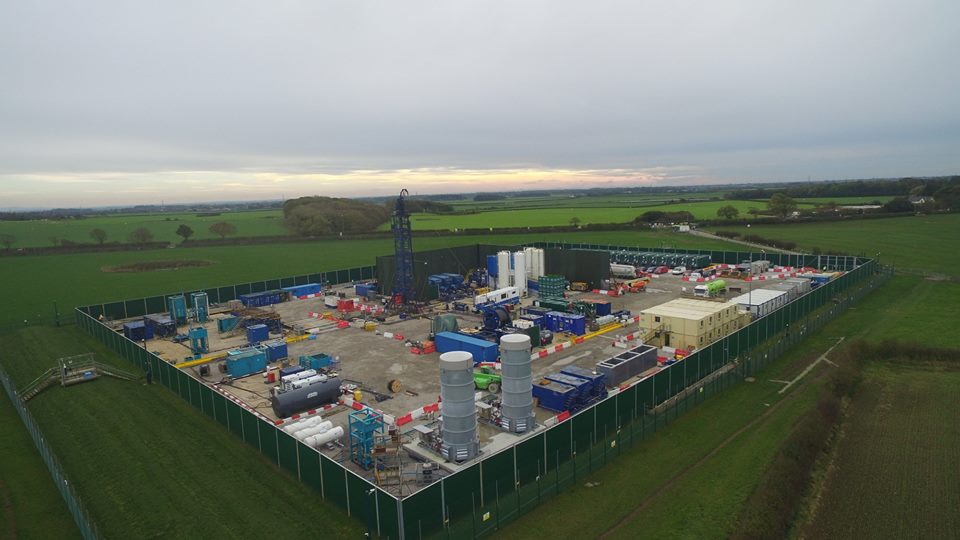
Cuadrilla’s Preston New Road fracking site, 31 October 2018. Photo: Eddie Thornton
The fracking company that warned today it was “about to choke” from regulations on earth tremors worked with government officials six years ago to develop rules that were stricter than those used in other countries.
Francis Egan, chief executive of Cuadrilla, complained in the Financial Times that the UK shale gas industry could be “strangled before birth”. In an interview with The Times, he said “we are not getting effective fractures” and that unrepresentative results could “turn off investors”.
Last week, Mr Egan told the Department for Business, Energy and Industrial Strategy that the rules on seismic events triggered by fracking needed to be relaxed to make the process commercially-viable in the UK. It looks unlikely that he got the answer he wanted. The energy minister, Claire Perry, said today a change to the regulations would be “foolish” at the moment.
But in 2012, Mr Egan appeared to take a different approach, accepting seismicity thresholds “well below levels commonly used worldwide” and “a much larger factor of safety at this exploratory stage”.
Agreed earthquake limits
In a letter dated 1 November 2012, Mr Egan answered questions put to him by the then energy minister, John Hayes, about changes implemented by Cuadrilla on monitoring and controlling seismic events during fracking.
The questions were prompted by earthquakes linked to Cuadrilla’s fracks at Preese Hall, another site near Blackpool, in 2011. Two earthquakes measured 2.3ML and 1.5ML and were felt by people in the Blackpool area. There were reports of damage on the surface and evidence of deformation of the shale gas well.
Mr Egan told Mr Hayes:
“In conjunction with industry experts and your team at DECC we have developed a “traffic light” seismic monitoring and mitigation system”.
He explained that fracking would be slowed down or stopped if seismic activity exceeded pre-determined levels “such that there are no ‘felt’ seismic events at surface.”
Mr Egan said:
“The concept of a seismic traffic light system itself is not new, having been extensively used for geothermal and other projects worldwide.
“The traffic light levels set for our potential forthcoming fracturing operation in Lancashire have, however, been set well below levels commonly used worldwide to ensure that we maintain a much larger factor of safety at this exploratory stage.”
The letter did not challenge the recommendation on seismicity controls already made in a report for the Department of Energy and Climate Change on the Blackpool earthquake. The authors, Green, Styles and Baptie, had proposed a red traffic light level of 0.5ML.
In December 2012, a month after Mr Egan’s letter, the then energy secretary, Ed Davey, issued a written ministerial statement in which he confirmed the red light should be triggered by events measuring 0.5ML or above. He described this as “an appropriately precautionary approach.” DrillOrDrop report The shadow of Preese Hall
Fracking-induced tremors
Ed Davey’s traffic light system was first used in October 2018 when Cuadrilla started fracking at Preston New Road.
In the past fortnight, there have been more than 30 seismic events recorded near the site on the edge of Blackpool. Cuadrilla has temporarily suspended fracking three times when seismic events passed thresholds in the traffic light system.
So far, the largest magnitudes of tremors during fracking, as measured by the British Geological Survey, have been 0.8ML (local magnitude) and 1.1ML.
Mr Egan has called for the red light threshold to be lifted from 0.5ML to 2.0ML, which he said was used for fracking in some other countries and was below that used in North America.
He told The Times:
“We are not getting effective fractures. We are not getting enough sand into the ground to get a good test.
“We may not want to flow test it because it’s not a totally indicative representation of what this shale rock could do if tested with sensible [earthquake] limits.”
Mr Egan told the Financial Times:
“It certainly looks like it would be — I can’t say impossible — but I could say very difficult to make this a commercial venture if you had to continue operating within a 0.5 red line.”
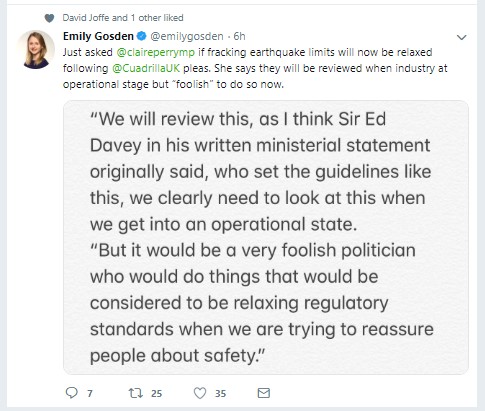
Emily Gosden, of The Times, tweeted that the energy minister, Claire Perry, looked unlikely to review the limits immediately. The minister was quoted as saying:
“We will review this, as I think Sir Ed Davey in his written ministerial statement originally said, who set the guidelines like this, we clearly need to look at this when we get into an operational state.
“But it would be a very foolish politician who would do things that would be considered to be relaxing regulatory standards when we are trying to reassure people about safety.”
DrillOrDrop asked Cuadrilla why Mr Egan offered a traffic light system “well below” worldwide levels in 2012 but was now seeking a level of 2.0ML.
A spokesperson said:
“The traffic light system was setup by DECC. Mr Egan was simply observing in the letter that the concept of a traffic light system is not new and that UK shale has a traffic light system set at far levels lower than those set worldwide. And that opinion has not changed.
“What has changed since 2012 is that we have begun fracking the first horizontal well into UK shale rock and the evidence so far is that the Traffic Light System is working, as we have said before, but the red light threshold is clearly set very low and all the seismicity created so far has a level that is way below anything that can be felt at surface and a very long way from anything that would cause damage or harm. The micro-seismic events have not impacted on well integrity and indeed the larger events at the Preese Hall well likewise did not lead to any loss of well integrity.”
The local Conservative MP for Preston New Road rejected Cuadrilla’s call for a higher red light level.
Mark Menzies, speaking in a debate on shale gas planning today, said:
“For six years the industry was not approaching me, or not approaching anyone, to say that this threshold was far too low.
“We now have calls to say that actually it needs to be a 1.5 or it needs to be a 2 in order to trigger a red event.
“I’m sorry but that ship has sailed. You had six years in order to make the case for that and no case was made.”
Categories: Regulation

 DRILL OR DROP?
AJ Lucas investors look for the exit today by the look of it. 17% in red.
UK shale investment doesnt look attractive to local investors now with all the seismic problem.
“the red light threshold is clearly set very low and all the seismicity created so far has a level that is way below anything that can be felt at surface and a very long way from anything that would cause damage or harm.”
And this is bad?
For Egan, who had developed a TLS which is “not new”, we can indeed be too safe! Words come cheaply for Egan.
Confidence in Cuadrilla is diminishing rapidly. Everyone now associates Cuadrilla with causing earthquakes and most people remember the Preese Hall earthquakes in 2011.
The announcement that higher limits are needed will have a knock on effect on the permitted development decision. No point in destroying democracy and bypassing the planning system for an untrustworthy industry that cannot operate within agreed safe guidelines.
The Government would not want this industry as a NSIP. To risky and no Conservative vote gains.
The planning arena is where anti frackers have the upper hand. We have been there many many times with our Environmental consultants, legal teams, and specialists. The decision makers in the Councils listen to what we have to say and are shown to have rejected many planning applications.
An allowance of a higher threshold would only give a temporary reprieve.
It was famously said that David Cameron refused to build more council houses as it would create more Labour voters…..
It appears he, Georgie and those that followed missed the ‘shale effect’ on voter’s choices. I’m sure the PR team who are paid to create the stories for the blues are having sleepless nights with this one; I feel a political shift coming after the Brexit fiasco and shale will be a pleasing casualty.
Reblogged this on sdbast.
He does not like it when his words and deeds come back to haunt him, just give it up a sa bad joke Francis.
Looks like Gold Standard should look.
Start a process under tight controls based upon precaution, but not experience, and then check whether the controls work well for that site from both sides of the question, as experience indicates.
As the antis have been nattering on for several years about the unique geology in the UK, one would have expected that as this unique geology was fracked then the experience was incorporated into current and future plans ie. how the real world works.
Oops-just seen the flaw in that.
Certainly wouldn’t expect many MPs to recognise that either. Not many of them have been out in the real world yet-which is why they will fight boundary changes, as the thought of that is such a nightmare to many of them.
The so called elusive Gold Standards
Are now are shown to be Cold Standards
Then will soon be Fold Standards
That are fast becoming Mould Standards
Then are revealed to be Null Standards
Along with the unaccountable Old Standards
Then will become Sold standards
Then that will result in Dole Standards…..
Then that will result in Bald Standards ???????Maybe???
….taxi for TW…..
Ah, poor Francis, now too scared to give an interview on local radio this morning and sent his sidekick Lee Petts, The Shadow Chancellor however, who has visited the site, gave an excellent interview as to what is so wrong with the entire process of fracking.
Ahh, a politician who knows more about the process of fracking, than those who conduct it.
Next, he might try the same regarding taxation. Ohh, he did this week. Shame it was so contradictory with the policies of JC, and was exposed yesterday.
In other words, they make it up as they go along
Reblogged this on Wessex Solidarity and commented:
Strangle the fuckers before they kill us all.
Look like Cuadrilla has given up fracking today.
Cuadrilla knew about the traffic light system in 2012. In fact they had a hand in formulating it. And now as soon as they get going they don’t like it. Well that’s tough.
Cuadrilla has given government a ‘Get Out Of Fracking Free’ card. No need to change government policy, no need to go against manifesto commitments, just let the industry fail under the regulations that the industry helped to write.