
Gas flares at Cuadrilla’s fracking site at Preston New Road near Blackpool, 2 November 2018. Photo: Cuadrilla Resources
A publicity video used by Cuadrilla as evidence of the first shale gas production from its site in Lancashire may not be quite what it seemed.
The company sent up a drone to film a burning flare stack at the site near Blackpool in early November 2018.
It released the news to the media, describing the development as “significant” and “a good early indication of the gas potential that we have long talked about”. The pro-fracking group, Lancashire for Shale, said the gas flow was a “real credit to the expertise and tenacity of Cuadrilla”.
But an official document released this week reveals that the volume of gas reaching the surface at Preston New Road at the time was so low that the company had to feed in propane as a support fuel to light the flare.
Opponents of Cuadrilla’s operation had been sceptical about the 12-second video and the volume of gas in the well.
This week, the Environment Agency confirmed that the volume of gas coming to the surface was “very low” and that the day before the video was released methane was released unburnt into the atmosphere.

Extract from Environment Agency report, 2 November 2018
The details are in a report of a site inspection by the Environment Agency on 2 November 2018. The document, called a Compliance Assessment or CAR report, said:
“On the 1st November gas was sent to the flare from the separator. The gas was not burnt at the flare on this occasion due to the very low volume of natural gas. The gas was picked up on the onsite monitoring instruments at very low levels (5ppm over ten minute period).
“We acknowledge that the level of methane detected was significantly below anything that would have an impact on human health or constitute a risk of explosion and there was no environmental impact. Gas was managed in this way for safety purposes and does not constitute a breach of the permit.
“On the morning of 2nd November gas was again sent to the flare from the separator. On this occasion a support fuel (propane) was used to assist combustion. There was no visible increase in methane emissions on the boundary monitoring equipment.”
DrillOrDrop asked Cuadrilla what were the volumes or proportions of shale gas and support fuel burned in the flare on 2 November 2018. We also asked why Cuadrilla had not mentioned the support fuel in the press release and how long the company had continued to use a support fuel in the flare.
A spokesperson for the company said:
“As you are aware, we are now in the flow testing phase at Preston New Road and will look to publish results in due course. We are very encouraged by what we are seeing but are not providing a daily commentary on testing.”
The campaign group, Frack Free Lancashire, said today:
“It would seem that Cuadrilla’s woeful PR campaign has fallen flat on its face yet again. In November, desperate for some good news after provoking a series of earthquakes, they published a video showing the flaring of gas from their first well.
“Widely ridiculed at the time, as it only lasted a few seconds before being seen to have petered out, we now learn that far from being a “significant” find, this gas flow was so weak that they had to add patio gas to it to make it burn. No further comment is really needed, is it?”
There are several options for dealing with gas during flow testing. It can be piped into the gas grid – as Cuadrilla plans to do during the extended well test at Preston New Road. It can also be flared or – usually in emergencies – vented to the atmosphere.
The Environment Agency said in the CAR report:
“We are currently reviewing what is best practice including the benefits of using a support fuel to assist the combustion of very low levels of natural gas against the management of natural gas without combustion through the flare.”
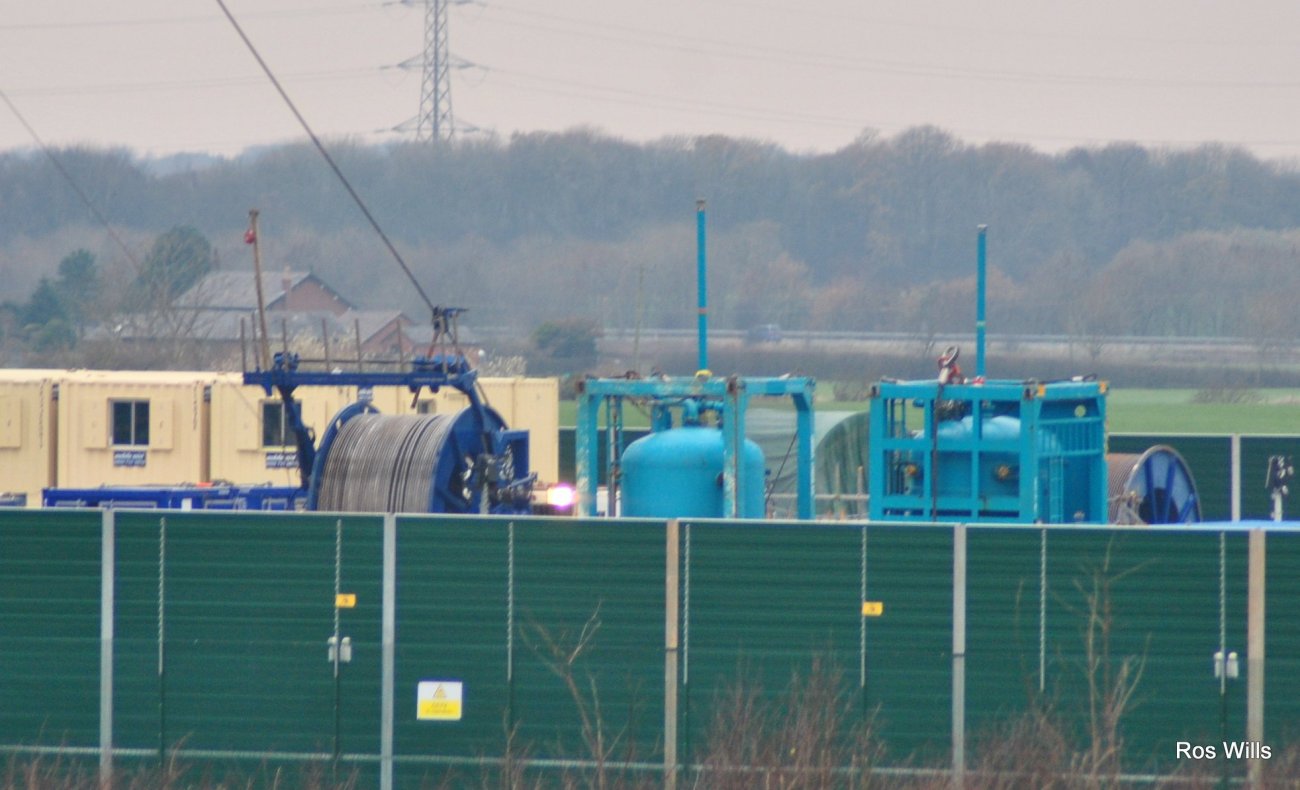
Preston New Road, 21 November 2018. Photo: Ros Wills
The gas flow press release came after a difficult fortnight for Cuadrilla.
By 2 November 2018, fracking at Preston New Road had already caused more than 30 earth tremors.
The company’s Australian partner, the mining group A J Lucas, had seen its share price fall since the start of fracking on 15 October 2018. By 2 November, the price had dropped from 0.39 to 0.26 Australian dollars.
Cuadrilla’s chief executive, Francis Egan, told the Financial Times on 30 October that UK rules on fracking-induced seismicity – known as the traffic light system – were too strict. The country’s shale gas industry could be strangled, he said.
He called for an urgent raising of the limit at which fracking should pause from 0.5ML (local magnitude) to 2.0ML.
But the energy minister, Claire Perry, responded on 31 October that this would be “foolish” while the government was trying to “reassure people about safety”.

Extract from a letter by Claire Perry to Francis Egan, 2 November 2018
It has since emerged that she also wrote to Mr Egan on 2 November, saying:
“I note that your Hydraulic Fracture Plan was developed and reviewed over several months with reference to existing regulations, including the traffic light system and at no point did you communicate that it would not be possible to proceed without a change in regulations”.
She concluded the letter, released this week in response to a freedom of information request, saying:
“The Government believes the current system is fit for purpose and has no intention of altering it”.
The A J Lucas share price rose rose after the press release, reaching 0.31 AUD on 5 November 2018 but since then it has fallen to 0.20 AUD today.
Categories: Industry

 DRILL OR DROP?
Reblogged this on sdbast.
Cuadrilla lying to the public again. What a surprise.
Ellie is clueless again – what a surprise
Comment from Cuadrilla:-
Just for info, we use propane to ignite the flare in a similar way to your pilot light in your boiler. Natural gas from the reservoir beneath PNR has been flared at the site on several occasions since the beginning of November.
John Harrison. Evidence please. If natural gas from the reservoir beneath PNR had been flared at the site on several occasions since the beginning of November, Cuadrilla would have been shouting it from the rooftops.
Is Judith Green in charge of the cuadzilla PR debacle? After all she always thinks it is the public who are stupid so perhaps thought she could get away with hiring a bottle of gas to fool everyone.
It certainly gave us a laugh tonight in the pub reading her rants.
AD – yep – pretty clear you’ve been drinking
If you are in PR your response says it all.
Reading your posts in the pub now Judith! Fame first, maybe fortune will follow.
Perhaps they were drowning their sorrows after Dr. Benny Peiser, director of the Global Warming Policy Foundation, said ” If Britain had stuck to its move towards natural gas and nuclear energy you could have reduced carbon emissions for half the price”.
Quite easy to see what worries the antis when they are so keen to show it. Think it is called reality.
Just hope their pub, (“The Alternative Engineer”?) was not cooking any food with the old red diesel. After all, that’s why it is red! (You need to have been there.)
AD – Judith doesn’t realise that her patronising posting is part of Cuadrilla’s problem. Long may she carry on!
AD-Refracktion doesn’t realise his patronising posting around PNR, that he visits in his diesel BMW is part of the anti’s problem. Long may he carry on, and on, and on….
More Collywibble from Mr Duracell 😂
PS – antis’ not anti’s please
Didn’t think you recognised batteries, reaction, unless someone else paid for them!
I always have time torecognise the ones that go on and on and on Mertin
But not to invest in them, reaction!
“Do as I say, not as I do”. Obviously not a believer in the UN report, with respect to personal actions. Calculated the carbon footprint of a bottle of Shiraz yet? How much brown coal to manufacture a BMW?
I wasn’t aware ‘d told you to invest in batteries Marton.
You’ll be telling me Syrha is different from Shiraz next. Oh no you already did 😂
Hilarious, difficult to believe anything cuadrilla says! Appear to have become a bit of a joke, as has Judith!
IMMEDIATE……… FOSSIL FUEL PHASEOUT , could arrest climate change – study
https://amp.theguardian.com/environment/2019/jan/15/immediate-fossil-fuel-phaseout-could-arrest-climate-change-study
JackTL
That course of action is something we could all follow, but with difficulty I guess.
Very unethical conduct if it is true. Cuadrilla is desperate and all hype.
Uncanny resemblance to what happened at West Newton A when the flare system didn’t work and gas was released. Rathlin couldn’t come up with a solution which is why EA would not permit work at Crawberry Hill. All this only revealed by actions of Protectors.
Proves regulators do not monitor problems and the industry relies on secrecy and spin. Close the frackers down.
Jon and Val
Closing down fracking would not address your concerns regarding the suitability of the Rathlin flare to burn the heavy ends that went through it ( see past DOD reports ), nor issues with the extraction of conventional gas and conventional oil onshore or offshore in the UK.
Fracking may not work in the uk shale, but this does not affect existing and future small scale onshore gas fields here in the uk.
Had Rathlin had a gas as low in such heavy ends as Cuadrilla has ( it seems ) then they would not have had the odour issues one suspects.
Well, the drinks seem to have been working!
The record shows when flow testing started-long after this little event. I wonder what the response would have been if they had flared much greater quantities of gas? You just have to look at the discussions at the IGAS Appeal.
There have been many posts and discussions regarding what is needed for the flow test to begin. Cuadrilla have been quite open on that.
If some, including DoD, wish to ignore all of that for their own purposes that’s understandable, but please do not believe others who have been keeping an eye on this, including any investors, are not aware. Jumping the gun.
But, of course, if some-like Jono- are that fascinated by flow tests then have a look at the latest data from HH, issued today. Sorry Prof., your speculation is looking to be exactly that, but looking at some of the posts here, you are in “good” company.
The fact that the EA says “no environmental impact” shows how they are no longer an impartial protector of our environment. All methane emissions have an impact and the relevant question is about how much.
Not to worry Chris, Donald will drain the swamps and that will deal with much of the methane! Shame about the amphibians and reptiles.
It seem there is more gas from the pros than in Cuadrilla’s well; well, well 🙂