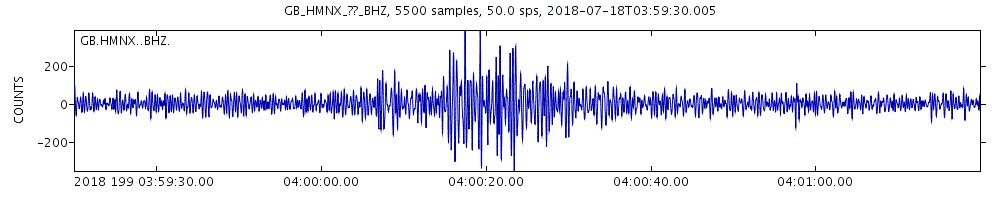
Chart of the 18 July 2018 Newdigate earthquake. Source: Stephen Hicks
As geologists continue to disagree about the cause of the Surrey earthquakes, a local MP has urged the government to investigate any link with oil operations.
Crispin Blunt, who represents the area around the Horse Hill wellsite, said today:
“There now needs to be another detailed independent examination of the evidence”.
He also said he would call for a moratorium on oil exploration and extraction in Surrey if the strength and frequency of tremors increased and if a local oil company failed to provide relevant information.

Mr Blunt (left) was speaking after people across the county and beyond were woken up by a 3.1ML (local magnitude) earthquake early on 27 February 2019.
This was the most powerful of the 24 seismic events affecting the Newdigate area since 1 April 2018. 11 of the tremors have been felt by local people.
The swarm continued through last summer until 19 October 2018 . It resumed on 14 February 2019, with a 2.4ML event, followed by a 2ML on 19 February, both of which were also felt. DrillOrDrop page on details of the Surrey swarm
The MP’s comments follow denials by oil companies that their operations cause the quakes and contradictory studies by geologists.
In November 2018, the report of a workshop organised by the Oil and Gas Authority (OGA) concluded that there were no links to oil and gas sites.
In February 2019, one of the participants in that workshop and two colleagues from Edinburgh University, concluded that oil exploration at Horse Hill could have triggered the earthquakes. They called on the site operator to provide detailed records of operations at the site. They also predicted:
“future oil exploration and production close to critically-stressed faults in the Weald is likely to result in similar earthquake events”.
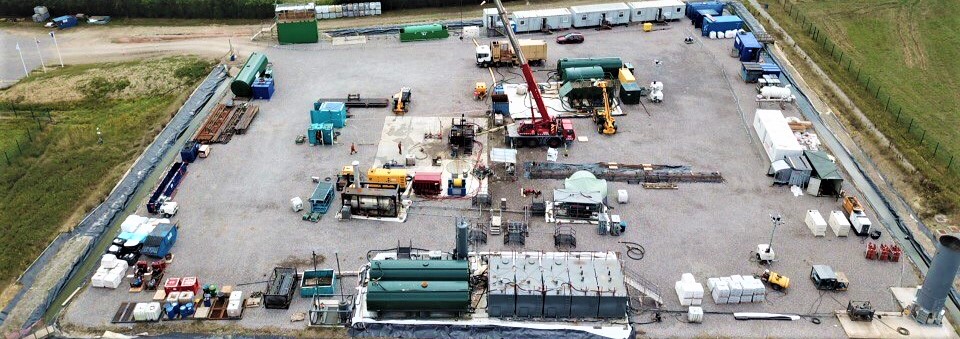
Horse Hill oil site near Gatwick Airport, October 2018. Photo: Used with the owner’s consent
This week, UKOG, the major investor at Horse Hill, gave details of a paper going through the peer-review process by another group of geologists.
This proposed an alternative screening system to assess whether earthquakes were natural or induced by human activity. The authors, who included two participants in the OGA workshop, concluded that events in the Surrey swarm up to August 2018 were natural and not caused by operations at Horse Hill or another local site at Brockham.
Today Mr Blunt called on his website for an independent investigation. He said it was needed to establish:
- Scientific proof or probability of a direct correlation between recent local seismic activity and oil exploration
- The likelihood of continued further seismic activity with or without ongoing local oil exploration
- Whether or not local people should be concerned about future seismic activity both in terms of frequency and strength.
Mr Blunt said:
“I have also written to the Secretary of State for Environment, Food and Rural Affairs [Michael Gove] reminding him that evidence connecting recent local seismic activity to oil exploration activities at Horse Hill and Brockham remains inconclusive and urging his Department to investigate categorically whether or not there is a causal connection.”
He said he wasn’t calling for an immediate moratorium because the strength of the tremors was “not sufficient” and there was no conclusive link to activities at Horse Hill and Brockham. But he added:
“I would plainly urgently review this position if I was made aware of authoritative advice that earthquakes at this strength should be a cause of serious concern.”
He added:
“I would be in favour of calling for an immediate cessation of oil exploration and extraction activities at Horse Hill and Brockham, if i) local earth tremors increase in strength and frequency before an independent examination reaches its conclusions, and ii) UKOG fails to produce information relevant to the examination.”
The MP said:
“we do need reassurance about the medium and long term implications and we must enable independent experts to examine all data they deem necessary and we must expect UKOG to provided what they have and indeed assist if more is needed to make conclusions more reliable.”
How to tell whether earthquakes are natural
The OGA workshop assessed the cause of the Surrey earthquakes using the Davis and Frohlich Criteria, developed in the United States. This system asks a series of questions, which if answered yes, suggest the earthquakes were likely to be induced, rather than natural.
An alternative system was proposed in an unpublished paper submitted to the journal, Seismological Research Letters, but made available this week. Link to paper
The authors, Dr James Verdon, of Bristol University, Dr Brian Baptie, of the British Geological Survey, and Professor Julian Bommer, of Imperial College, suggested slightly different questions.
They covered:
- Have there been previous earthquakes?
- Did seismic events happen at the same time as operational activities?
- Were seismic events linked to injection or extraction?
- Were the earthquake epicentres at the same depth as operational activities?
- Were the epicentres and the operations nearby?
- Is there a plausible mechanism for the seismic events?
- Do source mechanisms indicate the seismicity was induced?
Rather than yes/no answers, they scored the questions based on the relative importance of the issue and the certainty of the evidence.
This gave two scores:
- Induced Assessment Ratio (IAR) – whether events were induced (positive) or natural (negative)
- Evidence Strength Ratio (ESR) – based on the strength of the available evidence (high for robust; low for ambiguous)
The paper used as case studies the Surrey oil sites of Brockham and Horse Hill, based on 18 earthquakes between April and August 2018. The academics said they used information provided by UKOG about Horse Hill and published data about Brockham.
They calculated the Induced Assessment Ratio for Brockham was -33% and for Horse Hill (described as HH-1) -79%. The Evidence Strength Ratio was 92% for both sites.
The paper concluded:
“The negative IAR values indicate that neither Brockham nor HH-1 is a likely cause for these events, and they are therefore natural, although the evidence against Brockham as a cause is more ambiguous than the evidence against HH-1 as a cause.
“The high ESR value indicates that this judgement is robust, and that most of the desired evidence is available.”

Earthquake near Newdigate 5 July 2018 Source: British Geological Survey
Debate continues
UKOG said it had “fully cooperated” with the Verdon research and “provided the data necessary for analysis”.
It added:
“As a responsible and ethical organisation with employees living in the area, UKOG will continue to work with and provide necessary scientific data to such experts”.
But the conclusion of the Verdon paper has not settled the controversy about the cause of the Surrey earthquakes.
The judgements on scoring remain open to interpretation, which was a criticism of the Davis and Frohlich system, and the IAR still benefits from full information release.
The paper appears not to have considered the 11 earthquakes or wellsite operations since August 2018. There remain questions over when site operations began at Horse Hill in spring 2018.
The paper gave a maximum negative score to both sites on distance from the epicentre, even though Horse Hill was about 2km away.
On the question of depth, the Verdon paper said the earthquake epicentres at 2km were “significantly below the production horizons at Brockham and Horse Hill. But the British Geological Survey’s online database records the depth of the first 13 earthquakes at 1km.
On previous seismicity, the paper scored -5 for both Brockham and Horse Hill because it said there had been an earthquake 15 miles (as the crow flies) away at Billingshurst in 2005. Other researchers have pointed to the absence of earthquakes in the Newdigate area in living memory.
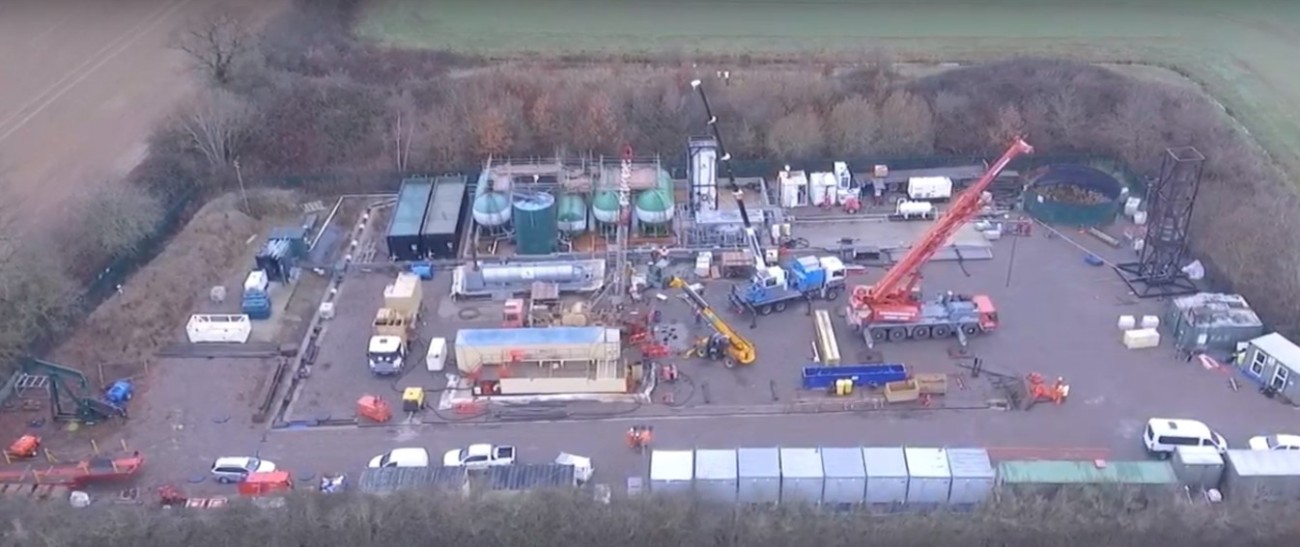
Angus Energy site at Brockham, Surrey, on 16 December 2018. Photo: Brockham Protectors
Ada Zaffina, of Brockham Oil Watch, said:
“The report only refers to waste water reinjection and flow testing operations, but doesn’t give any attention to pressurised injections of acid-based fluids. Those are permitted at both sites, but because they are intended to be kept at below hydraulic fracture pressure, none of the regulators require any monitoring of the volumes, pressures or timings.
“The traffic light system [regulation on fracking-induced seismicity] doesn’t apply here either, meaning there is no protocol for evaluating potential links between injections and seismicity.
“We believe that anything that has the potential to change the downhole pressure, either to increase it or to decrease it, could induce seismicity. And if that is correct, then even activities such as an acid wash under a pressure slightly greater than formation pressure could be responsible for earthquakes. And even more so if the acid is applied at a greater pressure.
“There are also concerns about the quality of data. The report refers to monthly injection and production data publicly available for Brockham, but the monthly totals seem not granular enough for a meaningful analysis, and in any case, the numbers still haven’t been verified after inaccuracies had been pointed out.
“Even if Brockham is not the culprit, this highlights the fact that some of the analysis is based on inadequate and unreliable data collected by a regulatory regime based on industry self-monitoring.”
James Knapp, of Weald Action Group, said of the Verdon paper:
“Introducing this added level of complexity will do nothing to help public trust when even the simpler Frohlich method of determining whether the earthquakes were man made could be so easily distorted by the simple trick of ignoring the existence for Horse Hill well, 3kms from the epicentres and drilled through the fault.
“In the letter to the Secretary of State which preceded the OGA workshop, the academics concluded ‘In the interest of safety, best practice also requires that a respect distance is made mandatory when drilling near faults.’
“In contrast the principle author of this new paper, Dr. James Verdon, also known as @TheFracDoctor, wrote a paper for the OGA arguing against having a mandatory respect distance for drilling near faults, ironically the very thing that would have helped Surrey residents sleep well in their beds at night.
“This paper ignores the Edinburgh investigation that looked into Horse Hill as a possible cause and which uncovered the existence of continuous pressure increases during the 2016 well testing, which were resolved by periodic venting until the well was shut in when well testing permissions ran out. The operator returned to work on the well site in March 2018, their work on the plinth and well cellar construction coincided with the start of the Swarm and pointed to the trigger being the sudden release of long built up gas pressure.
“So it’s disingenuous for the authors to be basing their tests on the start of the main flow test in July 2018, as they do here. Post dating the start of operations makes either method of assessment invalid.”
9/3/19 End date of first swarm corrected to 19th October 2018
Categories: Research

 DRILL OR DROP?
Why not listen to the seismologists rather than activist scaremongers?
cant you read ? This is because of the work of seismologists ! ” In February 2019, one of the participants in that workshop and two colleagues from Edinburgh University, concluded that oil exploration at Horse Hill could have triggered the earthquakes “
Jono – Stuart Haszledine is not a seismologist. He is a geologist who knows very little about seismology. If you loke at the volumes of fluid injected in that well and take into account the distance between the week and the fault then it’s quite easy to calculate how there is no way that the operations are connected to the tremors
For readers interested in facts;
1. The Edinburgh hypothesis has absolutely nothing to do with injection from Brockham.
2. The disagreement is not over the seismology, but in whether the existence of the Horse Hill well should be considered as a possible cause in the Davis Frohlich test at all.
3. Seismology is a branch of geology, if you can drive a truck you can drive a car, but not the other way round.
Dorkinian, the whole point about whether to consider the Horse Hill well is just as much to do with injected or produced volumes as it does to the distance from the well to the reactivated fault. There are many examples, most of which are not in the public domain, where industry has observed coupling between operations in one well and production rates in a very distant well (I.e. up to 20 kms). However, in all cases many orders of magnitude more fluid has been injected or produced. This isn’t the case in the Horse Hill case.
The analogy between geology and seismology is silly. In know many good seismologists who are pretty clueless about most areas of geology. However, most geologists are totally clueless about seismology. In this case, it’s the seismologists to accurately locate the events but one needs skills in poro-elasticity and possibly poro-plasticity to assess whether the events could be cause by operations in the Horse Hill well.
Judith,
Please check your posts for grammatical errors.
We all make them when caught up in the moment but your posts contain that many I sometimes wonder if you have the education and knowledge you claim.
This post has been up for many hours now and remains incorrect.
Peter, I could see why you would jump to that conclusion as many of the anti-frackers don’t seem to be too good at thinking outside the box. However, the fact is that the typos are simply due to me forgetting may glasses yesterday. Even if the mistakes had not been due to my lack of glasses and open minded person might have wondered whether English was my first language or whether or not I was dyslexic. However, not being particularly open minded you jumped to the conclusion that suited your agenda – I can’t say that I’m particularly surprised given the fact free nature of most of your posts.
Wont be long now , time to sell up .
All geologists are educated in Universities supported by the oil and gas industry. It is extremely unusual to find a geologist who has not worked in the industry or in the case of academics is not reliant on industry funding. Obviously the whole system relies on the industry because geology would not be studied if there were no well paid careers in oil and gas. It seems naive to take what they say on trust Martin especially when the facts remain secret because of commercial sensitivity.
I’ve seen this kind of weighting and scoring method used before: “Problem Solving & Decision Making” by Kepner Tregoe, also known as Rational Decision Making. And I’ve seen it abused. It is simply too easy to fudge the weightings and scores to get the result you want, whilst convincing yourself and others that you’ve made a rational decision. For how can it be ‘rational’ when both the questions and their weightings are subject to the opinions of the people who then give a score to them.
Crispen Blunt – arch conservative (and ex military/Sandhurst) is one of the least likely people to be influenced by activist scaremongering that I can think of. The call for an independent evaluation seems entirely reasonable.
Good job there has been one, then, PhilipP.
Keep asking the same question until you run out of experts to assess, and end up with an answer that satisfies the non experts? So, you would have to find a group of seismologists with no connection to the oil and gas industry? Hmmm-they would be pretty expert! (Bit like saying find a group of medical consultants with no connections to the pharmaceutical/medical devices industries, or marine biologists with no connection to commercial fisheries.)
Yep. The anti scientific approach. A lot of it about.
Local MPs are influenced by what they think will get them elected next time. That’s one of the reasons why certain areas get investment that would be better placed elsewhere. Shock/horror.
Or rather a truly scientific approach Martin rather than a bankrolled one (by the industry). The industry has shown a history of lobbying hard to to get regulations relaxed or removed – the Trump era is the brought this to the fore, in the extreme. Have you noticed how keen Cuadrilla has been to get independent monitoring of emissions stopped?
Really? Lobbying is not being conducted by the antis? Bankrolling-yep, that too.
Whilst I can understand some antis wanting to remove scientific appraisal by saying, when it is done, they don’t like it. You only have to look at the “experts” who post on here and then it is pretty clear that is not the route to go.
Government and decision making by Giggle! (And sometimes an inability even to Giggle.)
The proposals are becoming more ridiculous by the week. I wonder why?
Yes really Martin. I’m afraid your schoolboy attempts to belittle professional research – as informed only by ‘Giggle’ – are beneath a serious response. Of course there has to be sources of funding for anyone to challenge those vested interests whose profits and bottom lines are not best served by interest of the public realm, or the environment, and the regulations put in place to protect them.
Sauce for the goose is sauce for the gander then! So, why lack of scrutiny regarding the goose sauce?
Contrary to your waffle PhilipP, it is you who wish to belittle the professional research which has already taken place. It didn’t meet your “expert” opinion ie. it did not produce results to match your wishes, so, you want to find a mechanism where the research will be a little less professional, may match your own “expert” opinion and fulfill your wishes.
Why not try Tarot cards? I am sure there is some validation for the technique somewhere within Giggle. (I should invest in some quickly as I think they are next on the list of “all options on the table” for the alternative Brexit, and may be hard to get.)
Barrel – bottom – scrape. Nothing left to say, but keep ‘digging’ if you like (to mix only two metaphors).
No barrel bottoms to scrape here, PhilipP. They are all full of oil.
Reblogged this on sdbast.
These conclusions are too subjective and too dependent on the input from the companies operating the wells. Until ALL site and well logs are made available for public scrutiny it is a waste of time. And it doesn’t address the only question that we locals are interested in. Given there are earthquakes occurring, given they are shallow and have a large intensity at the surface, is it recommended to give HH permission to go into full production with 6 wells using acid stimulation and allow water injection via a seventh well. As a lay person I would say it would be madness. I would also make the point that at Groningen a series of earthquakes, non larger than 3.6 (and we are at 3.1) have damaged 100,000 homes with an estimated repair bill in excess of €1 billion
PeterM – the causes of seismicity in Groningen are well known and they have zero to do with fracking. Most of the damage in Groningen hasn’t in fact been caused by earthquakes but is due to subsidence and poor house construction. The 1 billion repair bill is nothing compared to the income the Netherlands has received from the sale of the natural gas.
How about addressing Peter’s main point Judith? i.e. the strength of those earthquakes in relation to potential damage. The linkage to HH is moot.
Did I mention fracking? I understand the reason for earthquakes is different but the end result is an earthquake of relatively small magnitude causing damage to buildings. As for poor house construction, I understand it is the brick built houses that suffer the most damage. And you are right, the Dutch Government, ExxonMobil, and Shell have made a fortune but they are very slow to compensate. Do you think UKOG would be in position to pay compensation in the event of structural damage in Newdigate and the surrounding areas? Since you seem to understand these matters, please could you address my major concern. Is it wise to press ahead with production from 6 wells, with acid stimulation and with water injection in a 7well?
PhilIP – there is no reason not to go ahead with operations. Acidization is a standard and perfectly safe operation. It is undertaken all the time in places that have a massive amount of natural seismicity (e.g. California) and doesn’t cause any propblems. The amounts of acid to be injected are very small and the impacts on the faults that have been active will be nonexistent.
Judith, interesting you mention California, where acid stimulation at ANY pressure is regulated in exactly the same way as hydraulic fracturing, and acid fracking apparently uses more water than hydraulic fracturing (Khadeeja Abdullah, Acidizing Oil Wells, 2016). The regulations require both a notice to the regulator and a notice to people living in the vicinity of the well so they can do pre and post monitoring of water quality in their wells.
Don’t confuse acid fracking and acid wash / acid matrix stimulation.
You are correct in that acid fracking uses large volumes of water – that it is how it works, the acid is pumped above the matrix fracture pressure and into the open fractures to etch them out so that when the pressure is removed the fractures remain open.
Not sure this process has been used onshore UK – effective in limestone and some dolomites, preferably with existing natural fractures.
Paul, do you mean don’t confuse acid fracking/matrix acidising with acid wash. That is how the CA regs are looking at it and indeed our own EA, although they don’t have any specific definitions or monitoring.
No BOW, I meant exactly what I said. We don’t live in California – fortunately. Stimulation techniques are generally split between above fracture pressure and below fracture pressure. I have managed and executed all of them (except on shale) so do have a fairly decent understanding of the issue. You generally use similar equipment for wash and matrix and another set of equipment for acid frack / proppant frack.
https://www.glossary.oilfield.slb.com/Terms/s/stimulation.aspx
https://www.glossary.oilfield.slb.com/en/Terms/a/acid_stimulation.aspx
https://www.glossary.oilfield.slb.com/en/Terms/a/acid_frac.aspx
https://www.glossary.oilfield.slb.com/en/Terms/a/acid_wash.aspx
Perhaps in California they categorise stimulations by those that inject fluid into the formation vs those that don’t, although the acid washes I recall doing included sqeezing the acid into the nearby well bore formation but small volumes.
I recall I did use acid treatment at Stockbridge in Hampshire with Amoco on the Great Oolite but I think this was below fracture pressure i.e. a matrix job.
No need to worry because they are all low risk (other than to the operators directly involved with mixing who wear suitable protective gear).
OK, but it’s the UK that is meant to have the most robust onshore regulations in the world not California. Also you’re referring to acid jobs on conventional geology, which the Kimmeridge is not. There’s been also some 200 fracking jobs in the past on conventional reservoirs in UK – those are not even properly recorded anywhere because they were not seen as an issue.
Gatwick Airport in relation to potential damage?
If you wish to speculate, why leave it with oil/gas?
If you want decisions to be fact and science based, then ask the experts to examine the issue. They have.
“•Scientific proof or probability of a direct correlation between recent local seismic activity and oil exploration”
What does this mean?
It may be that a frack or acid wash triggers a local seismic event and that certainly needs to be thoroughly investigated. If the industry is confident they will release full details of their activities. Commercial sensitivity is not a reasonable defence of secrecy if the industry claims that science proves there is no risk. Science cannot be conducted in secret.
Alternatively “Scientific proof or probability of a direct correlation” must also look at the cumulative impact of fracking and acid washes because the history of Oklahoma suggests that seismic activity increased to unprecedented levels over many months.
This suggests a cumulative impact as the chemicals involved fracture and lubricate boundaries between strata and make it more likely that pressures within strata are released in seismic events. The trend towards a gradual increase in seismic activity over the weeks after fracking and acid washes started in Lancashire and Surrey hints at a possible cumulative effect which would have to be measured over months and years rather than the simple exercise of correlating a particular activity to a particular seismic episode.
It would be misleading to claim that the lack of immediate links between an operation by the exploration company and a seismic event is conclusive proof that fracking and acid washes are harmless; cumulative impact must also be studied.
Sorry Jon. I am sure you are an expert in your own orbit. However, I think I will trust seismologists who have already investigated this rather than a cobbled together version without access to the key information.
Fracking in Lancashire is supposed to trigger seismic events-that is the purpose of it. Your attempts to conflate that and the Weald demonstrates you are somewhat adrift from the seismologists in your understanding, or you think some others may become excited.
Strange road to go down, as your “logic” would also propose that a seismic event is NOT conclusive proof that fracking is harmful. “Cumulative impact must also be studied.”
Rock on Cuadrilla. Ten years time you can be judged!
You are funny Martin (sometimes).
Fracking in Lancashire is supposed to caused seismic events? Really?
That’s not what Cuadrilla spouted when they denied any responsibility for the swarm of earthquakes that struck the Fylde when fracking at Preese Hall!
Anyway they’ve agreed to certain limits that they cannot adhere to at PNR and now they’re crying.
Oh and don’t forget that the build up of damage deep below ground is the reason for these limits, that’s what caused the well problems at Preese Hall, not the numerous melons being dropped in the surrounding fields.
Quote of the year from Martin “Fracking in Lancashire is supposed to trigger seismic events”. It’s a whoppa.
Judith’s slip is also revealing … not noticing that fracking wasn’t mentioned. Critics in the past have been flayed for equating acid washes with fracking. Was Judith doing so inadvertently? It will be interesting to see how they cover their tracks. I’m enjoying this thread.
Really, PhilipP? It’s a whoppa? No, it is the truth, and perhaps to you, that makes it quote of the year. Somewhat different.
Please explain how it would be possible to break open the shale below ground without that energy being recorded by extremely sensitive instruments on the surface? There are plenty of physics text books but you will struggle to find one that supports your opinion. Most conform to the Laws of Physics.
Try Giggle. That may be more fertile ground.
Howler may be a more appropriate word Martin. Sorry but you did ask me to point out your mistakes … you’ve betrayed a fundamental misunderstanding of the aim the fracking process in shale formations – which is to enlarge and prop open naturally occurring fissures and boundaries within the shale (where the target gas is), not to release energy stored in faults by making them slip against each other (seismic events), or to create new events. Faults are bad news for shale drilling and fracking and serious ones have to be worked around or bypassed where possible, particularly where they are pre-stressed. Why would the industry go to so much trouble with the imaging? They often cut across strata as well, therefore offering potential pathways for vertical methane and frack fluid migration.
“Fracking in Lancashire is supposed to trigger seismic events-that is the purpose of it.”
What have you been putting in your pipe Martin?
If like on the Fylde before Cuadrilla turned up earthquakes were virtually unknown, the liklihood us that a new industrial operation is to blame.
Eventually Cuadrilla accepted the blame for the earthquakes around Preese Hall despite vigorous denials for several months.
This time around Cuadrilla haven’t even attempted to deny responsibility, just gone off site in a huff!
Mind you they’ve burnt through lots of investment in the meantime and continue to do so in the false hope that they can persuade the regulators to increase the permitted earthquake strengths.