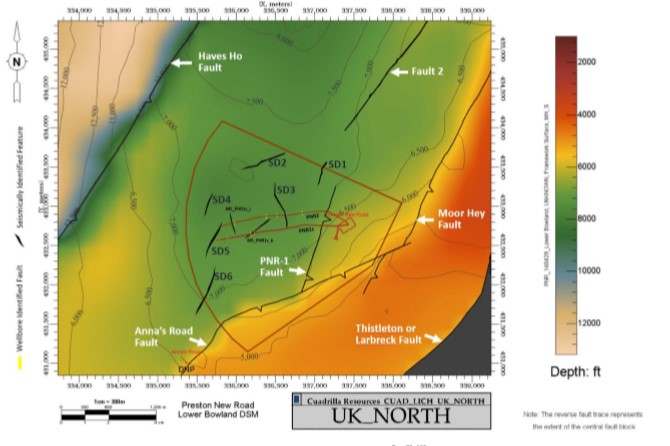
Map of faults near PNR2. Extract from Cuadrilla’s hydraulic fracturing plan for PNR2, 17 June 2019.
People living near Cuadrilla’s Lancashire fracking site have said there are “serious and fundamental errors” in the company’s interpretation of local geology.
Preston New Road Action Group, which opposes operations at the site near Blackpool, has sent a lawyer’s letter to the Environment Agency (EA) about its concerns.
The EA is currently considering Cuadrilla’s hydraulic fracturing plan for the second well at Preston New Road, PNR-2. Cuadrilla said last week it expected to begin fracking this well by the end of August.
The group challenged a previous version of the hydraulic fracturing plan for PNR-2 in November 2018. But it said the Environment Agency did not respond beyond an acknowledgement. Cuadrilla later withdrew the document.
Barrister Estelle Dehon, acting for Preston New Road Action Group (PNRAG), has now asked the EA to confirm by 16 July 2019 that it will consider concerns about the revised version of the plan before any decision is taken on it.
She has also asked the EA to provide any disagreement with the assessment of geology submitted by the group within 28 days.
Fracking plans
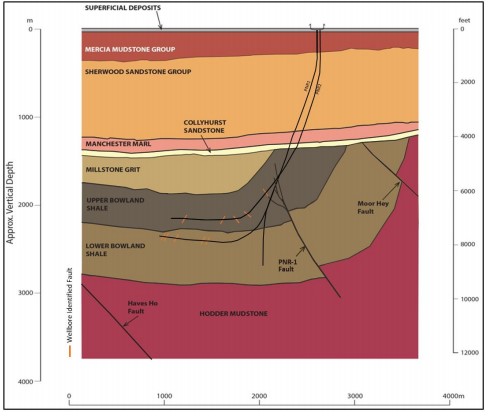
Section of the PNR-1, PNR-1z and PNR-2 wells. Source: Cuadrilla Resources hydraulic fracturing plan for PNR-2
Cuadrilla drilled PNR-2 to a depth of 2,100m. The well then extends horizontally for 750m into the Upper Bowland shale formation.
The hydraulic fracturing plan for PNR-2 sets out procedures for fracking, data on nearby faults, expected size of fractures and measures to control induced earth tremors.
Since submission of the original version of the plan, new data has been made publicly available. Cuadrilla also fracked the first well at the site, PNR-1z, into the deeper Lower Bowland shale.
Despite this new information and the original PNRAG challenge, the group said there were “only insignificant amendments” to the geological interpretation in the revised version of the hydraulic fracturing plan.
PNRAG said important assumptions made by Cuadrilla about the geology had been shown to be incorrect and the group’s earlier concerns still stood.
A spokesperson for PNRAG said:
“Concerns regarding the understanding of the geology around the Preston New Road Site presented in the previous version of the Frack Plan were raised with the EA.
“Since then the industry regulator, the Oil & Gas Authority, has released information which gives further clarity of the geology and also the data from fracking well 1, which all raise more questions.
“The majority of the concerns raised have not been addressed in the current version of the Frack Plan and to date we have not had a response from the EA.
“We want to ensure that the issues raised have been fully investigated prior to any approvals to frack being given. If the geology is not properly understood we face the risks of further seismic events and potential groundwater contamination”.
Key issues
A key issue centred on the presence or absence of Millstone Grit. Cuadrilla had predicted from its 3D seismic survey that this rock formation would be above the Upper Bowland shale at the PNR-1 pilot hole. But the formation turned out to be absent. Cuadrilla said this was because of geological faulting but it would be present above the PNR-2 well.
PNRAG used a report by David Smythe, emeritus professor of geophysics at University of Glasgow, to argue that Cuadrilla had misinterpreted the seismic survey data.
Professor Smythe said it would be “geologically unrealistic” to say that Millstone Grit would be present above PNR-2 when it was not above PNR-1. The company’s argument was not supported by 3D seismic survey data, he said, and cast doubt on Cuadrilla’s interpretation of the subsurface geology.
New concerns
Professor Smythe has also reviewed new data available from the Oil & Gas Authority (OGA). PNRAG said this raised new concerns about potential pathways for fluids:
- Cuadrilla and the OGA identified many small seismic discontinuities in the Upper Bowland shale near the wellbores
- Many near-vertical faults cut the Top Sherwood Sandstone Group and Mercia Mudstone Group extend to the near-surface and may feed ponds and sumps near the wellsite
- The Mercia Mudstone Group is not a homogenous low-permeability barrier to upward flow
- The PNR-1 fault, mapped as a single fault by Cuadrilla and the OGA, is actually set of faults cutting the Lower Bowland and into the Upper Bowland, some of them cutting the wellbores
The group added that fracture modelling had not been revised in the light of what was observed in fracking PNR-1z.
The letter concluded:
“We remain confident that a proper consideration of the concerns raised by Professor Smythe will lead to the EA refusing to approve the HFP [hydraulic fracture plan) for PNR-2.”
- DrillOrDrop invited Cuadrilla to respond to PNRAG’s legal letter to the Environment Agency. This article will be updated with any response from the company.
Categories: Regulation

 DRILL OR DROP?
This is completely irrelevant. The oil and gas industry works all of the time in areas where there is massive uncertainties in the geology of the subsurface and it just isn’t a big deal. The suggestion that faults are likely to provide a pathway for fluids to migrate to the surface is a complete red herring and shows a lack of understanding of fault-related fluid flow.
What are your qualifications, please Judith?
Zoe, I stated many times that many years ago I did a PhD in chemistry, which was quite orientated towards numerical modelling. I’ve since spent around 30 years working mainly as a consultant doing a range of projects related in environmental services, radioactive waste disposal, geothermal, oil and gas etc. I’ve done a lot of work on projects that work at the interface of geophysics and geomechanics.
And your credentials are?
Are you a rejected scientist or geologist?
I have checked your profile and see none!
[Edited by moderator]
Are you industry?
Are you saying all the faults are known?
Are you admiring Cuadrtlla do not see earthquakes as a problem?
That will do for now!
Would love to know who we are actually speaking too I mean it could be Elf Egan himself to be sure!!!!!
Fracky – I’m not saying all faults are known – that would be impossible given the resolution of seismic. I’m saying that one doesn’t need to know the position of faults. There have been 2 million frackjobs world wide and the only earthquake-related injury ever caused was when the Chinese stupidly fracked in an area that has a history of large destructive earthquakes. I don’t know Cuadrillas view on earthquakes but given the statistics I don’t think there’s too much of an issue.
May I clarify and add a couple of points to what has been written above? Cuadrilla and, independently, the OGA, did identify a few small seismic discontinuities near the well bores – but there are many more than they have interpreted. The frack modelling quoted in the HFP is out of date. As well as using erroneous geology it fails to predict the highly asymmetrical frack pattern as observed in PNR-1z, when all the fracks went northwards from the frack sleeves and none went southwards. A curious and unexplained phenomenon, for which I have yet to see another example anywhere.
Fracture modelling is simply to ensure that the fractures are contained within zone and there is no evidence that the fractures in PNR1-z went out of zone.
The first thing to check regarding the the lack of events located to the south of the borehole is how the microseismic was processed. There is often a 180 degree ambiguity in the location of events when detected from a vertical array of geophones with a short spacing. This can be removed by taking a more sophisticated approach to interpretation (see paper by Jones et al. – Geophysical Prospecting, 01/2014, Volume 62, Issue 1). This may well not be the explanation in this case. If not I would then look at the completion technology; Cuadrilla used quite a new completion technology and I can certainly see reasons how that could cause asymmetries in the direction in which the fracture propagated.
Either way, I don’t know of anyone who has a significant understanding of hydraulic fracture design or execution who sees issues with the approach being taken by Cuadrilla. There are no dangers to those living around the site and to suggest so is simply irresponsible scaremongering.
“We remain confident that a proper consideration of the concerns raised by Professor Smythe will lead to the EA refusing to approve the HFP [hydraulic fracture plan) for PNR-2.”
We will see. I doubt Cuadrilla would mobilise without a green light.
Paul – it might just be the case that they are quietly confident that no agency who has any power over this decision would take seriously evidence from someone who is regarded as a bit of a joke amongst not just experts in this field but virtually everyone who knows his work and has a PHD in geology, geophysics or geomechanics. His views aren’t worth the energy that it takes to relay them.
The usual sad ad hominem response from a presumed industry supporter, in place of reasoned argument. But Mr Maynard misses the point; it is not whether the EA ignores my views; the fact is that the EA (and/or the OGA) will face a legal challenge if they do.
I am only pointing out others reading the comments exactly what the rest of the scientific community think of your work – my comment is both factual and relevant. I don’t think EA will be too worried by your threats.
Please be aware DAVIDKSMYTHE
There may be some very desperate and bitter shale investors operating on here. DON’T BE INTIMIDATED.
As a point of interest……….. Have you seen the IGAS private investors, share chat page on the London Stock Exchange recently ??????
Hardly a happy bunch, anyone who questions the foundations of the company is heavily insulted . It’s like Saturday night in the Dosshouse.
Ahh, Green Jack today!
Very revealing that you take the time to read the chat page for IGAS. Have you done the same for UJO? Could it be, wrong place, wrong time?
(And you do realise there is one nasty individual under several titles (hmmm) creating most of that? You should do, we have discussed it before. Well, it might have been Blue Jack or baby jack, so, if so, apologies.)
However, if you want to be serious, than yes there will be some frustrated IGAS investors who timed their ins and outs wrong. Equally, there will be some who timed that correctly but will be less likely to post about it. Ever thus. The joys of AIM.
I would like to know your credentials to make such a statement and wonder how Ruth would allow this with no evidence?
This is about a legal challenge so unlike normal social media where you have a little power to disrupt it’s up to grown ups to make real decisions on the evidence provided by respected scientists.
Looks as if desperation cloaked as science has caused a (very) little excitement. Not new, and previously shown to be inaccurate and legal challenges previously failed.
Another Monday. Nothing new-except UK energy security less secure than it was a week ago, and more UK gas/oil supplies being open up to development. Sounds reasonable and a possibility to avoid the Yellow Vests in UK [edited by moderator]
And of course there was the cricket world cup and the British Grand Prix. Much more exciting.
Davidksmythe’s legal challenge would be good. Unfortunately it will delay the next stimulations if a JR is granted but it would be good to get all this out in the open and put it to bed. Also good to spend another load of Luxembourg money and Enemies of Industry money.
For anyone interested in the scientific studies into faults acting as a pathway for contaminants, they are discussed in this paper; https://www.solid-earth-discuss.net/se-2015-134/se-2015-134.pdf see in particular; 5. Faults as conduits for contamination of groundwater resources.
These studies led to fracking being banned in other European countries which recognised the fact that our geology is very different to the US, and fracking here is consequently much more damaging. Read the whole paper if you have questions.
No surprise that industry and it’s promotors are dismissive on this key topic and oppose a mandatory respect distances for drilling near faults, preferring the consequential effects of earthquakes and contamination.
Dorkinian, why don’ you read what the reviewers thought of the paper that you have posted a link to. The paper is complete nonsense and was rejected for publication.
Yes, Dorkinian, it lead OTHER European countries to decide their situations were different to other countries. Some other European countries have also banned certain clothing for some religious groups.
Good job that little old UK tends to believe in their own scientific expertise and freedom of expression, rather than a herd instinct.
Martin. But rhat culture of our great Liitle Britain is being rapidly eroded by popular vote seeking politicians personal ideology based on cherry science rather than facts and reasons. Scientific ideas and concepts have become political idea rather than natural observations. Sad to see as a scientist myself.
Yes, TW, The Chief Scientific Officer can say that humanity needs to understand arithmetic and physics but it does not mean any part of humanity will take note. However, I would tend to support our bit of arithmetic and the laws of physics rather than someone else’s but admit it is not a very high bar! The bar is raised however if the scrutiny is upon arithmetic and the laws of physics rather than speculation and fabrication.
This is the same Gayzer who told a group of people that Cuadrilla were going to use depleted Uranium at PNR, it is that kind of scaremongering that reflects badly on the anti fracking movement. David Smyth has far more credentials than many of those who see fit to criticise him.
Punisher. Whatever Gayzer says. I can assure you he does not speak for or represent many of those in the anti fracking movement.
Having noticed recently that United Utilities have started to replace the cast iron clean water supply pipes between Westby Reservoir and the South Fylde settlements of Lytham and St. Annes with blue plastic pipes I must again ask the following fracking related question:
‘Were the original water pipes damaged during the two failed fracking attempts by Cuadrilla over the last few years which were halted due to earthquake activity?’
Concerns about infrastructure damage sustained quite rightly concentrated on the below ground level damage to the fracking wells and were shown at Preese Hall to be correct. Could it be that the large number of water leaks reported and repaired around the Fylde were exacerbated by the fracking process?
The suggestion that the tremors at PNR created any damage to the water pipes is complete nonsense. The ground movement created by the tremors was far less than is created by traffic and that isn’t creating large amounts of damage to water pipes
Well Judith, something has spurred United Utilities on to replace all the very old cast iron clean water pipes all over Blackpool and now Lytham St Anne’s.
My deductions are that is either purely old age exacerbated by massive extra demand due to all the new housing, it’s linked to the Cryptosporidium contamination in the same area a few years ago OR the old pipes have been rattled by the two swarms of earthquakes, totalling over one hundred, Cuadrilla have caused in the same locality!
Leave it with you, we’ll probably find out soon enough unless the Government come to their senses which is very unlikely if Boris Johnson replaces the totally useless U-TURN specialist May!