Regulation of the UK onshore shale industry is “lax, fragmented and frequently incompetent”, a new study has concluded.
The journal paper by emeritus Professor David Smythe, a leading critic of fracking, says a lack of geological expertise among regulators risks “unsound decisions and environmental damage”.
It argues:
“UK regulation of the subsurface aspects of onshore unconventional hydrocarbons is very far from being of gold standard; it is woefully inadequate”.
The 60-page paper, for the peer-reviewed International Journal of Environmental Research and Public Health, is based on 18 case studies of UK onshore oil and gas sites and licences.
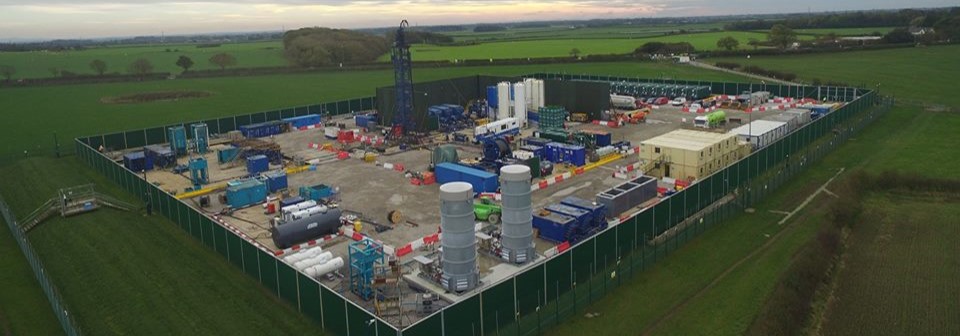
They include Cuadrilla’s shale gas operation at Preston New Road in Lancashire, where fracking-induced earthquakes in 2018 and 2019 prompted the government to impose a moratorium on hydraulic fracturing in England.
The review also highlights examples of what are described as “severe geological errors”, as well as failures to comply with licence obligations, breaches of conditions, poor record keeping, conflicts of interest and misleading descriptions of operations.
Professor Smythe said:
“The case histories demonstrate a lax, fragmented, and frequently incompetent regulatory regime which has no overarching geological remit or understanding and which seems to be driven by the government’s directives.”
He criticised the work of all four main regulators: the Oil & Gas Authority (OGA), which issues licences and monitors activity; the Environment Agency, which grants environmental permits; mineral planning authorities (MPAs) at county councils or unitary authorities, which give planning permission; and the Health and Safety Executive (HSE), which approves well design and monitors site operations.
The industry’s record was defended to DrillOrDrop by the OGA and UKOOG, an organisation representing onshore companies. See Reaction
“Lack of expertise”
Professor Smythe said insufficient experience and knowledge of the industry was a key flaw in onshore regulation:
“the depth of required expertise is either lacking, and/or is distributed in such a manner between the various regulators that sound decisions may not be arrived at. Furthermore, whatever the decision, no one agency will take responsibility.”
He said earth science personnel were unlikely to have sufficient experience and knowledge of the industry to “scrutinise effectively” the geological content of planning applications for unconventional oil and gas planning applications.
In MPAs, competence on geology had “evolved little in the last decade”, he said. As a result:
“a planning decision may therefore be overly dependent on what the developer chooses to disclose about the geology”.
Where MPAs had sought external advice, the result had “proved poor”, he said, and experts may have been recommended by the developer, giving rise to conflicts of interest.
“Gaming the system”
Professor Smythe accused operating companies of taking advantage of regulators’ lack of knowledge:
“The operators have learned to game the system by providing progressively less geological information and by the use of misleading or anodyne geological descriptions, avoiding words like fracking or shale.”
As a result, he said:
“the regulators let inadequacies in geological understanding, and even mendacious geological interpretations by hydrocarbon operators, slip through the net.”
He warned that if geological pathways were not properly understood and mitigated they may lead to long-term pollution of ground and surface water, as well as methane and hydrogen sulphide emissions.
The Environment Agency and the Scottish Environmental Protection Agency [SEPA] were “particularly inadept” at addressing major geological inconsistencies and errors, he said. Several permits had been issued in “clear disregard of environmental risks”, he added.
Professor Smythe said there was a “history of inadequate record-keeping” by the HSE and EA at Brockham, Horse Hill and Leith Hill sites in southern England, which “works to the advantage of the developers”.
He concluded:
“even if no significant contamination or damage has been detected to date … it does not imply that it might not arise in the future; nor does it imply that regulation has been successful to date”.
“Unmet obligations”
Professor Smythe said some operating companies failed, without sanction, to meet ambitious work commitments they agreed to under oil or gas licences.
“The OGA allows licence obligations to lie unfulfilled. No sanctions on the licensees are ever applied and there appears to be no effective means of cancelling the licences of inadequately performing operators.”
He cited a work programme agreed by Ineos, which included 1,363km2 of 3D seismic surveys:
“Ineos committed in 2017 to undertake within five years some 1363 km2 of 3D, in areas where the entire UK onshore hydrocarbon industry had only achieved 1969 km2 in the previous 20 years—this target is logistically unrealistic, even if finance is not a problem.”
Reaction
A spokesperson for the OGA said:
“It is regrettable that we were not invited to contribute prior to publication of this report in order to correct any misapprehensions or misunderstandings about our role and our actions within the industry. However, we will read its contents with interest.
“The OGA regulates the licensing of exploration and development of England’s onshore oil and gas resources, and it has strict controls in place to ensure that operators manage the risk of induced seismicity from such operations. The OGA issues well consents, development programme approvals, completion of work programme approvals and production consents.”
A spokesperson for the Environment Agency said:
“We take the environmental risks associated with oil and gas exploration and production very seriously, including shale gas fracking.
“All the sites we regulate must meet the highest environmental standards in order to protect people and the environment. If the activity poses an unacceptable risk it will not be permitted.”
The EA said any permit breaches or environmental impacts at oil and gas sites would be investigated and would be subject to enforcement and, if necessary, sanctions. It said it worked closely with other regulators to ensure that all onshore oil and gas exploration was effectively regulated to manage environmental risks.
Ken Cronin, chief executive of UK Onshore Oil and Gas, which represents the industry, said:
“From leading academics and universities to multiple planning authorities, regulators and operators, it seems that no one is immune from the author’s criticism. Unfortunately, while the behavioural assessments are plentiful in this paper, actual evidence of harm to the environment is not.”
DrillOrDrop also invited the Local Government Association, representing MPAs, to respond to the paper.
Categories: Regulation, Research, slider

 DRILL OR DROP?
Surprising if it is that woeful that UK environment is not like Venezuela, Russia, parts of USA etc. etc.by now!
(Those wind turbine blades still finding their way into landfill?)
Surprising that with so much knowledge, above and beyond all such operators and agencies that multiple consultancies do not limit, or inform output. Heaven forbid that perhaps a consultancy with Ineos might identify what is realistic rather than “logic”. Direct experience is usually better than logic. “Logic” without direct experience is really speculation.
Thank you for a very extensive and comprehensive review Professor Smythe. Unfortunately, I suspect it will be slipping under the radar of analysis, appreciation and discussion due to the fixation, perhaps understandably, on the Covid situation.
Predictable responses from the pro industry representatives.
The OGA is actually a public limited company, funded by the industry and with some members on the board with previous employment from the industry. In the statement above they have not announced the primary aim that their website pronounces:-
“To regulate,influence and promote in order to maximise the economic profitability. ”
In addition, the OGA, apparently failed at the first hurdle when regulating the seismic activity. Cuadrilla appeared to frack just a few days after inducing a sizeable earthquake to then introduce an even bigger one that shut the industry down.
The UK onshore and gas then seem to regard the lack of evidence of harm to the environment when clearly it has been exposed to not being monitored to sufficiently expose the problems unless it is obviously then experienced such as with earthquakes. Or perhaps when the water supplies provided by aquifers are shown to be polluted with gas 20 years later? No indication of a country or region where fracking has been and gone without leaving pollution…. please advise of one….
Richard – there isn’t a single case of gas from a shale finding it’s way into an aquifer as a result of fracking. You also seem to criticise the OGA for employing people who have worked in the industry. The fact of the matter is that one has worked in the industry it is difficult to gain the knowledge and experience necessary to regulate operations. The ridiculous article by “Prof” Smythe is what happens when one writes about something you that is outside of your competency.
Borehole into aquifers and the water catching light from the tap, no evidence at all. Poachers and gamekeepers.
Richard – what do you make of the carbon isotopic composition of the methane in the groundwater? Does it not ring alarm bells that it’s not thermogenic. I guess you haven’t looked at that have your Richard. You’ve just watched Gaslands and it fits your preconceived ideas. Do you know anything about critical appraisal of evidence? Or are you just another anti with a PhD from the University of Google?
Possibly, a software engineer on safety related systems, nuclear power, fighter aircraft, sonar detection, wind tunnels. Just an analyst, not green. Coal and gas power stations are fine when done right, fracking in the middle of the desert with no people and aquifers around fine.
Let’s talk about well casings never being able to crack and leak when passing through an aquifer next, shall we?
That it? All gone quiet from the pro crackers. Forgot to mention there’s been no isotopic testing of the leisure lake water at Wakepark close to the PNR site to test and resolve whether it is fed by the Sherwood aquifer potential resurgence or if a superficial local aquifer. Not for methane, just to see where water originates with some cross correlation. Get your arguments sorted. No one disputes methane can come from a variety of sources. You test the isotopes in the water.
Richard-
Try UK!
Try India!
There-two for the price of one.
Clubs can win the Champions League via a string of 2-1 results, (and even a loss along the way) but there will still be retirees and children pontificating that the 1 would have been avoided with them in charge, and the missed penalties would not have been missed if they were in charge. But they are not in charge, and there are sound reasons for that.
Your point about lack of evidence is ludicrous. There has been a huge, and disproportionate amount of monitoring (compared to other industries) regarding UK on shore oil and gas. There are even the unofficial “monitors” causing excitement about dirty wheels and non existent selenium. Perhaps you should compare the environmental risk of importing oil and gas compared to UK on shore production-because that is the current comparison that would be meaningful. I can give you a starter there-Torrey Canyon.
Read the comment properly, fracking just started in both countries
The U.K. and India have been fracking wells for many years. I guess it wasn’t in your backyard so it went unnoticed.
Read on , search on shallow aquifer fracking
https://www.climatechangenews.com/2016/02/15/shallow-fracking-wells-contaminate-drinking-water-warns-scientist/
Clearly no new normal in fracking gibberish.
Really, high volume high pressure fracking being going on for many years?
[Word inserted at poster’s request]
Yes, indeed Simon.
I read the comment properly, Richard. I knew it was fake, so corrected it. That’s what happens on a public forum and you just might find that some people have information that you don’t. Afraid it just means that some will immediately filter your comments into that bracket. Shame really, as I suspect there may be some factual points you wish to make that will now go unnoticed. That’s life.
Sorry, just noticed my mistake. Perhaps fracking never actually started in the UK. All the energy went into priming the faults and bedding planes into causing earthquakes rather than fracturing the rock. Path of least resistant and all that….
[Comment removed by moderator]
I wonder why why all the major environmental accidents in power generation, in the past few years have been been at “green” energy sites?
Bill – you’re totally correct. We don’t hear much about the thousands of deaths caused by the collapse of dams used for hydroelectricity. It’s also interesting that no one seems to have mentioned the seismicity in the geothermal well just completed in the south of England. When similar sized events occurred at PNR the antis went crazy..
Self Regulation was never going to work; it was a licence to do whatever they wanted. Angus Energy at Balcombe couldn’t even manage their planned traffic flows into and out of the site. And where were the government agencies during their last catastrophic failure? It was down to Balcombe residents to log, photograph and video the repeated breeches of their plan, erroneously approved by WSCC Highways but never checked by them. One wonders what breeches of the regulations and their plans took place on-site. We’ll never know, because if there were any, they most certainly won’t have reported on themselves.
How did the system not work, Malcolm?
Where is the environmental damage?
Planned traffic flows? OMG! Stand outside a building site for a day or so. Goodness, they even have tanks of DIESEL on site, as do most farms that supply our food.
I risk life and death if I cross a road. If I carry on living, without any injury, then the risk has been managed pretty well.
Not sure though, that I would walk under a wind turbine on a stormy day, or advise a raptor to try and perch upon it’s blades!
I thought we had heard the last of this guy Smythe. When did he ever have a paper peer reviewed??????
At last he’s found a journal that will publish [edited by moderator]. One only has to look at the reference list to realise that the journal isn’t worth the energy that it takes to download it from the internet let alone the paper that it’s printed on.
It’s amazing that drill or drop manage to single hit a single ex-academic to report on and ignore that thousands who know that fracking is the safest way to get hydrocarbons out of the ground.
It’s funny he acknowledges Joe – I wonder if he realised that the reason he was given the data was the same as handing someone a rope to hang themselves with.
Good afternoon SIMON,
Now we’ve been here an endless number of times …… You know it , I know it, every man and his dog knows it .
Take a look at the USA , the motherland of Fracking …… The clear and definative evidence shows Fracking to be nothing more than a , highly toxic , environmentally damaging, dangerous to human and animal health, debt ridden ponzi scheme .
That’s a FACT .
Just Google……. Frackings dangers , Fracking health risks , Fracking bancruptcies, Fracking debts.
It’s all there , more than you can shake a stick at , an almost endless number of studies and reports from professional , highly qualified people / organisations.
Ahh, the king of Giggle, returns!
Try Giggling about relationships, little green jack. You will be surprised what you find, and surprised again if you believe it to be reality.
But, of course, in USA they are so thick that they continue, against your Giggling, to continue fracking. Perhaps they just don’t want to be sold your pup-or oil or gas?
By the way, there are many highly qualified people who will put their names, for reward, to all sorts of garbage, sometimes because they have a personal motive, sometimes because they are actually not that knowledgeable about the particular subject. You can look at all the Covid “experts” currently contradicting each other to see how it works in another situation. You will find a common thread-those who are not selected as the best experts in the field, are usually the ones who then criticise those that are, usually without the inside information that the best experts have because they have been selected (employed).
But, carry on with Giggling, jack. It is full of answers-just unfortunate that most of them are the wrong ones.
Hang in there, jack. The $60k/annum jobs for dishwashing will be back in the Permian.
MARTIN ,
I’ve never been away …. I must say I’ve thoroughly enjoyed your contribution to this forum during these darkened times of Covid 19 . You’ve never been of the site . You’ve really worked hard with your posts and I must say it’s been very much appreciated , as they’ve been a great source of entertainment and laughter. THANK YOU ….
MARTIN , have you ever thought about putting your talents to better use ? Maybe writing childrens fantasy books, you’d be a dab hand at it .
I see old habits does hard MARTIN , still spouting yours opinions, NEVER backing anything up with any evidence..
Keep it up please .
MARTIN
I’m amazed that such a well traveled, well educated person like yourself hasn’t put 2 + 2 together and come up with the simple answer on this one , everyone else with more than 2 brain cells has .
Fracking continues in the USA , mainly for two reasons .
( 1 ) In the vast open spaces of the USA these companies can continue polluting and destroying the environment without being seen ( Out Of Sight, Out Of Mind as they say .)
( 2 ) The US Oil an Gas industry has the politicians in their pockets…. Almost ANYTHING is acceptable by the industry no matter how harmful or destructive it is …. YOU could say eviournmental issues and public health come SECOND to lining the pockets of a few billionaires.
HAHA MARTIN, temper, temper.
Many highly qualified people put their names and reputations on the line to speak out against toxic and dangerous practices….They do this to make a stand for what they feel is right .
Unlike the Fracking industry that only has , hmmmmmm , it mainly only has YOU speaking up for it , you with no medical , engineering or Oil and Gas expertise.
Like l’ve said many times before , Fracking is nothing more than a toxic , polluting, environmentally damaging, climate changing , dangerous to animal and human health , debt ridden ponzi scheme .
Now if theres anything in the above that you disagree with , please let me know . I will be more than happy to show you the evidence.
Well, Jack, I think I will leave it at three posts from YOU with NO evidence!!
So, deflection hasn’t worked, because it was still noticed.
Your evidence-when offered? That of a Giggler. It has already been observed that is all you have to offer (selectively) but there is a lot out there, so your supply is endless. Trouble is your blunderbuss approach shows how you do not really know what you are on about AND you contradict yourself. How do a few billionaires stay billionaires within the fracking industry which a certain Jack constantly states (LOL) is bankrupt?? In English, Jack, that is known as an oxymoron. Have a word with the other Jacks and get your messaging straightened out.
Those vast open spaces in US, out of sight and mind? BUT filled with turbine blades stuffed in the ground and sighted! Giggle it.
(I could have a lifetime mentoring you. All I would need to do would be whisper, “don’t go there” and eventually you should see the problem. But, you don’t and just blunder on into quicksand. I really hope you are not rewarded for such activity.)
You have been pretty reluctant to offer any experience yourself, like NONE, (apart from Giggling) so another area to try deflection. No one will notice!?
Disney will be re-employing Mickey in the future, if you feel under qualified for the dishwashing. Good luck, but I understand the pay is not so good (I believe you can Giggle that, but if a pay wall exists, you may have the same issues you had before.)
Enjoy your weekend.
MARTIN ,
I look forward to continuing this debate next week.
Enjoy your weekend.
When working at PNR commenced the speed limit past the site entrance was kept at a ridiculous 50mph following expert advice from the Lancashire County Council highways department and other national experts.
Shortly afterwards following one serious accident, several minor incidents and many near misses the experts revisited the site entrance, realised their total stupidity and reduced the speed limit to that required, 20mph.
Local knowledge is everything and that knowledge also was correct when we protested vigorously that fracking the Fylde would put our health, wealth and happiness at risk. Fortunately the swarms of earthquakes caused by Cuadrilla were powerful enough to close the industry down once again.
Lancashire County Council were supposed to be keeping residents safe instead they conspired with Lancashire Constabulary and Cuadrilla to break planning conditions dozens of times in one night to force the first set of fracking equipment on to PNR during hours of darkness.
No prosecutions followed this ultimate betrayal of the residents of the Fylde!
Oh there was one, Peter.
Mr. Knox?
There, police and Cuadrilla so thoughtful to try and avoid such by mitigating against it, but still not sufficient. But, they tried.
It amazes me how those that are pro fracking continue to argue in favour of a dead duck industry. Sometimes it is better to accept reality. Have they not read what Kwasi Kwarteng on behalf of the government has said? Not to mention all the opposition parties are against fracking. Fracking is a none starter in the U.K. the government no longer support the industry. Time to move on.
Well, KatT, it depends on the context. I have previously made my own comments about the subject and where it may go, or not.
Your term dead duck is a bit final. The current decision is not final, so will be debated still. Lib Dems were against Brexit, they now “accept” it.
If you look at UK energy policy you would be hard pressed to find ONE element of it which has remained stable over the last 50 years. I would be amazed if that changed.