The climate impact of using fossil fuels must be assessed before any decision is made on production plans, a landmark challenge at the Supreme Court argued today.
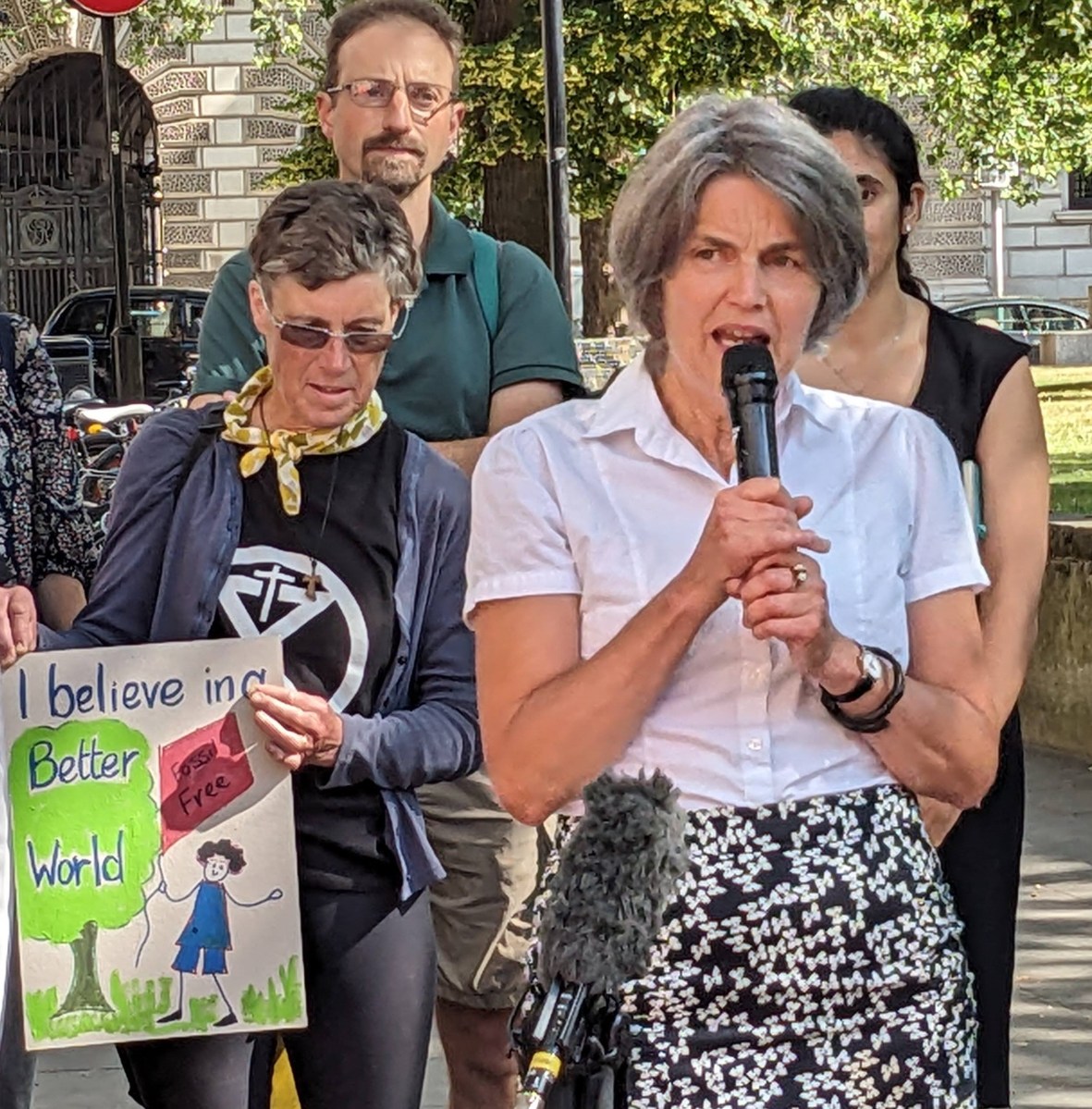
Lawyers for campaigner Sarah Finch, who brought the case, said:
“Extraction of hydrocarbons for commercial purposes are destined for combustion, which inevitably causes greenhouse gas emissions.”
The challenge seeks to overturn a majority ruling at the appeal court last year. If successful, it would have have major implications for future fossil fuel projects, including a new coal mine in Cumbria.
Key facts about the case and why it is important
The case centres on a decision by Surrey County Council about the environmental impacts of oil production at the Horse Hill site near Horley.
In 2018, the site operator, Horse Hill Developments Ltd (HHDL), was preparing a planning application for 20 years of oil production and four new wells.
The council decided HHDL’s environmental impact assessment (EIA) must include the greenhouse gas emissions from the process of production at Horse Hill – estimated at 112,000 tonnes of CO2 equivalent.
But, after correspondence with HHDL, the council ruled there was no need for the EIA to include emissions from using the oil, estimated at more than 10 million tonnes of CO2e, also known as indirect or downstream emissions.
A year later, the council approved the Horse Hill proposals.
Estelle Dehon KC and Marc Willers KC, for Sarah Finch, said:
“the grant of planning permission based on a complete absence of any assessment of the unavoidable indirect effects on climate of the inevitable burning of the extracted petroleum was unlawful.”
They said:
“Such downstream greenhouse gas emissions are required to be assessed at the point of fossil fuel extraction by a growing body of national courts around the world.”
If the Court of Appeal decision was upheld, it would leave the United Kingdom as an “outlier”, they said. Decision-makers would, they said, be able to grant permission for commercial fossil fuel production without the climate impact of the development ever being subject to a full environmental impact assessment.
They said the appeal court had been wrong in law to exclude end-use emissions from an EIA because they depended on intermediate processes, such as refining and distribution of the oil, that may take place elsewhere.
They said the appeal court was also wrong to rule that:
- the decision on including end-use emissions in an EIA was at the discretion of local authorities and not the courts, and
- end-use emissions were a material consideration in a planning decision but not an indirect environmental effect
Ms Dehon and Mr Willers said:
“It is an error of law to permit the wholesale omission of assessment of a likely significant indirect effect from every part of the EIA process.
“The question raised in this appeal is not a political question. The Appellant is simply asking this Court to apply the words of the EIA Regulations as they stand, to the world as it is.”
Council response
Harriet Townsend, for Surrey County Council, defended the appeal court ruling.
She said burning the oil was not an indirect effect of the Horse Hill production scheme:
“If you build a major factory, you don’t assess the effect of the product that the factory sells.”
She said:
“It is known that combustion will take place when oil has been extracted, refined, distributed and sold.
“That fuel will form part of the international supply, indistinguishable from that from many other sources.
“Emissions will occur at some point in the future. But nothing is known about when, where or in which circumstances they will occur. Those facts cannot be known.”
Ms Townsend said the definition of “project” was the key to the case.
“The project is only the extraction of oil, and the commercial purposes for which it is extracted are those of the ‘extractor’ – not those of the ‘refiner’, nor those of the petrol station, nor those of the person driving the car which may one day – somewhere in the world – burn the product created from the crude extracted from the site.”
David Elvin KC, for HHDL’s owner, UK Oil & Gas plc, also defended the appeal court ruling.
He said scope 3 or end-use emissions were “not an EIA concept”:
“It is really a red herring. It is a matter for accounting for emissions.”
He said the “inevitability” of combustion related to the fuel produced at the end of the refinery process:
“Crude oil cannot be used for combustion, without going through the refining process. It cannot be used directly itself.”
Mr Elvin continues his case tomorrow morning, followed by lawyers for the levelling up secretary.
Reporting from this case was made possible by donations from DrillOrDrop readers

 DRILL OR DROP?
Extraction of hydrocarbons for commercial purposes are destined for combustion, which inevitably causes greenhouse gas emissions.”
These emissions are akready accounted for in other ways nationally and internationally
Why does Sarah Finch think she can change the world?
Which part of ‘No’ did she not understand?
Without carbon there will be no trees plants flowers all greenary will die . The oxygen they produce will be lost forever wich will be a lot of oxygen gone no rain forests nothing plant like can survive without carbon
.’Why does Sarah Finch think she can change the world?
Which part of ‘No’ did she not understand?’’
Should we not all be trying to change the world? Or are you happy with it as it is’? I will not bore you with a list of luminaries who thought they might change the world, even a little, and yet who did so.
Are you not missing the point with reference to Ms. Finch?
I doubt she wishes to change the world. My guess is that she wishes to point out that we should curtail the extraction of hydrocarbons for commercial purposes as this process is, inevitably as you point out, producing those greenhouse gas emissions which, as I type, cause untold suffering to humanity and presage eventual planetary extinction.
Which part of this argument do you not understand, MK?
Maybe I can answer your question with another couple of question based on facts?
Maybe I am also allowed a opinion instead of someone else’s forced on me especially if they are not a taxpayer!
Is it not the case that the gases and emissions of imported fossil fuels are 25% higher than from those home produced?
If so why do you not want to produce our own indigenous oil and gas to reduce emissions?
Do we not also benefit from our own natural resources for energy security within the transition to net zero 2050 by producing our own?
Do we not benefit from the UK economy jobs taxes and the balance of payments defesits. To stop us as a country becoming poorer?
All of this while benefiting from taxes to help move the ‘transition’ forward.
I don’t live in cloud cuckoo’s land believing money grows on trees or we can just wave a magic wand and we will live in a sustainable world without oil and gas.
In the real world the resource need producing until the world no longer needs the resource. The reality is that the UK produces only about 1% of world emissions
while being a industrial nation.
Hi MH, I can answer your questions. Unfortunately you’ve fallen for some misinformation.
No, the emissions from imported oil and gas are not always higher than home produced. Some are lower, eg oil from Norway and Saudi Arabia has lower carbon intensity than UK oil. Importing Norwegian oil, via pipeline, is likely to be more climate-friendly than using our ‘home-grown’ oil. Also the carbon intensity of Chinese crude oil may be slightly less than that produced in the UK. Exporting UK crude oil to China could therefore displace lower-carbon intensity Chinese-produced oil and therefore increase emissions within China.
No, UK-produced oil and gas do nothing for energy security as most of it is exported. We export some 85% of UK-produced oil, and import a similar amount. This was all explained by the oil industry association representative in the High Court case on Horse Hill but perhaps you didn’t hear that.
Noone believes we can wave a magic wand and live in a sustainable world. We need to work hard to speed up the transition to renewable energy, which will give us real energy security, cheaper fuel, and save the climate.
Thanks for your interest. Reading this fully-referenced briefing will help clear up some of your confusion on these points. http://www.wealdactiongroup.org.uk/2020/10/new-briefing-briefing-why-we-dont-need-more-onshore-oil/
Around 80% of UK offshore oil production is exported, with the two primary destinations being The Netherlands and China!
https://oeuk.org.uk/offshore-energies-uk-oeuk-why-is-the-uk-exporting-gas-when-we-are-short-supply/