The government is proposing no changes to national planning policy for onshore oil and gas.
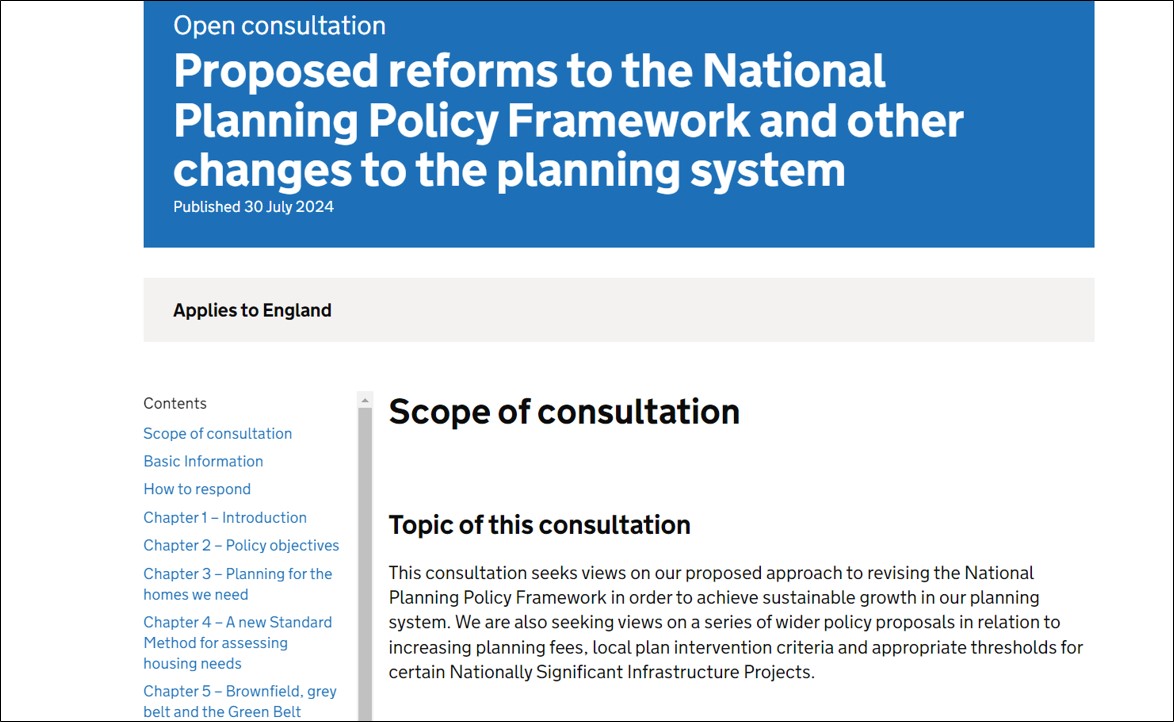
A consultation published this week on proposed revisions to the National Planning Policy Framework (NPPF) made no alterations to the key section on minerals (chapter 17).
This means decision-makers on planning applications for onshore oil and gas should continue to follow paragraph 221a. This states they should:
“clearly distinguish between and plan positively for, the three phases of development (exploration, appraisal and production), whilst ensuring appropriate monitoring and site restoration is provided for.”
Paragraph 217, which requires decision-makers to give “great weight” to be benefits of mineral extraction, remains the same.
There is also no change to the former paragraph 155 (now 153), which says mineral extraction developments are “not inappropriate” in the green belt provided “they preserve its openness and do not conflict with the purposes of including land within it.”
The government wants to add a new paragraph (24) on “effective strategic planning across local planning authority boundaries”. Strategic policies include minerals and energy, conservation of the natural environment, and planning measures to address reducing the effects of climate change.
Another new paragraph (27a) seeks to ensure a “consistent approach” is taken to planning delivery of major infrastructure, including minerals.
Anyone can comment on the proposed changes (see details at the end of this article).
The consultation also asks for suggestions on how national planning policy could do more to address climate change mitigation and adaptation.
Labour promised in its manifesto to ban fracking and to stop issuing licences to explore for new oil and gas fields. Neither of these measures were included in the list of bills to be introduced in the current parliamentary session.
But this week, the government announced changes to the windfall tax (Energy Profits Levy) on oil and gas companies, which was in Labour’s election manifesto.
The tax rate will rise from November 2024 from 35% to 38%. The levy had been due to expire in March 2029. But the government has extended it for another year, to the end of March 2030, provided that prices fall “to, or below, historically normal levels for a sustained period”.
Labour will also abolish the levy’s 29% investment allowance for qualifying expenditure incurred on or after 1 November 2024. More details will be given in the budget.
Proposed changes to the NPPF
The revision to the NPPF focusses on changing the planning system to help meet government policy on economic growth and more home building.
Key changes seek to:
- Support the government commitment to build 1.5m homes in this parliament
- Broaden the existing definition of brownfield land
- Identify low quality “grey belt land” in the green belt
- Support renewable energy schemes
Consultation details
The consultation runs until 11.45pm on Tuesday 24 September 2024.
Responses can be
- Online via Citizen Space
- By email to PlanningPolicyConsultation@communities.gov.uk
- In writing to:
Planning Policy Consultation Team
Planning Directorate – Planning Policy Division
Ministry of Housing, Communities and Local Government
Floor 3, Fry Building
2 Marsham Street
London
SW1P 4DF
DrillOrDrop has closed the comments section on this and future articles. We are doing this because of the risk of liability for copyright infringement in comments. We still want to hear about your reaction to DrillOrDrop articles. You can contact us by clicking here.
Categories: Regulation, slider

 DRILL OR DROP?