Contamination from a West Sussex oil site could potentially end up in a drinking water reservoir, villagers told the Court of Appeal today.
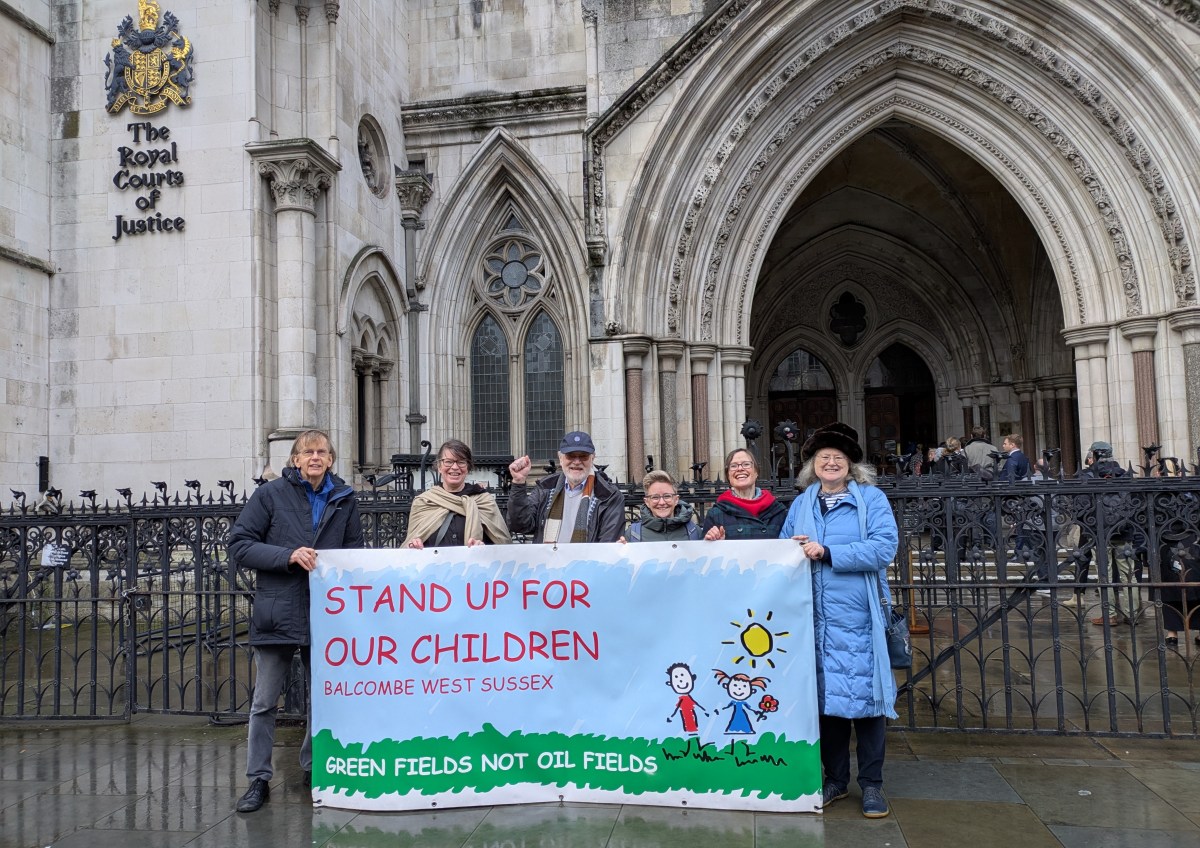
Balcombe residents were in court for the third time to challenge permission for a well test at the Lower Stumble exploration site.
The operator, Angus Energy, did not assess any risk from the site to the Ardingly Reservoir, which supplies large areas of Sussex with drinking water.
The company’s approach was later supported by a planning inspector and a High Court judge, who both granted planning permission for the well test.
The argument between the two sides centred on whether water from the oil site could reach the reservoir, through a hydrological link.
Angus Energy said there was no hydrological link because the site was separated from the reservoir by a watershed of higher ground.
But Frack Free Balcombe Residents Association (FFBRA), which brought the appeal, said there was an indirect link that should have been investigated.
It said a stream close to the site flows into a tributary of the River Ouse. When levels in the reservoir are low, South East Water would pump water from the Ouse to refill the reservoir.
David Wolfe KC, for FFBRA, told the court:
“the impact of the site on the Ardingly Reservoir should never have been ruled out of the scope of Angus’s hydrological risk assessment.”
He said the inspector “relied solely” on the developer’s assertion of no link to the reservoir, even though villagers had submitted evidence that water was abstracted from the Ouse.
The High Court judge, Mrs Justice Lieven, had described the risk as “so slight as not to be a material matter upon which the inspector needed to give further reasons or consideration”.
She also said the inspector was entitled to rely on the permitting regime operating effectively.
In papers submitted to the court, Dr Wolfe said:
“There is evidence to demonstrate that the risk was more than ‘very slight’, given there have been multiple occasions of such pumping and the water pathway between the River Ouse and the Ardingly reservoir is frequent and recurring.”
Hereward Phillpott KC, for Angus Energy, rejected FFBRA’s case that the judge and inspector had made errors of fact and public law. He said:
“The risk of pollution to Ardingly Reservoir as a result of the indirect connection between the River Ouse and the reservoir was not an ‘obviously material consideration’ on the facts as the Inspector found them. Indeed, his conclusions necessarily meant that any such concern was unfounded.”
Ben du Feu, for the local government secretary, said a connection between the site and reservoir was possible only if pollution got into the River Ouse and was them pumped into the reservoir.
He said the site had measures to prevent chemicals reaching the ground, including plans for a new impermeable membrane.
He said:
“whether there is an indirect hydrological link between the Ouse and the Ardingly Reservoir was simply not material to the decision as the Inspector found no material risk to the River Ouse from the development.”
Fracking policy
FFBRA also argued that the inspector and High Court judge misinterpreted West Sussex planning policy on hydraulic fracturing when they granted planning permission for the well test.
This was significant because the Balcombe site is in the High Weald Area of Outstanding Natural Beauty, where hydraulic fracturing was unlikely to be approved.
The court heard that the local minerals plan had two policies on hydrocarbon developments. Policy M7a applied to those not involving hydraulic fracturing, while policy M7b applied to those that did.
Mrs Justice Lieven and the inspector said policy M7a should apply to Balcombe.
But Dr Wolfe, for FFBRA, said they should have applied policy M7b. Although the application did not involve hydraulic fracturing, Angus Energy had expressly not ruled it out, he said.
Dr Wolfe said the judge was wrong in her understanding of the different policies and she did not give any lawful reasons for her conclusions.
He said any application for production involving hydraulic fracturing in the AONB would be “bound to be rejected under M7b”.
Mr Phillpott described FFBRA’s argument as “an artificial and wholly-contrived attempt to link this proposed development to hydraulic fracturing”.
He said it was “entirely misconceived” that policy M7b would apply to any application for exploration unless the applicant had ruled out any future applications that might involve hydraulic fracturing.
Tom Cosgrove KC, also for the secretary of state, described FFBRA’s approach to the minerals policy as “obviously wrong”.
Exceptional circumstances
FFBRA told the court that the inspector and judge had also misinterpreted national policy on the “exceptional circumstances” that must justify major developments, like the well test, in AONBs.
Under the policy, decisionmakers should consider the cost and scope for developing elsewhere, outside the AONB, the court heard.
West Sussex County Council had refused planning permission for the well test in 2021 saying the exceptional circumstances test had not been met. It said there were alternative sources of hydrocarbons.
Ruchi Parekh, for FFBRA, said the inspector and judge had unlawfully concluded that the Lower Stumble hydrocarbon resource could not be explored outside the AONB and the cost of this would be uneconomic.
Ms Parekh said:
“The judge’s interpretation would severely narrow the exceptional circumstances protection for AONBs in the context of mineral developments and has no basis in the policy wording.”
Mr Phillpott, for Angus Energy, said it was reasonable to limit the search to within the licence area. In the Balcombe case, the licence area was almost entirely AONB. He said:
“the judge was correct, therefore, to find that the inspector’s approach to alternatives was a rational exercise of planning judgement on the particular facts before him and was not tainted by any misinterpretation of policy.”
Benefit versus harm
FFBRA also argued that the judge was wrong to conclude that the inspector had not taken into account the benefits of future extraction of hydrocarbons while excluding the harms.
Dr Wolfe said the judge had not given reasons for her conclusion – she simply stated there had been no error in law.
Mr Phillpott, for Angus, said the inspector recognised the aim of the application was for exploration and appraisal and that benefits from production would arise in the future.
- The case was adjourned until Wednesday morning (29 January 2025) at 10.30am for closing arguments. The judgement is likely to be reserved until a later date.
DrillOrDrop has closed the comments section on this and future articles. We are doing this because of the risk of liability for copyright infringement in comments. We still want to hear about your reaction to DrillOrDrop articles. You can contact us by clicking here.

 DRILL OR DROP?