The UK’s first formal assessment of carbon emissions from burning onshore oil has been criticised as “flawed”, “misleading” and “unlawful”.
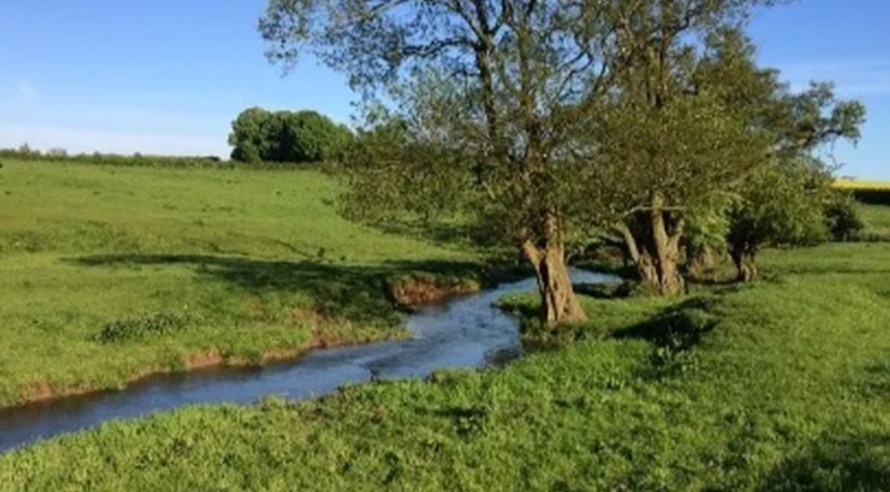
Photo: SOS Biscathorpe
Egdon Resources was required by a landmark legal judgement to review the greenhouse gas [ghg] emissions likely to result from burning oil that it wants to extract from its Biscathorpe site in the Lincolnshire Wolds.
The company concluded that the total emissions would not have a significant impact on climate change. These include the emissions from burning Biscathorpe oil, known as scope 3 or downstream emissions.
But climate groups, local campaigners and environmentalists have criticised the way this conclusion was reached.
Egdon’s assessment was published earlier this year in an addendum to an earlier environmental statement (ES) for the Biscathorpe project.
Planning permission for long-term oil production and a new sidetrack well at Biscathorpe had been granted on appeal by a planning inspector in November 2023. But it was quashed in July 2024 following a ruling by the Supreme Court in a successful and influential challenge by Sarah Finch and the Weald Action Group.
The Planning Inspectorate will now reconsider Egdon’s plans, taking account of scope 3 emissions and other changes since the 2023 decision.
“Entirely misleading conclusions”
Egdon estimated that total emissions would account for less than 0.15% of the UK carbon budgets from 2023-2042.
The company also said the “projected emissions were not of a magnitude” that could “materially affect” the attainment of the UK Carbon Budgets over the 15-year operational life of the Biscathorpe wellsite.
But Egdon’s approach has been criticised by the Weald Action Group (WAG), which opposes onshore oil and gas in southern England, and the climate campaign, Uplift.
They both said the significance of Biscathorpe’s Scope3 emissions should be assessed in relation to the available space in the global carbon budget required to limit temperature rise to1.5C.
WAG said in a response to the addendum:
“The approach of assessing scope 3 emissions against UK carbon budgets is flawed and has led to entirely misleading conclusions by Egdon Resources.”
Uplift said:
“In our view the ES Addendum does not comply with the legal requirements of the EIA [Environmental Impact Assessment] Regulations following the Finch decision.”
WAG said the assessment failed to take account of existing and approved projects and ignored that greenhouse gas emissions accumulate globally, rather than locally. It said:
“the significance of a project’s downstream greenhouse gas emissions should be assessed relative to the available space in the remaining 1.5°C global carbon budget, once existing and committed fossil fuel projects have been accounted for.”
Uplift said the assessment did not follow the principle of using the worst-case scenario or take a precautionary approach. It said:
“The emissions are erroneously compared to the total UK carbon budget, without taking into account the emissions from existing and approved projects.”
Uplift also said:
“We recommend that a global approach is taken to cumulative assessment, taking into account the remaining global carbon budget in the context of existing and approved global emissions from other fossil fuel projects.
“We recommend that the Planning Inspectorate require an assessment of these cumulative effects before considering and making a decision on the Biscathorpe Project.
“Not only is this a legal requirement, but a proper assessment of cumulative effects is critical to any meaningful consideration of the significance of downstream GHG emissions.”
Uplift said framing a project’s scope 3 emissions only as a fraction of national or global total emissions was:
“a meaningless exercise in the absence of a cumulative assessment of the existing global emissions to which it adds.”
The group added that an independent review of the Egdon assessment, carried out by Surrey County Council, suggested that in the worst-case scenario the Biscathorpe project accounted for 0.57% of the total UK seventh carbon budget in 2038 to 2042. Uplift said:
“This means that just 200 projects on the same scale would account for the entire five-year carbon budget for the UK, not accounting for committed emissions.”
Both WAG and Uplift urged the Planning Inspectorate to wait for the outcome of a consultation by the Offshore Petroleum Regulator for Environment and Decommissioning (OPRED) on offshore oil and gas projects. This is due in the spring 2025. They said there was no reason why onshore and offshore emissions should be assessed differently.
Other key objections
Protected landscape
The Biscathorpe site is in the Lincolnshire Wolds National Landscape (NL), formerly known as an Area of Outstanding Natural Beauty (AONB).
The Countryside Charity, CPRE, and many other objectors said the plans for oil production would have a detrimental impact on the special qualities of the Lincolnshire Wolds, particularly the natural beauty, dark skies and tranquillity.
Many pointed to the 2023 Levelling Up and Regeneration Act (LURA) that strengthens the duty on decision-makers to ensure that a proposal furthers the purposes of a National Landscape.
CPRE said the duty included avoiding harm to protected landscapes and required decision-makers to further the conservation and enhancement of NLs. CPRE said:
“there is no evidence that this proposal will further the purposes in order to conserve and enhance the natural beauty of the Lincolnshire Wolds NL.”
CPRE also said the Biscathorpe proposals did not conform to relevant local and national planning policies.
Threat to rare chalk stream
Many of the objections to Egdon’s plans mentioned the proximity of the site to the River Bain, a rare and protected chalk stream.
85% of the world’s remaining 200 chalk streams are in England. They were specifically named in the Levelling Up and Regeneration Act, with the aim of increasing their protection.
Ruth Craig, project lead for the Lincolnshire Chalk Streams Project Partnership, described the Biscathorpe proposal as “of significant concern”. She said:
“Careful consideration must be given to the full impact on this chalk stream from, in particular, traffic, anthropogenic noise and vibration and pollution”.
One comment described chalk streams as “rarer than the Bengal tiger”.
Transport emissions
CPRE said Egdon had got its maths wrong when it said there would be an estimated annual total of 1,095 heavy goods vehicle (HGV) visits, which would equate to 2,100 movements from 2026-2040.
The organisation said the total actually equated to 2,190 movements. This was just above the agreed condition set in the 2023 permission, which limited HGVs to a maximum of 21 per week, or 2,184 movements per year over the 15-year production phase.
CPRE and Lincolnshire Climate Commission also criticised Egdon for not considering the impact on transport emissions if the site produced up to 6.5million barrels of oil, the high case scenario. Egdon had not accounted for the increased number of HGVs needed to visit the site over a 15-year period, they said.
Other concerns
- Industrialisation of the Lincolnshire Wolds
- Failure of the site to meet national needs for oil
- It is wrong to assume all oil would be used in the UK
- Loss of quality arable land
- Increase in traffic at a junction in Caistor
- Air, water and noise pollution
- Lack of benefits to the local economy
- Threat to health of communities
- Threat to local tourism
- Traffic impact on horse riders, cyclists and pedestrians using the Lindsey Trail and Viking Way
- Lack of adequate notice of consultation for local residents
Call for public hearing
Many respondents asked the Planning Inspectorate to hold a public hearing on the Biscathorpe proposals.
The inspector handling the case can decide to hold a public inquiry, a less formal hearing or consider only written representations.
One comment in support
At the time of writing, there was one comment in support of the Biscathorpe scheme among about 40 published objections.
This said the oil and gas used from the proposed site would be “the greenest (smallest carbon footprint) available for use within the UK. Using oil and gas from the nearest source avoid transporting them around the world, “at a heavy cost to the environment”, the supporter said.
Egdon’s “omissions and/or inadequacies”
In correspondence seen by DrillOrDrop, the Planning Inspectorate gave Egdon’s environmental statement a grade document D, when A is best and E is worst.
Grade D is defined:
“Parts are well attempted but must, as a whole, be considered just unsatisfactory because of omissions and/or inadequacies.”
In February 2025, we reported that the Planning Inspectorate asked Egdon to provide more information on the environmental statement (ES).
Following freedom of information requests (here and here), we now know that the extra information includes details of:
- energy generation facilities, source of fuels and emissions and impacts on climate and landscape
- likely significant effects on cultural heritage or justification on why this is not required
We also know that Egdon has offered to provide the additional information by 16 May 2025.
In response, the Planning Inspectorate said it had requested of Egdon “a high-level outline of the timetable to prepare this information to support their suggested time requirement”.
There is no public information on whether Egdon’s 16 May 2025 deadline has been accepted, when a new public consultation will begin or when any hearing, if allowed, would take place.
Links to responses to Egdon’s addendum here and here
DrillOrDrop has closed the comments section on this and future articles. We are doing this because of the risk of liability for copyright infringement in comments. We still want to hear about your reaction to DrillOrDrop articles. You can contact us by clicking here.
Categories: climate, Opposition, slider

 DRILL OR DROP?