Waste fluid from oil wells across southern England can be tankered to a village in the Surrey green belt, where it will be pumped underground, councillors decided this morning.
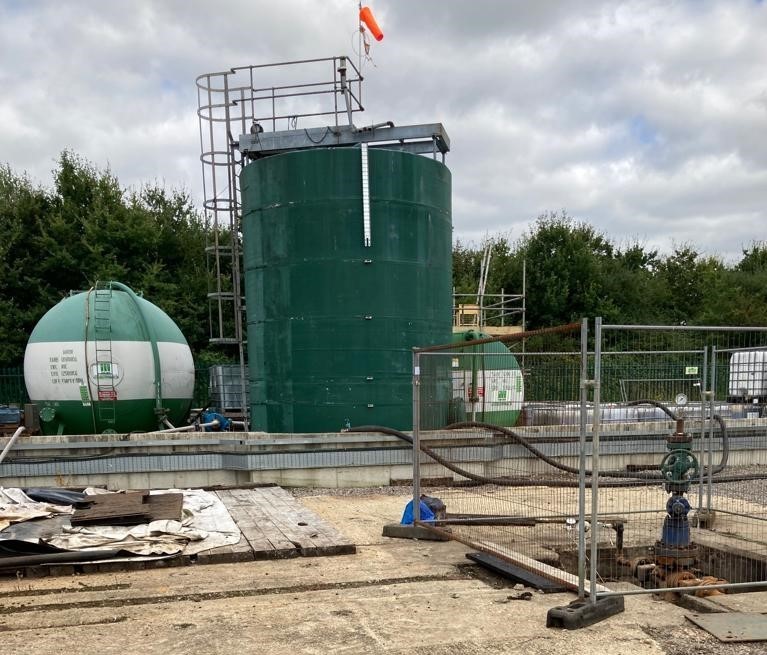
Angus Energy was granted permission to import the waste fluid, produced alongside oil, to the declining well site at Brockham, near Dorking.
The operation was approved by Surrey County Council’s planning committee by 9 votes to 1.
The committee heard that the process, known as water reinjection, would help to produce the “final barrels of oil” from the Brockham site, by increasing the reservoir pressure.
It would also reduce the cost of disposing of fluid.
The waste could come from Angus Energy’s other well sites at Balcombe and Lidsey in West Sussex and potentially from other wells across the Weald.
The Felton’s Farm site at Brockham already had planning permission, granted nearly three years ago, to inject fluid extracted from its own wells
But Angus Energy told the committee the volume of fluid from Brockham’s wells wasn’t enough to increase the pressure in the Portland oil reservoir, which was now less than 50% of the original.
Today’s permission will last until December 2036, when production at Brockham is due to end.
Support and opposition
Planners had recommended granting permission with conditions. They said in a report to the committee that no new surface equipment would be needed and access would remain the same, avoiding the village. The report concluded:
“No harm has been identified to the water environment, visual amenity, biodiversity, highways, heritage or residential amenity.”
The planners agreed that water injection at Brockham was “inappropriate development” in the green belt. But they said extraction of indigenous oil was an “unmet need” that represented the “very special circumstances” needed to justify the development.
Opponents of the proposals included Mole Valley District Council, Weald Action Group, Save Surrey Countryside, Dorking Climate Emergency and individuals.
They had argued the proposal should be refused because of climate change, seismic activity, increased noise and traffic, impact on the green belt and risks of air and groundwater pollution.
Jerry Hamilton, an opponent of the proposal, told the committee that fluid injection could induce seismic activity. He said:
“Lack of suitable assessment of this identified risk could render Surrey County Council liable for any ensuing impacts”.
He said there was no “unmet need” for the development. He described Angus Energy’s claims about energy security as “contrived” and should be disregarded.
Mr Hamilton said:
“This company want to create a waste disposal site under the untruth of increasing oil production from a well site that is spent.
“The local community were promised that the site be restored to farmland at the end of its natural life cycle. Please don’t be duped into approving an unofficial waste disposal site that will leave residents fuming when the truth is realised.”
Nick Mace, a planning consultant for Angus Energy, told the committee that fluid injection was a “well-used technique” to maintain reservoir pressure and maximise oil recovery.
Angus Energy proposed to inject up to 25m3 a day from two daily deliveries by heavy good vehicle tankers, he said.
Mr Mace said the injection pressure would not fracture the formation and there was “no risk to seismicity”.
He said the operation would “arrest declining production” and return the site to commercial levels of oil extraction. He added that the site had an environmental permit from the Environment Agency for fluid injection.
Brockham resumed production in June 2024 after nearly a decade of intermittent production. The average daily production since June 2024 was 22.5 barrels of oil and 58 barrels of waste fluid.

Councillor comments
The local county councillor, Helen Clack, who is not on the planning committee, called for a condition that would prevent the volume of fluid injection from exceeding oil extraction. But planners said the committee could not impose this restriction.
Cllr Jonathan Essex, another county councillor not on the committee, said the proposal would industrialise the Brockham site and change its nature from oil production to waste disposal. He said this would create a precedent for oil wells at the end of the productive life. He asked:
“Is this right? Is this the way we would wish oil sites to end their life in Surrey?”
Committee member, Cllr Ernest Mallett, described the Brockham wells as “an isolated site” where there would be no real impact on “anyone or anything”. He said:
“Very few people know it is there and, if they do, there can be very little interference with their daily life at all.”
He said he didn’t accept there would be any difference in the operation of the site. “Extraction is extraction and there may be different methods”, he said.
Cllr Jeffrey Gray asked: “getting the last few barrels of oil out – does this constitute very special circumstances?”
Cllr Catherine Powell said Brockham’s environmental permit did not set a volume limit for fluid injection. She said the council should ask the Environment Agency to review the limit.
The council’s planning development manager, Sian Saadeh, said the original planning permission also set no limit on what could be extracted at Brockham. She said the only harm to the green belt was to its openness – and this would be “very limited”.
On groundwater contamination and seismicity, Ms Saadeh said councillors should assume that other regulatory regimes would be “conducted properly”.
On tanker movements, planners said there would be a section 106 legal agreement on the access and departure routes for tankers.
The committee agreed to add an informative note on injection volumes. The wording was to be finalised outside the meeting.
- More questions on Horse Hill – see our separate report coming soon about questions to today’s committee on the Horse Hill site, where planning permission was quashed by the Supreme Court in June 2024.
DrillOrDrop has closed the comments section on this and future articles. We are doing this because of the risk of liability for copyright infringement in comments. We still want to hear about your reaction to DrillOrDrop articles. You can contact us by clicking here.
Categories: Regulation, slider

 DRILL OR DROP?