Plans to inject waste fluid at a Surrey oil site could cause “potentially damaging earthquakes”, two earth scientists have warned.
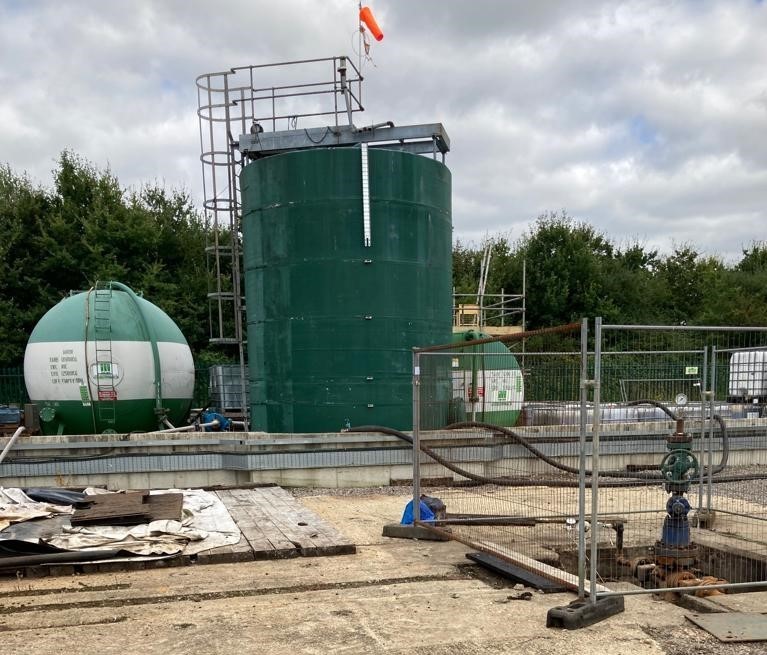
The academics from University College London made their warning about operations at Brockham, near Dorking, in correspondence with the government and the site operator, Angus Energy.
They said they had no response from the company.
An official for the energy secretary, Ed Miliband, was “unable to comment on the specifics of proposed operations on an individual site”.
The academics, Dr Matthew Fox and Professor Philip Meredith, said in their correspondence:
“The current plans to inject waste fluids at Brockham has the potential to generate seismicity and cause potentially damaging earthquakes.”
They called for a seismic monitoring network to be installed by the British Geological Survey (BGS) before any injection of waste fluids began.
Waste injection at Brockham
Angus Energy has planning and environmental consents to inject waste at Brockham.
The fluid, also known as produced water, is extracted along with oil or gas. It can be pumped back into a hydrocarbon reservoir through an injection well to help maintain continued production.
At Brockham, the fluid is to be injected into the Portland sandstone rocks to raise the reservoir pressure, which dropped as the site aged.
Injection also avoids the need for treatment of the waste fluid. This can be very expensive because the fluid can be highly saline and contain naturally-occurring radioactive material.
Injection and fracture pressures
The academics’ concerns centre on the variability of rocks in the Portland sandstone reservoir and the high pressure that Angus said it would use to inject the waste fluid at Brockham.
The company told Surrey County Council the injection pressure would not fracture rocks and there was no risk of earth tremors.
It said the injection pressure at Brockham would be 1535 psi [pounds per square inch], about 100psi below the fracture pressure of the Portland sandstone at 1635 psi.
But Dr Fox and Professor Meredith said there was large uncertainty about the fracture pressure in the Portland reservoir. It could vary by up to 20%, or 327 psi (pounds per square inch), they said.
They said some layers could fracture at about 1300 psi, much lower than the injection pressure of 1535 psi.
Dr Fox and Professor Meredith said they were concerned that the injection pressure could lead to the same environmental risks as those from fracking. There could also be a risk of earthquakes, they said.
Even if fracturing did not happen, they said, the pressures were still close enough to fracture pressure to lead to the growth of cracks. This, in turn, could trigger seismicity, they said.
In their correspondence, the academics said:
“The planned injection pressure of 1535 psi is 93% to the fracture pressure … and is more than sufficient to generate subcritical crack growth in these rocks.
“We believe that injection at that pressure will involve a very high risk of generating subcritical crack growth that will accelerate to produce dynamic (seismic) rupture.”
Dr Fox and Professor Meredith said there has been research on the rate at which fluids are injected can control how fractures development. But the rate of injection has not been discussed for Brockham
Other warnings
Dr Fox and Professor Meredith are not the first to highlight the risks of injection at Brockham.
In March 2025, local resident, Jerry Hamilton, warned Surrey County Councillors:
“Lack of suitable assessment of this identified risk could render Surrey County Council liable for any ensuing impacts”.
The Weald Action Group, which opposes onshore oil and gas in southern England, warned the council that there had been no 3D seismic survey of the area, despite the intersection of faults near the Brockham oil field:
“The site is in a seismic zone and may be heavily faulted. Detailed seismic data is necessary to determine safety and risks.
“The fractured geology across the Weald is particularly ill suited to subsurface disposal of waste.”
The council did not seek a comment from the North Sea Transition Authority (NSTA), which regulates the onshore oil and gas industry.
Weald Action Group said:
“In the absence of the NSTA, Surrey County Council would likely become the responsible authority by default. There being an identified, unassessed risk of harm, it may be advisable to consider risks to the council’s assets, and the applicant’s related insurance cover.”
What officials said
An official at the Department of Energy Security and Net Zero replied to Dr Fox and Professor Meredith:
“Reinjection activities are regulated by the Environment Agency and planning permission is granted by the local authority. Seismic monitoring is not a requirement for water injection wells.”
The official added:
“The Government is aware of a number of concerns related to low volume hydraulic fracturing used in the context of conventional oil and gas operations and is keeping relevant regulations under review to ensure they are appropriate.”
Planners at Surrey County Council, who recommended approval of fluid injection at Brockham, said earlier this year:
“Officers are … satisfied that the proposal would not result in land instability.
“The technical consultees have carefully reviewed the proposal and the mitigation measures for hydrological and geotechnical impacts and raised no objections.”
The Environment Agency said the operating procedures specified in the hydrological risk assessment would “ensure that there will be no over pressurisation of the reservoir”.
Newdigate swarm
In 2018 and 2019 an area of Surrey, including Brockham, experienced a swarm of more than 150 small earthquakes.
The swarm centred on Newdigate and prompted concerns that it may have been triggered by oil operations at either Brockham or nearby Horse Hill, operated by a subsidiary of UK Oil & Gas.
This was discounted by a majority of participants at a workshop of experts in 2018. All but one found no evidence of a link between oil operations and seismic activity.
A more recent report, in January 2025 by Dr Fox and Professor Meredith, concluded that the 150 earthquakes might have been triggered by oil operations.
They argued that the relationship between oil extraction and seismicity depended on the lithology that is targeted. They said:
“This is likely due to the different physical properties of the rocks, but more work is required to confirm this. Two factors prevent establishing, or eliminating, a simple link between oil production and earthquakes, leading to uncertainty. First, the seismic network, installed by the BGS, was not installed until after the first earthquakes had occurred. Second, the company operating the well has not released detailed activity information or pressure data from the wells.”
Injection underway
Official data confirms that Angus Energy has injected waste fluid from Brockham since June 2024.
But its plan to import and inject waste from sites across southern England, is on hold because a legal agreement with Surrey County Council has not been finalised.
DrillOrDrop asked Angus Energy to comment on the academics’ concerns. The company did not respond.
Dr Fox and Professor Meredith said:
“In order to avoid doubt about the cause of any potential earthquakes, a seismic network run by the British Geological Survey with data uploaded to their website would be very helpful. It would also help understand where fluids are going and whether there are risks to the ground water.”

 DRILL OR DROP?