A proposal for a new sidetrack production well at the Whisby oilfield in Lincolnshire is back with planners – three years after it was previously approved.
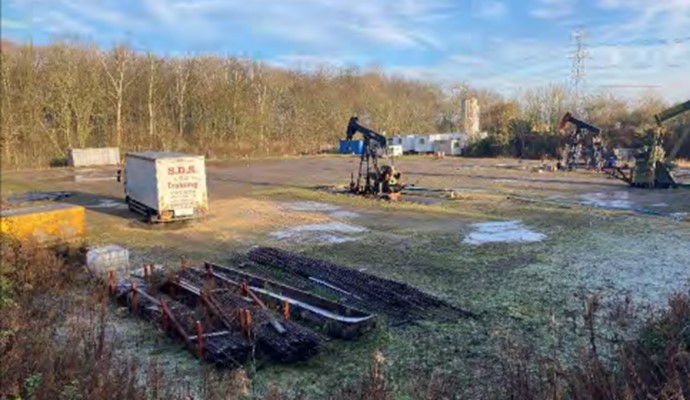
DrillOrDrop reported in 2022 that the Whisby operator, BritNRG, had applied for planning permission for a new well to target oil from the southern part of the oilfield that had previously not been exploited.
The plan to drill, test and produce oil was approved by planning officers under delegated powers in October 2022.
But limited work was carried out on the well. The company said:
“BritNRG have been progressing with detailed designs and securing other regulatory approvals from the EA under the Environmental Permitting regime. This work has meant that the company have been unable to implement the consent to a stage whereby the well is drawing oil”.
It agreed to submit another planning application to Lincolnshire County Council.
The new, very similar proposal, published on the North Kesteven District Council website, has one key difference.
This time, Lincolnshire County Council has ruled that the application needs an environmental impact assessment (EIA) that would include an assessment of greenhouse gas emissions from using the oil. This follows the landmark ruling at the Supreme Court in the Finch V Surrey County Council 2024.
BritNRG has estimated the proposal would generate 184,362 tonnes of CO2 equivalent, more than 94% of which is from burning the produced oil.
The well is expected to extract a total of 118,000 barrels. Different documents estimate this would peak at 88 or 200 barrels a day. Production would fall, over 10 years, to 5 barrels a day.
BritNRG still plans to drill from the suspended Whisby 5 well on the Whisby A site, near the hamlet of Eagle Moor. The new borehole would still be called Whisby 7.
The trajectory of the sidetrack has changed slightly, the new application said. It would continue to target the basal Permian sandstone at a depth of 980m. It could also extract from the underlying carboniferous limestone and Loxley Edge formations.
The company said work on the new well would use the existing access and there would be no need to change the site’s surfacing, perimeter or security.
One application document said the whole project would take up to 40 days. But another said the rig could be on site for at least six weeks and up to 18 weeks. One document estimated rig construction would last 7 days, using a 25m truck-mounted rig. Drilling would take 14-28 days, with a further 5 days for rig demobilisation.
Heavy goods vehicle (HGV) movements would be limited to 7am-7pm, the company said.
The application estimated 80 HGV movements on days 1 and 2 for the delivery of plant and equipment. Days 3-6 would see 20 HGV movements for the import of drilling flux, water and other raw materials. On the other drilling days, 24 HGV movements were expected for the removal of waste and delivery of raw materials.
Any oil would be piped to the nearby Whisby 4 site for stabilisation, storage and distribution. It would then be transported by road tanker in 120-barrel batches to a refinery.
The export of oil was expected to increase HGV movements from 20 per month to 25 per month, BritNRG said.
Employment would vary over the life of the project from 20 people during drilling to 3-4 during a three-month extended well test.
The application said if Whisby 7 could not be brought into production both it and Whisby 5 would be decommissioned. Both wells would also be decommissioned when the Whisby 7 oil had been depleted.
The site would then be cleared and restored for arable cultivation. The site perimeter would be planted with woodland edge habitat.
Categories: Regulation, slider

 DRILL OR DROP?