The government risks undermining its goals to cut methane emissions without stricter regulations on onshore oil and gas operations, environmental campaigners have argued.
They were responding to publication of the government’s methane action plan, which reviewed achievements and future actions.
The groups welcomed the government’s commitment to cutting methane emissions. But warned that the action plan was a “missed opportunity”.
Methane is regarded as a super pollutant. It is a more potent greenhouse gas than carbon dioxide per tonne but it is shorter lived in the atmosphere.
Cutting human-caused methane emissions has been described as a “climate emergency brake”.
The methane action plan accepted that methane reductions were “essential” to meeting our statutory net zero target by 2050.
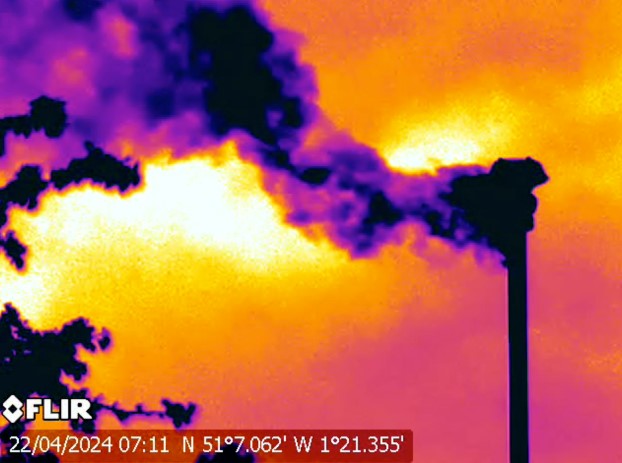
One of the key sources of methane from the oil and gas industry is flaring (inefficient burning of methane) and venting (releasing unburnt methane).
The action plan said the North Sea Transition Authority would require zero routine flaring and venting by 2030. But it had no specific mention of the onshore sector.
The UK Methane Campaign said efforts had focused on offshore production, but it was “crucial that the onshore oil and gas sector is not left behind”.
It said methane emissions from onshore remained a significant source of climate pollution. It was essential to apply forthcoming regulation across both onshore and offshore operations, the group said.
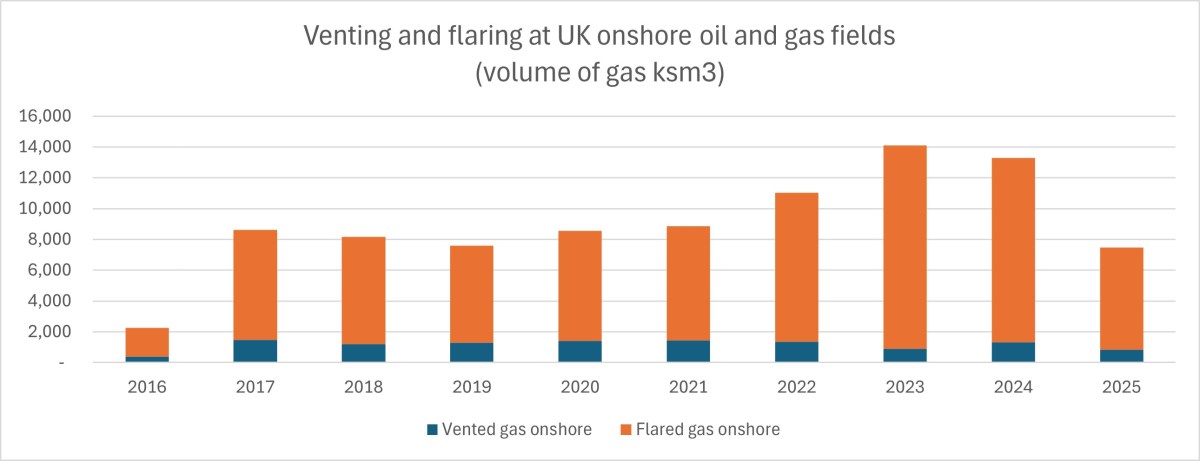
Data publication began in 2016. 2025 is for January-August only.
Source data: North Sea Transition Authority
Emily Mott, of the UK Methane Campaign and the Weald Action Group, said:
“We are pleased that the UK has recognised the urgency of tackling methane through its new Methane Action Plan and is signalling leadership on the global stage.
“However, by failing to reference and include the onshore oil and gas sector, the Government has missed a critical opportunity to tackle all domestic fossil emissions and is jeopardising its communities and their right to a safe and healthy environment.”
“We’ve witnessed sites in the South Downs National Park where methane was flowing out of the ground through cracked cement; deliberately leaked from opened tanks, black carbon burning and methane venting 24/7.
“The Methane Action Plan is a good start, but without mandatory methane regulations for the onshore fossil-fuel industry, the UK risks undermining its own goals.”
Ian Round, of SOS Biscathorpe, a campaign group in Lincolnshire, said:
“The venting and flaring by the oil and gas industry defies any logic in its release of methane to the atmosphere.”
“It is indefensible that they make minimal effort to capture and use the gas. Whilst we transition to renewable energy, some fossil fuel production will have to be tolerated, but it is vital that legislation and regulations force these companies to maximise the utilisation of methane and not waste this damaging gas.”
Rebecca Tremain, UK director at Clean Air Task Force, said:
“Methane emissions from the fuel supply sector remain underreported and underregulated, and the plan’s ambition falls short of what’s needed to meet the UK’s global commitments.
“Real progress means giving this plan regulatory teeth — turning pledges into enforceable action that cuts waste, strengthens UK competitiveness, and slows the rate of warming in our lifetimes.”
UK methane emissions reduced by 62% from 1990-2023, one of the highest percentage reductions in OECD countries, the action plan said. The government estimated that methane emissions would fall by 12.7Mt from 2020-2030.
Upstream oil and gas made up less than 2% of all UK methane emissions, the plan said. Most methane emissions from fuel supply came from leaks in distribution.
The industry estimated flaring by offshore fields had already fallen by 51% from 2018-2024, the plan added.
The campaigners urged the government to use the UK regulatory roadmap from the Clean Air Task Force. This recommended measurement, monitoring, reporting and verification to reduce methane from the fossil fuel sector. It also recommended prohibition of all flaring and venting and mandatory leak, detection and repair programs.

 DRILL OR DROP?