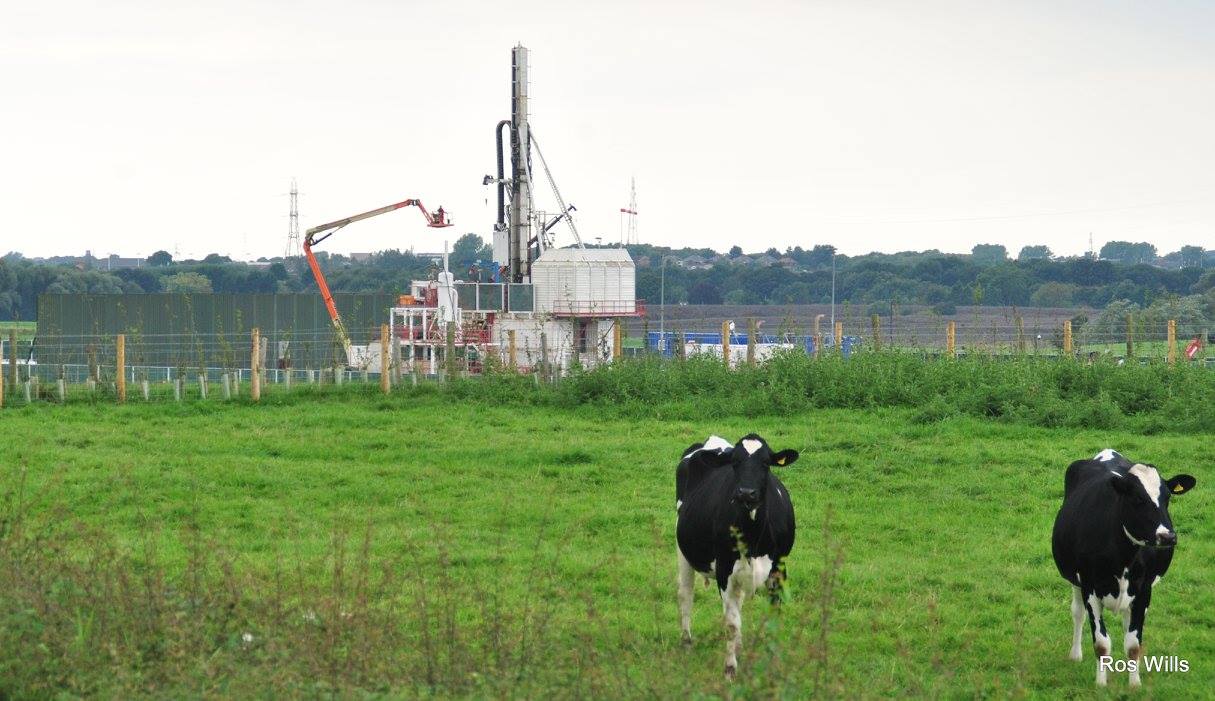
Cuadrilla’s Preston New Road shale gas site, 22 August 2017. Photo: Ros Wills
Two geoscientists, writing in the journal, Nature, suggested today that official definitions could allow fracking in the UK to “creep under the radar”.
 David Smythe (left), former chair of geophysics at Glasgow University, and Stuart Haszeldine, Professor of Carbon Capture and Storage at Edinburgh University, said in a letter to the journal:
“We are concerned that fracking of unconventional oil and gas formations risks being classed as conventional hydrocarbon exploration, a relatively insignificant and unobtrusive cottage industry in the United Kingdom.”
The issue centres on government definitions, which the two scientists argue “have little rational or scientific basis”.
In the UK, high volume hydraulic fracturing (HVHF) was defined in the Infrastructure Act based on the volume of fluid used: 1,000m3 per fracking stage or 10,000m3 in total. At these volumes, higher than those commonly used in the US, legal controls on fracking apply.
Since the Infrastructure Act became law, there have been questions over this definition based on volume.
Professor Haszeldine told The Guardian last year that analysis of more than 17,000 gas wells fracked in the US from 2000-2010 showed that 43% would not be defined as fracking under UK rules. Of 4,500 US fracked oil wells, 89% would not be covered by the UK definition.
Ministers have denied that companies would try to get round the rules by reducing the volume of fracking fluid. Speaking in October 2015, the then Energy Minister, Andrea Leadsom, said:
“That absolutely would not be in anyone’s interests to play games like that. That would be an appalling thing to do. I would absolutely not permit that sort of game-playing to happen. There will be a very clear definition.”
“It won’t be the case that you can simply flout the rules by having a litre or two less of water. That will not be the case I can assure you of that.”
But Hannah Martin, energy campaigner for Greenpeace UK, told The Guardian:
“If the government were as serious as they claim to be about regulating fracking, they would have chosen a definition of this technique that reflects what actually goes on at many drilling sites.”
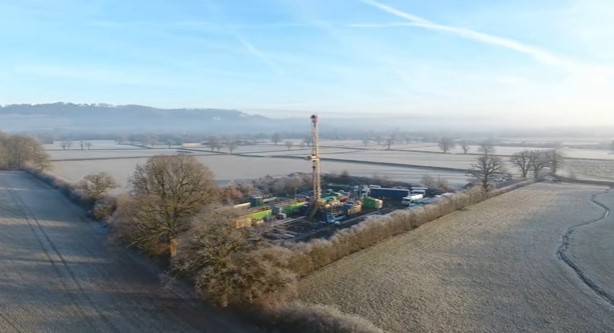
Angus Energy’s Brockham site in Surrey. Photo: Weald Oil Watch
“Avoiding obligations”
In their letter today, David Smythe and Stuart Haszeldine raised the prospect that in parts of the UK operators could use hydraulic fracturing but avoid the obligations by keeping fluid volumes to below 10,000m3 per well and using the confusion around definitions of what is an “conventional” and “unconventional” formation.
The Oil and Gas Authority, which regulates the industry for the government, said in a Freedom of Information response:
“’conventional’ or ‘unconventional’ are not defined terms”.
The British Geological Survey, in response to questions from a researcher, said:
“Depending on local geological conditions, economics and drilling methods, sandstone or limestone could be interpreted as conventional or unconventional, or tight or not tight”.
But guidance on mineral extraction from the Department of Communities and Local Government defined conventional hydrocarbons as “oil and gas where the reservoir is sandstone or limestone” and unconventional hydrocarbons as “oil and gas which comes from sources such as shale or coal seams which act as the reservoirs”.
David Smythe and Stuart Haszeldine said today:
“This [definition from DCLG] overlooks unconventional ‘tight’ (low-permeability) limestone and sandstone.”
This is a key issue in the Weald Basin in southern England where UK Oil and Gas (UKOG), Angus Energy and Europa are seeking to explore for oil in the ‘tight’ Kimmeridge limestones.
Angus, for example, has described its Kimmeridge limestone exploration plans at Brockham near Dorking in Surrey as “conventional”. UKOG describes itself as “a conventional oil and gas company” with a mandate to “only recover oil and gas by conventional recovery methods”. Both companies have said they do not need to use hydraulic fracturing.
But critics have argued that Kimmeridge oil is unlikely to be extracted in commercial quantities without some form of stimulation of the rock formation. Some have argued that the Kimmeridge limestone would be better described as “unconventional”.
In their letter, the scientists said the sites in the Weald were currently registered as conventional, because the operators were testing thin limestone layers and were not yet fracking. But they said:
“Assuming the UK licensees start HVHF, they can then in principle claim that it is conventional hydrocarbon production by keeping the fracking fluid volume to less than 10,000m3 per well, which would evade environmental obligations specified in the 2015 UK Infrastructure Act.”
North Yorkshire definition
The North Yorkshire draft minerals plan has attempted to tackle the issue of definition by volume. It has developed a new definition of hydraulic fracturing:
“The fracturing of rock under hydraulic pressure regardless of the volume of fracture fluid used.”
But the plan faced opposition in its draft form from INEOS, Third Energy, Egdon Resources, the services company Zetland Group and the industry body UKOOG. It is expected to be opposed by the industry when it is considered by a government-appointed inspector.
Response from industry
In a statement, Ken Cronin, Chief Executive of UK Onshore Oil and Gas, said:
“We would like to clarify some assumptions made in this article.
“The US data used in this report is per well whilst the lower limit of 1000 cubic metres in the Infrastructure Act 2015 is per stage of fracturing and so is therefore not directly comparable. We do not know how many stages are included in the US data and therefore cannot extract per stage data.
“The definition in the UK Act on hydraulic fracturing is very clear: hydraulic fracturing means operations in ‘shale’ or in ‘rock encased in shale’, that use more than 1,000 cubic metres of fluid at each stage, or expected stage, or more than 10,000 cubic metres of fluid in total.
“In the Weald Basin the Kimmeridge limestone is naturally fractured and the operators have put forward no plans to use hydraulic fracturing technology.
“The suggestion that onshore oil and gas producers would “evade” environmental obligations by taking advantage of the wording of the Infrastructure Act 2015 is, put simply, untrue.”
Categories: Regulation

 DRILL OR DROP?
And here’s a reminder that the definition actually originates at EU level.
“According to Florence Limet of the European Commission’s Directorate-General for the Environment (DG Environment) the Commission’s definition is drawn from a study conducted by sustainability consultants Ricardo-AEA on behalf of the DG Environment.
As the study states:
Within the scope of this study, hydraulic fracturing is to be understood as the cycle of operations from the upstream acquisition of water, to chemical mixing of the fracturing fluid, injection of the fluid into the formation, the production and management of flowback and produced water, and the ultimate treatment and disposal of hydraulic fracturing wastewater.
Hydraulic fracturing is used for vertical wells in conventional oil and gas formations to a limited extent in Europe and to a considerable extent in the US. Hydraulic fracturing is used in vertical and directional wells in unconventional formations.”
https://www.desmog.uk/2015/02/26/definition-fracking-political-not-scientific
UKOOG and the companies planning HVHF make much of their concern to protect communities thus earning respect and support for their methods. One wonders why they are so anxious to avoid the extra protection offered by the “gold standard regulations” applicable to HVHF. Perhaps cost and a determination to sidestep the rigours of shale planning application help explain this position. Whichever, the effect is to increase public suspicion as to their integrity. Leadsom’s comments reassure no-one. North Yorkshire are right to abide by the original definition.
Interesting that Mr Smythe has been so discredited that you’ve had to bring in someone else to back up his daft arguments.
So, BG, I have been “so discredited” – by whom?
The ongoing case in the Sheriff Court in Glasgow (Professor David Smythe vs. University of Glasgow) means that I am prevented from providing more details. However, you will note that the Nature letter quotes my university email address, which has been reinstated. [Edited by moderator]
It would be preferable, BG, to stick to the science, and avoid ad hominem comments.
When all else fails the industry resort to defamation. Well done David.
Perhaps Mr Smythe could explain why his paper was shredded by proper scientists? https://www.solid-earth-discuss.net/se-2015-134/
Nobody brought me in, BG. I managed it all by myself! Can you manage to tell us all why the arguments you describe as ‘daft’ are so?
I don’t believe that he has been ‘discredited’. He has been ‘smeared’ in the Daily Mail, and also by proponents of fracking and its kissing cousin acidisation. The fact that a similarly senior expert subscribes to similar attitudes should command our attention, not our derision. I personally am hugely grateful to him for devoting time to this issue. When considering all such issues I feel that we should be asking ourselves, ‘What does the proponent of a forcefully expressed opinion have to gain personally from unconventional oil and gas extraction?’ David Smythe has no easily discernible financial interest. He is a retired academic who has devoted a large chunk of his life to the understanding of issues. Many of his critics are involved in unconventional oil and gas extraction or stand to benefit from it in some way. Surely this should be heavily factored in to any serious consideration of what he is saying?
Thank you for covering this critical issue. It is shocking how inadequate current regulations around unconventional exploration are in the UK. A very far cry from the ‘gold standard’ that the industry is so keen to invoke. Everyone including the investors should make a careful note of this.
http://www.telegraph.co.uk/news/earth/energy/fracking/11005179/Scientist-who-gave-evidence-against-fracking-site-accused-of-claiming-false-qualifications.html
Did you find that all on your own Tom ? Things have moved on since 2014
Here’s another list for you to try and discredit Tom.
The British Medical Journal , Public Health England’s draft report on shale gas extraction
http://www.bmj.com/content/348/bmj.g2728/rr
Some people are very sensitive it would appear!
However, back to the subject. Well, if there is a subject. There is no need to modify any definitions at all. It has long been the practice to open fractures/hold fractures open within certain types of conventional drilling, and is not fracking, as is now the terminology for a completely different type of development.
This is simply an attempt to use semantics again to confuse the easily confused. Seems to be the current methodology to maintain some degree of excitement amongst the antis. Meanwhile, conventional oil drilling and exploration continues in the Weald, fracking does the same elsewhere. Onwards, and downwards.
Yes Martin. Many of us are quite sensitive. We live in areas that are being drilled. Do you? Many of us would also like to see an immediate switch of investments away from fossil fuels and towards renewable energy sources, in an effort to combat an increasingly worrying climate crisis that is affecting us all. Please do not assume that we’re more easily confused than any other group of people. Politicians for example, or policy makers. If you can spare the time, I’d be very interested to know what you regard as the fundamental differences between fracking and the techniques that you describe. I’d also be interested to know why the dangers associated with fracking should not be associated with the forms of flow stimulation that you describe as being standard practice within ‘conventional’ drilling projects. And if you can spare a moment more, I’d also be interested in knowing how you yourself would define ‘conventional’ and ‘unconventional’. Not so much interested in semantics as what’s actually going on. My own understanding is that people on both sides of the argument are ‘playing with’ the looseness of the terminology that is applied to drilling projects.
I work in academic research and oh man do they love debating and over complicating things over a defintion. But it is their bread and butter. It is also a matter of professional ego trip of my intellectual interpretation is better (academically) than yours but it is not necessary going to make a damn difference in practical or real life values.
These are academic comments on politically-inspired, incorrect definitions!
Jonathan-yes, I do live in a drilling area, but that is hardly relevant.
The context of this attempt to redefine terminology (redefining history now as well, so all very much of a pattern) relates to the current exploration in the Weald. From the start at Horse Hill there have been attempts to define the exploration as fracking, simply to cause interference in what is really happening. This has continued now with the current wells, one of which is starting flow testing, and two others to come into production shortly. The timing of this letter is clumsy and obvious, as have been other attempts to show these wells have been drilled inappropriately.
There is plenty of information available for the Weald as to what is happening and I will not enter into a semantic roundabout to give credibility to what is a last gasp attempt to obtain wider support against this perfectly normal drilling for oil. If the current(?) flow tests prove to be good then this little exercise will be seen for what it is, a final attempt to muddy the waters, and try to prevent production following.
This says more about the decline in Scottish academia than anything else, and with only yesterday there appearing an up-date of the £ billions that were miscalculated for the Scottish economy at the last referendum, and the economy now boarding on recession it does seem quite widespread.
Mr Collyer; regarding the Weald and what you say is “perfectly normal drilling for oil”, I would be grateful if you could read my analysis of Horse Hill-1 drilling:
Click to access Smythe%20Horse%20Hill%20analysis%20v1.1.pdf
It’s a bit technical, but I am preparing a non-technical blog about it. In brief, the technical competence of UKOG appears to be in question. I am advising them to re-map their conventional Portland Sandstone discovery before they make any more claims about its size. Their Kimmeridge oil flow is due to their having drilled unkowingly into a fault zone, therefore one cannot extrapolate results from Horse Hill, where the rock is naturally fractured by being in the fault zone, to the wider Weald, as UKOG and others ar claiming.
Can you explain why you’ve tied lines C80-130 and BP-85-74 with a large shift (page 13) How did you determine this shift, given the phase differences between the seismic lines?
I am not clear what you mean by “phase differences”. Both surveys were vibroseis (i.e. a zero phase wavelet after correlation) and the final displays were the same polarity (negative numbers plotted white, as per normal). The 25 ms static shift required (done by visual inspection) is probably due to different field statics, but decon and bandpass filtering might also have contributed, to say nothing of different gain applied on the final display.
In my experience, having spent a lot of time a decade or more ago for industry clients, matching up different overlapping surveys in the Wessex Basin, and then reprocessing certain lines, a static shift of 25 ms between different surveys vintages is not unusual. Of course my visual match of the reflectors might be wrong, and you are welcome to get the images from UKOGL and try it yourself, but, having done the tie, the yellow reflector I marked (Top Portland Sandstone) makes a near-perfect match to the two wells. What more do you need? The main point I am making with that slide is the evident lack of any faulting between the wells, as followed by the circuitous route along the available seismic from one well to the other, around the tip of the Horse Hill Fault.
A final lesson from the untenable UKOG story is that we really need more seismic. To have based a whole prospect on just three lines, as Magellan did, is crazy. It should have been followed up by more seismic, before any drilling. Nevertheless UKOG might be able to salvage something from its minor Portland discovery. I have no technical objection to conventional oil exploration in the UK. As we said in our Nature letter, it is a “relatively insignificant and unobtrusive cottage industry”.
Dear Martin, You don’t appear to have addressed my questions (apart from whether you live in a drilling area or not). It is a clear indifference to the concerns of residents affected by drilling projects on the part of ‘experts’ that is in part fueling protests. Those of us that live in affected areas have a right to an understanding as to how we will or will not be affected. Whilst I perfectly understand how you may find an intellectual tussle with David Smythe to be more satisfying to you than any attempt to educate someone that is not an expert in oil extraction or geology, any disrespect with regard to our concerns will simply reinforce prejudices that many of us already hold with regard to the haughtiness of many involved with, or in favour of, non-renewable energy industries. What might be your message to those of us that are most concerned to preserve the viability of our living environment?
I think you will find david that no one is extrapolating anything. UKOG are currently organising to flow test their site, Angus will shortly be producing from their two sites, and the mishmash that owns Horse Hill are planning to do a great deal more testing work at Horse Hill-none of it fracking.
All companies concerned have been quite careful to state repeatedly that more wells need to be drilled and tested to give a clearer idea about the extent of the Weald oil, and more importantly, how much can be extracted. A few outside voices and investors have been the loudest extrapolating, which is as usual. However, there have been very credible independent sources assessing the potential within the Weald recently, as you know, and that is nothing to do with UKOGs technical competence.
I am sure UKOG will be really interested in your blog, but suspect they are also quite happy to see what they get flowing in the next few weeks and then, maybe, fine tune their plans regarding more testing at Horse Hill.
This is obviously not a “traditional” oil reservoir, or sponge-as referenced, and that is perhaps why it has been under the radar for some years, but it does not mean that it is impossible to access with modern technology-but not all modern oil extraction technology is fracking, by any definition.
Who knows. There could be years of testing and then a conclusion is drawn that the only way to access the oil is with fracking, and then that would be down to the government of the day and their experience, by then, of UK fracking. In that situation, fracking could have become the friend to all householders in the UK! However, that is not the current indication or intention, and in my opinion will not become the outcome-apart from the friend to all householders bit (like current petrol prices due to US success with oil production, dropping oil below $50/barrel).
Anyway, we will soon get a better idea from flow rates.
Meanwhile, I note a new dilemma. I can have lithium in my drinking water which means I will be able to find where I parked my diesel/petrol car, or no lithium in my drinking water which means that dementia will stop me remembering where I have parked my plug-in hybrid. Life is a really complicated business, but it is better than the alternative.
So according to Ken Cronin, fracking supporters and industry there is no intention to exploit any potential definition loophole – so why are they pushing so hard for the definition contained in Infrastructure Act to be used in the North Yorkshire Plan? Surely the proposed definition by the local planning authorities should not be an issue? Drop the opposition then and prove your intention. There is no planning necessity to use the Infrastructure Act definition. So prove your honest intent.