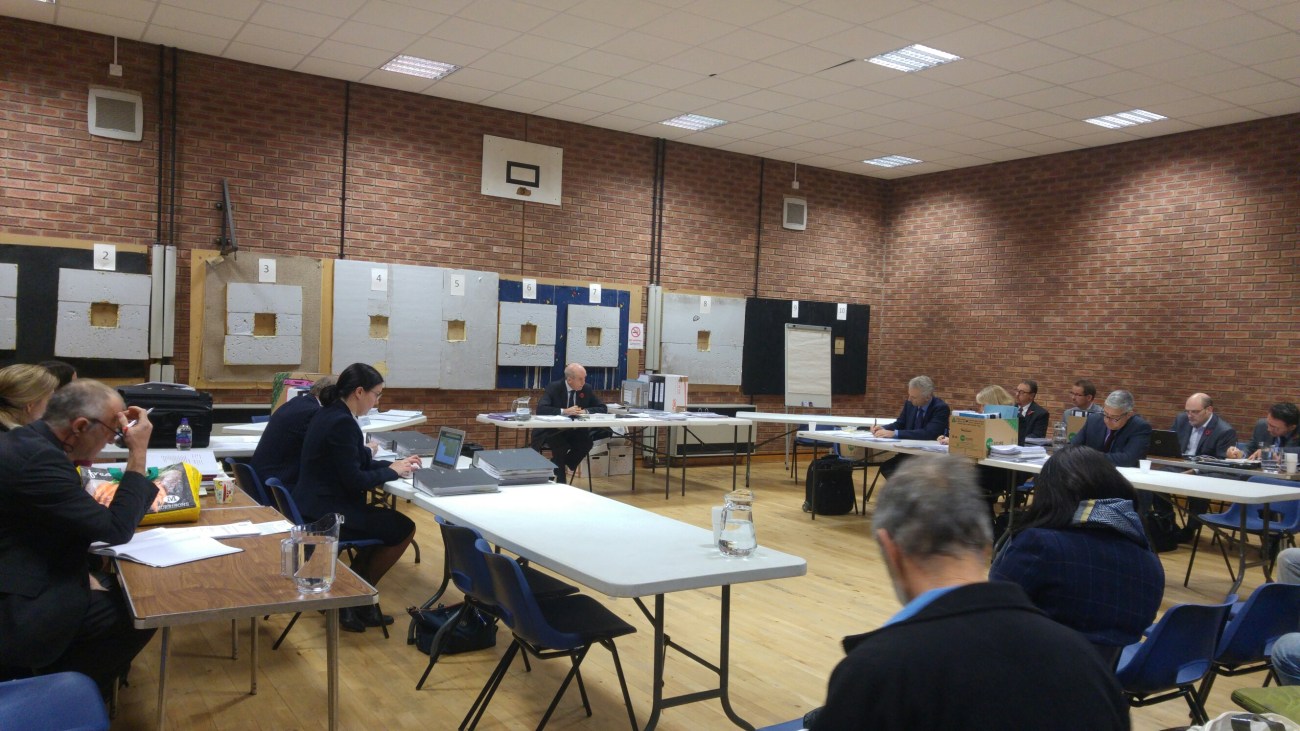
Public inquiry into Egdon Resources’ Wressle oil plans, 7 November 2017. Photo: DrillOrDrop
Live updates from the first day of the public inquiry into plans by Egdon Resources to produce oil from its site at Wressle in Lincolnshire.
The company is appealing against refusals of planning permission by North Lincolnshire Council in January and July 2017. The decisions by councillors were despite a recommendation each time by planning officers that the application should be approved.
Egdon is seeking permission for 15 years of production at Lodge Farm, Clapp Gate, Appleby. The proposals include the use of two production techniques, proppant squeeze and acidisation.
The hearing, at Grange Farm Hobbies Centre, in Scunthorpe, is expected to last until the middle of next week.
5pm Closure of the inquiry for the day
The inquiry resumes on Wednesday 8 November 2017 at 9.30am.
4.45pm North Lincolnshire Council’s case
Re-examination of Susan Wagstaff
Precautionary principle Ms Wagstaff points to an Environment Agency guidance document on groundwater risk. She says in the absence of adequate information you either get more information or you don’t do something, following the precautionary principle
Contamination of Ella Beck or the secondary and the other aquifers, breaching drinking water standards, would count as serious, she says. Once contamination gets into the sub-surface it is hard to get out. If it got into the multi-layered aquifer like the Great Oolite it would be very hard to get it out.
Source protection zones Alan Evans, for North Lincolnshire Council, asks about the definition of source protection zones. He puts it to her that they say what should happen, rather than what is discretionary. Ms Wagstaff says people haven’t been bothered and the Environment Agency was short of resources.
Deficiencies Mr Evans asks Ms Wagstaff whether deficiencies in the application were important, even if the councillors weren’t aware of them.
“The decision should be based on good evidence, data, analysis and conclusions. If you don’t understand what is happening below the sub-surface, how can you understand the risk?”
Ms Wagstaff says:
“The Environment Agency should be following its own guidance and more information should have been provided.”
She says “I never really thought it was my job to comment on the Environment Agency’s work.”
Risk assessment Ms Wagstaff says with risk assessment, you assume things go wrong, not right. She says there’s no merit in screening out something – in this case Egdon screened out the Lincolnshire Limestone. She says it would be better to include more, rather than fewer than was appropriate.
Monitoring Mr Evans asks whether monitoring in Ella Beck would deal with total concerns about contamination risks. Ms Wagstaff says:
“Monitoring in Ella Beck only tells you what is in the beck at the time. It doesn’t tell you what is in the blown sand below the site. You could contaminate a lot of the aquifer before anyone noticed.”
Site liner Ms Wagstaff says it is appropriate to reassess the suitability of the site liner at this stage before production is likely to be a longer-term operation with more traffic than the exploration stage. Ms Wagstaff says the stone cover looked the same across the site. There was no sandy material. There was one wet ponding area.
4.25pm North Lincolnshire Council’s case
Questions from the inspector for Susan Wagstaff
Precautionary principle Mr Williams asks what document should be followed for guidance on the precautionary principle. Ms Wagstaff says it is how you manage the risk – if you don’t know the risk you err on the side of caution. She says will find a document to provide guidance.
Stone covering Mr Williams asks why a wheelwash is needed. Ms Wagstaff says all the trucks will come on an unmade dirt track, bringing dirt onto the pad, which would clog the stone layer covering the liner.
He asks about the issue of fine material impeding the drainage of the stone layer. Ms Wagstaff it should be no finer than fine stand.
British Steel borehole On abstraction from the British Steel borehole, Mr Williams asks why Ms Wagstaff thought 250m source protection zone was inadequate. She says Environment Agency guidance recommends the larger the abstraction, the wider the source protection zone.
Faults Mr Williams asks what influence might there be of a fault on the protection of the aquifer. Egdon says the fault isolates the aquifer from the site. Ms Wagstaff says no weight should be given to this. You can’t tell by looking at it whether it is an impermeable or permeable fault.
Radial drilling Mr Williams says the second scheme omitted radial drilling. Did this make any difference to the assessment. Ms Wagstaff says it is not relevant at that depth.
Monitoring boreholes Ms Wagstaff says she is not satisfied by the boreholes. Another borehole is needed between the site and Ella Beck and make sure they were deep enough.
Rectifying problems Mr Williams asks how easy would it be to solve any contamination problem. Ms Wagstaff says “Very difficult”. She says contamination could be pumped out of the aquifer but you might not succeed. Once it is in the aquifer it will be difficult to get it out. If it went horizontally it would probably discharge into water course.
“It is very hard to get it out once it is there”, she says.
Interceptor Mr Williams asks if there was a better interceptor. Ms Wagstaff says you could have a higher quality of interceptor.
3.15pm North Lincolnshire Council’s case
Cross-examination of Susan Wagstaff by Egdon Resources
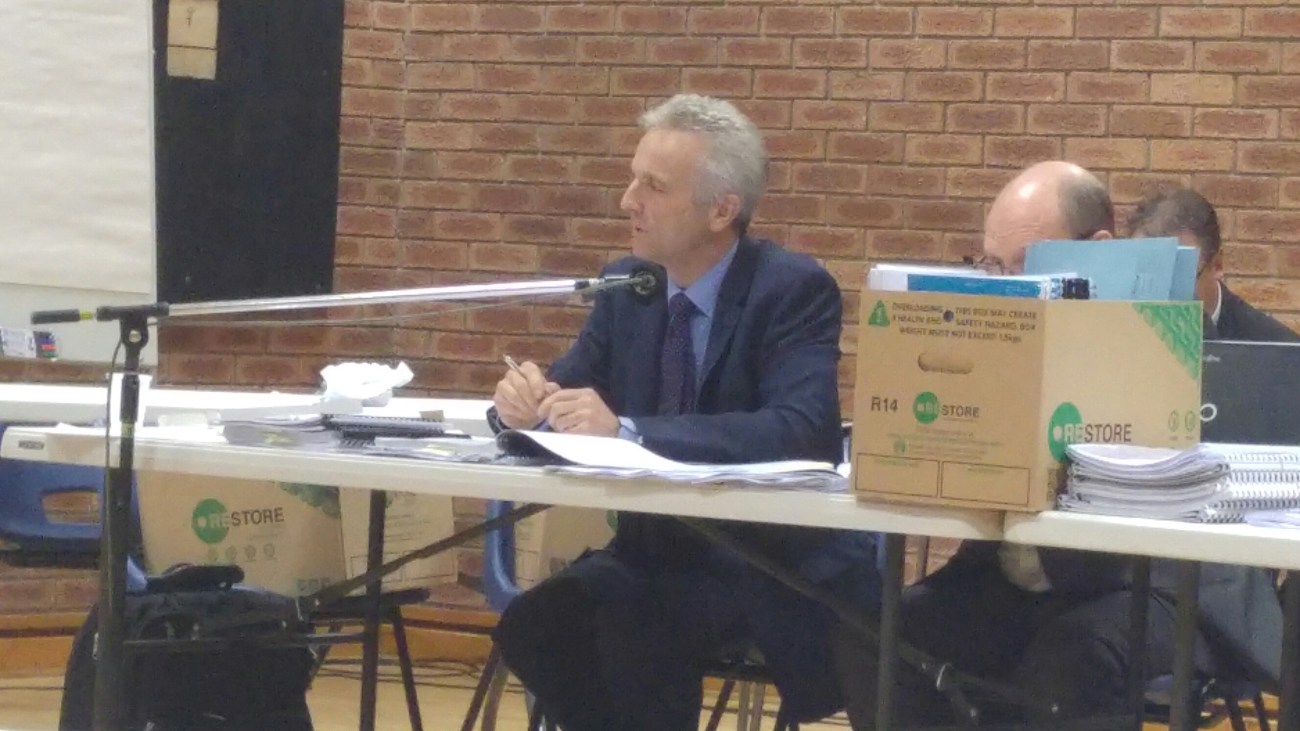
Richard Glover, cross-examining Susan Wagstaff, 7 November 2017. Photo: DrillOrDrop
Richard Glover, for Egdon Resources, puts it to Ms Wagstaff that her technical objection could not be used to defend the council’s first refusal of permission because she had not been appointed until five months after the decision.
Ms Wagstaff said many of the issues raised by members of the public to that application were among concerns she had raised.
Environment Agency role
Mr Glover says the Environment Agency has an expertise for this sort of application. Ms Wagstaff says there would not necessarily be specialists working on the application.
“They might not. It would be great if they did”, she said.
Mr Glover says the planning committee should give serious and substantial weight to the Environment Agency’s view. Ms Wagstaff says “I don’t know whether I can answer that.” But she concedes weight should be given to its guidance.
Mr Glover says the EA did not object to the application.
Ms Wagstaff says the key was whether the EA had correct information on which to base its decision. The issue of whether the groundwater gradient is up or down influences the decision made by the EA. There was confusion on this issue, she says.
Mr Glover puts it to Ms Wagstaff that there are more risks at the exploratory stage than at production. Ms Wagstaff says the deep risks are greater exploratory stage but the longer you do something the greater the shallow risks because of the vulnerability of the liner.
Mr Glover put it to Ms Wagstaff that it was a serious omission that she had not commented on the EA’s view on the case. Ms Wagstaff said it was not role to comment on the EA’s case.
He suggested that if the protections worked as they were designed to Ms Wagstaff would not have any concerns about the site. Ms Wagstaff said she had concerns about the operation of the valve and the interceptor. Those issues weren’t considered, she said.
It is a fully contained site, it is being designed, operated and managed properly to standards that the EA is happy with so the sensitivity of the aquifers doesn’t matter, Mr Glover said. Ms Wagstaff said the interceptors were not designed to work for crude oil.
Mr Glover put it to Ms Wagstaff that she was not saying there would be contamination. Ms Wagstaff said there was not enough evidence. Mr Glover said her evidence did not support the reason for refusal – that there would be an unacceptable impact on local residents, community and economy.
Ms Wagstaff said:
“If you don’t know youhave to take a precautionary principle and assume it would happen.”
Mr Glover said:
“You cannot say it wlll have an unacceptable impact”.
Ms Wagstaff said:
“If you do’t have enough information, you either err on the side of caution or you get more information”.
Council procedure
Mr Glover said it was not right that the council refused permission on the grounds of not enough information.
The inspector, Kit Williams, said Ms Wagstaff could not be asked to speculate on how the council should act.
Mr Glover said it would have been more appropriate for the council to ask for the information it needed. Ms Wagstaff said the company could have produced more detailed reports.
Mr Glover said if a spill were to occur it would be cleared up. Ms Wagstaff said:
“That would be great. When I visited the site there were dark marks which were evidence of drips off the bottom of trucks that had not been cleared up.”
Mr Glover said there were different practices for an operational active site. Ms Wagstaff said a spill could be washed into the stone layer and then the interceptor, which may not pick up all the hydrocarbons. It is quite easy for contamination to get into that stone layer.
Ella Beck
Mr Glover said Ms Wagstaff had not mentioned monitoring locations on the beck in her evidence. Ms Wagstaff said she had no problems with this issue. Ms Wagstaff it was a bit late if contamination got into the beck. “You wouldn’t necessarily pick up everything but it is reasonable.
Ground investigation
Mr Glover says the original application was approved by the local authority and the Environment Agency. Ms Wagstaff says she was not asked to comment on this. She says what was proportionate for a temporary well site that would be there fore a few months was not what was acceptable for a 15-year site.
She says there had been no ground investigation or documentation on the laying of the liner. You need a report to show the liner has been installed following guidance and correctly, Ms Wagstaff said. Without that, you can’t prove that you did. The integrity of the liner depends on it being installed properly.
Mr Glover says drillers logs reduced concerns about the stability of the ground. Ms Wagstaff says she didn’t put much store by drillers’ logs as a professional.
Mr Glover says there have been no problems with ground stability during the drilling operation. Ms Wagstaff says there was weeds growing on the liner. Mr Glover says it’s not an active site. Ms Wagstaff says “You don’t want roots into your liner.”
Permeablity of the liner
Mr Glover says the permeability of the liner is the equivalent of concrete. It is a good barrier, he says. Ms Wagstaff says if there is a significant head of water on a bentomite barrier it will leak. Mr Glover says it is a suitable liner. Ms Wagstaff says in landfill sites, where it is mainly used, there would not be a head of water. Mr Glover says water on an oil site would be tankered off. Ms Wagstaff said in a worst case there could be a head of water.
“There was a bit of water ponding on site when we went to visit. If the drainage on site is compromised then you may get that head sitting there for a while because it is not free draining”
Stone covering
Mr Glover put it to Ms Wagstaff thatarte she gave misleading evidence when she said the stone cover was too sharp and too large.
Ms Wagstaff said:
“If you look at my third photograph you can see stone next to the liner and they are quite angular and large.”
“You are not suggesting that is throughout the 300mm?”, Mr Glover asks.
Ms Wagstaff says the stone would be uniform through the covering.
Mr Glover says bentomite is self-closing. Ms Wagstaff says:
“It also gets thinner under compression so you have to be careful that you create thin clay sections which would be a weak area.”
Groundwater monitoring boreholes
Mr Glover says the boreholes had been approved by the EA and the council. Ms Wagstaff says the issue was in the detail. Based on the levels of the water in the boreholes, only half the site was covered by the boreholes.
If the EA wasn’t happy they would not have signed up to them, Mr Glover said. They are the decision-maker. They are going to look at this carefully.
I wouldn’t think it was their job to work out the gradient and direction of flow. It is quite complex. I can’t imagine them working that diagram themselves. Ms Wagstaff says.
They are going to make sure they are fit for purpose, Mr Glover says.
Conceptual model
Ms Wagstaff says in cross-examination Egdon’s model was not a conceptual model because it was too general.
No capping
Mr Glover puts it to Ms Wagstaff that it is not true to say there is no capping. The drillers’ records show 13m of grey clay, 5m of sandy clay above the limestone. There is a clear indication that there is nearly 20m of clay.
Ms Wagstaff says that is what the driller described from the cuttings from the borehole. There was no drilling method with the drilling logs. It looks like grey mush, which the driller called clay.
Are you suggesting that this is wrong?,Mr Glover says.
Drillers are descriptions of what comes up from a driller who is not a geologists or engineer, Ms Wagstaff says. These are tiny particles or sludge, she says. I would be very cautious. He describes as limestone as a hard grey rock.
Mr Glover says this is evidence of clay. Ms Wagstaff says if you really want to know what is down there you core it. They could also have done a permeability testing of the borehole. That would have answered these questions, she says.
These issues were not raised before you, Mr Glover says.
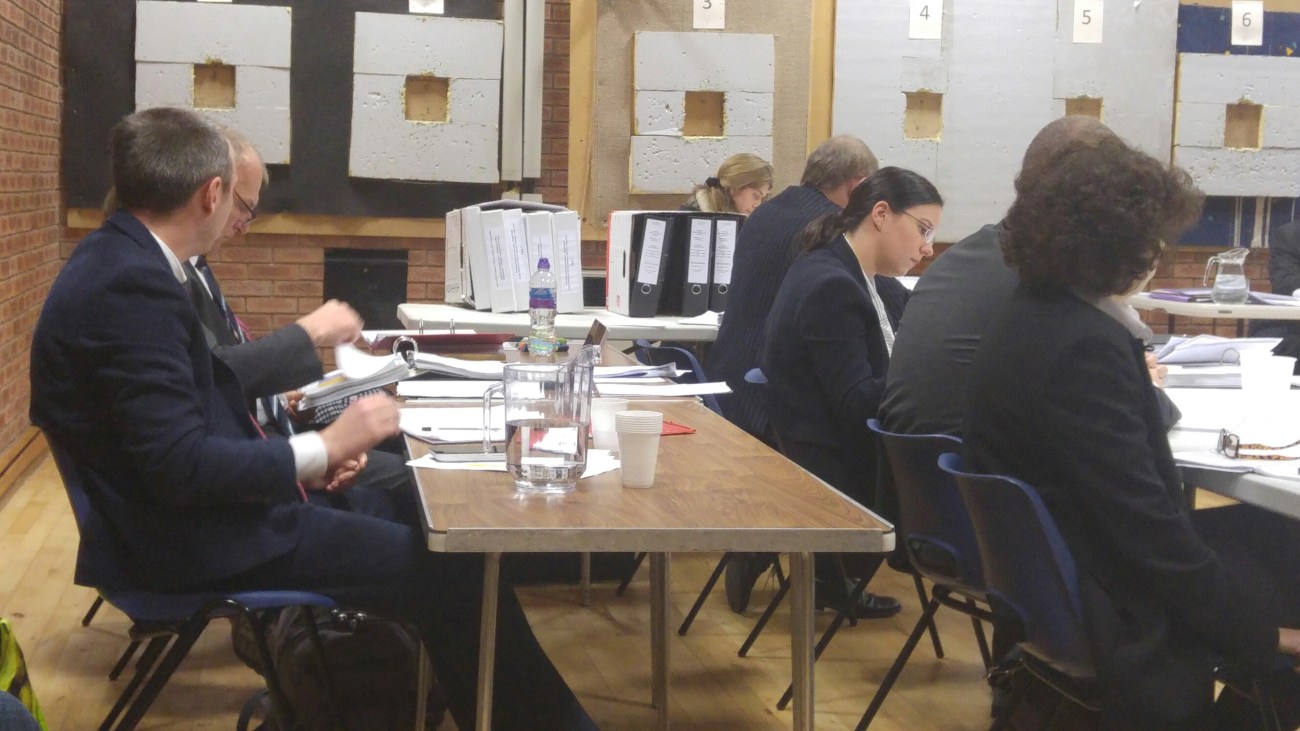
North Lincolnshire Council team, 7 November 2017. Photo: DrillOrDrop
1.45pm Lunch break
The inquiry resumes at 3.15pm
11.32am North Linconshire Council’s case
First witness: Susan Wagstaff, geology

Susan Wagstaff, Wressle inquiry 7 November 2017. Photo: DrillOrDrop
Alan Evans, for the council, introduces Susan Wagstaff, a chartered geologist,and technical director of JBA Consulting. She has stepped in as a council witness, replacing Dr Michael McDonald, who was unable to attend because of illness.
“Potential for contamination”
She says there is potential for contamination from the proposals. She says her evidence is limited to activities at the surface or near surface. The risk is to ground and surface water.
The site is 9m from the Ella Beck, a main water course. A credible pollution pathway exists between the groundwater and the beck, she says.
There are aquifers beneath the site, she says, which range from shallow to deep. Within these aquifers there are sources of water, including one used by British Steel.
The first planning application had a “very limited” assessment of risk of contamination. The second application had a similar level of analysis, she says.
“I am concerned that the proposed mitigation measures at the surface may not be sufficient to protect against accidental spillages or contamination.”
“No ground investigation”
There is no documentation of ground investigation of the sub soil, she says. The development could have an adverse impact on groundwater because of the inadequate protection of the liner.
There should have been a detailed ground investigation to document the properties of the sub-surface before the liner was put down, Ms Wagstaff says. This would have looked at the capacity of the soil to withstand compression from vehicles and equipment.
Mr Evans, barrister for the council, asks Ms Wagstaff whether a ground investigation is recommended by the Environment Agency as part of UK onshore oil and gas guidance.
Ms Wagstaff says the guidance refers to a document by Ciria, which recommends an investigation.
There was no site investigation at the Wressle site, Ms Wagstaff says. There was no geotechnical log or ground investigation before membrane went down.
Evidence from groundwater monitoring boreholes show there is evidence of sand, which is fairly consistent ground strata, Ms Wagstaff says. There is peat close to the site, which is highly compressible. Logs provided last week by Egdon, suggest the risks were ameliorated but there was still no investigation. Provided the water level was deep and the sand was dry it would be competent but there was no data, she says.
“It would probably be ok. But you shouldn’t be deciding things on ‘probably ok'”
“Stone cover over site liner not deep enough”
The clay liner on the site had a finite but low permeablity, Ms Wagstaff says.
If there is water on top of it they will leak, she says. Clay liners were predominantly used for landfill. On this site, at times, valves allowing discharge from the site would be closed, which would prevent drainage. This would lead to a head, or pressure, of water above the liner. The weight of water would drive the water and any contaminants through the liner.
The sand directly below the site is a secondary A aquifer. A aquifers have more potential to supply water, Ms Wagstaff says.
The crushed stone cover above the liner is 300mm thick at Wressle, Ms Wagstaff says. This is the “absolute minimum” cover, she says. In areas where there is traffic it should be more than 300mm. 600mm would be more appropriate, she says.
The liners have been developed and used in landfill operations, Ms Wagstaff says.
Mr Evans refers to guidance on installing covers over liners. Ms Wagstaff says the guidance recommends there should be 600mm cover in areas with frequent traffic.
An oil site, expected to operate for 15 years, with trucks travelling directly on top of the liner, should have a 600mm stone cover as an absolute minimum, she says.
300mm stone covering is low enough to allow trucks to be directly on top of the liner, Ms Wagstaff says. The pressure of the vehicles could drive the stone into the clay liner and degrade it.
“Size of stone too great”
Ms Wagstaff says she visited the site last week. A photograph shows that a lot of stone making up the cover on site is bigger than would be expected. There are stone pieces that are at least 60mm. The stone is too large because it is way over 25mm, she says.
She adds that there is new stone on the site, some of which is flint. One example was 60mm.
“Flints are quite sharp. They are not ideally what you would put over a liner and then traffic over it.”
Liners are not very strong, which is why you need to protect it with a cover.
Mr Evans asks Ms Wagstaff if she would be confident about an extension of planning permssion. She replies:
“No I think it should be upgraded and designed after a ground investigation. It is important to design it with the extra traffic in mind.”
She says the membrane could puncture or rupture, the seams could part because it is overloaded or the head of water over the liner allowing it to leak. The hydrocarbons that could be spilled on site which would affect drinking water standards and the quality of the water in the Ella Beck.
Release of hydrocarbons in site drainage
The site is allowed to drain when the value is open, Ms Wagstaff says.
Water will discharge through an interceptor. This would allow hydrocarbons to drain at the rate of 5mg/litre of water. This type of interceptor is used for garages.
But this site would have the full range of crude oils, with longer chains of hydrocarbons. These hydrocarbons would not be dealt with fully the interceptor and would have a greater impact on the environment.
Concerns about monitoring of surface and ground water
Ms Wagstaff says she is concerned that a leak from the site would not be protected from contaminating ground and surface water.
She is concerned from drillers’ records that the monitoring boreholes don’t go to the full depth of the sand layers.
If there was a pollution event, spilt hydrocarbons would migrate to the bottom of the sand because they were denser. The shallow boreholes would not pick up any spilt hydrocarbons, she says. If there were engineers’ logs this would be clear, she suggests, but they are not provided.
Because of the design of two of the boreholes, it could be possible to under-estimate the level of any hydrocarbon contamination, Ms Wagstaff said.
She adds that spills on about half the site would not be picked up by any of the monitoring boreholes.
“Pollution risk assessment insufficient”
Ms Wagstaff criticises Egdon Resources’ application:
“Insufficient analysis has been presented on the risk to groundwater around the site.
“A detailed conceptual model of the strata has not been provided.”
She says Egdon had provided an environmental management and mitigation document. But she says: “Much more” should have been provided.
A conceptual model needs to show the direction of groundwater flow, Ms Wagstaff says. It needs to be at least 2D, if not 3D. The Environment Agency guidance recommends thematic maps, sources, pathways, resource productions, receptors, monitoring points, processes. It is quite detailed, she says. It is not the generalised vertical section provided with Egdon’s application. There is no detail into how the site connects with Ella Beck, Ms Wagstaff says, or detailed information on the multiple aquifers.
“They should have provided more information. Particular things that are missing are: historical mapping, ground investigation, old boreholes on site that might provide pathways, engineers logs of boreholes.”
There are old boreholes and water wells in the vicinity, Ms Wagstaff says, not all of which have been identified. They can provide a pathway from the near surface to deeper geological strata and aquifers.
Ms Wagstaff says it was not the council’s job to provide a conceptual model. It had provided a section, which was closer to what was required but still not detailed enough. The consultancy had produced it to try to understand what was going on, she says.
“It is a way of visualising the pathways and linkages.”
“No evidence of capping layer”
Egdon Resources argues that the Lincolnshire limestone aquifer is capped by a layer which protects it from contamination.
Ms Wagstaff says there’s no sufficient evidence of a capping layer.
“There is variation of permeability but that doesn’t constitute a capping layer”
Egdon says there are artesian conditions, which require a cap. Ms Wagstaff says:
“You don’t need an impermeable layer to create artesian conditions. You just need a variation.”
“There is a low permeability layer but it is not necessarily impermeable.
“There is huge variation in permeability.”
The only non-aquifer near the site is a clay, she says, but this is not picked up by the boreholes.
Risk to British Steel borehole and regional aquifer
Ms Wagstaff says the water in the British Steel borehole comes from the great oolite group, despite what Egdon told the council. There is a direct connection from the blown sand layers on the site to the oolite aquifer and the British Steel borehole. She says:
“I am concerned that the level of analysis is too limited.”
“There is a lack of information about the risk to the Lincolnshire limestone, the regional principal aquifer.”
Ms Wagstaff says:
“The risk to the Lincolnshire limestone aquifer was screened out [by Egdon Resources consultants] because of the capping layer and hydrological gradient, neither of which exist.”
Those receptors are taken through to the risk assessment table, she says.
“Information provided by the appellant is insufficient to ensure
“It is reasonable for the council to be concerned about contamination risk.”
Ms Wagstaff says there are inconsistencies and inaccuracies in the application information that should concern the council.
11.17am Statement by Vicky Dunn
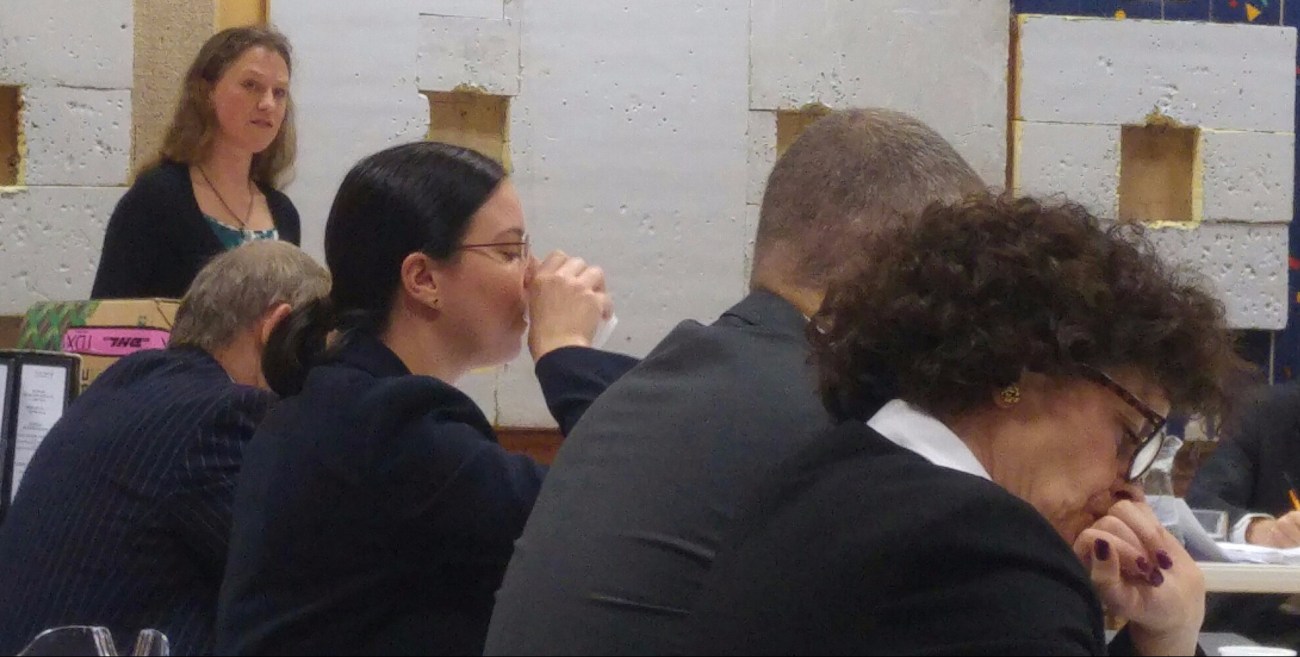
Vicky Dunn (standing), 7 November 2017. Photo: DrillOrDrop
Ms Dunn, a chemistry teacher, and former environmental consultant, gives a statement to the inquiry. She supports the council’s refusal of planning permission.
She says the proposed proppant squeeze is described as a single activity, but she says a proppant squeeze can’t be a single activity. She says its purpose is to make fractures in the rock.
“Its name has been changed to minimise public concern.
“It is the thin edge of the wedge.”
If the well casing corroded, briny water and the fracking fluid would be able to get back up and contaminate the aquifer.
Ms Dunn says the proposal is unusual. If there was evidence of using hydrofluoric acid in the UK, this would have been included in the application’s non-technical summary. But it is not there, she says. This is evidence that this is an unusual wellbore treatment.
On one page, the company says it is not making fractures but on another it said it was making fractures, she says.
This is testing a new technique. We will see wells doing this all over the UK, in contradiction of our Paris Climate Agreement, she says.
Ms Dunn says there is no evidence that the well bore will remain intact in 50-100 years.
She also refers to the environmental permit. One condition is that groundwater activity must be limited to the footprint of the site but this won’t be known. If something goes wrong, no one will know, she says.
She says the hydraulic fracturing will be only once, according to the environmental permit. But this is “pretty much meaningless” because the company can seek a variation.
Ms Dunn says information required by the permit has not be put before the council. Mr Glover said all that information had been submitted to the council.
11.05 Opening statements – Egdon Resources
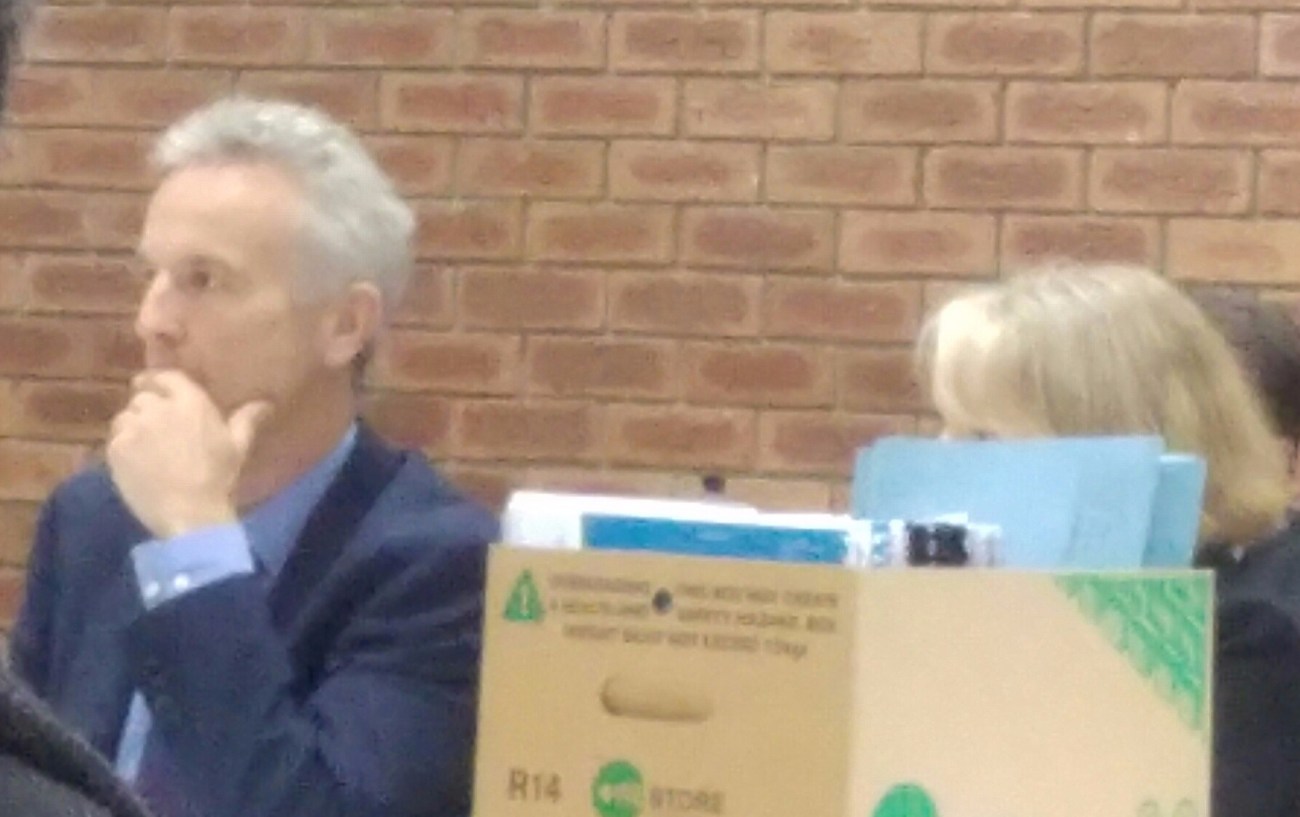
Richard Glover, for Egdon Resources, Wressle inquiry, 7 November 2017. Photo: DrillOrDrop
Richard Glover, for Egdon Resources, says there is nothing unusual or controversial about the proposal or the site. The original planning permission was granted in June 2013, with no objections. The exploratory well was successfully drilled and tested in 2014 and 2015. The council accepted that the land use was suitable at that time. The applicant was able to operate in a safe and acceptable manner, as its track record showed.
The estimated 2.15 million barrels estimated at the site was a material find. Domestic sources were more environmentally friendly than importing. With the decline of the North Sea production, onshore alternatives needed to be sourced.
Mr Glover said a great deal of effort was taken by Egdon to address all concerns before the application went to the planning committee.
There had been no objections from statutory consultees to the applications considered on 3 January and 11 July 2017. In both cases, the planning officer recommend approval.
The decisions by councillors were fundamentally flawed and without foundation. The refusal of the first application was motivated by lack of trust in the Environment Agency. The councillors failed to take proper regard to the views of the Environment Agency or the planning officers.
A considerable amount of information was submitted on both applications and was enough to approve them, he said.
The committee did not appear to understand the information or have due regard to it. There was no evidence that the proposal would have undue impacts on local residents or the environment and economy.
The committee should have deferred the proposal, Mr Glover says, and the applicant would then have submitted what it was asked for. The reasons given for a refusal were a fiction and not justified from a local or national planning policy point of view.
The council has now appointed consultants who have a difficult tasks of defending the refusal, he says. The council’s geology evidence is not relevant. The planning officer fails to take a proper planning assessment or balance.
The evidence submitted by the applicant will demonstrate that sufficient information was submitted and the reason for the refusals were lacking in justification. It also counters the assertion that the proposal would have an unacceptable
All three appeals should be allowed and planning permission should be granted subject to suitable conditions.
10.48am Opening statements – North Lincolnshire Council
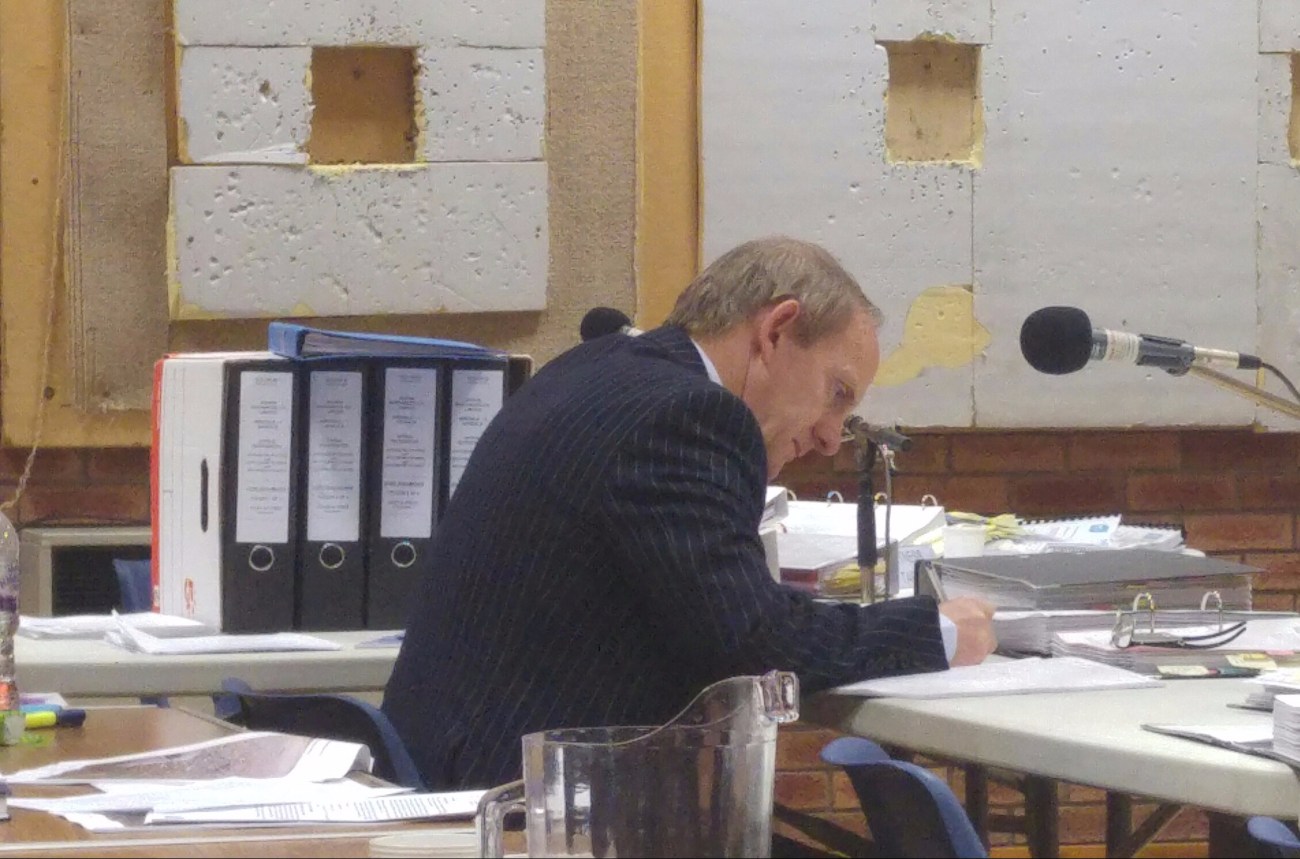
Alan Evans, for North Lincolnshire Council, 7 November 2017. Photo: DrillOrDrop
Alan Evans, for the council, said there were three appeals before the inquiry. The first and second appeals are over the refusal of applications for the retention of the Wressle well site. The third appeal relates to the refusal of application for an extension of the original planning permission for 12 months.
He said:
The reason for the first two refusals was because there was insufficient information submitted with the application to allay the concerns of the local planning authority about ground contamination from both water run-off and and infiltration of water used in the development into water courses.
The proposal would therefore have an unacceptable impact on local residents, community and the local economy.
Mr Evans said the proposed development was therefore considered to be contrary to local planning polices M23, DS13 and DS15 of the North Lincolnshire Local Plan and Policy CS18 of the North Lincolnshire Core Strategy.
Mr Evans said
“Groundwater protection, the quality of water resources and associated mitigation measures are material considerations at the local level in North Lincolnshire and fall to be considered as part of the development plan.”
He added that the considerations are “material at national policy level and they do not ease to be so by reason of the role of the Environment Agency as regulator in this case”
Mr Evans said the concerns of the council relate to:
- Potential impact of the development on the Lincolnshire Limestone aquifer, a principal aquifer from whcih British Stell draws a water supply
- The potential impact of the development of the Blown Sands aquifer, a secondary A aquifer, immediately below the sitte
- Conceptual modelling for the groundwater risk assessment
- Tertiary containment and the geo-synthetic clay liner
He added that the third refusal was based on the argument that there was no reason to extend the time period for restoration of the site.
Mr Evans argued that all three appeals should be dismissed.
10.30am Break
Inspector, Keri Williams, calls a break so that the company can read the council’s new documents
10.23am Extra documents
The two sides discuss additional late documents which are being submitted to the inquiry. They include two documents from the council about the site liner and the monitoring boreholes drilled under previous planning permission.
10.11am key issues
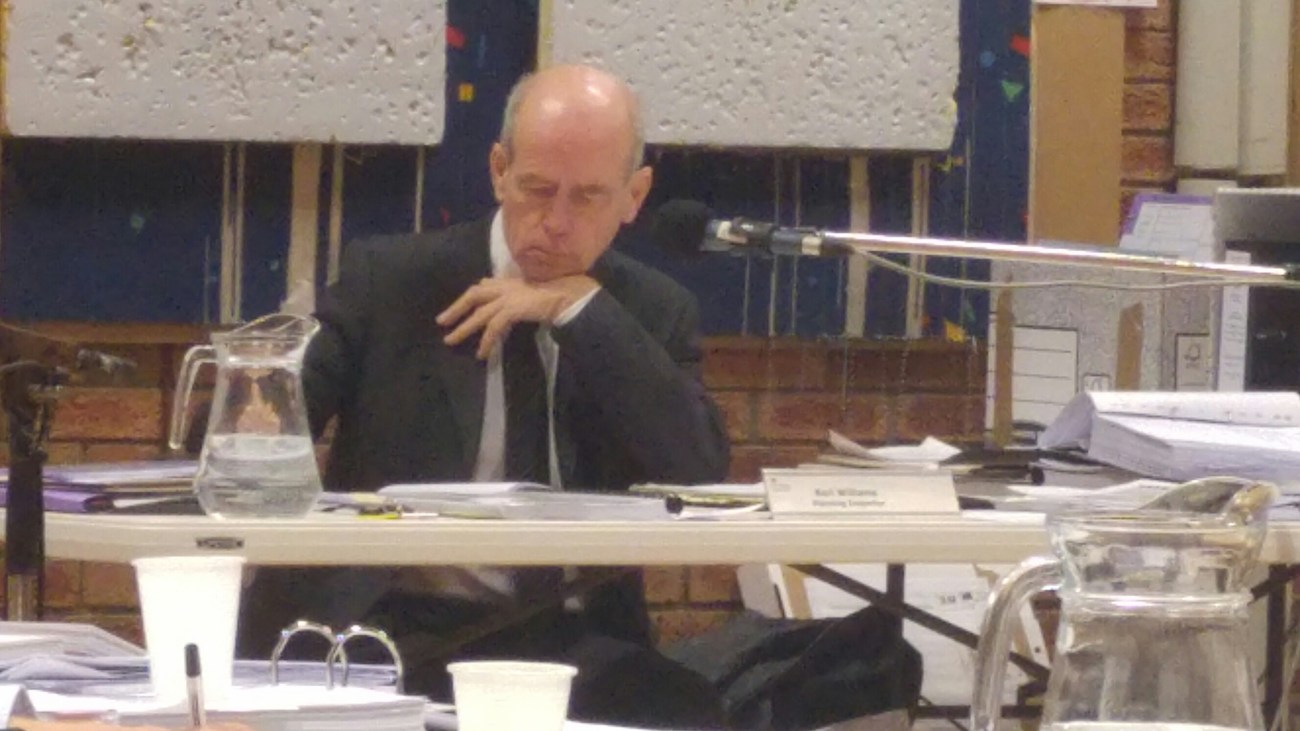
The inspector, Keri Williams, 7 November 2017. Photo: DrillOrDrop
Inspector, Keri Williams, says the key issues are:
- The impact of the development on groundwater
- The impact of the plans on the amenity of local residents
He says other issues include, noise, traffic and compatibility with tackling climate change
10am Inquiry opens
The inspector, Keri Williams, opens the inquiry.
Alan Evans, representing North Lincolnshire Council, says he will call two witnesses: Susan Wagstaff (geology) and Katie Atkinson (planning)
Richard Glover, for Egdon Resources, will call Mark Abbott (Mangaging Director, Egdon Resources), Jonathan Foster (operations consultant), Mark Dobbs ((hydrogeology), Paul Foster (planning).
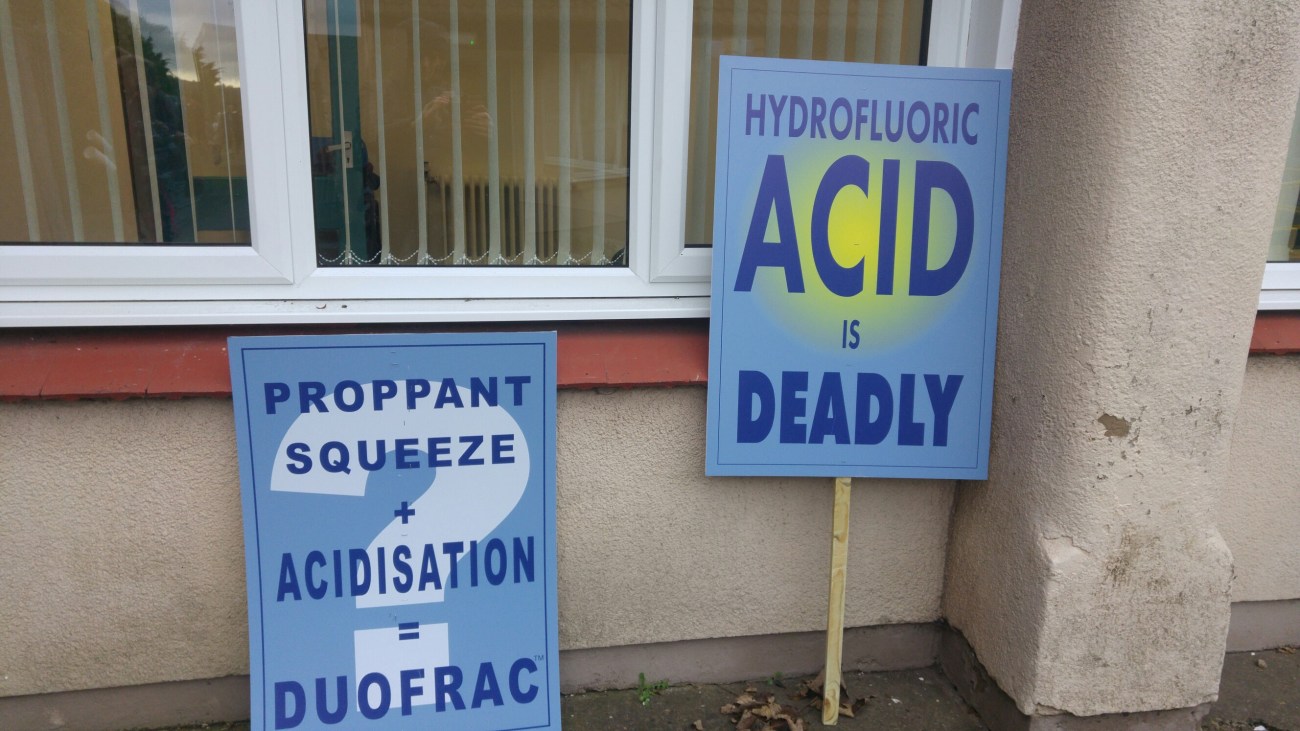
This report has been made possible by donations from individual DrillOrDrop readers
Categories: Regulation

 DRILL OR DROP?
If the hearing is likely to last that long, surely they could have come up with some more comfortable chairs!
(And perhaps some not constructed out of the material they are deciding should/should not be produced?)
Well of course that is the first priority isn’t it martin?
Perhaps they appreciate that if they have chairs that are too comfortable they will never get rid of Egdon again? Bitter experience perhaps?
Wow these arguments by the council are pathetic. I’m surprised councilors are able to leave their homes for fear of being hit by a meteorite.
The council is fully aware they are in trouble for refusing these applications and are clutching at straws.
We might as well cancel any new development and go back to the stone age if these numpties are allowed to dictate anymore planning applications.
Better to go back to the shale age is it peeny? Sometime back in the carboniferous isn’t it?
Keep acid fracturing those rocks peeny, the bath water is getting cold.
No Acid Fracking Fanatics.
Protect English Environment No Yanks
N.A.F.O.F.F. P.E.E.N.Y.
You do realise I’m not ‘Peeny’ and I’m British lol.
It’s a typical psychological flaw you antis have, you don’t believe the plain obvious and like to make up little stories to suit your own agenda.
peeny you admitted you made up all these names on this web site, don’t you remember?
Trouble is GBK, if heating is to come from dried mammoth dung, it will require a long return trip to Siberia and back, utilising an awful lot of fossil fuel.
The hypocrisy from these antis beggars belief. I’m tempted to throw in the towel and sell these muppets sawdust from China for their bonkers biomass and they will love me for it whilst I sun myself in warmer climates on the proceeds.
[Comment removed by moderator]
Its okay to pull oil from the North Sea without a Liner. But on land its a big issue? I’d like to see which objector has the biggest cubic capacity on their cars. Range Rover, Jag, Mercedes AMG. Worth asking the question just to see the cringe 🙂
Really what’s up, there are old boreholes and water wells in the vicinity and no pollution at all.
Ohhh peeny! another ID?
Getting back to reality the text indicates Susan Wagstaff’s concerns are extremely valid and expertly put, the use of flint is totally inappropriate for a stone surface protection above an inadequate unprotected liner and a sand aquifer just below the membrane, As a protection 300mm is totally inadequate for HGV and LHV turning movements, a road construction for such vehicles is as Susan Wagstaff says, is a minimum of 600 of clean rounded stone (not flint) 22mm DTP3 which is the drainage category specification. Definitely no flint or sharp material. If no drainage is required, it is still 600 mm thick of rolled and compacted (carefully by hand initially so as not to pierce the membrane) of DTP Type 1 or 2 which is 40mm down to dust rounded aggregate size. 60mm dia is out of spec, flint is out of spec and must be removed and the membrane replaced as it will have been compromised. There should be two membranes considering the hydrocarbon leak possibilities, they should have been lapped and sealed properly and certified water resistant before running course was laid.
That is only the running surface.
i would refuse permission and order the site to be stripped and started again with on site supervision by the authorities.
I wonder how the other oil wells in the area are doing? Strange that the things we could do perfectly well (excuse the pun) are now so difficult and full of uncontrollable risk. Oh, the joys of the internet!
Next item,
No site investigation?
I cant think of another site i have worked on here or abroad that had the danger of hydrocarbon leaks not having a site investigation? What did they base their entire construction calculations on? It beggars belief? No wonder they had an inadequate and dangerous specification.
The only conclusion is that these guys are cowboys, they should not be allowed to continue let alone get permission.
The only thing that should be allowed to be squeezed on that site is the whole lot of them out of the gate.
That was a great cross examination of Ms Wagstaff. Interesting that her predecessor bailed at the last minute knowing who was going to cross examine his evidence!
She is preaching the same nonsense that the antis preach constantly “what if”.
Doesn’t “what if” form the basis of all risk assessment?
Correct KatT.
Wagstaffs entire gripe appears to be the same excuse that they refused first application on and that is not trusting the EA are doing their job correctly! This will not stand up in a court so they will have to do far better than this.
Just refuse it on technical incompetence grounds, easily provable.